Part III: Financial Outlook
The revised financial statement projections show a continuation of operating surpluses accompanied by significant reductions in debt.
Operating Result
The revised operating result projections show little change for 1999-2000, but in the following two years expenses are expected to increase at a greater rate since budget time than revenues, mainly reflecting government decisions and parameter changes. In particular, the projections are affected by legislative changes to The New Tax System package and Australia’s involvement in peacekeeping and aid activities in East Timor.
A summary of general government revenues, expenses and operating results for the current and forward years is shown in Table 7.
Table 7: Summary of General Government Revenues and Expenses(a)
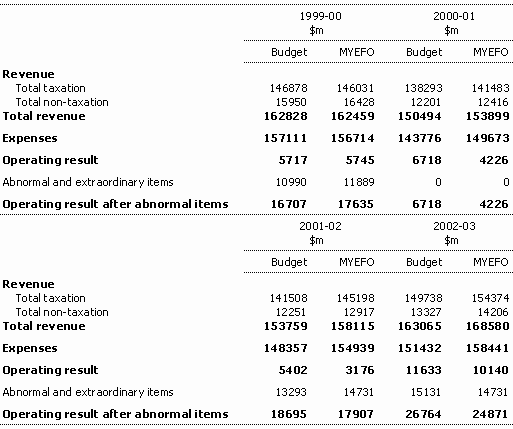
(a) All data in this table are produced on a AAS31 basis. There are certain classification differences between revenue and expenses produced on a AAS31 basis and on a GFS basis. These differences, which relate largely to the treatment of economic revaluations, are outlined in Table 10.
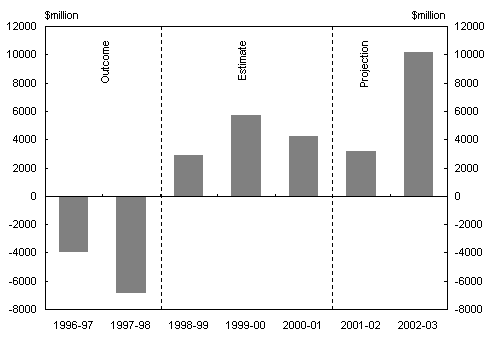
The trend in general government operating results is shown in Chart 4.
Chart 4: General Government Operating Result
Part IV contains detailed descriptions of revenues and Part V contains detailed descriptions of expenses.
Net Assets
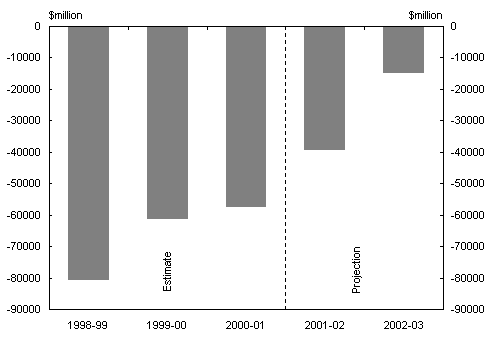
Expected movements in net assets will be influenced mainly by the operating results referred to above and the use of budget surpluses to reduce debt and increase investments.
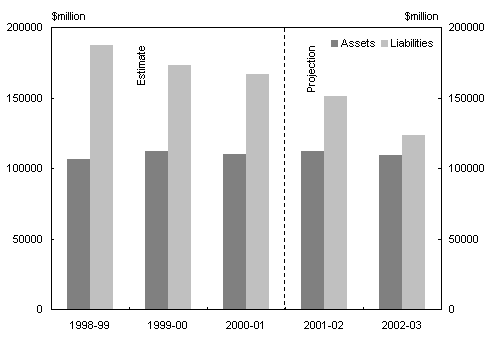
For 1999-2000 and 2000-01, the excess of liabilities over assets is expected to improve by $2.6 billion and $0.1 billion respectively over the budget estimate. However, in 2001-02 and 2002-03 net assets are expected to decline by $1 billion and $3.1 billion respectively compared with budget time.
Table 8 summarises the revised movements in assets and liabilities, compared with those shown in the 1999-2000 Budget and Chart 5 highlights the general government balance sheet aggregates.
Table 8: Summary of General Government Balance Sheet(a)
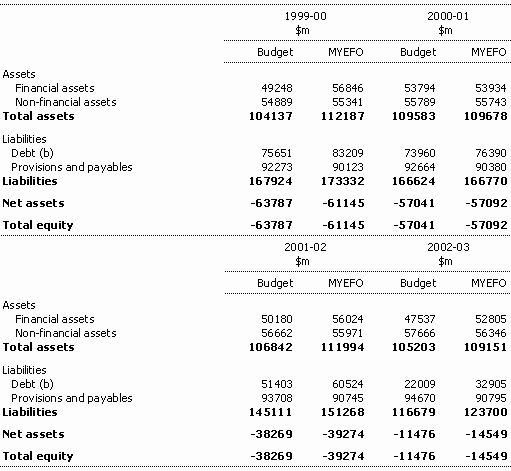
(a) All data in this table are produced on a AAS31 basis.
(b) Net debt data on a GFS basis are provided in Table D5.
Chart 5: General Government Balance Sheet Aggregates
Panel A: Assets and Liabilities
Panel B: Net Assets
Cash Flows
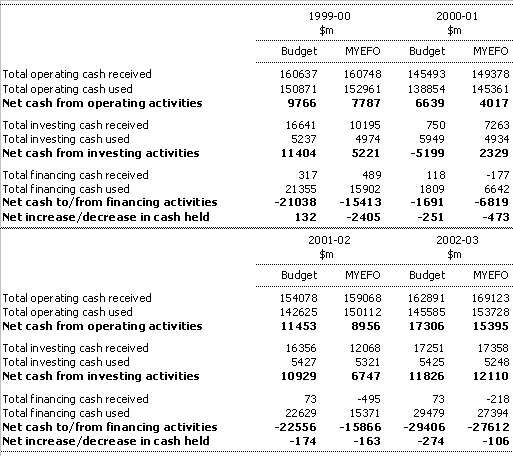
There are three significant features of cash flows for the budget and forward years:
- a fall in cash from operating activities in 2000-01 (mainly from reduced indirect taxes) and a resumption of growth in the remaining out years (mainly from increased taxation receipts);
- continued high levels of cash from asset sales (receipt of $6.3 billion of Telstra 2 proceeds has been deferred to 2000-01); and
- continued high levels of cash applied to debt reduction (reflecting the flows of cash from operating activities and asset sales).
The factors affecting operating cash flows are broadly the same as those affecting revenues and expenses.
Table 9 provides a summary of general government cash flows.
Table 9: Summary of General Government Statement of Cash Flows(a)
(a) All data in this table are produced on a AAS31 basis.
Reconciliation of Accounting Operating Result and Fiscal Balance
The financial statements presented in this part are consistent with Australian Accounting Standard 31: Financial Reporting by Governments. However, as outlined in Appendix D, there are some differences between AAS31 and the Government Finance Statistics (GFS) framework from which the fiscal balance is derived.
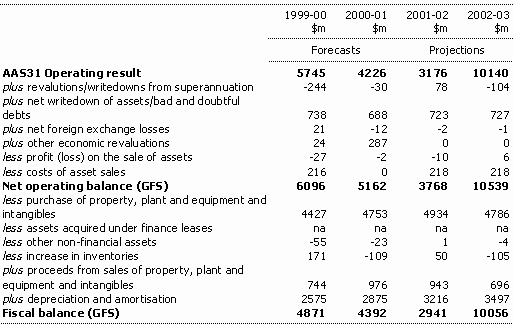
Table 10 reconciles the accounting operating result to the GFS net operating balance and fiscal balance (GFS net lending).
The reconciliation can be divided into two parts. The first part shows differences between the AAS31 operating result and the GFS net operating balance. These differences relate mainly to the treatment of revaluations of financial and non-financial assets and liabilities under the two standards. Major revaluations include: writedowns of bad and doubtful debts (excluding those that are mutually agreed); changes in the valuation of superannuation liabilities; and foreign exchange gains and losses.
Under AAS31, valuation changes impact on revenues and expenses, but they are omitted from the calculation of the GFS net operating balance as they are not regarded as economic transactions. Consequently, in the reconciliation table net gains are subtracted from the accounting operating result while net losses are added back in.
The second part of the reconciliation shows the adjustment for net capital investment required to derive the fiscal balance from the GFS net operating balance. Net capital investment is measured by purchases of property, plant and equipment, plus net investment in other non-financial assets less proceeds from the sale of these assets and depreciation.
The derived fiscal balance measures the extent to which the Government is adding to or drawing from the national savings pool and contributing directly to the current account deficit.
Table 10: General Government Reconciliation of AAS31 Operating Result and Fiscal Balance