
Document
Index
Portfolio Budget Statements
Department of the Treasury



|
Document
Index |
|
|
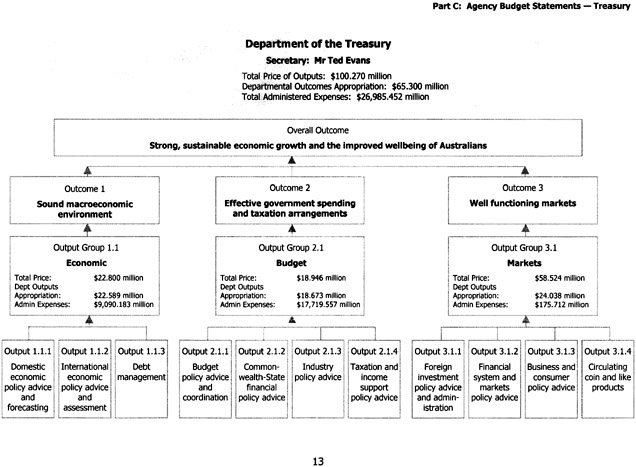
The map on the following page shows the relationship between Government outcomes and the contributing outputs for the Department of the Treasury. Financial detail for Outcomes 1, 2 and 3 by output appears in Tables 2.2.1, 2.2.2 and 2.2.3, while non-financial information for the three outcomes appears in Tables 2.3.1, 2.3.2 and 2.3.3.
A sound macroeconomic environment is an essential foundation for strong sustainable
economic growth and the improved wellbeing of Australians. Treasury provides ongoing
policy advice to Treasury portfolio Ministers to assist them in developing and
implementing policies to achieve this outcome.
A sound macroeconomic environment is characterised by stable prices, low interest rates,
healthy economic and employment growth and a sustainable external position. As there are
many influences on macroeconomic outcomes beyond the control of the Government, policy is
aimed at improving the prospects for the Australian economy, rather than targeting
specific outcomes for major economic indicators. Success is judged more by medium- to
long-term performance relative to Australia's past and to other countries, rather than by
particular results in any year.
Table 2.1.1 shows the relationship between the programme structure for 1998-99 and the new
outcome structure for the 1999-2000 Budget for Outcome 1.
Table 2.1.1: Relationship between Programme and Outcome Structure for Outcome 1 --
Sound Macroeconomic Environment
| Programme Management Budgeting | Accrual Budgeting |
| Programme 1 --
Treasury To improve living standards of the Australian community through high, sustainable economic and employment growth with low inflation and efficient and sustainable use of resources |
Outcome 1 Sound macroeconomic environment |
| Sub-programmes Sub-programme 1.1 -- Domestic Economy Sub-programme 1.2 -- International Economy Sub-programme 1.6 -- Debt Management Sub-programme 1.11 -- Corporate Direction and Support |
Output Groups Output Group 1.1 -- Economic |
| Appropriations for Programme 1 | Appropriations for Outcome 1 |
| Sub-programme
1.1 Appropriation Bill 1 Running costs, including Section 31 receipts (670-1) |
Output Group 1.1 |
| Sub-programme
1.2 Special Appropriations Asian Development Bank (Additional Subscription) Act 1995 Appropriation Bill 1 |
Special Appropriations Asian Development Bank (Additional Subscription) Act 1995 |
| Sub-programme 1.6 Special Appropriations Airports (Transitional) Act 1996 -- Former debts of the Federal Airports Corporation -- Interest Commonwealth Inscribed Stock Act 1911, Loans Securities Act 1919, Loans Redemption and Conversion Act 1921 -- Commonwealth Government Securities interest Commonwealth Inscribed Stock Act 1911, Treasury Bills Act 1914 -- Payment of Special Bond premiums on redemption Financial Agreement Act 1994 -- Assistance for debt redemption Financial Agreement Act 1994 -- Commonwealth Contribution to Debt Retirement Reserve Trust Account on State and Northern Territory Debt Financial Agreement Act 1994 -- Interest on Debt Retirement Reserve Trust Account Balances Loans Redemption and Conversion Act 1921 -- Interest on overdue stocks Loans Securities Amendment Act 1988 (Swaps) -- Interest Loans Securities Amendment Act 1988 (Swaps) -- Principal Moomba -- Sydney Pipeline System Sale Act 1994 -- Costs on former debt of the Pipeline Authority Qantas Sale Act 1992 -- Costs on former debt of Qantas. Qantas debt servicing |
Special Appropriations Airports (Transitional) Act 1996 -- Former debts of the Federal Airports Corporation -- Interest Commonwealth Inscribed Stock Act 1911, Loans Securities Act 1919, Loans Redemption and Conversion Act 1921 -- Commonwealth Government Securities interest Commonwealth Inscribed Stock Act 1911, Treasury Bills Act 1914 -- Payment of Special Bond premiums on redemption Financial Agreement Act 1994 -- Assistance for debt redemption Financial Agreement Act 1994 -- Commonwealth Contribution to Debt Retirement Reserve Trust Account on State and Northern Territory Debt Financial Agreement Act 1994 -- Interest on Debt Retirement Reserve Trust Account Balances Loans Redemption and Conversion Act 1921 -- Interest on overdue stocks Loans Securities Amendment Act 1988 (Swaps) -- Interest Loans Securities Amendment Act 1988 (Swaps) -- Principal Moomba -- Sydney Pipeline System Sale Act 1994 -- Costs on former debt of the Pipeline Authority Qantas Sale Act 1992 -- Costs on former debt of Qantas. Qantas debt servicing |
| Appropriation Bill 1 Running costs, including Section 31 receipts (670-1) Loan management expenses (670-2-02) Overseas bond issues -- Payments in respect of lapsed coupons (670-2-03) Australian National Railways Commission -- Debt acquisition (670-2-04) |
|
| Sub-programme 1.11 Appropriation Bill 1 Running costs, including Section 31 receipts (670-1) Compensation and legal expenses (670-2-01) |
Outcome 1 Appropriation Bill 1 Departmental outputs Administered expenses |
A new specialist agency, the Australian Office of Financial Management (AOFM), is to be
established within the Treasury portfolio. The new agency will significantly enhance the
Commonwealth's capacity to manage its net debt portfolio, offering the prospect of savings
in debt service costs and an improvement in balance sheet net worth over time. The AOFM
will commence operations from 1 July 1999. The Office will assume responsibility
for the Commonwealth's existing debt management activities, currently undertaken within
Treasury.
The AOFM will be established as a 'prescribed' agency under the Financial Management
and Accountability Act 1997.
A new specialist agency, the Australian Office of Financial Management (AOFM), is to be established within the Treasury portfolio. The Government will make a capital injection to fund the acquisition of computer equipment for the AOFM. Investment in specialist financial management computer software and hardware is necessary to support the operations of the new agency.
Table 2.2.1 shows how the 1998-99 appropriation and programming structure relates to
total resourcing for Outcome 1.
Table 2.2.1: Total Resources for Outcome 1 -- Sound Macroeconomic Environment
| Estimated Actual | Estimated Actual | Budget |
|
| 1998-99 CASH $'000 |
1998-99 ACCRUAL $'000 |
1999-00 $'000 |
|
| Administered Expenses (including Third Party Outputs) |
|||
| Appropriation
Structure 1998-99 Loan management expenses (670-2-02) |
3,153 |
3,153 |
|
| Overseas bond issues -- Payments in respect of lapsed coupons (670-2-03) | 10 | 10 | |
| Australian National Railways Commission -- Debt acquisition (670-2-04) | 366,600 | 315,600 | |
| International Finance Corporation -- Capital subscription (670-2-06) | 8,421 | - | |
| International Bank for Reconstruction and Development -- Capital subscription (670-2-07) | 5,251 | - | |
| Contributions to the International Monetary Fund -- Enhanced Structural Adjustment Facility (670-2-08) | 2,500 | - | |
| Special
Appropriations Asian Development Bank (Additional Subscription) Act 1995 |
2,750 |
- |
|
| International Monetary Agreements Act 1947 | 2,082,558 | -18,249 | |
| Multilateral Investment Guarantee Agency Act 1997 | 3,000 | - | |
| Airports (Transitional) Act 1996 -- Former debts of the Federal Airports Corporation -- Interest | 53,000 |
53,000 |
|
| Commonwealth Inscribed Stock Act 1911, Loans Securities Act 1919, Loans Redemption and Conversion Act 1921 | 7,816,501 |
7,524,056 |
|
| Commonwealth Inscribed Stock Act 1911, Treasury Bills Act 1914 -- Payment of Special Bond premiums on redemption | 5 |
5 |
|
| Financial Agreement Act 1994 -- Assistance for debt redemption | 81,700 | 81,700 | |
| Financial Agreement Act 1994 -- Commonwealth Contribution to Debt Retirement Reserve Trust Account on State and Northern Territory Debt | 5,189 |
5,189 |
|
| Financial Agreement Act 1994 -- Interest on Debt Retirement Reserve Trust Account Balances | 829 |
829 |
|
| Loans Redemption and Conversion Act 1921 | 5 | 5 | |
| Loans Securities Amendment Act 1988 (Swaps) -- Interest | 1,282,925 | 1,314,412 | |
| Loans Securities Amendment Act 1988 (Swaps) -- Principal | 4,147,169 | -441,821 | |
| Moomba -- Sydney Pipeline System Sale Act 1994 | 19,070 | 2,070 | |
| Qantas Sale Act 1992 -- Qantas debt servicing | 356,284 | 33,284 | |
| Other | |||
| Early debt repayment adjustment | - | 180,411 | |
| Loans Redemption and Conversion Act 1921 -- Loan Fund | 10,236,818 | -29,400 | |
| Loan Flotation Expenses | 161 | 161 | |
| Loan Consolidation and Investment Reserved Money Fund | -186,460 | -186,460 | |
| Loans Redemption and Conversion Act 1921 -- Net repurchase premia | 330,000 | 330,000 | |
| Total Administered Expenses | 26,617,439 | 9,167,955 | 9,090,183 |
| Price of Departmental Outputs Output Group 1.1 -- Economic Output 1.1.1 -- Domestic economic policy advice and forecasting |
6,482 |
5,349 |
5,827 |
| Output 1.1.2 -- International economic policy advice and assessment | 9,120 | 10,005 | 10,409 |
| Output 1.1.3 -- Debt management | 3,029 | 2,984 | 6,564 |
| Appropriation Structure
1998-99(a) Sub-programme 1.1 -- Domestic Economy Sub-programme 1.2 -- International Economy Sub-programme 1.6 -- Debt Management Sub-programme 1.11 -- Corporate Direction and Support |
|||
| Subtotal Output Group 1.1 | 18,631 | 18,338 | 22,800 |
| Revenue from Government (Appropriation) for Departmental Outputs | 18,384 | 18,157 | 22,589 |
| Revenue from Other Sources | 247 | 181 | 211 |
| Total Price of Outputs | 18,631 | 18,338 | 22,800 |
| Total for Outcome 1 | 26,636,070 | 9,186,293 | 9,112,983 |
| 1998-99 | 1999-00 | |
Staff Years (Number) |
158 | 144 |
Treasury aims to contribute to a sound macroeconomic environment by monitoring and
assessing economic conditions and prospects, both in Australia and overseas, and by
providing advice on the formulation and implementation of effective macroeconomic policy,
including monetary and fiscal policy, and labour market issues.
Effective macroeconomic policies operate in a clear, transparent framework and are set
with the objective of achieving strong sustainable economic growth and the improved
wellbeing of Australians.
The Government's medium-term fiscal consolidation strategy has made an important
contribution to a more stable macroeconomic environment in the face of recent adverse
international influences. This strategy aims to ensure that the operations of the
government make no net call on private saving on average over time. A legislated Charter
of Budget Honesty holds governments to a high level of fiscal transparency and
accountability.
The Government has also sought to lock in Australia's low inflation by setting monetary
policy in a clear, forward-looking framework which was introduced by agreement between the
Government and the Reserve Bank. The framework sets out an inflation objective and
enhances the independence of the Bank.
Treasury provides advice on advancing Australia's interests at international fora such as
the World Bank, the IMF, the Asian Development Bank and APEC. At present, a significant
contribution is being made to international efforts to sustain international economic
stability and growth through these fora.
Treasury also aims to ensure that Government debt is managed at the lowest possible cost,
consistent with an acceptable degree of risk.
The effectiveness of Treasury's contribution to a sound macroeconomic environment is
judged primarily by feedback from Treasury portfolio Ministers on the quality and
relevance of Treasury's advice.
| Table 2.3.1: Performance Information 1999-2000 | |
| Performance Information for Administered Items (Including Third Party Outputs) | |
| Subscriptions to international financial institutions | Facilitation of achievement of Government objectives in international fora, including strengthening the international financial system, multilateral debt relief and institutional reform in the multilateral development banks. |
| Debt issued by the Commonwealth (including CGS allocated to States and Territories) and debt assumed from Commonwealth agencies. | Achievement of the Commonwealth's financing task in a cost-effective manner. |
| Performance Information for Departmental Outputs | |
| Output Group 1.1 -- Economic | |
| Output 1.1.1 -- Domestic Economic Policy Advice and Forecasting | Advice on economic policy and the economic
outlook meets Treasury portfolio Ministers' needs in administering their responsibilities
and implementing Government decisions that contribute to a sound domestic economy. Effective presentation of budget documents and other publications to adequately inform public debate. |
| Output 1.1.2 -- International Economic Policy Advice and Assessments | Advice meets Treasury portfolio Ministers' needs in administering their responsibilities and implementing Government decisions relating to international economic and financial issues. |
| Output 1.1.3 -- Debt Management | Achievement of the Commonwealth's financing task
in a cost-effective manner. Timely production of reports on debt management activities. Efficient execution of the Commonwealth's borrowing activities. Partial indicators include the range of accepted bids and the basis point spread between tender and secondary market yields. Efficient management of the Commonwealth's cash balances. Indicators include achievement of the Ministerially-endorsed cumulative average cash balance target as at end-year. |
Feedback will be sought from key clients on a regular basis on the effectiveness of
policy advice.
Performance in producing the Debt Management output is evaluated using benchmark analysis
and regular review of the broader risk management framework to ensure that it remains
appropriate in the light of Commonwealth operations and market conditions.
Results of evaluations will be presented, as appropriate, in Treasury's Annual Report.
Effective government spending and taxation arrangements provide an overall fiscal
outcome which best contributes to the goal of strong sustainable economic growth and the
improved wellbeing of Australians. The Government has established a medium-term fiscal
strategy of maintaining fiscal balance on average over the course of the economic cycle to
achieve this objective.
At the same time individual spending measures should be effective in meeting their stated
objectives, minimise other behavioural distortions and deliver significant benefits in
relation to cost. Taxation measures should meet revenue objectives (or other objectives if
taken for public policy reasons) and be consistent with the principles of economic
efficiency, horizontal and vertical equity, certainty and transparency whilst minimising
compliance and administrative costs. By meeting their objectives, these measures
contribute to the wellbeing of Australians, either directly or by providing the revenue
base to finance government services.
Policy advice to Treasury portfolio Ministers promotes Government decisions which further
these objectives and thereby contribute to this outcome.
Table 2.1.2 shows the relationship between the programme structure for 1998-99 and the new
outcome structure for the 1999-2000 Budget for Outcome 2.
Table 2.1.2: Relationship between Programme and Outcome Structure for Outcome 2 --
Effective Government Spending and Taxation Arrangements
| Programme Management Budgeting | Accrual Budgeting |
| Programme 1 --
Treasury To improve living standards of the Australian community through high, sustainable economic and employment growth with low inflation and efficient and sustainable use of resources |
Outcome 2 Effective government spending and taxation arrangements |
| Sub-programmes Sub-programme 1.4 -- Taxation Sub-programme 1.5 -- Fiscal Sub-programme 1.8 -- Financial and Currency Sub-programme 1.11 -- Corporate Direction and Support |
Output Groups Output Group 2.1 -- Budget |
| Appropriations for Programme 1 | Appropriations for Outcome 2 |
| Sub-programme
1.4 Appropriation Bill 1 Running costs, including Section 31 receipts (670-1) Ex-Gratia payment to approved charitable organisations or trust funds in memory of the Princess of Wales (670-2-09) |
Output Groups Output Group 2.1 |
| Sub-programme
1.5 Special Appropriations States Grants (General Purposes) Act 1994 |
Special Appropriations States Grants (General Purposes) Act 1994 |
| Appropriation Bill
1 Running costs, including Section 31 receipts (670-1) |
|
| Appropriation Bill
2 Australian Capital Territory -- Special revenue assistance (977-01) |
|
| Sub-programme
1.8 Appropriation Bill 1 Running costs, including Section 31 receipts (670-1) |
|
| Sub-programme
1.11 Appropriation Bill 1 Running costs, including Section 31 receipts (670-1) Compensation and legal expenses (670-2-01) |
Outcome 2 Appropriation Bill 1 Departmental outputs |
| Appropriation Bill 2 Administered expenses |
The Government is providing additional funding to the Treasury for the development and implementation of business tax reform, the Goods and Services Tax (GST) and other elements of the Government's tax reform package, including developing a response to the Review of Business Taxation, chaired by John Ralph, AO.
At the 1999 Premiers' Conference, the Commonwealth, States and Territories signed the Intergovernmental
Agreement on the Reform of Commonwealth-State Financial Arrangements. The Agreement
will facilitate the implementation of the reforms proposed in the Commonwealth's A New
Tax System. The new arrangements will provide the States and Territories with all of
the revenue from the GST, which will replace the existing financial assistance grants and
allow them to remove a range of inefficient taxes.
As foreshadowed previously by the Commonwealth, the Agreement provides for transitional
financial assistance to be paid to the States and Territories, in the form of a loan in
the first year of reform and grants thereafter, to meet the Commonwealth's guarantee that
the budgetary position of each State and Territory will be no worse off in the initial
years following the introduction of the GST.
At the Premiers' Conference on 9 April 1999, the Commonwealth agreed to allocate
additional funding for its guarantee to the States and Territories in relation to:
The Commonwealth also agreed to more generous arrangements for guarantee grants in the
third year of reform, so that States and Territories with gains to their budgets in that
year may retain all of those gains and the Commonwealth will fund those States and
Territories with budget shortfalls.
Further to the additional assistance to be provided by way of the grants to balance State
and Territory budgets, the Commonwealth agreed at the Premiers' Conference to separately
provide extra funding to the States and Territories to meet higher State and Territory
public housing costs resulting from tax reform (subject to the resolution of the new
Commonwealth-State Housing Agreement).
The purpose of this measure is to meet the Commonwealth's commitment made at the April
1999 Premiers' Conference to provide additional transitional assistance to the States and
Territories as part of the Intergovernmental Agreement on Commonwealth-State Financial
Relations.
At the April 1999 Premiers' Conference, the Commonwealth, States and Territories signed
the Intergovernmental Agreement on the Reform of Commonwealth-State Financial
Arrangements. As foreshadowed previously by the Commonwealth, the Agreement provides
for transitional financial assistance to be paid to the States and Territories to meet the
Commonwealth's guarantee that the budgetary position of each State and Territory will be
no worse off in the initial years following the introduction of the GST.
The Commonwealth agreed at the Premiers' Conference to allocate additional funding to its
guarantee to the States and Territories. The additional amounts relate to:
As a consequence of these changes, the estimate of Commonwealth advances to balance State and Territory budgets has increased by $182.7 million in 2000-01, with a commensurate increase in the repayments of advances by the States and Territories to the Commonwealth in 2001-02.
Table 2.2.2 shows how the 1998-99 appropriation and programming structure relates to
total resourcing for Outcome 2.
Table 2.2.2: Total Resources for Outcome 2 -- Effective Government Spending and
Taxation Arrangements
| Estimated Actual | Estimated Actual | Budget |
|
| 1998-99 CASH $'000 |
1998-99 ACCRUAL $'000 |
1999-00 $'000 |
|
| Administered Expenses (including Third Party Outputs) |
|||
| Appropriation
Structure 1998-99 Ex Gratia payment to approved charitable organisations or trust funds in memory of the Princess of Wales (670-2-09) |
793 |
793 |
|
| Australian Capital Territory -- Special revenue assistance (977-01) | 25,000 | 25,000 | |
| Community education and information programme on the tax system (978-01) | 19,443 | 19,443 | |
| Special Appropriations | |||
| States Grants (General Purposes) Act 1994 | 23,581,599 | 16,943,326 | |
| Total Administered Expenses | 23,626,835 | 16,988,562 | 17,719,557 |
| Price of Departmental Outputs Output Group 2.1 -- Budget |
|||
| Output 2.1.1 -- Budget policy advice and coordination | 3,851 | 3,789 | 3,531 |
| Output 2.1.2 -- Commonwealth-State financial policy advice | 2,476 | 2,436 | 2,360 |
| Output 2.1.3 -- Industry policy advice | 1,100 | 1,083 | 912 |
| Output 2.1.4 -- Taxation and income support policy advice | 11,278 | 11,114 | 12,143 |
| Appropriation
Structure 1998-99(a) Sub-programme 1.4 -- Taxation Sub-programme 1.5 -- Fiscal Sub-programme 1.8 -- Financial and Currency Sub-programme 1.11 -- Corporate Direction and Support |
|
||
| Subtotal Output Group 2.1 | 18,705 | 18,422 | 18,946 |
| Revenue from Government (Appropriation) for Departmental Outputs | 18,434 |
18,187 |
18,673 |
| Revenue from Other Sources | 271 | 235 | 273 |
| Total Price of Outputs | 18,705 | 18,422 | 18,946 |
| Total for Outcome 2 | 23,645,540 | 17,006,984 | 17,738,503 |
| 1998-99 | 1999-00 | ||
Staff Years (Number) |
174 | 187 | |
Effective government spending and taxation arrangements are crucial to achieving the
Government's objectives for the economy and the wellbeing of Australians. Ongoing advice
to the portfolio Ministers from the Treasury assists in formulating, implementing and
explaining government spending and taxation decisions which meet this objective.
More specifically, in the coming year Treasury will provide advice on:
At present, Treasury is devoting significant resources to the development and
implementation of the Government's taxation reform agenda, which encompasses significant
reforms to income tax, indirect tax, family payments and Commonwealth/State financial
relations. The Review of Business Taxation is also being supported by a Secretariat which
includes officers from Treasury.
The outcome of the taxation reform process will be a taxation system which provides a
stable and equitable revenue source to fund government services essential to the wellbeing
of Australians. Taxation reform is an important element of an integrated economic policy
framework necessary to ensure stronger economic and employment growth and thereby improve
living standards.
The effectiveness of the contribution of these outputs to the outcome will be gauged
primarily in terms of feedback from Treasury portfolio Ministers as to whether Treasury
advice meets their needs in formulating, implementing and explaining government spending
and taxation decisions.
| Table 2.3.2: Performance Information 1999-2000 | |
| Performance Information for Administered Items (Including Third Party Outputs) | |
| Payments to State and Territory Governments | Accurate calculation of amounts
payable according to agreed formulae. Payments made according to agreed schedules. |
| Performance Information for Departmental Outputs | |
| Output Group 2.1 -- Budget | |
| Output 2.1.1 -- Budget Policy Advice and Coordination | Advice meets Treasury portfolio
Ministers' needs in administering their responsibilities and implementing Government
decisions as they relate to assessments of the budget position and outlook, and budget
strategy. Effective presentation of budget documents and other publications to adequately inform public debate. |
| Output 2.1.2 -- Commonwealth-State Financial Policy Advice | Advice meets Treasury portfolio
Ministers' needs in administering their responsibilities and implementing Government
decisions as they relate to Commonwealth-State financial relations. Effective presentation of relevant information, including in the budget documentation and other publications to adequately inform public debate. |
| Output 2.1.3 -- Industry Policy Advice | Advice meets Treasury portfolio
Ministers' needs in administering their responsibilities and implementing Government
decisions as they relate to industry policy. Effective presentation of relevant information to adequately inform public debate. |
| Output 2.1.4 -- Taxation and Income Support Policy Advice | Advice meets Treasury portfolio
Ministers' needs in administering their responsibilities and implementing Government
decisions relating to taxation and income support policy. Effective presentation of relevant information, including in the budget documentation and other publications to adequately inform public debate. |
Feedback will be sought from key clients on a regular basis on the effectiveness of policy advice. In relation to payments to State and Territory Governments, there will be an evaluation of the accuracy of calculation and the timeliness of payments. Results of evaluations will be presented, as appropriate, in Treasury's Annual Report.
Well functioning markets contribute to the achievement of high sustainable economic and
employment growth and the wellbeing of Australians, by enabling resources to flow to those
parts of the economy where they can be used most productively. Well functioning markets
operate when investors and consumers have confidence and certainty about the regulatory
framework and are able to make decisions that are well informed and free of market
distortions and impediments.
Treasury provides advice on policy processes and reforms that promote a secure financial
system and sound corporate practices, remove impediments to competition in product and
services markets and safeguard the public interest in matters such as consumer protection
and foreign investment.
Table 2.1.3 shows the relationship between the programme structure for 1998-99 and the new
outcome structure for the 1999-2000 Budget for Outcome 3.
Table 2.1.3: Relationship between Programme and Outcome Structure for Outcome 3 -- Well
Functioning Markets
| Programme Management Budgeting | Accrual Budgeting |
| Programme 1 -- Treasury To improve living standards of the Australian community through high, sustainable economic and employment growth with low inflation and efficient and sustainable use of resources |
Outcome 3 Well functioning markets |
| Sub-programmes Sub-programme 1.3 -- Structural Sub-programme 1.7 -- Investment Sub-programme 1.8 -- Financial and Currency Sub-programme 1.9 -- Business Law Sub-programme 1.10 -- Consumer Affairs Sub-programme 1.11 -- Corporate Direction and Support Programme 2 -- Royal
Australian Mint |
Output Groups Output Group 3.1 -- Markets
|
| Appropriations for Programme 1 | Appropriations for Outcome 3 |
| Sub-programme 1.3 Appropriation Bill 1 Running costs, including Section 31 receipts (670-1) |
Output Group 3.1 |
| Sub-programme 1.7 Appropriation Bill 1 Running costs, including Section 31 receipts (670-1) |
|
| Sub-programme 1.8 Special Appropriations Banking Act 1959 Appropriation Bill 1 |
Special Appropriations Banking Act 1959 |
| Sub-programme 1.9 Appropriation Bill 1 Running costs, including Section 31 receipts (670-1) |
|
| Sub-programme
1.10 Appropriation Bill 1 Running costs, including Section 31 receipts (670-1) |
|
| Sub-programme
1.11 Appropriation Bill 1 Running costs, including Section 31 receipts (670-1) |
Outcome 3 Appropriation Bill 1 Departmental outputs Administered expenses |
Australia has the capacity to develop as a Centre for Global Financial Services (CGFS)
and gain a greater share of world financial services business.
The Government's role in promoting Australia as a CGFS will require best international
practice in the overall economic and regulatory policy framework, taxation reform and
sound economic management. Complementing this focus will be a more effective and
coordinated promotion of Australia as a CGFS.
This measure provides $3.5 million in each of 1999-2000 and 2000-01 for initiatives
developed jointly with the financial services industry that will promote Australia as a
CGFS.
The Government has decided to allocate additional resources to the Corporations and
Securities Panel to fund its enhanced role and to provide a full-time independent
secretariat to service the Panel.
The Corporations and Securities Panel provides a mechanism for peer review of takeover
activity, with the aim of being more efficient and less formal than a court. Under
proposals currently before the Parliament, the Panel's role is to be greatly expanded, so
that it will take the place of the courts as the principal forum for the resolution of
takeover disputes under the Corporations Law, during the bid period. Reduced litigation
will allow takeovers to be based on commercial rather than legal considerations.
The operation of the Panel will be effectively cost neutral within the context of the
national corporations scheme. The ongoing costs of the Panel are to be recovered in the
same manner as the costs of the regulator (the Australian Securities and Investments
Commission), that is through the imposition on parties bringing matters before the Panel
of fees and charges based on expenditure in the previous financial year. The fees and
charges will be set as part of a review of companies' fees to be completed in
December 1999.
This measure will provide for the offsetting savings to enable the National Competition
Council to meet the costs of additional legal obligations associated with Part IIIA of the
Trade Practices Act 1974.
See also the related expense measure under the National Competition Council Agency
Statement.
Table 2.2.3 shows how the 1998-99 appropriation and programming structure relates to
total resourcing for Outcome 3.
Table 2.2.3: Total Resources for Outcome 3 -- Well Functioning Markets
| Estimated Actual | Estimated Actual | Budget |
|
| 1998-99 CASH $'000 |
1998-99 ACCRUAL $'000 |
1999-00 $'000 |
|
| Administered Expenses (including Third Party Outputs) |
|||
| Appropriation
Structure 1998-99 Grants under the Commonwealth Financial Counselling Program (380-6-03) |
2,004 |
2,004 |
|
| Housing Loans Insurance Company Limited -- Payments in respect of insurance claims (670-2-05) | 26,000 |
27,483 |
|
| Companies and securities regulation -- Compensation for loss of revenue (977-02) | 133,479 | 133,479 | |
| Special Appropriations | |||
| Banking Act 1959 | 13,000 | 11,387 | |
| Total Administered Expenses | 174,483 | 174,353 | 175,712 |
| Price of Departmental Outputs Output Group 3.1 -- Markets |
|||
| Output 3.1.1 -- Foreign investment policy advice and administration | 3,796 | 3,740 | 4,259 |
| Output 3.1.2 -- Financial system and markets policy advice | 7,336 | 7,241 | 13,245 |
| Output 3.1.3 -- Business and consumer policy advice | 6,198 | 6,115 | 6,634 |
| Output 3.1.4 -- Circulating coin and like products (a) | 126 | 27,572 | 34,386 |
| Appropriation
Structure 1998-99(b) Sub-programme 1.3 -- Structural Sub-programme 1.7 -- Investment Sub-programme 1.8 -- Financial and Currency Sub-programme 1.9 -- Business Law Sub-programme 110-- Consumer Affairs Sub-programme 1.11 -- Corporate Direction and Support |
|||
| Subtotal Output Group 3.1 | 17,456 | 44,668 | 58,524 |
| Revenue from Government (Appropriation) for Departmental Outputs | 17,177 | 17,008 | 24,038 |
| Revenue from Other Sources | 279 | 27,660 | 34,486 |
| Total Price of Outputs | 17,456 | 44,668 | 58,524 |
| Total for Outcome 3 | 191,939 | 219,021 | 234,236 |
| 1998-99 | 1999-00 | |
Staff Years (Number) |
177 | 184 |
Treasury provides advice to portfolio Ministers to assist them in carrying out their
responsibilities in formulating, implementing and explaining the policies needed to
achieve well functioning markets -- markets that are competitive, efficient, informed,
fair and transparent.
Foreign investment policy advice is provided to the Government on foreign investment
proposals and on general foreign investment policy matters, including Australia's
participation in multilateral and bilateral agreements on investment. In addition,
awareness and understanding of the Government's foreign investment policy is fostered in
the community and in the business sector, both in Australia and overseas, and compliance
with policy is monitored.
In relation to the financial system, significant steps have recently been taken to enhance
the framework for financial supervision following the Financial System Inquiry (FSI),
including the establishment of the Australian Prudential Regulation Authority (APRA) and
the Australian Securities and Investments Commission (ASIC). In the coming year Treasury
will provide advice on the implementation of other Government decisions in relation to the
FSI. In addition a review of the effectiveness of the legislation administered by APRA to
prudentially regulate deposit-taking, insurance and superannuation entities will be
continued. Advice will be provided on enhancing Australia as a Centre for Global Financial
Services.
Treasury participates with other government departments and agencies in formulating policy
for the progress of structural reform in key sectors of the economy, including energy,
transport and communications. National competition policy initiatives are coordinated and
implemented and the effectiveness of competition and pricing provisions in the Trade
Practices Act 1974 and the Prices Surveillance Act 1983 is monitored and
legislation amended as required.
In the coming year, legislation will be developed to reform the regulation of financial
products, markets and services; amend the Corporations Law to reform the system of
registration and regulation of auditors; and amend the Commonwealth Inscribed Stock
Act 1911 to enable Commonwealth securities to be settled electronically.
Assistance is also being given to the Government in relation to the passage of the
Corporate Law Economic Reform Program Bill 1998, which involves reform to accounting
standards, fundraising, takeovers, and directors' duties and corporate governance.
The Corporations and Securities Panel will be reconstituted and expanded to promote a more
efficient market for corporate control.
A Financial Reporting Council will be established to provide broad oversight of the
process for accounting standard-setting and to give the relevant portfolio Minister
reports and advice on that process. Treasury will provide secretariat services to the
Council.
The portfolio will also develop and implement proposals to reduce the paper compliance
burden of Australian companies and enable ASIC to make greater use of communications
technology. Fees set under the Corporations Law will also be reviewed with the objective
of reducing fees to be paid by small business.
Consumer affairs policy advice will provide for the implementation of Government
commitments on consumer affairs, the coordination of national policy on consumer
protection and electronic commerce, industry self-regulation (particularly codes of
conduct) and alternative dispute resolution schemes. A review of product safety regulation
will be undertaken. Consumer information advice and materials targeting older Australians,
rural/regional consumers and low income earners, and an Internet One Stop Shop
will be provided.
The Royal Australian Mint is a semi-autonomous body responsible for the production of
coinage. Treasury will continue to chair the Royal Australian Mint Advisory Board and also
provide advice relating to the currency system.
| Table 2.3.3: Performance Information 1999-2000 | |
| Performance Information for Administered Items (Including Third Party Outputs) | |
| Compensation -- Companies Regulation payments to
the six States and the Northern Territory |
Amounts payable, according to agreed formulae,
are accurately calculated. Payments are made according to agreed schedules. |
| Performance Information for Departmental Outputs | |
| Output Group 3.1 -- Markets | |
| Output 3.1.1 -- Foreign Investment Policy Advice and Administration | Proposals are processed efficiently to meet the
needs of Ministers, the Foreign Investment Review Board (FIRB), foreign investors and
their agents. The number of foreign investment proposals requiring Interim Orders gazetted due to lack of information is reduced. Advice meets Treasury portfolio Ministers' needs in administering their responsibilities and implementing government decisions as they relate to foreign investment policy. |
| Output 3.1.1 -- Foreign Investment Policy Advice and Administration (continued) | Effective
presentation of relevant information to adequately inform public debate. Government policy is appropriately represented and an agreed negotiating position is pursued effectively in international fora. |
| Decisions are
taken with respect to around 4,700 proposals: with 80 per cent decided within 20 days and
90 per cent within 30 days of receipt of completed application and all statutory deadlines
met. Responses are provided within an average of 5 days to around 30,000 general telephone inquiries and 500 written requests for information on policy. Compliance checks are undertaken on around 1,000 previous proposals subject to conditions, possibly leading to prosecutions, but aimed at an overall reduction in non-compliance with policy or conditions. |
|
| Output 3.1.2 -- Financial System and Markets Policy Advice | Advice meets
Treasury portfolio Ministers' needs in administering their responsibilities and
implementing Government decisions as they relate to financial system and markets issues. Effective presentation of relevant information to adequately inform public debate. Statutory and other procedural requirements are met. Secretariat services provided to advisory bodies are effective. Representation and/or liaison by Treasury officers with other agencies, private sector organisations and international bodies, is assessed by participants as effective. |
| Output 3.1.3 -- Business and Consumer Policy Advice | Advice meets
Treasury portfolio Ministers' needs in administering their responsibilities and
implementing Government decisions as they relate to business and consumer affairs policy. Effective presentation of relevant information to adequately inform public debate. Statutory and other procedural requirements are met. Secretariat services provided to advisory bodies are effective. |
| Output 3.1.3 -- Business and Consumer Policy Advice (continued) | Representation and/or liaison by
Treasury officers with other agencies, private sector organisations and international
bodies, is assessed by participants as effective. The extent of progress towards improving self-regulatory mechanisms in the marketplace and introducing enhancements of the consumer protection and unconscionable conduct provisions of the Trade Practices Act. |
| Output 3.1.4 -- Circulating Coin and Like Products | Advice meets Treasury portfolio
Ministers' needs in administering their responsibilities and implementing Government
decisions as they relate to coinage and Royal Australian Mint operations. Effective presentation of relevant information to adequately inform public debate. Statutory and other procedural requirements are met. The Royal Australian Mint meets targets for operational efficiency and rate of return. |
Feedback will be sought from key clients on a regular basis on the effectiveness of
policy advice.
In relation to companies regulation compensation payments to the six States and Northern
Territory, there will be an evaluation of the accuracy of calculation and the timeliness
of payments.
There is ongoing evaluation of foreign investment policy administration in the context of
statutory deadlines and target response rates.
Results of evaluations will be presented, as appropriate, in Treasury's Annual Report.
