
|
|
| Home | Search | Site Map | Help | |



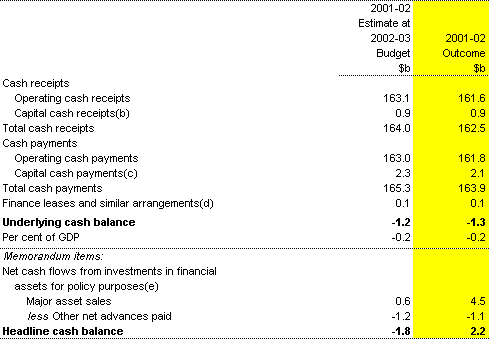
In 2001-02 the Commonwealth general government sector recorded a small underlying cash deficit of $1.3 billion, or 0.2 per cent of GDP. This was $0.1 billion greater than estimated at the time the 2002-03 Budget was brought down. The accrual fiscal deficit of $3.7 billion (0.5 per cent of GDP) was $0.7 billion larger than estimated at the 2002-03 Budget.
Commonwealth net debt declined by a further $3.7 billion in 2001-02. This represents the fifth consecutive year that Commonwealth net debt has been reduced.
Table 1: Commonwealth general government sector budget aggregates(a)
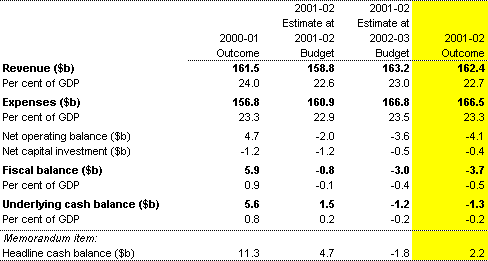
In relation to revenue, total cash receipts were around $1.5 billion lower than expected at the 2002-03 Budget. This was predominantly due to lower than expected income tax withholding receipts, indicating more subdued underlying wages growth than anticipated at Budget. Total accrual revenue was $0.8 billion below the 2002-03 Budget estimates.
On the expenditure side, total cash payments were $1.4 billion lower than anticipated at the 2002-03 Budget, partly reflecting some slippage of defence expenditure and lower than expected spending on various personal benefit payments (including lower unemployment benefit payments) and a number of health programmes.
In contrast to cash expenditure, accrual expenses were only $0.3 billion lower than expected at the 2002-03 Budget. The smaller reduction was partly due to the recognition in accrual terms of the Commonwealth's liabilities associated with measures to address disruption in the medical indemnity industry. The Prime Minister announced these measures following the Budget, in late May 2002. The associated liabilities, which are estimated to total up to $0.5 billion, will be funded by a future levy on medical practitioners.
Commonwealth general government sector net debt fell by $3.7 billion in 2001-02 to $35.6 billion (5.0 per cent of GDP). This reduction was $3.3 billion larger than anticipated at the 2002-03 Budget, primarily because of the full receipt of cash proceeds from the sale of Sydney Airport Corporation Limited in 2001-02 instead of 2002-03.
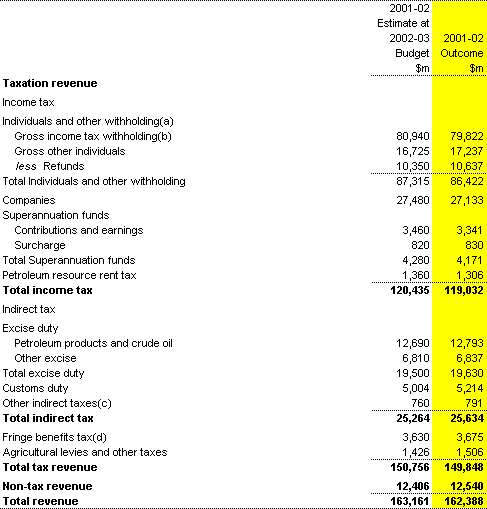
In underlying terms, total Commonwealth accrual revenue in 2001-02 was around $8 billion (5 per cent) higher than for 2000-01.1 This outcome compares with nominal GDP growth over the year of 6.5 per cent.
However, the 2001-02 total Commonwealth accrual revenue outcome of $162.4 billion was around $800 million below the 2002-03 Budget estimate. There are several factors, which explain the lower than expected outcome for 2001-02.
These lower than expected outcomes were partly offset by higher outcomes in other heads of revenue.
Table 2: Commonwealth general government revenue (accrual basis)
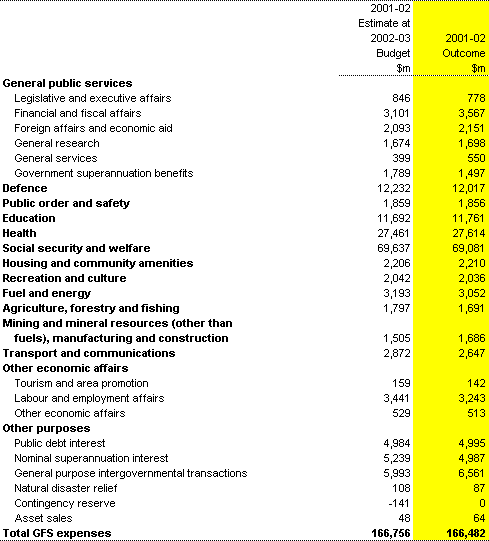
Total accrual expenses were $166.5 billion in 2001-02, a reduction of $274 million from the estimate provided in the 2002-03 Budget. This reduction is largely the result of:
These lower expenses were partly offset by:
Table 3: Commonwealth general government expenses by function
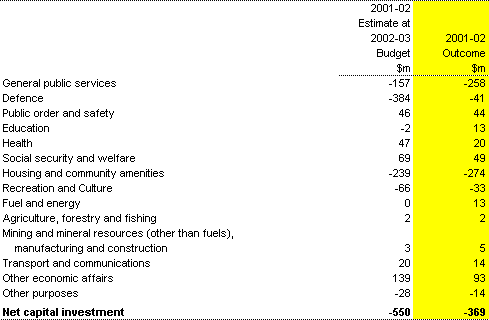
Net capital investment was $181 million higher than estimated at the 2002-03 Budget, largely due to higher than budgeted Defence inventory purchases to maintain stock levels needed for increased capability for overseas deployments in 2001-02 ($293 million).
Table 4: Commonwealth general government net capital investment by function
The level of Commonwealth general government net debt fell to $35.6 billion at the end of 2001-02. Since 1996-97, $60.7 billion of net debt has been repaid. The fall in net debt in 2001-02 was $3.3 billion greater than estimated at the 2002-03 Budget, mainly reflecting the earlier than expected full receipt of proceeds from the sale of Sydney Airport Corporation Limited in late June 2002. Net debt fell to 5 per cent of GDP in 2001-02 compared with a high of over 19 per cent in 1995-96.
Commonwealth general government net worth fell from -$41.2 billion in 2000-01 to -$47.0 billion in 2001-02. This reduction was due mainly to a fall in the Telstra share price over the year to 30 June 2002, reducing the market value of the Commonwealth's shareholding.
Net interest payments in 2001-02 were higher than anticipated at the 2002-03 Budget. This partly reflects higher than anticipated interest payments by the ATO on overpaid taxation and lower than expected earnings on Commonwealth investments. The greater than expected fall in net debt did not have a large impact on net interest payments as it occurred late in the financial year.
Table 5: Commonwealth general government net worth, net debt and net interest payments
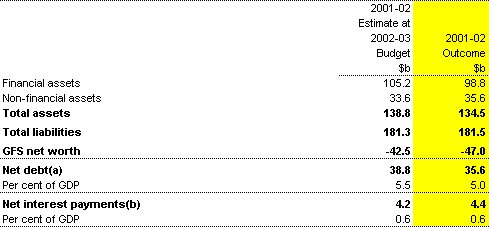
Table 6: Summary of Commonwealth general government cash flows(a)
These outcomes were partly offset by higher than expected collections from company tax ($130 million), excise duty ($116 million) and gross other individuals ($75 million).
The Commonwealth Charter of Budget Honesty Act 1998 requires that the Final Budget Outcome be based on external reporting standards, and that departures from applicable external reporting standards be identified.
The major external standards used in the Final Budget Outcome are the Australian Bureau of Statistics (ABS) accrual Government Finance Statistics (GFS) framework and Australian accounting standards, including Australian Accounting Standard No. 31 Financial Reporting by Governments (AAS31).
The GFS framework requires that flows and stocks are valued at current market prices (or where these are not observable, a suitable proxy indicator). While this is the case for flows in the operating statement and the cash flow statement, not all assets and liabilities in the GFS balance sheet are currently valued at current market prices. This is principally because Australian accounting standards allow reporting entities to elect to value their assets at either cost or fair value (current market value). The accounting profession is considering general valuation issues relating to liabilities. In addition, the early years of accrual budgeting have focussed on preparing robust GFS operating and cash flow statements. Refinements to the GFS balance sheet valuations of assets and liabilities will be considered over time, in consultation with the ABS, as the new framework is bedded down.
The draft ABS GFS publication (Australian System of Government Finance Statistics: Concepts, Sources and Methods Cat. No. 5514.0) requires that provisions for bad and doubtful debts be excluded from the balance sheet. This treatment has not been adopted because excluding such provisions would overstate the value of Commonwealth assets in the balance sheet (and would therefore be inconsistent with the market valuation principle).
The Commonwealth revenue and expenses outcomes in Parts I and III and Appendices B and C do not include goods and services tax (GST) collections and equivalent payments to the States. Under the Intergovernmental Agreement on the Reform of Commonwealth-State Financial Relations (the IGA), all GST receipts are appropriated to the States and Territories and thus are not available for expenditure by the Commonwealth. Because the Commonwealth collects GST as an agent for the States and Territories, GST receipts are not shown as Commonwealth revenue. GST cash receipts are provided in Note 15 of Part III.
In order to ensure the reporting of reliable budget estimates and outcomes, taxation revenue is recognised the earlier of when an assessment of a tax liability is made or cash payment is received by the Australian Tax Office or the Australian Customs Service. Accordingly, for most categories of taxation revenue, there is a short lag between when the revenue is recognised and the time at which the underlying income (or economic activity) giving rise to the tax liability occurs. Longer lags, of up to a year, occur for some elements of company and superannuation funds taxation.
Additional information on the external reporting standards and budget concepts is provided in Appendix A.
1 The 2000-01 accrual revenue outcome included around $8 billion due to an overlap of revenue recognised under the old company instalment system and the new Pay As You Go system. Companies and superannuation funds were able to defer much of this overlap. More information is provided on page 5-7 of the Budget Strategy and Outlook 2002-03, Budget Paper No. 1.
2 ACIS credits are issued to exporters of Australian automotive products and may be used to offset future customs duty on imports. Under accrual accounting, an expense is recognised when the ACIS credits are issued and revenue is recognised at the time that they are redeemed. In 2001-02, the higher customs duty is largely offset by higher expenses arising from the issuance of ACIS credits.
3 The IBNR scheme was announced by the Prime Minister on 31 May 2002. The $501 million estimated expense represents a preliminary estimate of the liability in relation to the largest MDO, UMP/AMIL. The estimate is based on the information available from a report provided by the provisional liquidator of UMP/AMIL to the Supreme Court of New South Wales on 29 August 2002. It represents the upper figure of a range nominated by the report for the estimated liability. It should be noted that the estimate may include some incidents that are not intended to be covered by the Commonwealth's proposed IBNR scheme, and is subject to future revision following further actuarial analysis. Payments by the Commonwealth relating to this liability are expected to commence from 2002-03. The liability is to be funded by a future levy on medical practitioners.
4 Commonwealth cash receipts on a revenue head basis are provided in Table C3.