
|
|
| Home | Search | Site Map | Help | |

A good standard of housing and infrastructure is essential for good health. The Government has always made housing and infrastructure programmes a priority and will continue to do so, with significantly increased expenditure for Indigenous housing in this year's Budget. The Government believes that better management of the existing Indigenous housing stock and more effective targeting of resources to where need is greatest are central to improving housing outcomes for Indigenous Australians.
Current Commonwealth annual expenditure on Indigenous-specific housing and infrastructure programmes is over $300 million. The Government will build on this commitment through an additional $75 million to be spent over four years to upgrade existing houses and for new construction. This initiative will also improve the provision of essential housing related infrastructure (providing clean water, reliable power and safe waste disposal). This funding will also increase the capacity of housing organisations to adopt more effective management practices to better address the needs of their Indigenous clients. Aboriginal and Torres Strait Islander people themselves will undertake the maintenance work, resulting in greater opportunities for training and skills development. Negotiations with States on the use of the new funds will involve improved accountability arrangements focused on outcomes.
Subject to agreement on matching funding from the Queensland Government, the Federal Government will offer an additional three years funding of $15.3 million for a major infrastructure upgrade in the Torres Strait region. The first stage of this project produced substantial and permanent improvements in water supply, sewerage, roads, drainage and other essential services throughout the region. This second stage will extend these advantages to other island communities.
The Government's decision to provide additional funding follows evidence that significant gains have already been made in Indigenous related housing and infrastructure. The results of the 1999 Aboriginal and Torres Strait Islander Community Housing and Infrastructure Needs Survey (CHINS) were released in April 2000 by the Australian Bureau of Statistics (ABS) and ATSIC. It showed progressive improvement in the status of Indigenous housing and infrastructure since a similar survey in 1992:
Chart 3: Housing and Infrastructure Needs in Discrete Indigenous Communities
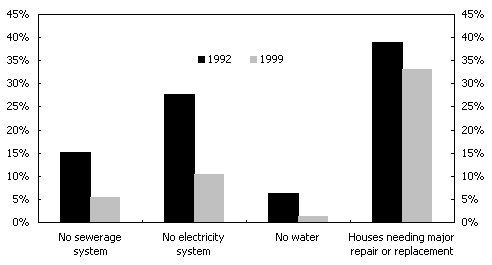
Source: ATSIC Annual Report, 1999-2000, p104
Note: Indigenous people living
in discrete communities make up around 30 per cent of the total Indigenous
population. This chart does not include Indigenous people living in towns and
cities who have access
to the same infrastructure available to other residents in these towns and cities.
The CHINS survey echoed improvements revealed in the results of the 1996 Census. In the preceding fifteen years, overcrowding had been reduced to the extent that the average number of people per Indigenous household had fallen from 4.4 persons to 3.7 persons and the proportion of Indigenous families who live in improvised dwellings had dropped significantly to 3 per cent from 20 per cent in the 1970s.
A number of States and Territories have entered into bilateral agreements with the Commonwealth (represented by ATSIC) to pool housing and infrastructure funds and to allocate these funds regionally on the basis of need. These bilateral agreements ensure the coordinated delivery of services and increase Indigenous participation in decision making. Agreements now exist in all states and territories except Tasmania, Victoria and the Australian Capital Territory.
Home ownership is an important part of giving Indigenous people a financial stake in the wider economy and reducing welfare dependency. Over $50 million is being spent on ATSIC's home ownership scheme which provides some 450 home loans per annum. Programmes such as these have resulted in real progress over the past two decades. The proportion of Indigenous families that own or are purchasing their own home has increased from 24 per cent in the early 1970s to 33 per cent today.
The Government is particularly proud of the ATSIC Army Community Assistance Programme (AACAP). Careful targeting, consultation and partnerships have achieved both immediate and long-term benefits in some of the most disadvantaged communities in the country. The Government has provided $51.2 million in total funding for AACAP. In the three years from 1997-2000, around $17 million has been spent to construct much-needed infrastructure in many communities. For example, in Melville Island the Army rebuilt the road access to Milikapiti, installed better drainage against wet season flooding, refurbished existing houses and built new houses. On Bathurst Island the Army built a water tower, installed sewerage and improved roads.
Communities that have been assisted include Bulla (NT), Marthakal Outstations (NT), Milyakburra (NT), Milikapiti (Tiwi Islands, NT), Wurankuwu (NT), Jumbun (QLD), Oombulgurri (WA), Oak Valley (SA) and Docker River (NT). Projects are planned for 2001-02 at Yarralin, Lingarra and Amanbidji in the Northern Territory. In each of the communities assisted under the programme, the Army has provided additional medical, dental and veterinary services, while they were in the community. Importantly, it has also provided the local community with the skills to construct, maintain and manage their new assets, an important part of the process of building community capacity.


