
|
|
| Home | Search | Site Map | Help | |

Aboriginal and Torres Strait Islander people continue to experience the lowest health status of any group in the Australian community, with the problem being more pronounced in remote regions. The major causes of death for young and middle aged adults are cardiovascular and respiratory diseases, injury, cancer and, increasingly, diabetes related illnesses. Dealing effectively with diet and lifestyle issues, including substance abuse, is critically important to increasing life expectancy for Indigenous Australians.
Considerable effort has been invested in making mainstream programmes more accessible and more responsive to the needs of Indigenous Australians. A range of initiatives including improved access to medicines for remote Indigenous Australians, the use of Medicare in Aboriginal community controlled health services and streamlined enrolment and billing arrangements have resulted in greater use of the Medicare and Pharmaceutical Benefits Schemes by Indigenous Australians.
The Government has recognised that these mainstream systems, whilst they are an important contribution to Indigenous health, also need to be complemented by more targeted programmes in order to meet the greater health needs of Indigenous Australians. This Budget provides for additional ongoing funding of around $20 million each year from 2003-04 for the Indigenous specific Primary Health Care Access Programme. These funds will be used to provide doctors, Aboriginal health workers, and health promotion activities to Indigenous communities in locations where they are most needed.
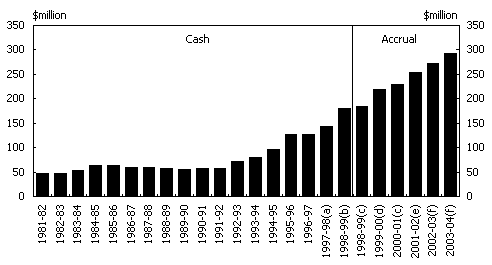
By 2003-04 Federal Government spending on Indigenous specific health programmes through the Office of Aboriginal and Torres Strait Islander Health (which accounts for the bulk of such spending) will have increased by 86 per cent since 1996 to $253 million per year. The Government is expanding its efforts in this area in a manner that builds a sustainable health care infrastructure.
Under the $13 million Rural Nursing Scholarships initiative, ten scholarships will be specifically set aside for Indigenous nursing students or health workers to improve access to undergraduate nursing education in rural areas. As part of this initiative, $2.1 million over four years will be provided for support measures associated with the scholarship with a particular emphasis placed on Indigenous nursing students. Funding will be provided to facilitate greater access to mentor/preceptor programmes and financial assistance will be made available to scholarship holders in exceptional circumstances where students suffer financial hardship. Funding will also be provided for culturally appropriate training for rural nurses to assist them in providing care to Indigenous Australian clients.
Aboriginal and Torres Strait Islander children are one of the groups who will benefit from the $23 million to be spent over four years on the National Childhood Pneumococcal Vaccination Programme. Aboriginal children, especially in Central Australia, are at particular risk of pneumococcal infections, which can cause meningitis.
Chart 3: Identifiable Commonwealth Expenditure on Aboriginal and Torres
Strait Islander Health 1981-82 to 2003-04 (in 2001-02 Dollars)
Source: Figures from 1981-82 to 1994-95 - Department of the Parliamentary Library, Current Issues Brief No.18 of 1997-98, Dr John Gardiner-Garden
Figures from 1995-96 to cash Budget 1998-99 - Addressing Priorities in Indigenous Affairs, Statement by the Minister for Aboriginal and Torres Strait Islander Affairs, 12 May 1998
Figures for 1999-2000 to 2003-04 provided by the Department of Health and Aged Care.
Note: (a) Cash based estimated outcome for 1997-98
(b) Cash based Budget figure for 1998-99
(c) Accrual based estimated outcome figures
(d) Accrual based actual outcome figure
(e) Accrual based Budget figure
(f) Forward estimate figure
Long lead times are required before demonstrable improvements in Indigenous health outcomes will be evident. Factors such as low birth weight and lifestyle continue to influence death and illness rates for many years after the events. Nevertheless, changes in the health status of Aboriginal and Torres Strait Islander people are occurring. For example, the rate of Indigenous infant mortality has fallen from 138 infant deaths per 1,000 live births in 1965 to 14 deaths per 1,000 live births in 1999. Other real gains achieved over the last five years include:
Evidence is emerging that the strategic approach taken since the mid-1990s is working. The health status of Indigenous people is improving in places where local health services providing sound clinical and population health programmes have been established and are delivering services in a way that actively engages individuals and communities in managing their health. Examples of achievements include:
The evaluation report of the four landmark coordinated care trials conducted in Aboriginal communities between 1997 and 2000 showed significant improvement in increasing access for Aboriginal people to services, health care planning and population health programmes. For example:
Another outcome of critical importance has been improvements to the capacity of local communities, organisations and services in identifying and meeting local health needs. The Aboriginal coordinated care trials showed that progress can be made to improve Aboriginal health when governments, local communities and health services work together in partnership. The Government will draw on the lessons learned from the trials and extend this innovative approach to service delivery to other parts of Australia.
Through the National Aboriginal and Torres Strait Islander Health Council, the Commonwealth is currently participating in the development of a National Aboriginal and Torres Strait Islander Health Strategy. A draft strategy is currently available for consultation.


