
|
|
| Home | Search | Site Map | Help | |




The Government believes that improving education outcomes for Indigenous Australians throughout the school, vocational education and higher education systems will be vital in reducing Indigenous disadvantage and dependency on welfare.
While the proportion of Indigenous adults who have never attended school has fallen from 24 per cent in 1971 to three per cent in 1996, more needs to be done to encourage Indigenous students to stay on at school and improve academic achievement. As a part of the Australians Working Together package, $10.2 million over four years will provide support for Indigenous students to stay on and complete Year 12 and go on to further education and training and move into paid employment. Some 1,600 students will receive assistance. Project coordinators will work to develop compacts with business, schools and Indigenous families to provide support and encouragement to these students.
Under this new initiative a further 2,300 secondary school students, particularly in remote areas will be assisted through the support of local business to undertake vocational learning opportunities as part of their secondary schooling. Projects involving both on and off the job vocational training suited to the needs of local communities will be identified with the assistance of the Enterprise and Career Education Foundation. Students will be able to develop a better skills base which in turn will lead to greater employment opportunities.
These new initiatives build on the Government's solid policy and programme effort in Indigenous education over the past five years. The Indigenous Education Strategic Initiatives Programme (IESIP) provides supplementary funding on a per capita basis to preschools, schools, and to vocational education and training providers. It also provides funding for travel, accommodation, and related activities for distance education students in the tertiary sector to attend compulsory residential schools as part of their course of study. This is the main Indigenous specific education programme and plays a key role in the Commonwealth's strategy to close the gap between Indigenous and non-Indigenous education outcomes. IESIP funding has grown by about 71 per cent in five years, from $89 million in 1995-96 to nearly $152 million in 2001-02.
In addition to the per capita IESIP funding, some $27 million over four years has been earmarked for the National Indigenous English Literacy and Numeracy Strategy, launched by the Prime Minister in March 2000. The objective of this Strategy is to ensure that Indigenous people achieve English literacy and numeracy levels comparable to other young Australians.
The Strategy is designed to implement the national goals agreed to by Commonwealth State and Territory Education Ministers in relation to literacy and schooling: that all children leaving primary school should be numerate, able to read, write and spell at an appropriate level, and that every child commencing school from 2001 will achieve a minimum acceptable literacy and numeracy standard within four years. It aims to lift Indigenous school attendance rates, address health problems that undermine learning, attract and retain good teachers and use the most effective teaching methods to obtain successful results for Indigenous students.
Other key initiatives under the National Indigenous English Literacy and Numeracy Strategy, that have a strong impact across education systems and raise the profile of this Strategy within States and Territories, are:
Under the Indigenous Education Direct Assistance (IEDA) programme, the Aboriginal Tutorial Assistance Scheme (ATAS) already assists nearly 27,000 students through 825 Homework Centres and around 15,500 students through individual or small group tuition. IEDA also supports nearly 99,000 students through the Aboriginal Student Support and Parent Awareness programme which assists parents to engage with their children's education.
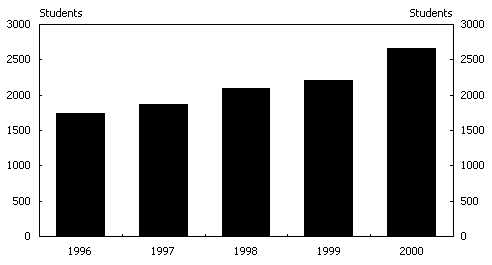
In 2000, about 87 per cent of Indigenous students were enrolled in the government school sector. The Year 12 retention rate has increased from 29.2 per cent in 1996 to 38.0 per cent in 2000.
Chart 5: Number of Indigenous Students Entering Year 12
Source: Schools Division, Department of Education, Training and Youth Affairs
The participation rate for vocational education and training by Indigenous people under the age of 24 years has increased from 13,500 in 1996 to 21,967 in 1999 (an increase of 62.7 per cent). The total number of Indigenous students in vocational education and training has dramatically increased from 15,100 in 1990 to 50,800 in 1999, an increase of around 340 per cent. The number of Indigenous people commencing traineeships and apprenticeships has increased significantly from around 800 in 1994 to approximately 4,880 in 2000.
On 30 June 2000, the Commonwealth and the State and Territory Ministers of Training endorsed Partners in a Learning Culture: Australia's National Aboriginal and Torres Strait Islander Strategy for vocational education and training 2000-2005 and a Blueprint for Implementation. The Strategy and the Blueprint propose actions which should assist young Indigenous people to participate in vocational education and training and increase participation rate even further.
Higher education Indigenous student numbers almost quadrupled between 1987 and 2000. Between the censuses of 1991 and 1996 the proportion of 20 to 24 year old Indigenous people with a University degree tripled.
The Government has shown that it is prepared to support new and innovative approaches that produce better outcomes for Indigenous students. The Federal Government is the major financial contributor to the successful Croc Eisteddfods which provide an opportunity for Indigenous students to succeed in school-based community events with a strong anti-drugs message. The Prime Minister and a number of other ministers attended Croc Eisteddfod events last year and were impressed with the motivational impact on students, parents and communities alike. The Government has therefore undertaken to increase its contribution to allow for more Croc Eisteddfods in 2001.