
|
|




Consistent with the Government's 1997 policy statement on the aid program, Better Aid for a Better Future, Australia's aid program is heavily concentrated in East Asia, Papua New Guinea and the Pacific Island countries - with selective engagement in South Asia, Africa and the Middle East.
A focus on the Asia-Pacific region enables Australia to maximise the impact of our development assistance on reducing poverty. The number of people living in extreme poverty in Asia and the Pacific has fallen by around 90 million in the last decade. But there are still nearly 800 million people living on less than two dollars a day in our region, and this presents an immense challenge.
In February 2001, the Government adopted a new poverty reduction framework for the aid program. The framework will strengthen the program's focus on poverty by increasing understanding of who the poor are, the causes of their poverty and what aid actions will most effectively help reduce their poverty. The framework addresses a number of critical issues including key strategies for reducing poverty, the importance of poverty analysis and principles to guide future action.
The framework is based on four pillars: growth, productivity, accountability and vulnerability. Each pillar incorporates key aspects of good governance, reflecting the pivotal importance of transparent, accountable and participatory government for the development process. The framework focuses the aid program on activities that:
The four pillars are closely connected and mutually reinforcing. Inclusive growth policies can be essential for allowing the poor to realise opportunities for improving their productivity. Enhancements in access to education and health can be critical for allowing greater involvement in decision-making processes, and support wider moves towards greater accountability in government, society and private sector operations. Improved accountability arrangements increase the likelihood that broader policies, including those encompassing macroeconomic and microeconomic factors, include an analysis and redirection of the distributional consequences of those policies. Reductions in vulnerability will often be reinforced by other actions such as improved health services and better risk management in policy formulation.
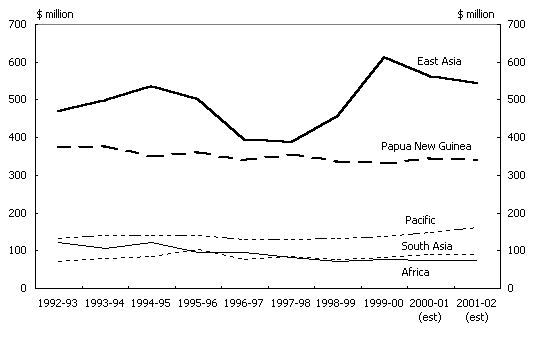
In 2001-02, Papua New Guinea will receive around one fifth of total flows, in line with flows in recent years. East Asian and Pacific countries will remain a high priority, with allocations to South Asia and Africa remaining similar to 2000-01.
Diagram 1: Total Australian aid by region 2001-02 (% of total aid)
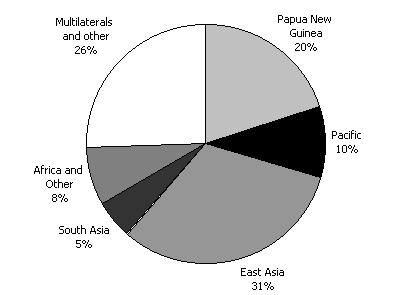
Diagram 2: Trends in total Australian
aid by region
(constant 2000-01 prices)
Australia's ODA/GNP ratio is estimated to be 0.25 per cent in 2001-02, which is well above the latest (2000) donor average of 0.22 per cent.
Diagram 3: ODA/GNP ratio of Australia and DAC weighted average*
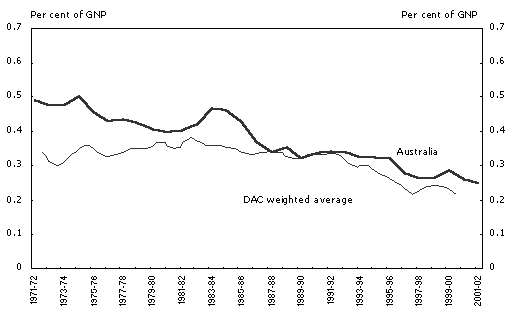
*DAC figure for 2000 is provisional.
The aid program provides assistance in five key sectors: governance, agriculture and rural development, health, education and infrastructure. Activities in these sectors are underpinned by a commitment to environmental sustainability and gender equity.
Country and regional strategies, which are developed in consultation with partner governments, are the primary means through which sectoral priorities are translated into programs on the ground. Strategies take account of partner government priorities, Australia's strengths and the activities of other donors. Often work within one sector can have a flow-on effect in others. For example, governance activities aimed at strengthening public institutions can improve the delivery of health and education services for the poor.
The figures in this chapter are approximate forecasts and subject to change over the course of the year as a result of programming decisions.
Diagram 4: Estimated breakdown of the aid program by sector 2001-02
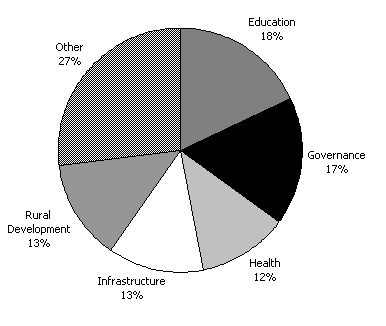
Diagram 5: Estimated expenditure by key sector 2001-02
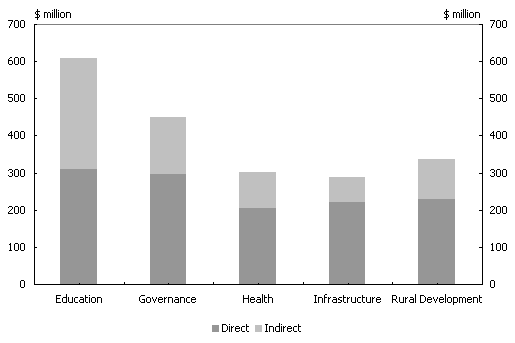
Good governance is essential for sustainable development and for effective aid. This underpins the increasing importance of governance in the aid program, with expenditure on governance activities in 2001-02 estimated to reach $295 million. Governance activities represent about 17 per cent of overall aid expenditure.
The elements of governance are interdependent and mutually reinforcing, as recognised in the aid program's support for:
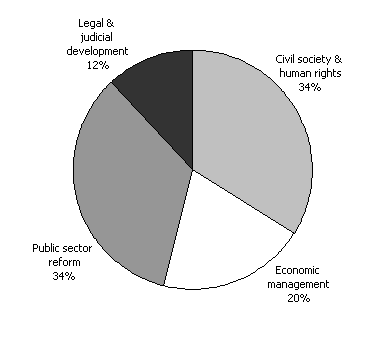
In 2001-02, the aid program will continue to work with partner governments and their citizens to build representative, accountable and effective governance processes, adherence to the rule of law, and strong and pluralistic civil societies. Ongoing funding for the Centre for Democratic Institutions will provide a continued focus for enhancing broad political participation and human rights in the Asia-Pacific region. The Human Rights Fund will maintain support for small-scale human rights activities and the strengthening of national and regional human rights institutions.
Recognising that economic growth and poverty reduction are best achieved in an efficient, open and market based economy, the aid program will continue to work with partner governments to achieve the necessary policy and planning frameworks, strong public institutions, dynamic private sectors and social investments in people. Increased support for microfinance will feature, with an emphasis on sustainability. In a globalised world, there will also be a greater focus on trade-related assistance to enable developing countries to attract private investment and to participate in global and regional trading arrangements.
Diagram 6: Estimated Australian assistance to the governance sector
2001-02
Income generation is at the centre of Australia's aid programs to assist the rural poor. The Rural Development Strategy is designed to increase opportunities for the poor to generate income through improving agricultural sector productivity, stimulating rural non-farm employment, and managing natural resources sustainability.
The aid program will provide $230 million for rural development in 2001-02, which represents around 13 per cent of overall aid expenditure. In addition, around $105 million will be spent in rural areas on education, governance, health and infrastructure activities that make a significant contribution to basic needs and essential services for the rural poor.
In 2001-02, aid activities in the rural sector will be focused on projects that have long timeframes and clearly defined objectives. Past experience has proven these forms of activities to be more effective than complex, multi-sector projects with interdependent components. A priority will be activities that increase the productivity of subsistence producers, in an effort to help their food security and nutritional status, as well as assist them to generate cash income through marketing of surpluses.
The Government's Food Security Strategy for the aid program is aimed at improving access of the poorest and most vulnerable to sufficient, nutritionally adequate and safe food. Food aid and other food security activities will continue under a pledge made by Australia in 1998 to contribute $1 billion over four years from July 1998 to June 2002. Australia will spend over $250 million dollars under the pledge in 2001-02. The major part of Australia's food aid is directly sourced from Australian commodities.
Effective national investment in health assists developing countries by increasing the capacity of children to learn and adults to earn. Australia's assistance to the health sector aims to improve the basic health of those most in need, to improve the quality of health service delivery and to address the health effects of natural disasters and emergencies.
In 2001-02 Australia will provide an estimated $205 million of direct health assistance to developing countries. Australia's support for health in developing countries has increased substantially since 1996-97, when it accounted for only around 4 per cent of total overall aid expenditure. In 2001-02, health expenditure will account for around 12 per cent of overall aid expenditure.
Diagram 7: Estimated Australian assistance to the health sector 2001-02
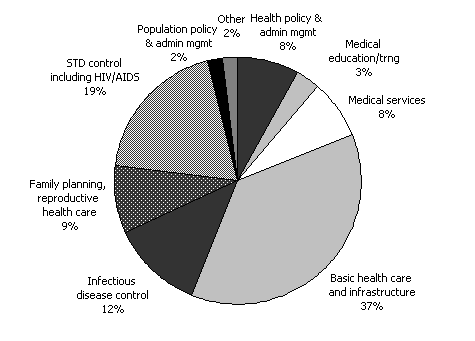
Approaches to implementation are tailored to address local priorities and circumstances. The aid program will have a strong focus on the following areas in 2001-02:
Combating HIV/AIDS HIV/AIDS is one of the highest priorities of Australia's aid program. The epidemic threatens to reverse decades of development, and puts at risk the political stability and economic security of developing countries. The social and economic devastation is already significant in many countries: villagers too sick to harvest their crops, children orphaned as parents die, families divided where relatives living with HIV/AIDS are ostracised, school teachers and health workers too sick to contribute any longer to the development of their community. Most of the 36 million people currently living with HIV/AIDS reside in developing countries. The great majority of these people live in sub-Saharan Africa, although there are signs that the annual number of new infections in sub-Saharan Africa may have stabilised. In Asia and the Pacific, well over seven million people are infected with HIV and the rate of infections has been increasing, threatening to have a devastating impact on the region. Australia is actively supporting international efforts to counter the HIV/AIDS epidemic at a global, regional and bilateral level. Securing high-level political commitment is critical if the advance of the epidemic is to be reversed. At the United Nations, Australia is working to ensure that a special session in June 2001 intensifies global action against HIV/AIDS. The Australian Government is providing leadership in our region by convening a meeting of ministers from the Asia-Pacific, A lengthening shadow-HIV/AIDS in the Asia-Pacific, in Melbourne in October 2001 to discuss how governments can best respond to this public health crisis. At the bilateral level, the Australian Government is helping developing countries counter the advance of HIV/AIDS through a six-year $200 million initiative. Australia is assisting countries like Papua New Guinea, Indonesia and China to prevent the epidemic from devastating the health of their populations and stalling their social and economic development. Expenditure on the initiative in 2001-02 will be approximately $27.6 million, with new activities due to commence in China and South-East Asia. |
Education contributes to the alleviation of poverty and achievement of sustainable development by developing knowledge and skills, strengthening the capacity of countries to manage their own affairs, and increasing the productivity of national labour forces. Improved educational standards have an effect at both a national and individual level, with flow-on effects for future generations. In 2001-02 Australia will spend an estimated $310 million through the aid program on the education sector. This represents about 18 per cent of overall aid expenditure.
Access, equity and quality are increasingly important issues for education activities funded by the aid program. Access to basic education has been a higher priority in recent years, which is in turn starting to create a stronger demand for secondary places. Many education programs also aim to overcome obstacles that face female and minority populations. A greater emphasis is also being placed on the quality of education services.
Diagram 8: Estimated Australian assistance to the education sector 2001-02
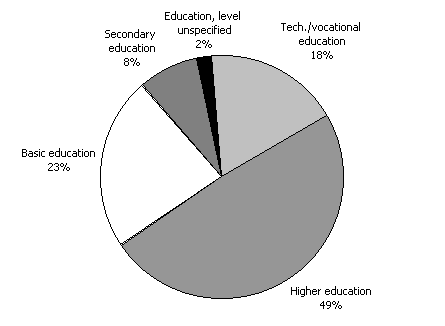
Basic education provides a foundation for all future learning. It equips people to make informed decisions and contribute more effectively to their societies, has a positive effect on child health and nutrition, and improves employment opportunities for individuals. Since 1996, basic education has increased substantially as a share of total education aid, rising from 6 per cent or around $15 million to 23 per cent or $70 million. Support for basic education is an important part of Australia's assistance to PNG and the Pacific, where school age populations are increasing rapidly and educational needs are very great. Australia will also assist at least 12 countries across Asia to improve basic education during 2001-02.
Direct aid program expenditure on technical and vocational education has increased significantly, from 14 per cent of education expenditure in 2000-01 to an estimated 18 per cent in 2001-02. Australia has responded to requests from developing countries where workforce skills are critically short and unemployment high. Partner countries are benefiting from Australia's recent experience in reforming its own technical and further education (TAFE) systems. Many partner countries are improving the relevance of technical and vocational education by introducing demand driven approaches. This is allowing private sector employers to be more actively engaged as partners in the development, delivery and funding of technical and vocational education.
In 2001-02, spending on higher education will account for approximately half of the aid program's total education sector expenditure. Around 90 per cent of higher education expenditure is on Australian Development Scholarships (ADS). Scholarships will be used as an aid delivery mechanism across most country programs, with the highest ADS participation in Indonesia, Papua New Guinea, Viet Nam and the Philippines. Approximately 3000 students were funded through scholarship activities in 2000-01. It is expected that around 1100 new scholarships will be offered in 2001-02.
Scholarships contribute to human resource development in our partner countries, having a direct effect on all priority development sectors through tertiary training provided at Australian institutions. The majority of scholarships are expected to be awarded to candidates from key government agencies, health professionals (including public health workers), science professionals (particularly agriculture and food science), educators and engineers.
The development of basic infrastructure such as safe drinking water, sanitation facilities and roads has a range of benefits for the poor. Infrastructure development can act as a catalyst for economic development, which in turn leads to increased employment opportunities. The well-being of the poor can be improved, for example, through a decrease in death and illness associated with poor sanitation systems and contaminated drinking water. The development and maintenance of roads can significantly improve access for the rural poor to markets and services.
It is estimated that Australia will provide about $220 million in 2001-02 towards infrastructure. This represents about 13 per cent of overall aid expenditure.
During 2001-02, support for infrastructure will focus on:
Environmental degradation has a major and disproportionate effect on the poor. The World Bank estimates the annual cost of environmental degradation in East Asia and the Pacific is five per cent of GDP. In urban areas, the health of the poor is affected by air pollution and unsanitary living conditions. In rural areas, deforestation, soil erosion and the destruction of fisheries directly affect the livelihoods of the poor.
In 2001-02, Australia will provide an estimated $70 million for activities that address environmental problems in developing countries (around 4 per cent of overall aid expenditure), with an additional $140 million of indirect expenditure. Activities will range from support for improved water, waste and natural resource management to biodiversity conservation, climate monitoring and renewable energy projects.
Australia assesses and manages all aid activities to avoid or minimise negative environmental impacts. In July 2000 the Commonwealth Environment Protection and Biodiversity Conservation Act 1999 replaced the Environment Protection (Impact of Proposals) Act 1974 as the law governing environmental impact assessment under Australia's aid program. In 2001-02 the aid program will implement environmental assessment guidelines revised to reflect the requirements of the new Act and will extend a comprehensive training program to support the new guidelines.
Other priorities for 2001-02 are to:
Mainstreaming gender into development initiatives is the priority of the aid program's Gender and Development policy. Strong progress is being made as the linkages between development, growth and gender disparities are becoming more widely recognised. During 2001-02 Australia will spend approximately $450 million on activities in which gender equality is a stated objective of the activity.
During 2001-02, Australia's aid program will work with partner countries to: