
|
|




Country |
GNP per capita |
Access to water supply |
Life expectancy (years) |
Adult literacy |
|
Papua New Guinea |
1240 |
42 |
64 |
64 | |
Source: GNP per capita and adult literacy (1999): DAC; Access to water (2000): Global Water Supply and Sanitation Assessment 2000 Report; Life expectancy (1999): Geographical Distribution of Financial Flows to Aid Recipients 1995-1999, OECD.
Programmed activities $300.3 million
Retirement benefits $14.1 million
Estimated other flows $28.5 million
Estimated total aid flows $342.9 million
Aid to Papua New Guinea (PNG) accounts for over one-fifth of the total Australian development cooperation program and is the largest aid program Australia has with any one country. The current aid strategy for PNG contains four key elements:
Funding for the Incentive Fund is expected to increase from the allocation of $15 million in 2000-01 to $20 million in 2001-02. The fund provides a high degree of contestability in the aid program by rewarding agencies and institutions that demonstrate a proven track record in program and financial management. Programs that will receive funding in 2001-02 include the extension of a primary school in Boroko, provision of health extension services for rural communities, a new marketplace in the Paiam Valley and a new university library and lecture theatre in Madang. The Incentive Fund will support the provincial implementation of key PNG Government development policies in the health, education and agriculture sectors.
Quality performance targets for key inputs and outputs of both the Australian and PNG Governments, established under a performance benchmark system, will be assessed for the first time in 2001-02. These benchmarks monitor Australia's responsibility to increase levels of PNG participation in the aid program and monitor PNG's responsibility to provide counterpart funding and make progress in the health, education and infrastructure sectors. Performance against benchmarks will be taken into account in deciding future resource allocations to PNG.
In 2001-02, Australia will also be examining options to assist the PNG Government to implement the National Charter on Reconstruction and Development, a key initiative in the PNG 2001 Budget.
Australian aid to PNG is focused on governance, education, health, infrastructure, renewable resources and assisting the peace process in Bougainville.
Diagram 9: Estimated total aid flows to PNG by sector in 2001-02
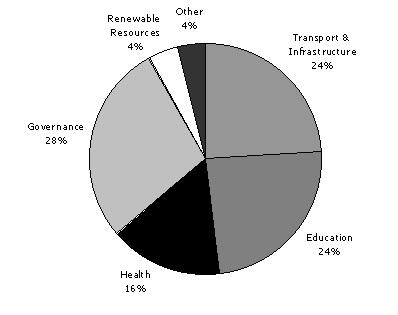
Governance constraints are seriously undermining the development performance of PNG. Economic and financial management, the efficient and accountable use of public resources, the rule of law, a vibrant private sector and an active civil society are key elements to poverty reduction.
The PNG Government is undertaking a wide ranging program of public sector reforms as part of the structural adjustment program with the IMF and World Bank. This program includes privatisation of key state owned assets, strengthening of Cabinet and budget processes, strengthening economic and financial management, rationalisation of the public service payroll, increasing independence of the Central Bank and revamping the country's superannuation industry. The PNG Government is also undertaking a functional and expenditure review of all government departments and agencies.
Australia's support for the public sector reform program adopts two broad strategies:
Australian assistance to the law and justice sector amounts to about 10 per cent of the total PNG program. A review of Australian assistance to the sector was recently undertaken and a new strategy is being formulated to guide future support. In line with PNG Government policy, the key objectives for Australian assistance will be to:
The aid program is funding a six-year Community Development Scheme that aims to enhance the capacity of PNG's civil society to engage and participate in the development process. The scheme channels financial and technical support to PNG non-government and community-based organisations to build the capacities of these organisations and help them undertake community development activities.
PNG's social diversity presents complex challenges for its education system. Although relatively small, the widely-dispersed population is highly diverse both linguistically and ethnically. A large proportion of men and women are illiterate and only 60 per cent of children who commence school continue beyond the sixth grade.
PNG is pursuing an ambitious program of education reform that seeks to achieve universal basic education and a literate and skilled population. Australia strongly supports the reform process and in 2001-02 will again provide approximately a quarter of its aid to PNG for the education sector.
Australian assistance to the sector is helping to improve the quality and relevance of teaching at the elementary, primary and secondary levels, the development and distribution of curricula, the construction and rehabilitation of physical infrastructure and the building of institutional capacity. Australia is the largest provider of tertiary scholarships to PNG; up to 150 new scholarships for study in Australian universities are available each year.
A strategy for future Australian assistance to the sector was agreed with PNG in 2000. Future assistance will continue current programs while at the same time giving increased attention to the institutional requirements of the sector, literacy and numeracy training for out-of-school youths and adults, and technical and vocational education and training. Planning of the forward program has commenced with a view to new activities starting early in 2002.
While health conditions remain a major concern in PNG, there are encouraging signs that the Government's strategy is beginning to make progress. Health has been identified as a priority sector in the PNG Government's 2001 budget with a significant increase in recurrent funding going to health programs. Expenditure in the health sector as a proportion of total Australian aid funding for PNG will increase from 15 per cent in 2000-01 to around 16 per cent in 2001-02.
During 2001-02, Australia will provide support for rural health services based on PNG Government health policies and implementation plans. This reflects the steady progress PNG has made in establishing the Health Sector Improvement Program, which uses a new aid framework, the sector-wide approach. Sector-wide approaches seek to combine donor funds and activities in support of the Government's medium term expenditure plans and programs. These resources are supported by transparent financial and performance monitoring systems. Australia and PNG are moving towards a sector-wide approach in the health sector to improve donor coordination and support for the PNG National Health Plan 2001-10.
Extensive support will also be provided for women's and children's health programs, rural health infrastructure, communications, medical equipment, drugs and vaccines. Training of a wide range of health workers will continue as an important means of improving the quality of health care.
The PNG Government has given high priority to addressing the HIV/AIDS crisis, including boosting funding for the National AIDS Council Secretariat. Australia will continue to support the PNG Government's Medium Term Plan for HIV/AIDS through the $60 million National HIV/AIDS Support Program, which began in October 2000. It is the largest HIV/AIDS project ever funded by Australia. The program works with government, community and non-government organisations to raise awareness, expand essential medical and community services, support legal reform and strengthen the capacity of PNG organisations to manage their own response to the epidemic.
Efficiently managed and maintained transport infrastructure is a prerequisite for economic development. Without it access to government services in health, education and communication become difficult, rural economic development is stymied through challenges in getting crops to markets and entrepreneurial activity is discouraged. PNG's existing stock of infrastructure has deteriorated over the last ten years as a result of insufficient funding for maintenance. The National Transport Development Plan for 2001-10 recognises this by making regular maintenance of transport infrastructure a top priority. Accordingly, the infrastructure strategy in Australia's aid program focuses on maintaining national assets in the area of land and air transport.
The land transport program is assisting the PNG Government to maintain national roads and bridges in six provinces, and working to strengthen local capacity to plan and manage construction contracts. In the Highlands, the program is rehabilitating a major section of the highway between Wabag and Wapenamanda. In 2001-02, funds will be provided for a new project that will upgrade many of the single-lane and poorly maintained bridges along the Highlands Highway, which currently impede traffic flow and create major safety problems. In East New Britain province, the aid program will provide assistance for the ongoing rehabilitation of the road between the new provincial capital of Kokopo and the port of Rabaul, which was damaged by devastating volcanic eruptions in 1995.
Air transport provides the only form of access to much of PNG's remote territory. Keeping the essential air links open and in safe working order is a priority. Australia will continue to provide support for the maintenance of national airports. The aid program will also support the newly established Civil Aviation Authority, with particular focus on planning and air safety.
The sustainable management of PNG's heavy reliance on its agricultural, fisheries and forestry resources is a key aspect of the effort to raise living standards in rural areas. In renewable resources, the aid program is focusing on institutional strengthening, training, and research to help PNG develop appropriate systems and expertise to ensure resources are preserved for future generations.
In 2001-02, Australia will continue to provide financial and technical assistance to agriculture, forestry and environment sectors, working in partnership with other donors including the World Bank. Ongoing projects include assistance to upgrade the Fisheries Staff College, and for agricultural rehabilitation activities in Bougainville. Support is also being provided to upgrade the agricultural research capacity of the National Agricultural Research Institute and for the PNG research and development activities of the Australian Centre for International Agricultural Research.
Australia is committed to helping consolidate the peace process, both through continued assistance to negotiations for a political agreement, and through encouraging a visible peace dividend to the people of Bougainville.
In 2001-02, Australia's aid program will target key sectors both at the community level and by assisting government service delivery. Initial emphasis has been on rehabilitating essential infrastructure, and restoring health and education facilities. As conditions have improved, support for reinvigorating economic activity has become a focus. This year, the aid program will assist to re-establish the cocoa industry, through the supply of seedlings and the replacement of cocoa dryers. Maintenance of the major coastal trunk road, essential for getting agricultural products to markets and accessing government services, will continue. Funding will also be provided to improve sea transport links by upgrading the wharf at Buka and constructing a jetty and warehouse at Kangu in the south.
Country |
GNP per capita |
Access to water |
Life expectancy (years) |
Adult literacy |
Fiji |
3425 |
47 |
73 |
93 |
Solomon Islands |
1162 |
71 |
71 |
30 |
Vanuatu |
1813 |
88 |
65 |
34 |
Samoa |
1643 |
99 |
69 |
96 |
Tonga |
2665 |
100 |
71 |
99 |
Kiribati |
1410 |
47 |
61 |
92 |
Tuvalu |
1843 |
85 |
67 |
95 |
Source: GNP per capita (1999): DAC; Access to water (2000): Global Water Supply and Sanitation Assessment 2000 Report; Life expectancy (1998): Geographical Distribution of Financial Flows to Aid Recipients 1995-1999, OECD; Tuvalu and Adult literacy: UNDP Pacific Human Development report 1999.
Estimated total aid flows to the Pacific $164.6 million
Pacific Island countries face significant development challenges as a result of their economic and environmental vulnerability. Countries in the Pacific lack diversity in terms of production and export sectors, making them especially vulnerable to economic shocks and crop failure. High transport costs caused by their remoteness from major markets increase significantly the costs of both exporting and importing goods.
Small island states, already facing the dual challenges of expanding populations and limited viable agricultural land, are particularly susceptible to natural disasters and environmental deterioration. Adverse events, such as cyclones, can have extremely detrimental effects on national infrastructure and production. Furthermore, small countries often lack adequate capacity in their public or private sectors to cope with the range of challenges presented by the rapidly globalising world. They do not have access to a sufficiently large pool of people with the technical, administrative and managerial skills a modern state requires.
Addressing the social and economic causes of actual and potential political instability is another important issue for Pacific Island countries as the events of 2000 have demonstrated.
Australia's long-term objective is to help Pacific Island countries achieve the maximum possible degree of self-reliance. The aid program aims to achieve five principal outcomes for Pacific Island countries: better governance, stronger economic growth, greater capacity, better service delivery and environmental integrity.
Work is currently underway to develop a new three-year strategy for assistance to Pacific Island countries. It is expected that this new strategy will maintain a strong focus on governance and economic growth, education, health and resource management.
In 2001-02, Australian assistance to Pacific Island countries will focus on support for governance and economic reform, education and training, health, environment and natural resource management and private sector development.
Stronger economic growth and better service delivery require good governance. In 2001-02 the aid program will continue to assist Pacific Island countries to enhance the policy, legislative and administrative frameworks needed for more effective public and private sectors. This work is in the areas of taxation, economic and fiscal management reform, customs operations and public sector reform. Australia will also provide support to legal sector institutions, including police, correctional facilities, courts and auditors-general.
Australia will continue to provide support for Pacific Island countries embarking on economic and public sector reform through the Policy and Management Reform program (PMR). In 2001-02, PMR will be expanded to include support for programs that promote peace and nation building. Total funding for this program in 2001-02 will be $20 million.
One area for PMR activity will be support for strengthening the capacity of Pacific Island countries to combat money laundering, which threatens their financial stability. Australia will also support the dissemination of research on economic and governance challenges in Pacific Island countries through outreach programs and publications of the National Centre for Development Studies and the Australian National University's State, Society and Governance in Melanesia Project.
Education and training is the largest element of Australia's aid program in the Pacific. In 2001-02, the aid program will provide funds to help Samoa, Kiribati and Tuvalu strengthen the capacity of their education departments through reforms to management systems and structures. In Fiji, Vanuatu and Samoa there will be an increased focus on upgrading teacher qualifications and skills at primary, secondary and vocational levels. Fiji, Vanuatu, Samoa and Kiribati will work to improve teacher training, curriculum development, facilities and teaching resources to enhance educational processes and outcomes.
Around 800 Pacific Islanders will receive scholarships for study at Australian and regional tertiary institutions. The aid program will provide support for innovative approaches to distance education and flexible learning at the University of the South Pacific (USP), utilising the USPNet communications network which links 12 Pacific Island countries.
In 2001-02, the aid program will provide continued support for national health reform and management, including the development of health information systems, provision of clean water and sanitation, and health training. At a regional level, funds will be provided to promote strategies to address non-communicable lifestyle diseases such as diabetes and cancer, family planning and the control of communicable diseases such as filiarisis, hepatitis and HIV/AIDS. Tertiary health services will continue to be enhanced through visits of volunteer medical specialists and the introduction of systems to maintain essential medical equipment.
A new phase of the regional HIV/AIDS program is currently being designed through extensive collaboration and participation by key stakeholders. It is anticipated that the program will focus on a multi-sectoral response at national levels. Support will also be provided for the Pacific Children's Program, which will assist Fiji, Samoa and Vanuatu to reduce the levels of violence against children by strengthening existing community-based initiatives and increasing government commitment to child protection. Other new initiatives in 2001-02 include an expanded regional program of immunisation and health infrastructure development. The aid program will maintain support for women's crisis centres in Fiji and Vanuatu.
As part of its ongoing effort to assist Pacific Island countries to protect their fragile environments, Australia will continue its support in the areas of waste management, conservation and management of tuna resources, sea level monitoring and disaster preparedness.
Regional initiatives in agriculture will include pest management, taro research and the conservation of the region's genetic material. Coastal and oceanic fisheries management support will also be provided through regional organisations. In addition, training will be provided to staff of national meteorological agencies in the practical application and analysis of weather forecasting data.
Australia will continue to provide support for the establishment of policy and regulatory environments to stimulate trade and support private sector development and investment in the Pacific region.
Australia expects to provide $2.3 million for a new phase of the World Bank's International Finance Corporation's South Pacific Project Facility, which assists entrepreneurs to develop commercial business opportunities, including through expanding current small and medium businesses. The Facility will also assist the development of businesses providing capital and financial services. The South Pacific Trade Commission, with continuing support from Australia, will focus on assisting export-capable businesses to develop markets in Australia, and promoting viable investment projects to potential Australian investors.
Australia's support for regional organisations - the Pacific Islands Forum Secretariat, the South Pacific Regional Environment Program, the Forum Fisheries Agency, the Secretariat of the Pacific Community, the South Pacific Applied Geoscience Commission and the University of the South Pacific - will help to address priorities and programs endorsed by their island members. These organisations have an important role in providing Pacific Island countries with technical assistance, capacity building and policy development across the range of economic and social sectors.
Increasingly, Australia is channeling regional program and project funds through regional organisations, and is providing training for their professional staff and support for corporate review processes. Australia has supported recent initiatives by the regional organisations to improve the quality and sustainability of their service delivery. The management capacity and performance of each organisation is being monitored annually by AusAID under its Multilateral Assessment Framework. In addition, AusAID will undertake an in-depth review of the Secretariat of the Pacific Community in 2001. The review will consider a number of issues including the organisation's effectiveness in program planning and delivery.
Estimated total aid flows to be determined
Following the May 2000 hostage crisis and ensuing political unrest in Fiji the Australian Government imposed a range of sanctions on the interim government on 18 July 2000. These sanctions are designed to give maximum incentive for Fiji to return to a democratically based system of government whilst having minimal impact on the poorer sections of the Fiji community.
As part of these sanctions, the bilateral aid program was reduced by around 30 per cent in 2000-01. Most non humanitarian activities have been suspended or terminated including all new scholarships and training as well as a range of public sector projects. These include the Mineral Resources Department, Civil Service Reform, National Planning Office, the Bureau of Statistics and the UNDP/Australia Information Services for Parliamentarians.
Health projects are continuing, as are activities in support of basic education and small scale projects aimed at helping poorer communities. In 2001-02, funds will be provided to help Fiji increase access to quality education through improvements in basic educational infrastructure and the overall quality of educational opportunities. The aid program will assist in addressing basic health needs by targeting activities such as primary and preventive care and measures aimed at improving the overall management and delivery of health care services. The aid program will also provide assistance to the Office of the Director of Public Prosecutions to increase public confidence in the law and justice sector, and help to improve Fiji's revenue base by working with its major revenue collection agency.
Following Fiji's announcement of new elections planned for August in accordance with the 1997 constitution, Australia announced a package of assistance for the conduct of these elections. However, sanctions against Fiji will not be reviewed before a fully constitutional and democratic government is in place.
Estimated total aid flows to be determined
The deterioration of security in the Solomon Islands in 2000 focused aid priorities on humanitarian and peace building activities. In 2001-02, the Australian Government will continue to provide support for the peace process in Solomon Islands. This will include contributing resources to the International Peace Monitoring Team, and providing support for the work of the Solomon Islands Peace Monitoring Council and other community, church-based and women's organisations.
In 2001-02, Australia's assistance will help people in Solomon Islands to deal with the serious economic and social consequences of the unrest in recent years by ensuring a minimal level of basic services continues, especially in the health sector.
Australian support will also assist with recovery, reconstruction and rehabilitation activities. The aid program will continue to provide support in the areas of financial management, education, customs, forestry and land administration. The program will have a strong focus on assisting rehabilitation of the law and justice sector in the Solomon Islands, through a long-term project which is helping to strengthen institutions of police, prisons and courts. The Community Peace and Restoration Fund, established in November 2000, will provide much-needed facilities in communities disadvantaged by the crisis, at the same time as providing employment and earning opportunities to help former combatants reintegrate into civilian life.
Country program allocation $12.5 million
Estimated other flows $7.0 million
Estimated total aid flows $19.5 million
In 2001-02, Australian aid in Vanuatu will continue to be shaped by needs identified by the Vanuatu Government in its Comprehensive Reform Program (CRP). Areas of focus will include the role and efficiency of the public sector, fiscal and economic management, the legislative framework and legal system, health and education.
Aid funding will assist the Vanuatu Government to develop key staffing and employment policies in the public sector, and to implement a comprehensive training program across the public service, including in provincial areas. Assistance for fiscal and economic management will be provided through provision of expertise within the Ministry of Finance and Economic Management. There will be an increase in activities to line ministries to improve budget and accounting processes. This will be supported by rollout and implementation during 2001-02 of the Finance Management Information System, which was developed and installed during the first half of 2001. Assistance will continue in the field of legislation drafting to support the CRP. Key offices in the legal sector, especially the State Law Office, the Public Prosecutor's Office and the Public Solicitor's Office, will benefit from an expanded program of capacity building, training and assistance.
A higher priority will be delivering key government services, especially to rural areas. Advisers working with Ministry of Health staff in the northern and southern districts will promote a service delivery focus, as will Australian-funded doctors based at the central hospital making regular visits to rural hospitals. Projects based within the Public Service Commission, Ministry of Finance and Ministry of Education will all increase service delivery components. The education sector will benefit through the planning of a project to refurbish and expand secondary schools in outer islands, and Australian teachers will continue working in outlying schools.
Country program allocation $11.1 million
Estimated other flows $4.0 million
Estimated total aid flows $15.1 million
Australian aid activities in Samoa focus on governance and public sector reform, health, education and natural resource management. In 2001-02, the aid program will strive to improve opportunities for, and the productivity of, Samoans dependent on the village economy, particularly young people and those living in relatively remote locations.
Samoa's allocation from the regional Policy and Management Reform program is now the greatest in the Pacific, due largely to an impressive public sector and economic policy reform record. In 2001-02, the aid program will provide assistance through institutional strengthening projects with the Public Service Commission, Ministry of Agriculture, Quarantine Service, Police Service and Immigration Department.
Priority will also be given to substantial projects aimed at improving the quality of, and access to, health and education services. The five-year Samoa Health Project, which commenced in January 2000, is working to strengthen the management and operational capacity of the Department of Health. Education initiatives include the Department of Education Institutional Strengthening Project, which aims to improve learning opportunities and outcomes for Samoan children.
Country program allocation $9.5 million
Estimated other flows $2.3 million
Estimated total aid flows $11.8 million
Australia's assistance to Tonga currently focuses on economic reform, health, education, private sector development and natural resource management. Priorities for 2001-02 include strengthening institutional capacity in finance, justice and revenue collection. The provision and quality of basic services, including education and health, will also remain high priorities. A new project aimed at improving the management of marine resources will assist the Ministry of Fisheries to manage in-shore fisheries on an effective and sustainable basis. This project also has the capacity to identify and effectively manage private sector involvement in the fisheries sector.
The aid program will continue to provide support for Tonga's outer islands, through the Ha'apai Development Fund, which works to strengthen community-based development, and the Ha'apai Outer Islands Electrification Project.
Country program allocation $7.3 million
Estimated other flows $3.4 million
Estimated total aid flows $10.7 million
In 2001-02, Australia will support economic planning and public sector reform in Kiribati through continued assistance for strengthening institutional capacity in the Ministry of Finance and Economic Planning, and through new initiatives in the Customs Department and the legal sector. Human resource development will be promoted through improvements in educational opportunities and the quality of education available. Outer island development will be supported through better education, improved water supply and sanitation, and more effective land management and planning.
Country program allocation $7.3 million
Estimated other flows $6.5 million
Estimated total aid flows $13.8 million
In 2001-02, Australia will continue to provide assistance in the form of scholarships to enable students from Tuvalu, Federated States of Micronesia, Marshall Islands, Nauru, Palau, Cook Islands, Niue and Tokelau to study either in Australia or at the University of the South Pacific.
In Tuvalu, the aid program will also provide support for the education sector and for the environment through a waste management activity. Assistance to the Federated States of Micronesia, Marshall Islands, Nauru, and Palau will support economic reform initiatives and service delivery in education and health. In the Cook Islands and Niue, there will be an ongoing focus on infrastructure development and public sector reform.
1 Development indicators from the Pacific are often unreliable and should be treated with caution. They do not, as well, reflect the vulnerability of small island states.