
|
|
| Home | Search | Site Map | Help | |




a comprehensive sports policy |
After a successful Olympic Games for Australia's organisers and athletes, the Government recently announced Backing Australia's Sporting Ability - A More Active Australia, the most comprehensive sports policy Australia has ever seen. |
The Government will be providing an additional $162 million for Australian sport over the next four years, bringing our total commitment to sport to $547 million over the next four years. | |
greater opportunities for Australians to participate |
The centrepiece of the package is a new strategy aimed at increasing participation in sport, particularly amongst young people and in rural areas where sporting groups are often a vital factor in the cohesion of local communities. |
funding to ensure Australia's outstanding record of sporting achievement is maintained |
The Government is also providing funding for high performance sport including for the Olympic, Paralympic and Commonwealth Games. This will ensure Australia's continued success in the international sporting arena. |
funding to support the |
To complement this package, this Budget provides $90 million towards developing facilities for the 2006 Melbourne Commonwealth Games. |
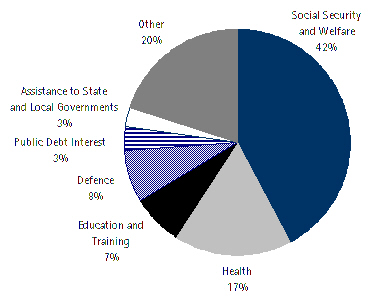
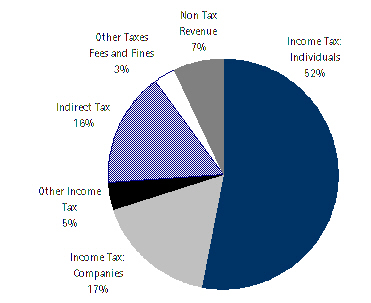
The allocation of expenses by function shows the Government's commitment to providing an equitable and effective social safety net, with spending on social security, health and education representing two-thirds of all outlays. Changes to revenue reflect the impact of tax initiatives introduced by the Government.
|
Commonwealth General Government Expenses
|
spending on social security, health and education represents around two-thirds of total expenses
spending on Defence is increasing to improve the capabilities of our Defence force
net annual Public Debt Interest payments are only three per cent, reflecting a low level of Government net debt |
|
Commonwealth General Government Revenue
|
a lower company tax rate will improve the competitiveness of Australian business
the abolition of fuel indexation lowers the indirect tax burden
GST revenue is not included here as it flows to the States |
This Budget continues to repay net debt, confirming the Government's commitment to sustainable government finances.
as debt is repaid, interest savings can be directed to other priorities |
This Budget continues to repay net debt. By the end of 2001-02, the Government will have repaid almost $60 billion of net debt since 1996-97 allowing interest saving of around $4 billion per year to be directed to other priorities such as tax cuts, support for the aged, welfare reform and health. |
Commonwealth General Government Net Debt
and Net Interest Outlays to GDP
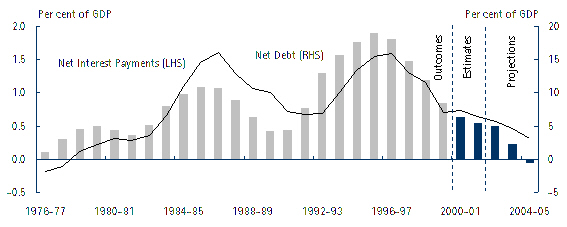
Australia's Government net debt is a fraction of the OECD average |
By international standards, Australia is in a very strong financial position. The average level of net debt in the OECD is over four times as high as the level in Australia. |
International Comparison
Total General Government Net Debt
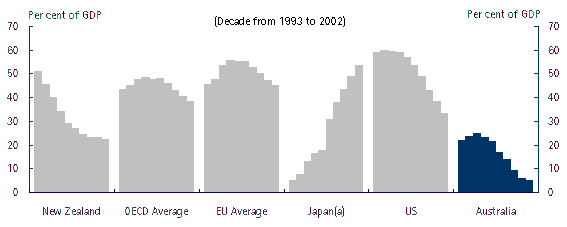
(a) The above net debt data for Japan include assets held by the social security system. Japan's net debt, excluding these assets, was estimated by the IMF to be almost 100 per cent of GDP by March 2001.
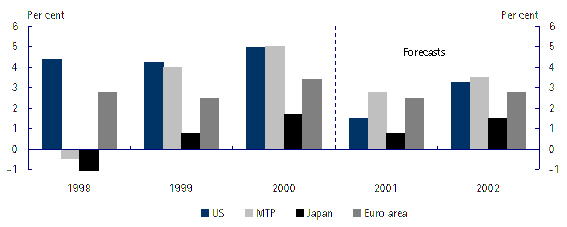
World economic growth was strong in 2000 but weakened considerably towards the end of the year. Growth is expected to moderate further in the first half of 2001 before recovering somewhat towards the end of the year and into 2002.
World growth is expected to be 3¼ per cent in 2001 and 4 per cent in 2002, down from an historically high 4.8 per cent in 2000. |
world growth weakened in late 2000 but is expected to strengthen towards the end of 2001 |
|
The expected decline in world growth in 2001 largely reflects a significant easing of growth in the United States, a weaker outlook for Japan, and an easing of growth in Europe. |
|
The slowdown in the United States is expected to lead to slower growth in other countries, including Australia's major trading partners in Asia. |
|
It seems likely that the slowdown will be short lived, with macroeconomic policy settings supporting a recovery. Growth across most regions is expected to rise in 2002. |
the most likely outcome is still for stronger growth in 2002 |
However, there is considerable uncertainty surrounding the outlook. If business conditions and confidence weaken further in the United States and/or Japan, world growth is likely to be slower than expected. |
considerable uncertainty surrounds the outlook |
Growth in Major Regions
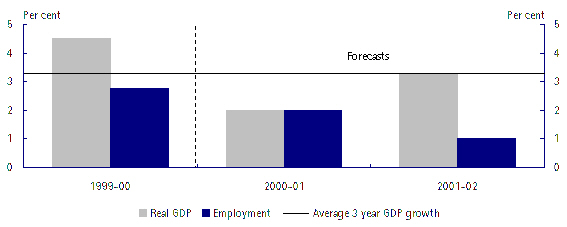
Economic growth in Australia is set to rebound over the coming year, with lower interest rates and the more generous First Home Owners Scheme (FHOS) producing strong growth in residential construction, feeding into employment growth and household consumer spending.
Growth in Gdp and Employment
the economy has grown by around 4 per cent per annum over recent years |
Since the March quarter 1996, the Australian economy has grown by an average of around 4 per cent per annum. |
the timing and composition of growth has changed in 2000 |
Several one-off factors, including the transitional effects of The New Tax System on housing, adverse seasonal conditions and the Olympics changed the timing and composition of growth over recent quarters. |
solid growth is expected in 2001-02 |
These factors have now largely run their course. Growth is expected to average 3¼ per cent in 2001-02 and around 4 per cent through the year to the June quarter 2002. |
net exports are contributing to growth for the first time since the Asian crisis |
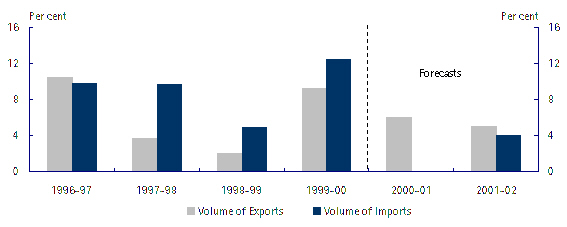
For the first time since the Asian crisis, net exports will contribute strongly to economic growth in Australia in 2000-01. Solid export growth is expected in 2001-02. |
lower interest rates and the beneficial impact of the more generous FHOS will flow through to employment growth |
Lower interest rates and the beneficial impact of the more generous FHOS should reinforce a rebound in activity in the labour-intensive construction sector, flowing through to stronger employment growth in the second half of 2001-02. |
inflation is forecast to decline |
Inflation is forecast to decline in 2001-02 to around 2 per cent. |
Solid export growth is expected in 2001-02, despite slower growth in the world economy. Australia's exporters are more competitive due to the lower exchange rate and the implementation of tax reform.
Growth in Exports and Imports(a)
(a) Growth in imports in 2000-01 is rounded to zero.
Export volumes are expected to grow by a solid 5 per cent in 2001-02. |
solid export growth is expected in 2001-02 |
Australia's exporters are benefiting from the lower exchange rate and recent tax reforms. This will help Australian exporters gain market share, supporting export growth in the face of slower world growth. That said, if world growth slows further than expected, export growth could be lower. |
|
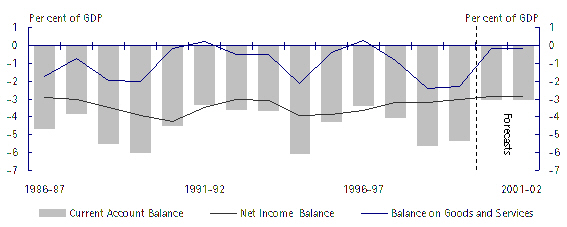
Australia's strong trade performance is contributing to a much lower current account deficit, expected to be around the lowest level in a decade as a share of GDP in 2001-02. |
Australia's strong trade performance means the |
Current Account Balance
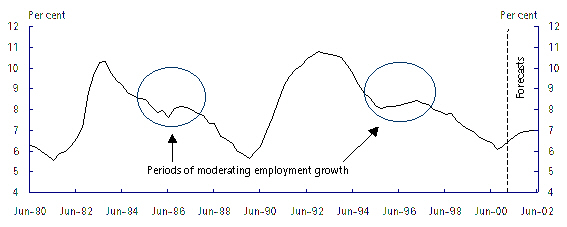
Australia's sustained period of rapid economic growth over recent years was accompanied by strong growth in productivity and employment and falling unemployment. The slower economic growth during 2000-01 has resulted in a slight upturn in the unemployment rate, which is expected to average around 7 per cent in 2001-02.
Australia's unemployment rate is expected to be broadly stable at around 7 per cent in 2001-02 |
The expected pick-up in economic growth should see the unemployment rate stabilise at an average of around 7 per cent in 2001-02. |
Since March 1996, the number of people employed has risen by around 824,400 or 9.9 per cent. | |
unemployment is well below levels inherited by the Government |
Over the same period, the unemployment rate fell from 8.2 per cent to a decade low of 6 per cent in September 2000, before rising to 6.8 per cent in April 2001. |
employment growth is set to improve in the second half of 2001-02 |
Employment is forecast to grow by around 2 per cent in 2000-01 and by about 1 per cent in 2001-02, showing stronger growth in the second half of the year. |
unemployment is expected to resume a gradual downward |
The current slight upturn in the unemployment rate is similar to that experienced during previous episodes of short-lived slow downs in economic growth (circled in the chart below). With the positive outlook for economic growth, unemployment is expected to resume a gradual downward trend over the medium term. |
Unemployment Rate
Inflation is expected to decline in 2001-02.
The Consumer Price Index is expected to increase by around 2 per cent in 2001-02. |
inflation is set to decline in 2001-02 |
Further measures in The New Tax System will help to reduce consumer prices, as will an expected gradual easing in world oil and domestic petrol prices. |
|
Inflation has been affected by one-off factors in 2000-01, including the one-off effect of the introduction of The New Tax System and higher world oil and domestic petrol prices. The Consumer Price Index is expected to increase by 5¾ per cent through the year to the June quarter 2001. |
inflation has been affected by one-off factors in 2000-01 |
Households have been compensated generously for the one-off price changes flowing from The New Tax System. Leaving these price changes aside, inflation is expected to be 3¼ per cent through the year to the June quarter 2001. |
|
The low inflation outlook has allowed interest rates to fall to around historically low levels. |
low inflation has allowed for low interest rates |
Inflation(a)
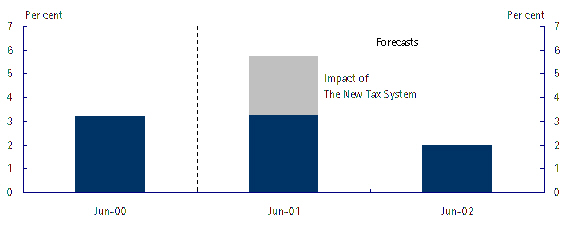
(a) Represents the increase in the CPI through the year to the June quarter of each year
Australia's prolonged economic expansion in the 1990s was driven by strong growth in productivity. Despite the recent slowdown in activity, Australia continues to enjoy the longer-run benefits of ongoing structural reform, a sound macroeconomic policy environment and the rapid adoption of new technologies. Australia has the potential to experience a second wave of strong productivity and economic growth in coming years.
ongoing structural reform and sound macroeconomic policies ensure that markets remain competitive |
The combination of ongoing structural reform and a sound and responsible macroeconomic policy environment has transformed Australia into one of the most open and competitive economies in the world. |
increased competition creates a strong incentive to apply new technology |
Increased competition has provided Australian firms with a strong incentive to improve their core business processes by applying new technologies. Indeed, there is a fundamental interplay between increased competition and the adoption of new technology. |
Australia has become a prolific user of new technology |
As a result of this rapid adoption of new technology, Australians are now amongst the most intensive and sophisticated users of new technology in the world. |
government policies are directly encouraging the efficient use and development of new technology |
The Government provides substantial funding to encourage the efficient use and development of new technology. The recently announced innovation package invests $3 billion over five years, making it the largest group of measures ever proposed by an Australian government to foster innovation. |
there is potential for a second wave of productivity growth in Australia |
Combined with our sound policy framework, the use of new technologies will encourage strong and sustained productivity growth in the future. |
productivity growth ensures long-term growth with more jobs |
Strong productivity growth will provide a strong base for sustainable long-term growth, increased employment and significant improvements in living standards and real incomes. |