
|
|
| Home | Search | Site Map | Help | |




This Chapter provides details of the provision of goods and services tax (GST) revenue to the States, and general revenue assistance payments to be made to the States in 2000-01 and 2001-02. It also discusses the composition of payments and the impact of horizontal fiscal equalisation.
The A New Tax System (Commonwealth-State Financial Arrangements) Act 1999 (the Act) provides that the States receive all GST revenue. Monthly payments of GST revenue to the States commenced in July 2000.
The distribution of GST revenue among the States is based on horizontal fiscal equalisation principles (discussed in detail later in this Chapter).
Tables 3 and 4 show the estimated provision of GST revenue to the States in 2000-01 and 2001-02 respectively. This revenue will be distributed, in accordance with the Act, using GST relativities recommended in the Commonwealth Grants Commission (CGC) Report on State Revenue Sharing Relativities 2001 Update, after accounting for a technical issue raised by Western Australia at the 30 March 2001 Ministerial Council meeting.
Table 3: Distribution of GST revenue, 2000-01 (estimated)
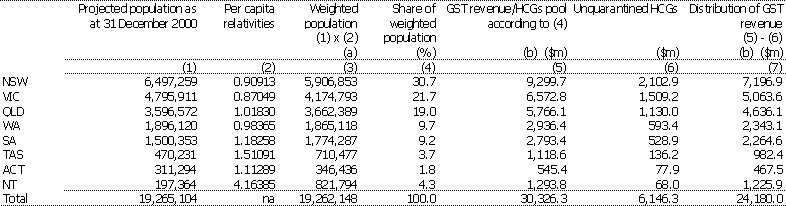
(a) Total weighted population differs from the total population in column 1 as the per capita relativities are calculated by the CGC using population numbers for the period 1994-95 to 1998-99 and are then rounded.
(b) Includes the GST growth dividend.
Table 4: Distribution of GST revenue, 2001-02 (estimated)
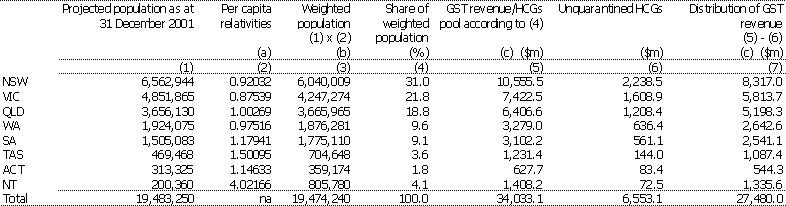
(a) The per capita relativities adopted to take account of a technical issue raised by Western Australia in respect of the data supplied for stamp duties paid on corporate reconstructions.
(b) Total weighted population differs from the total population in column 1 as the per capita relativities are calculated by the CGC using population numbers for the period 1995-96 to 1999-2000 and are then rounded.
(c) Includes the GST growth dividend.
In 2001-02, general revenue assistance will take the form of Budget Balancing Assistance (BBA), National Competition Policy Payments (NCPPs) and Special Revenue Assistance (SRA). As with GST revenue, general revenue assistance is `untied', that is, it is not required to be spent by the States in a specified area.
As outlined in Tables 1 and 2, the total level of general revenue assistance to the States in 2000-01 is estimated to be $3,432.2 million. In 2001-02 it is estimated to be $3,174.1 million.
Under the Act, the Commonwealth has guaranteed that in each of the transitional years following the introduction of tax reform, each State's budgetary position will be no worse off than had the reforms to Commonwealth-State financial relations not been implemented.
The amount of funding each State would have had available to it under the previous system of financial relations is known as the Guaranteed Minimum Amount (GMA) and is calculated for each transitional year, commencing in 2000-01.
To meet its guarantee, the Commonwealth pays the States transitional assistance (known as BBA) to cover any shortfall of GST revenue below the GMA.
Tables 5 and 6 show the latest estimates of the GMA, GST revenue and BBA for each State in 2000-01 and 2001-02 respectively. These estimates have been updated for policy, parameter and estimate changes since they were discussed at the 30 March 2001 Ministerial Council meeting.
On the basis of current estimates, the States will receive total BBA of $2,957.5 million in 2000-01 and $2,443.6 million in 2001-02. In both years, BBA will be paid as a grant. The final quantum of BBA paid in a year is determined by the Treasurer's GMA determination and the Commissioner of Taxation's GST revenue determination, as outlined in the Act.
In 2001-02, BBA will take into account the revenue forgone by the States from the abolition of Financial Institutions Duty and stamp duty on quoted marketable securities, of $1,195.9 million and $675.1 million respectively.
Table 5: Guaranteed Minimum Amount components, GST revenue provision and Budget Balancing Assistance, 2000-01 (estimated)
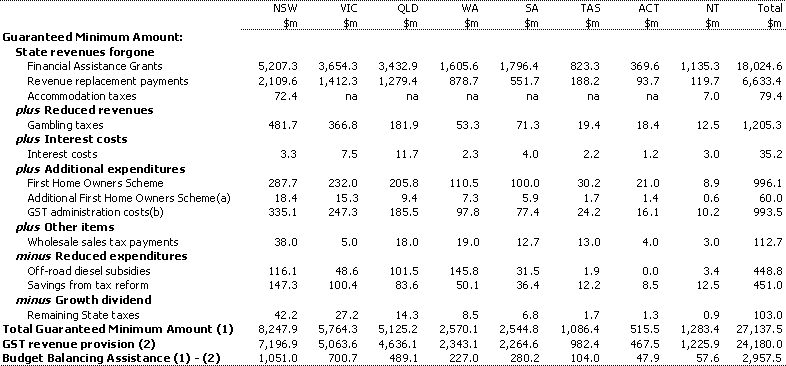
(a) Fully funded by the Commonwealth.
(b) Includes the GST administration costs for 1999-2000 totalling $377.4 million, and 2000-01 totalling $616.0 million.
Table 6: Guaranteed Minimum Amount components, GST revenue provision and Budget Balancing Assistance, 2001-02 (estimated)
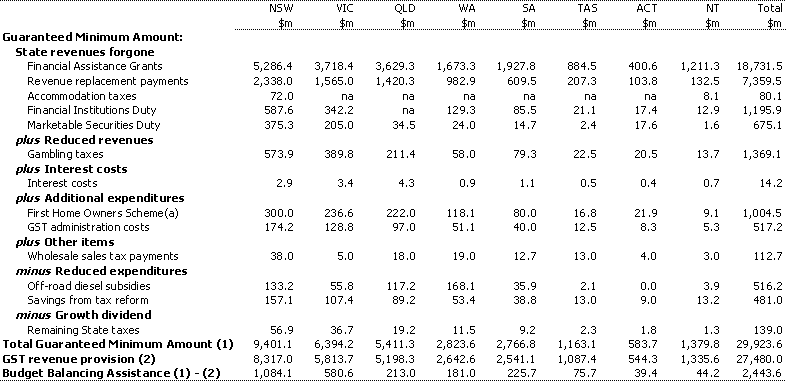
(a) This excludes the additional First Home Owners Scheme, which is to be fully funded by the Commonwealth via a Specific Purpose Payment in 2001-02.
At the April 1995 Council of Australian Governments meeting, the Commonwealth and the States concluded the Agreement to Implement the National Competition Policy and Related Reforms. Under that Agreement, the States are eligible for three tranches of ongoing NCPPs. The NCPPs commenced in July 1997 at an annual level of $200 million, and increased in July 1999 to $400 million in 1994-95 prices. The third tranche commences in July 2001 at an annual level of $600 million in 1994-95 prices. The Agreement specifies that the NCPPs be paid quarterly and be distributed to the States on an equal per capita basis.
Each State's NCPPs are subject to that State making satisfactory progress with the implementation of specified reform conditions in the Agreement. Prior to the scheduled payment of NCPPs in 2001-02, the National Competition Council will assess whether each State has met these conditions and provide a report for consideration by the Commonwealth.
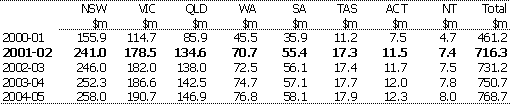
Subject to satisfactory progress in the areas to be reviewed by the National Competition Council, the Commonwealth will provide the States with NCPPs estimated to total $716.3 million in 2001-02.
Table 7 shows the allocation of NCPPs covering 2000-01 to 2004-05.
Table 7: National Competition Policy Payments, 2000-01 to 2004-05 (estimated)
In 2001-02, SRA comprises funding to the Australian Capital Territory for special fiscal needs. The level of these payments will reflect the recommendations of the CGC in its Report on State Revenue Sharing Relativities 2001 Update.
Special Revenue Assistance is provided to the Australian Capital Territory in recognition of the fact that certain functions (for example, the Family Court) are not directly funded by the Commonwealth, in contrast to the funding arrangements in other States. In 2001-02, SRA will amount to $14.2 million, an increase of $0.7 million. The increase reflects an expected increase in the consumer price index (CPI) adjusted to remove the impact of indirect tax reform, and increases in superannuation and debt charges related to the provision of police services in the Australian Capital Territory.
Special Revenue Assistance to the Australian Capital Territory also includes an amount for additional police service costs, which used to be paid as a separate transitional allowance. This amount is included as the Australian Capital Territory is not able to influence the terms and conditions of the Australian Federal Police.
Table 8 provides estimates of SRA to the Australian Capital Territory from 2000-01 to 2004-05.
Table 8: Special Revenue Assistance to the Australian Capital Territory, 2000-01 to 2004-05 (estimated)

The Commonwealth collects revenue on behalf of the States under `safety net' arrangements for petroleum, alcohol and tobacco products, and mirror taxes at Commonwealth places.
In accordance with the Intergovernmental Agreement, taxation of petroleum, alcohol and tobacco under the `safety net' arrangements ceased on 1 July 2000. However, due to collections being received which relate to taxable dealings that occurred before 1 July 2000, lagged payments continue to be made in 2000-01.
Table 9 shows estimated revenue replacement payments under `safety net' arrangements for 2000-01.
Table 9: Revenue replacement payments, 2000-01
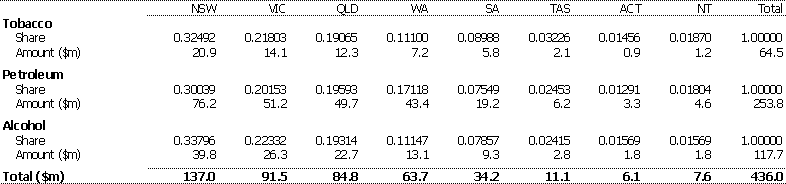
Table 10 summarises estimates of `safety net' surcharge collections and accrued mirror taxes on behalf of the States, from 2000-01 to 2004-05.
Table 10: `Safety net' surcharge collections and accrued mirror taxes on behalf of the States, 2000-01 to 2004-05

Following the High Court decision in Allders International Pty Ltd v Commissioner of State Revenue (Victoria), invalidating State taxes on Commonwealth places, the Commonwealth introduced taxes in 1998 to mirror State payroll taxes, Financial Institutions Duty, debits tax and stamp duties on activities on or in Commonwealth places. State land taxes were subsequently added to the list of mirror taxes. All mirror tax revenues are remitted to the States to ensure that they are not financially disadvantaged by the Allders decision.
The administrative arrangements for collecting, and ensuring compliance with, the mirror taxes are contained in bilateral arrangements between the Commonwealth Treasury and State Treasuries.
All GST revenue is provided to the States and distributed on the basis of horizontal fiscal equalisation (HFE) principles, in accordance with the provisions of the Act. General revenue assistance provided to the States by the Commonwealth is also partly distributed on the basis of HFE principles.
The objective of HFE is to improve equity for all Australians. The principle of HFE is that all State governments can provide services at the same standard if they make the same effort to raise revenue from their own sources and operate at the same level of efficiency.
The HFE principles are embodied in the per capita relativities recommended by the CGC. The CGC is an independent statutory authority established by the Commonwealth Grants Commission Act 1973.
In its assessment of per capita relativities, the CGC takes account of differences in the per capita capacities of the States to raise revenues and differences in the per capita amounts required to be spent by the States in providing an average standard of government services.
A State's actual per capita expenditure or revenue generally differs from the average of all States when:
Horizontal fiscal equalisation requires that only those factors beyond a State's control be taken into account in determining a State's relative needs.
The Commonwealth consults with the States concerning the CGC's terms of reference, with a view to reinforcing the CGC's position as an independent arbiter in relation to HFE. Terms of reference for the CGC define the general approach to be followed, as well as any specific conditions or limitations on the extent to which HFE is to apply.
The CGC undertakes both annual updates and five-yearly methodology reviews. Annual updates essentially revise the data upon which the CGC's assessments are based. Methodology reviews are aimed at improving the CGC's methods of assessment and involve substantial consultation with the States and the Commonwealth. The CGC completed its most recent methodology review in February 1999, and the results of the next methodology review are due to be released in early 2004 (see Box 1).
Box 1: Commonwealth Grants Commission's 2004 Methodology Review
|
In its Report on State Revenue Sharing Relativities 2001 Update, the CGC analysed State financial data for the period 1995-96 to 1999-2000 to form the basis of its recommendations on two sets of relativities:
The Ministerial Council meeting on 30 March 2001 resolved to adopt the recommended relativities for 2001-02 after adjustment for minor technical issues.
The GST relativities and FAGs relativities for 2000-01 and 2001-02 are illustrated in Table 11.
Table 11: GST relativities and Financial Assistance Grants relativities, 2000-01 and 2001-02
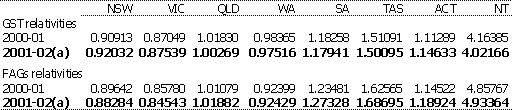
(a) These amended relativities take account of a technical issue raised by Western Australia in respect of the data supplied for stamp duties paid on corporate reconstructions.
The GST relativities are all closer to 1 than the FAGs relativities. This reflects the fact that fiscal equalisation requires a fixed dollar amount of funding (around $2.1 billion) to be redistributed. Since the GST pool (approximately $27.5 billion in 2001-02) is greater than the FAGs pool (approximately $18.7 billion in 2001-02) a smaller proportion of GST funding is redistributed among the jurisdictions.
One way of viewing the effect of HFE is to compare the GMA for each State with the amount that would be received on the basis of an equal per capita distribution. While HFE only applies to the FAGs forgone component of GMA, FAGs forgone is the largest component of the GMA. In 2001-02, around $2,148 million (or 7.2 per cent) of the total GMA is to be distributed among the States as a result of the application of the CGC's relativities to the pool of FAGs forgone, compared with an equal per capita distribution. The comparison is shown in Table 12.
Table 12: Effect of horizontal fiscal equalisation, 2001-02
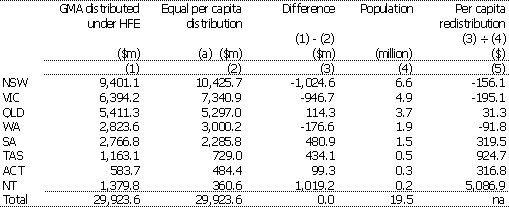
(a) The FAGs forgone component of the GMA has been distributed on an equal per capita basis in these calculations.
Some jurisdictions receive relatively less funding under HFE because their fiscal capacity is relatively strong - these `donor' States are New South Wales, Victoria and Western Australia. The other jurisdictions (the `recipient` States) receive relatively more funding because their fiscal capacity is not as strong.
Another way of viewing the effect of HFE is to consider the distribution of funding that might occur were Australia to have a unitary system of government, rather than the current federal system. It is, of course, not possible to quantify this approach. Nevertheless, it would seem likely that under a unitary system of government, the government would seek to provide a minimum level of services to all areas. This is a similar outcome to that which HFE seeks to achieve in the current federal system.