
|
|
| Home | Search | Site Map | Help | |




This Chapter provides a broad overview of the nature and purpose of Specific Purpose Payments (SPPs). It also discusses general purpose assistance to local government in 2000-01 and 2001-02.
Specific Purpose Payments are payments for policy purposes that relate to particular functional activities (for example, health and education). Specific Purpose Payments are made under section 96 of the Constitution, which states that the Commonwealth Parliament may grant financial assistance to any State on such terms as it sees fit.
Specific Purpose Payments can be classified into three groups:
Indexation arrangements and the distribution of SPPs among the States vary for each SPP. In most cases, SPPs are subject to conditions reflecting Commonwealth policy objectives or national policy objectives agreed to between the Commonwealth and the States. It is because of the conditions attached to SPPs that they are sometimes referred to as `tied grants'. Such conditions may include:
Specific Purpose Payments also include some payments that are not subject to conditions. These typically relate to revenue sharing arrangements or compensation (either for the transfer of responsibilities or for other Commonwealth action). For example, compensation payments are made to the States for revenue forgone as a result of the national system of companies and securities regulation.
Specific Purpose Payments `to' and `through' are estimated to total around $20,222.2 million in 2001-02. This is an increase of $981.4 million or 5.1 per cent on 2000-01 (after removing the $112.7 million and $97.0 million cost of the Natural Disaster Relief Programme in 2000-01 and 2001-02 respectively). Specific Purpose Payments `to' the States are expected to increase by around $601.3 million in 2001-02 or 4.2 per cent on 2000-01 after abstracting from SPPs associated with natural disaster relief.
Chart 3 shows the trend in the level of SPPs from 1981-82 to 2001-02. It contains adjustments for a number of classification changes and one-off factors, so as to allow comparisons on a more consistent basis.
Chart 3: Specific Purpose Payments to the States, 1981-82 to 2001-02(a)
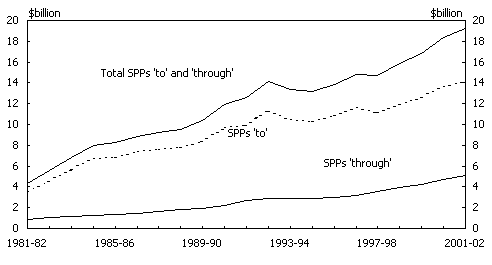
(a) Chart 3 incorporates the reclassification of funding under higher education from SPPs through the States to grants to the multi-jurisdictional sector. It also contains adjustments for reclassifications such as: payments under the Vocational Education and Training Funding Act 1992; the transfer in 1989-90 of nominated housing advances into Commonwealth-State Housing Agreements grants; and significant changes in the structure of hospital funding.
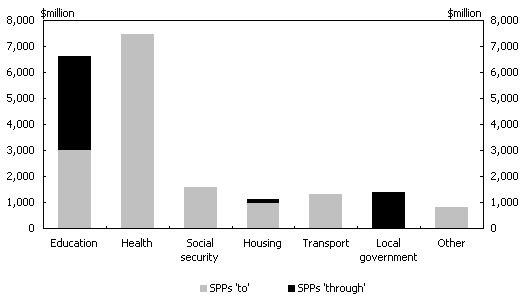
Chart 4 illustrates the composition of major SPPs (`to' and `through' the States) in 2001-02.
Chart 4: Composition of estimated Specific Purpose Payments `to' and `through' the States, 2001-02
More detailed information on SPPs, including estimated State splits for 2000-01 and 2001-02 and data on repayments of advances, advances and interest payments, is contained in Appendix B.
General purpose assistance to local government has been provided by the Commonwealth since 1974-75. Under current arrangements, the Commonwealth provides general purpose assistance to local government in the form of local government financial assistance grants and local government untied road funding. This assistance is paid to the States as an SPP on the condition that the funds are passed on to local government. Both forms of funding can be spent by local government on any purpose.
General purpose assistance is provided to local government authorities under the Local Government (Financial Assistance) Act 1995 (the Act). Under the Act, the Treasurer is responsible for determining the annual increase in Commonwealth general purpose assistance paid to local government. The Act previously provided for general purpose assistance to be increased each year by an escalation factor that reflected the underlying movement in general revenue assistance provided to the States. The escalation factor reflected the percentage increase in the States' Financial Assistance Grants (FAGs) pool in the current year, which in turn reflected indexation for population growth and the consumer price index (CPI). As a result of the cessation of FAGs from 1 July 2000, the Act was amended with effect from that date to remove the link to FAGs and to provide for the Treasurer to determine the escalation factor with reference to population growth and the CPI.
The Commonwealth will provide total payments of $1,322.5 million in local government general purpose assistance in 2000-01. These payments have been based on the estimated escalation factor of 1.0389 and take into account an underpayment of $1.7 million in 1999-2000. In June 2001, the Treasurer will determine the final 2000-01 escalation factor on the basis of the Australian Statistician's determination of population, and ongoing CPI (which excludes the estimated impact of the indirect tax reform measures in The New Tax System). This is consistent with the decision in the 2000-01 Budget that the ongoing CPI estimate will be used for indexation purposes for most Commonwealth expenses, including SPPs. The current estimate for the 2000-01 escalation factor is 1.0463.
General purpose assistance to local government is estimated to be $1,383.5 million in 2001-02 (after allowing for an estimated payment of $9.4 million to adjust for the difference between the escalation factor used to calculate payments in 2000-01 and the factor to be determined by 30 June 2001). In 2001-02, general purpose assistance to local government will again utilise an escalation factor based on estimates of population growth and CPI increases, excluding the estimated impact of the indirect tax reform measures in The New Tax System. The final escalation factor for 2001-02 will be determined by the Treasurer in June 2002.
As in the past, the interstate distribution of local government financial assistance grants for 2001-02 will be on an equal per capita basis, using the State populations at 31 December in the previous financial year. Untied local government road funding is distributed between the States on the basis of historical shares. State Grants Commissions determine the intrastate distribution of these payments to local governments. The financial assistance grants are distributed, as far as practicable, on a horizontal fiscal equalisation basis, while the identified road grants are distributed on relative road needs.
Table 13 sets out the payments of general purpose assistance to local government in 2000-01 and 2001-02.
Table 13: General purpose assistance to local government, 2000-01 and 2001-02 (estimated)
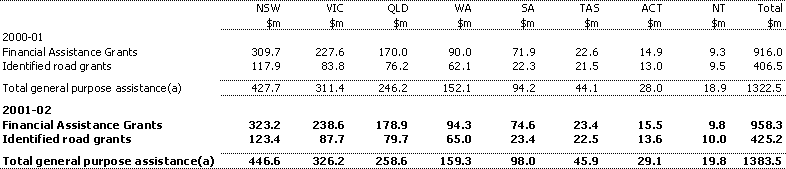
(a) Total general purpose assistance is the actual cash payment that the State receives on behalf of local government. It is equal to the estimated entitlement for a given year adjusted for an over or under payment from the previous year.