



Economic outlook
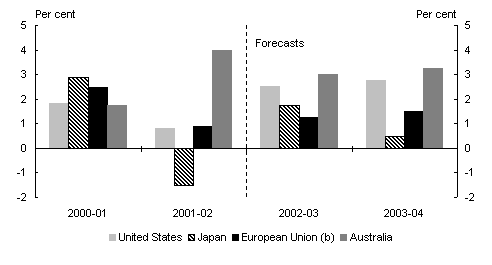
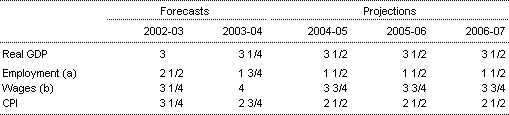
The Australian economy has remained very resilient over the past year despite a weak world economy and the most extensive drought in Australian meteorological records. In 2002-03, economic growth is forecast to be 3 per cent in year-average terms. Despite the drought, the Australian economy has been one of the top performers among the world's advanced economies over the past year. In 2003-04, growth is forecast to be 3¼ per cent in year-average terms, a little below trend. Australia is forecast to have stronger economic growth than the United States, Japan and the European Union in both 2002-03 and 2003-04 (Chart 2).
Chart 2: Economic growth in Australia and developed economies(a)
- Source: National statistical publications, International Monetary Fund and Treasury.
- Austria, Belgium, Denmark, Finland, France, Germany, Greece, Ireland, Italy, Luxembourg, the Netherlands, Portugal, Spain, Sweden and the United Kingdom, using weights based on purchasing power parity.
Economic growth in 2003-04 is expected to continue to be underpinned by solid, albeit moderating, domestic demand. Growth in consumption and investment is likely to slow a little from current above-trend rates and dwelling investment is expected to contract. Nevertheless, still solid growth in domestic demand and a gradual recovery in external demand should underpin growth in the non-farm economy. A rebound in farm production will boost economic growth provided that the drought breaks.
In 2003-04 employment growth is likely to be solid, with the unemployment rate remaining around 6 per cent. Inflation is forecast to be around 2¾ per cent in year-average terms in 2003-04 and around 2¼ per cent through the year to the June quarter 2004, within the target band.
The current account deficit should narrow a little as domestic demand eases and export growth picks up as global economic conditions gradually improve and the drought breaks.
Table 2: Major economic parameters (percentage change from previous year)
- Labour force survey basis.
- Average earnings (national accounts basis).
Source: Australian Bureau of Statistics (ABS) Cat. No. 5206.0, 6202.0, 6401.0 and Treasury.
Despite the solid domestic outlook, international developments will influence the performance of the Australian economy over the next year. Following a significant period of below-average growth, the world economy remains weak with considerable uncertainty around the outlook. With a large policy stimulus in place in many of the major economies, conditions could improve quickly once some of the uncertainty dissipates, but many of these economies also face severe structural problems which may impede recovery. Until these issues are resolved, the weak and uncertain global environment clouds an otherwise positive outlook for the Australian economy.
On balance, it is likely that with solid fundamentals and supportive policy settings, Australia will continue to grow solidly against this weak international backdrop. This would be further assisted, if a gradual world recovery proceeds as expected. Sustained economic reforms have increased the resilience of the Australian economy and improved its capacity to withstand adverse external shocks. Nevertheless, the possibility of further global deterioration provides a substantial risk to Australia's near-term growth prospects.