



Fiscal strategy
The Government's medium-term fiscal strategy is an integral part of a credible macroeconomic framework that creates an environment in which the economy can deliver sustainable economic growth, rising employment and higher living standards.
A medium-term approach to fiscal policy
The primary objective of the Government's medium-term fiscal strategy is to maintain budget balance, on average, over the course of the economic cycle.
The supplementary objectives of the fiscal strategy are:
- maintaining budget surpluses over the forward estimates period while economic growth prospects remain sound;
- no increase in the overall tax burden from 1996-97 levels; and
- improving the Commonwealth's net worth position over the medium to longer term.1
The primary fiscal objective of budget balance over the cycle ensures that the Government is not living beyond its means. It helps deliver macroeconomic stability, encourages private investment in a low interest rate environment, entrenches low public debt and ensures that, over time, the current account reflects private saving and investment decisions. The supplementary objective of no increase in the overall tax burden means the Government achieves balance over the cycle through a disciplined and prioritised approach to spending and not by recourse to increased taxation. Consequently, an important element in achieving the strategy is containing spending growth by eliminating waste and placing programme spending on a sustainable basis.
A credible and sustainable framework
The broader budgetary framework of discipline, transparency and accountability underpins the Government's fiscal strategy, as embodied by the Charter of Budget Honesty Act 1998 principles of sound fiscal management (Box 1).
Australia's longer-term fiscal sustainability was examined in the Intergenerational Report released as part of last year's Budget. The Intergenerational Report raised awareness of the potential long-term fiscal pressures facing the Commonwealth. The Government assists in maintaining fiscal sustainability by delivering low levels of general government debt and through increased saving contributing to improving net worth over time. Improving net worth from a significantly negative position increases fairness between generations. These improvements have been made possible by adherence to the balance over the cycle objective.
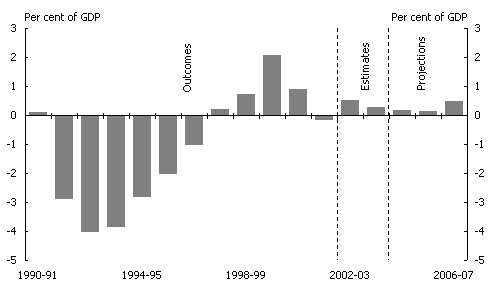
Over the past six years to 2002-03 the Commonwealth's cumulative underlying cash surpluses have amounted to around $27 billion (Chart 3).
Chart 3: Underlying cash balance
National savings
The medium-term fiscal strategy aims to enhance Australia's longer-term growth prospects by raising public saving, thereby ensuring the public sector is not hampering private investment. By achieving budget balance over the medium term, the fiscal strategy ensures that the Government is saving enough to cover its own investment needs and is neither diverting private savings nor adding to the current account deficit, on average, over the cycle.
Low public debt
Continuing the Government's fiscal strategy ensures that the current low levels of Commonwealth general government net debt will be maintained through time and will fall as a share of GDP.
- The Government will have successfully reduced Commonwealth general government net debt by around $63 billion, from 19 per cent of GDP in 1995-96 to around 4 per cent of GDP in 2002-03. This fall is due to a combination of the accumulated cash surpluses as well as proceeds from the sale of financial assets.
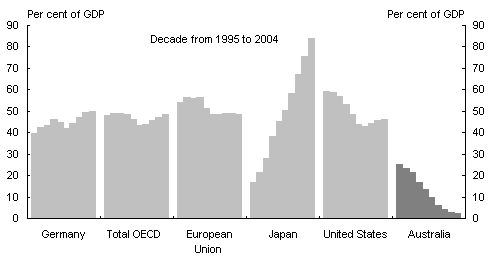
- Australia now has one of the lowest levels of general government net debt in the OECD. Unlike countries such as the United States, Japan and Germany, which are running up debt, Australia's net debt is falling (see Chart 4). This places Australia in a relatively better position to many countries in terms of its ability to respond to economic shocks.
Chart 4: General government net debt levels in selected countries(a)
- Source: OECD Economic Outlook 72 December 2002, ABS Cat. No. 5513.0 and 5512.0, and Commonwealth Government Final Budget Outcomes. From 2001-02 onwards, data is derived from jurisdictions' 2002-03 budgets and mid-year reports and Treasury estimates.
Fiscal stance
The 2003-04 Budget is being framed against a backdrop of an international outlook where a global recovery has not yet taken hold and risks remain heavily skewed towards the downside. Domestically, a slowing in non-farm production is expected to be offset by a rebound in farm production. In this challenging environment the Government is delivering responsible tax cuts and new spending in high priority areas while still forecasting an underlying cash surplus in 2003-04 and surpluses across all years of the forward estimates.
1 The supplementary objective of improving the Government's balance sheet was introduced in the 1999-2000 Budget and was framed in terms of the accounting standard `net assets'. The conceptually same measure in the GFS framework is `net worth'. As the flow indicators underpinning the fiscal strategy are based in the GFS framework, it has been decided to frame this supplementary objective in the terms of `net worth' rather than the `net assets' term.