



Budget priorities
This Budget delivers responsible tax cuts, while still providing substantial funding for new spending in the key areas of defence and domestic security, education and health.
REDUCING PERSONAL INCOME TAX
From 1 July 2003 the Government will reduce personal income tax. These tax cuts are additional to the significant reductions in income tax introduced as part of The New Tax System on 1 July 2000. The changes strike a balance between the Government's goals of maintaining a sound budget position, meeting the higher costs of defence, education, health and other priority programmes and the desire to provide lower taxes for individual taxpayers.
Changes to the personal income tax thresholds are to be made as follows:
- the 30 per cent threshold is to be increased from $20,000 to $21,600;
- the 42 per cent threshold is to be increased from $50,000 to $52,000; and
- the 47 per cent threshold is to be increased from $60,000 to $62,500.
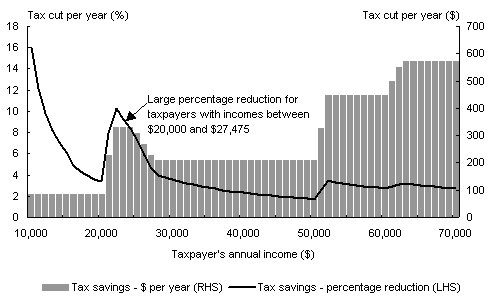
Low income earners will benefit from an increase in the low income tax offset of $85 to $235 per year. Those eligible for the full offset will not pay income tax until their annual income exceeds $7,382, up from $6,882 at present.
The income threshold at which the low income tax offset begins to reduce will also be increased from $20,700 to $21,600, making the whole or part offset available to taxpayers with annual incomes up to $27,475.
The changes to the low income tax offset and the increases in the personal income tax thresholds enable Australian taxpayers to keep a higher proportion of the earnings they receive after tax, providing improved incentives to pursue work, advancement and higher skills. Chart 5 shows the annual tax savings for taxpayers.
At present, senior Australians eligible for the Senior Australians Tax Offset and the low income tax offset pay no tax up to an annual income of $20,000 for singles and $32,612 for couples (depending upon the income earned by each member of the couple). The effect of an $85 increase in the low income tax offset is to lift these income levels to $20,500 for singles and up to $33,612 for couples. The Medicare levy thresholds that apply to senior Australians will also increase to ensure that senior Australians do not pay the Medicare levy until they begin to incur an income tax liability.
Chart 5: Tax saving - dollars per year and percentage reduction in income tax liability
STRONG DEFENCE
Australia's security is a key priority of this Government. In this Budget, the Government will again increase spending for defence by an additional $2.1 billion over five years from 2002-03. The Government has now committed over $38 billion in new funding to defence since coming to office in 1996.
To enhance the effectiveness of critical Defence capabilities, the Budget provides an additional $1.1 billion over five years from 2002-03 to augment logistics and support funding for a range of platforms and equipment, including F/A-18 fighter aircraft, C-130J Hercules transport aircraft, the Collins class submarines, as well as a range of transport vehicles. This funding is required in light of the Australian Defence Force's (ADF's) higher operational tempo in the new strategic environment and will enable the ADF to operate at current high levels on a sustainable basis.
To enhance the ADF's capacity to deal with unconventional threats, including those posed by terrorism, the Government will provide additional funding of $157 million over four years to establish a Special Operations Command. The Command will deliver an additional 334 combat and associated support personnel to coordinate the activities of Australia's Special Forces.
Current personnel numbers in the ADF are above planned levels. This reflects the fact that the Army and Air Force are presently experiencing better recruitment and retention outcomes, with separation rates at a 10 year low. The Government will provide funding of $103 million over three years for 786 additional personnel in 2003-04, 564 in 2004-05 and 250 in 2005-06, to take advantage of the opportunity to accelerate the achievement of the White Paper targets for higher ADF personnel numbers. The White Paper proposed an ADF personnel target of 54,000 by 2010.
The Government has provided $645 million to fund Australia's military engagement as part of the international coalition to disarm Iraq. Over 2,000 ADF personnel were engaged in action in the Middle East including those attached to a Special Forces Task Group, three Frigates, a squadron of F/A-18 Hornets and a range of transport and surveillance aircraft.
Part of the $645 million will also fund the ADF's involvement in post-conflict rehabilitation and reconstruction activities in Iraq. This involvement includes the deployment of personnel to the Office of Reconstruction and Humanitarian Assistance and the support of air operations at Baghdad International Airport. The Government has also committed a further $100 million to meet the urgent humanitarian needs of the Iraqi people.
ENHANCING AUSTRALIAN SECURITY
In response to the tragic events of 11 September 2001 and the Bali bombings, the Government provided $1.4 billion over five years from 2001-02 to upgrade security within Australia. Initiatives included enhancements to Australia's aviation security arrangements, as well as additional funding for our defence, intelligence and law enforcement agencies to assist them in identifying and responding to security threats.
The 2003-04 Budget builds on these strong foundations by implementing the A Safer Australia package which provides an additional $411 million over five years from 2002-03 to further enhance Australia's existing domestic security arrangements.
Specifically, $148 million will be provided to the Transport and Regional Services, Education, Science and Training, and Attorney-General's portfolios to further enhance critical security infrastructure at our airports, ports, and nuclear research facilities. Major initiatives include the adoption of a new international code of practice for maritime security, more funding for container x-ray facilities at Australian ports and enhanced aviation security measures at Christmas Island and Cocos (Keeling) Islands airports.
The Government has committed $152 million to enhance the capacity of Australia's intelligence agencies to respond to security threats. A National Security Hotline has been established to allow citizens to report suspicious activity and our border processing systems will be enhanced to better identify persons of concern, thereby reducing the risk of their unlawful entry to Australia.
A further $111 million will be used to upgrade our protective security services. Guarding arrangements for VIPs and embassies will be enhanced and funding will be provided for enhanced security for Defence personnel and facilities.
INVESTING IN EDUCATION
Continual improvements in the living standards of Australians requires increasing productivity and labour force participation, particularly in the context of an ageing population. Improvements in the education and skills of the workforce have an important role in achieving this objective. The 2003-04 Budget provides a substantial further investment in this area.
Our universities - backing Australia's future
The Government will introduce wide ranging reforms to ensure the higher education system provides greater access to a high quality of education for all Australians. It will ensure the long-term sustainability of the higher education system and foster greater diversity amongst institutions, while enabling individual institutions to specialise in their areas of strength and providing more flexibility in setting course fees. A substantial commitment will be made to achieve this vision, involving around $1.5 billion over the first four years. By 2009-10, an extra $870 million a year will be provided for higher education.
The Government will invest a further $775 million in Commonwealth Grants Scheme initiatives in higher education from 2005. This will include additional funding per student place of 2½ per cent in 2005, 5 per cent in 2006 and 7½ per cent in 2007. From 2004, the Government will also provide $123 million over the forward estimates period toward the costs of education in regional campuses. This will enable universities to improve the quality of the education they provide and will be accompanied by improvements in governance and workplace relations.
To make access to higher education more equitable and ensure the system has sufficient flexibility to serve the different needs of different students, the Government will introduce a new Higher Education Loans Programme (HELP) in 2005. A subsidised loans scheme will be developed for fee paying students (FEE-HELP) and a similar scheme will be available for students who wish to study overseas (OS-HELP). Universities will be able to set their own fees for Commonwealth-supported places within a band from fee free courses to a maximum of 30 per cent above the current Higher Education Contribution Scheme (HECS) rates, except for teaching and nursing where the maximum fee will not increase. The threshold for HECS repayments will be raised from $24,365 per annum to $30,000 per annum by 2005-06. An additional $800 million in student loans is expected to be made by 2007-08; a substantial investment in higher education.
The Government will also fund a package of scholarships and other equity initiatives from 2004 to enhance access and participation by Indigenous Australians and financially disadvantaged students. This will amount to a $184 million investment over the next four years.
To respond to current and emerging national priorities, such as educating Indigenous Australians and overcoming particular skill shortages, the Government will supplement its broad policy framework with a range of National Priority Initiatives. The Government will make a further contribution towards the costs of delivering education in the teaching and nursing disciplines and will create additional Commonwealth-supported places in these fields starting in 2004. This will amount to a $161 million investment over the next four years, providing 1,300 places by 2008.
Dedicated funding will be provided to develop a higher education system that has a diverse range of quality institutions. The main initiatives are to enhance the quality of teaching by creating a Learning and Teaching Performance Fund and establishing a National Institute for Learning and Teaching from 2004, with around $188 million in funding over the forward estimates period.
Growing Australia's international education industry
The education and training system is one of Australia's leading export industries and is an important link with the international community. To this end, the Government will ensure the quality, diversity and sustainability of Australia's international education industry through a set of initiatives costing $113 million over the next four years.
The Government will provide $42 million over the next four years for the additional promotion, and international development, of Australian education and training. Several international centres of excellence will be established to enhance the international recognition of Australian expertise in education and research in specific disciplines. This will involve seed funding of $36 million over the next four years.
To contribute towards the cost of growing Australia's international education industry, the Government will increase the International Education Contribution within the Student Visa Application Charge from 1 July 2003, providing $70 million in revenue over the next four years for the initiatives. The Government will also restructure the Education Services for Overseas Students Fee from 1 January 2004 to provide an additional $20 million in revenue over the next four years for international education activities. This will contribute to strengthening the quality assurance of Australian providers operating domestically and in overseas locations.
Raising standards in vocational training and schools
The Government will provide $3.6 billion from 2004 to 2006 under a new Australian National Training Authority Agreement with the States and Territories. This funding will build on the Government's achievements in developing a responsive, flexible and high quality training system.
To improve literacy and numeracy standards in school education, the Government will continue to fund national research projects and provide strategic assistance for programmes that deliver better learning outcomes for disadvantaged students, involving a further $210 million over the next four years.
SUSTAINING FIRST RATE HEALTH SERVICES
The Government is strongly committed to maintaining Australia's first rate health system. The Government's approach builds on its commitments to Medicare, where all Australians can access Medicare rebates; free treatment in public hospitals; and subsidies for prescription medicines through the Pharmaceutical Benefits Scheme.
To this end, the Government will spend more than $30 billion on health in 2003-04, representing around one-fifth of total Government spending. Including spending in 2003-04, this Government has increased health spending by around 65 per cent since coming to office. The Government has invested substantially in enhancing the operation of Medicare, strengthening public hospitals and ensuring that Australians are provided with greater choices in meeting their health care requirements.
As a result of the Government's commitment to ensuring that Australians have choice in health care, initiatives such as the 30 per cent private health insurance rebate and introduction of Lifetime Health Cover have seen private health insurance coverage jump from 30 per cent in January 1999 to 44 per cent in December 2002. Now more than 8.7 million Australians have private health insurance. Such initiatives also play an important role in assisting the Government to maintain its commitment to Medicare and public hospitals.
Recently announced improvements to Medicare will make the system fairer, benefiting all Australians. The reforms will provide for more doctors where they are needed most and improve access to Medicare for those on low incomes and people whose illness requires them to seek frequent medical care. The Government is also spending a record $42 billion to strengthen public hospitals under the Australian Health Care Agreements (see below).
The 2003-04 Budget builds on this already substantive funding base. Additional measures at a cost of $21 million over four years will be introduced to promote healthy living by integrating disease prevention and health promotion into clinical health care.
The Budget also provides for continued funding for 20 highly successful existing Government health initiatives at a cost of $561 million over the next four years, including:
- providing payments to long-serving general practitioners (GPs) in rural and remote areas to encourage them to continue to practice in these areas;
- funding health care centres in small rural and remote communities to provide a range of health care services focused on primary care and to address inequities in health access and outcomes in these areas; and
- funding the Enhanced Primary Care package announced in the 1999-2000 Budget which targets older Australians and those with chronic conditions. The package is designed to better coordinate health services and to improve people's self-reliance in managing their own conditions.
A Fairer Medicare - better access, more affordable
A package of $917 million over five years was jointly announced by the Prime Minister and the Minister for Health and Ageing on 28 April 2003. The package provides:
- $346 million for incentives for GPs who participate in the new GP Access Scheme to bulk bill concession cardholders;
- 150 additional GP trainees and 234 additional medical school students, at a cost of $232 million, targeted to areas where there is a shortage of medical services;
- $64 million for more practice nurses and allied health workers to work in outer-metropolitan areas where there is a shortage of GPs;
- a new Medicare safety net for patients with concession cards and a new private health insurance product covering Medicare out-of-hospital services at a cost of $157 million; and
- $62 million to improve access for veterans through higher payments to Local Medical Officers in recognition of the complex treatments that veterans require.
Australian Health Care Agreements
The Government is committed to ensuring Australians can continue to access a high quality and affordable public hospital system. The Government will provide a total of up to $42 billion from 2003-04 to 2007-08 for public hospitals under new Australian Health Care Agreements with the States and Territories. This represents a significant funding increase of more than $10.2 billion over five years, or 17 per cent real growth, compared with the current agreements.
Included in this funding will be $253 million over five years for a new Pathways Home initiative to improve services for people returning home from hospital, especially the elderly, and $783 million over five years to raise the quality of care in public hospitals. The funding provided under these agreements will be subject to certain terms and conditions, including a commitment from States and Territories to at least match the rate of growth in the Commonwealth's contribution.
The Pharmaceutical Benefits Scheme
The Intergenerational Report, published in the 2002-03 Budget, shows that spending on the Pharmaceutical Benefits Scheme (PBS) is the fastest growing component of Commonwealth health expenditure.
However, the financial sustainability of the PBS remains a concern as the Senate has twice blocked legislation implementing the 2002-03 Budget measure Sustaining the Pharmaceutical Benefits Scheme - realigning patient co-payments and safety net. These measures are designed to ensure Australians can continue to have access to an increasing number of new and expensive pharmaceuticals.
TOUGH ON DRUGS
The Government will provide funding of $316 million over four years for a range of new and continuing measures to address illicit drug use in Australia. This package will boost the Government's funding commitment to the National Illicit Drugs Strategy - Tough on Drugs to more than $1 billion since its inception in 1996-97.
Successes in detecting and intercepting the transport of illicit drugs into Australia, such as the recent apprehension of the freighter MV Pong Su, will be bolstered by additional funding for the Prevention of Illicit Drug Manufacturing Strategy. This strategy will inhibit the production of illicit drugs on our shores through targeting the source materials required in their manufacture. As part of this initiative, the National Institute of Forensic Science will coordinate the development of a national forensic database to assist research and analysis into illicit drug manufacturing activities.
The Government is renewing its commitment to a number of highly successful initiatives, including the Illicit Drug Diversion Initiative, the distribution of needles and syringes through pharmacies and drug education, counselling and referral services.
The Government will provide $216 million over four years for a second phase of the Council of Australian Governments' Illicit Drugs Diversion Initiative, as announced by the Prime Minister on 31 December 2002. This initiative, which was first introduced in 1999, seeks the early diversion of drug offenders away from the criminal justice system to education, treatment and assessment services. It is one of the most successful elements of the rehabilitation process, which complements the enhanced law enforcement powers and the increased focus on education of the Tough on Drugs strategy.
The Government is also providing continued funding of $16 million over four years for the distribution of injecting equipment to illicit drug users, through an increased number of pharmacies and other outlets, and $22 million over four years for education, counselling and referral services through community-based Needle and Syringe Programmes. These Needle and Syringe Programmes have proven to be effective in reducing the transmission of blood-borne viruses such as HIV and Hepatitis C.
The Government will provide $4.3 million over four years to enhance the Drug Use Monitoring in Australia (DUMA) research programme conducted by the Australian Institute of Criminology. DUMA's unique data collection system, which is the only reliable and valid source of data in Australia on illicit drug use and criminal behaviour, will be extended to include four new data collection sites and the trial of two rural/regional collection locations. DUMA's data is an invaluable source of intelligence for police and policy makers at federal and state levels on trends in drug use and drug related crime.
To continue the fight against those who supply illicit drugs in our community, the Government will commit $3.4 million to the Australian Transaction Reports and Analysis Centre (AUSTRAC) to provide financial intelligence to identify and reduce illicit drug trafficking and related activities. AUSTRAC's advanced financial intelligence capabilities will be harnessed to identify patterns of financial transactions indicative of drug trafficking and a precursor to chemical importation. This information, along with other intelligence collected by AUSTRAC, will enhance the Australian Federal Police, the Australian Customs Service and the Australian Crime Commission's efforts to reduce the importation, distribution and use of illicit drugs on Australia's streets.
PROMOTING PARTICIPATION TO ADDRESS DISADVANTAGE
The Government recognises that labour force and social participation by all Australians are central to both prosperity and social cohesion. Increasing labour force participation will have a significant positive impact on GDP and living standards, as well as easing the fiscal pressures associated with an ageing population. Social participation promotes connection to the community through people both contributing to society and receiving the support they need.
To encourage greater labour force participation by all Australians, the Government introduced the Australians Working Together package in the 2001-02 Budget. This package provides improved personalised assessment and services for job-seekers, more opportunities for training and work experience, better incentives, and reasonable requirements for people to find work and increase their earnings.
Employment assistance for people with disabilities
In this Budget, the Government is providing additional total funding of $186 million over four years to improve employment outcomes and conditions for people with disabilities and to assist the labour force participation of members of their families.
The Commonwealth has committed an extra $135 million over four years to improve services to people with disabilities who are seeking work. From 1 July 2004, funding for disability employment service providers will be changed from block grants to case based funding, so that service providers will be paid according to the needs of their clients, the services provided and outcomes achieved. This will improve employment outcomes for around 6,000 new job seekers over four years. Additionally, there will be greater incentives for service delivery in rural and remote areas, apprenticeship and traineeship placements and work based personal assistance.
An additional $25 million will be provided to assist business services which provide employment assistance for people with disabilities, to improve their viability while meeting higher standards for employee working conditions and productivity-based wages, as required by quality assurance legislation by December 2004. Currently, business services provide employment to 17,000 people with moderate to severe disabilities. Assistance to these services will include advice, training and support in business and change management, marketing and production processes.
An additional $26 million over four years will also help child care services employ additional carers to support children with special needs, assisting around 1,250 families a year. More parents of young children with special needs, including disability, will be assisted so that they can undertake work or study in the knowledge that their children are in a quality child care service.
These measures complement the measure, Recognising and improving the work capacity of people with a disability, announced in the 2002-03 Budget, which involves changes to eligibility rules for the Disability Support Pension to further increase the incentives for people with disabilities to seek employment and an expansion of assistance for job search and preparation. While the Senate has previously blocked the Disability Support Pension legislation, the Government remains committed to targeting funding to people with disabilities who have the highest support needs.
Employment assistance for Indigenous Australians
The Government will provide $62 million over four years to expand the Community Development and Employment Projects (CDEP) programme by 1,000 places per year. These additional places will be allocated to support projects that seek to prevent and address family violence and substance misuse in Indigenous communities. CDEP is the Aboriginal and Torres Strait Islander Commission's largest programme. CDEP participants voluntarily forgo their social security payments to participate in activities that benefit themselves and their community.
This Budget also provides for improved Indigenous employment. The Government will reallocate $11 million over four years to a new scheme, Indigenous Capital Assistance, to improve Indigenous employment outcomes by providing interest subsidies and related assistance to help Indigenous people set up small businesses.
Access and participation in higher education by Indigenous Australians will be enhanced with an additional $12 million over four years in scholarships and equity support. This comes on top of the $25 million already provided each year and is part of the Government's wider package of scholarships and equity initiatives to help disadvantaged students under its higher education reforms.
DEVELOPING INDUSTRY AND INNOVATION
The Government is strongly committed to developing Australian industry and innovation, as this is crucial to generating job opportunities for Australians. Fostering science and innovation is one of the Government's strategic priorities.
The Government will provide $20 million in additional funding in 2003-04 to support the Commonwealth Scientific and Industrial Research Organisation's (CSIRO's) Flagship programme. The Flagships involve partnerships between CSIRO, leading research institutions, universities and industry to conduct research on issues of national importance.
To encourage oil exploration in Australia the Government will provide $36 million in ongoing base funding for Geoscience Australia over four years from 2003-04 so it can identify promising opportunities for oil discovery. The Government also will provide $25 million to Geoscience Australia over four years from 2003-04 for the collection and preservation of seismic data, which will facilitate oil exploration investment in frontier areas.
To encourage additional research and development (R&D) in Australia by the pharmaceutical industry, the Government will provide $150 million over the five years from 2004-05. By providing an incentive for additional high quality R&D in Australia, the Government will help position Australia as an internationally competitive centre for the pharmaceutical industry.
The Government has announced a post-2005 assistance package for the automotive industry, which provides $4.2 billion over 10 years to the industry through the Automotive Competitiveness and Investment Scheme (ACIS). This will assist industry to adjust to the reduction in tariffs on passenger motor vehicles from 15 per cent to 10 per cent on 1 January 2005 and to 5 per cent on 1 January 2010. The package promotes production, investment, and R&D in new and innovative technologies and will foster an increasingly competitive and sustainable automotive industry in Australia.
In this Budget, the Government has committed an extra $379 million in 2006-07 to R&D Start, the Australian Research Council and Cooperative Research Centres programmes. This funding will facilitate forward planning for these programmes by providing funding certainty in advance of decisions on post Backing Australia's Ability directions in 2004. The Government will, in the second half of 2003, commence consideration of future policy to apply beyond the Backing Australia's Ability initiative. This will be informed by the mapping of Australia's science and innovation system and the implementation of national research priorities. Through Backing Australia's Ability, the Government is making a substantial investment of $3 billion to assist Australia's innovation system. This recognises that innovation is crucial to underpinning a strong industry base in Australia, creating employment and maintaining higher living standards.
SUPPORT FOR RURAL AND REGIONAL AUSTRALIA
Strengthening rural and regional communities throughout Australia is one of the Government's strategic priorities. The Government's policies aim to foster strong, sustainable, cohesive and prosperous rural and regional communities.
Drought assistance
To support farmers, small businesses and communities whose futures are at risk because of the most extensive drought in Australian meteorological records, the Government expects to provide around $740 million of financial support over the three years to 2004-05. This includes more than $480 million in Exceptional Circumstances support and more than $170 million for additional drought relief measures. In addition, to reduce the cash flow problems resulting from the drought, farmers in Exceptional Circumstances declared areas can gain early access to their Farm Management Deposits. This assistance is designed to ensure that farmers who run otherwise productive and sustainable farms are not forced off their land because of the impact of the drought.
The Government is also providing free personal counselling and employment services to those in drought affected areas.
Providing natural disaster relief and mitigation
The Government will provide additional disaster mitigation funding of $69 million over five years to establish a new Disaster Mitigation Australia Package. This will support cost-effective mitigation policies and reduce the economic and social costs of natural disasters - such as bushfires and floods - to individuals, communities and governments, especially in rural and regional Australia. Commonwealth funding is conditional on matching funding from the States and Territories and the introduction of more effective statutory land use planning, development and building controls by other governments.
Under the Natural Disaster Relief Arrangements, the Commonwealth provides funding assistance to States and Territories aimed at alleviating the financial burden associated with the provision of natural disaster relief payments and infrastructure restoration. While disaster relief is primarily the responsibility of States and Territories, the Natural Disaster Relief Arrangements ensure they are partly reimbursed for disaster relief once their expenditure exceeds a certain threshold. The Commonwealth expects to provide funding of around $100 million in 2003-04 to help communities recover from natural disasters, including the recent bushfires.
In addition, the Government provided more than $8 million in 2002-03 to help the States and Territories fight bushfires. To assist the States and Territories fight bushfires in 2003-04, the Government will provide a further $6 million. The Government will also provide over $7 million to the Australian National University to help rebuild the Mount Stromlo Observatory which was destroyed in the January 2003 Canberra bushfires.
Regional Partnerships
From 1 July 2003, the Government will incorporate a range of its regional programmes into a new integrated programme - Regional Partnerships - with additional funding of $62 million over three years from 2004-05 to 2006-07. The new programme will support initiatives in rural, regional and remote Australia in four key areas: strengthening growth and opportunities; improving access to services; supporting planning; and assisting structural adjustment for communities.
ENERGY REFORM FOR THE FUTURE
Current fuel excise arrangements have evolved over many years with consequent complexities and distortions. This has led to uncertainty about the long-term treatment of some fuels. Further, some fuels, in particular LPG, have benefited greatly from their preferential tax treatment. These arrangements no longer provide a sound basis for investments, particularly in alternative fuels where the increasing cost of exemptions cannot be justified on environmental grounds.
The Government will reform the fuel excise system to promote long-term sustainability and move to a neutral tax treatment between competing fuels. Reforms will also support the production of cleaner fuels and provide a more certain framework for investment in the fuels sector. This is consistent with the Government's strategic policy goal of an efficient and competitive energy sector.
The current effective excise free status of untaxed fuels (such as LPG, CNG, LNG, ethanol and biodiesel) will continue until 30 June 2008. However, all fuels used in internal combustion engines will become liable for excise from 1 July 2008.
The existing excise treatment of ethanol will continue along with existing subsidy arrangements. A broadly similar treatment will apply to biodiesel from 18 September 2003. This treatment will also remove an anomaly, as an effective excise rate of zero will apply to biodiesel when blended with diesel.
Effective excise rates for untaxed fuels and ethanol will increase in a series of five even annual steps commencing 1 July 2008. The Government will consult with industry and other stakeholders on the details of implementation. Final excise rates will have regard to the energy content of fuels.
These steps provide an extended transition path for industry and consumers, as stakeholders will continue to enjoy significant concessions for a further nine years. This will provide an opportunity for these fuels to establish their commercial credentials.
To encourage the early take-up of ultra low sulphur diesel, the Government will increase excise on regular diesel (more than 50ppm sulphur) by one cent per litre on 1 July 2003 and a further one cent per litre from 1 January 2004. The Government will increase grants provided to agriculture claimants under the off-road component of the Energy Grants (Credits) Scheme (EGCS) to compensate.
In accord with the Government's commitment under the Measures for a Better Environment package, the environmental component of the EGCS will comprise:
- payment of grants for producing or importing diesel with 10ppm or less sulphur content for two years from 1 January 2007, funded by an increase in excise/customs duty on all diesel sufficient to fund the proposal;
- payment of grants for producing or importing premium unleaded petrol with less than 50ppm sulphur content for two years from 1 January 2006, funded by an increase in excise/customs duty on all petrol sufficient to fund the proposal;
- new fuel quality standards for biodiesel and CNG; and
- inclusion of LNG and biodiesel as alternative fuels in the on-road component of the EGCS.
Improvements in the environmental performance of petrol and diesel have reduced the gap between these and alternative fuels. As petrol and diesel will continue to hold the most significant market share, further significant improvements in prospect will facilitate the adoption of new engine technologies leading to further reductions in vehicle emissions.
REFORMING INTERNATIONAL TAXATION
The Government is announcing in this Budget the outcome of its review of Australia's international taxation arrangements, following consultations conducted by the Board of Taxation.
The package of reforms will improve the competitiveness of Australian companies with offshore operations, by reducing the costs of complying with the controlled foreign company (CFC) rules, reducing tax on foreign `active' business income, and effectively reducing foreign taxes by modernising Australia's tax treaties.
The reforms will encourage the establishment in Australia of regional headquarters for foreign groups, and improve Australia's attractiveness as a continuing base for our multinational companies. The reforms will also enhance the competitiveness and reduce the compliance costs of Australian based managed funds.
The main components of the Government's package include:
- simplifying the application of the CFC rules for Australian companies operating in countries where tax arrangements are comparable to those in Australia and easing these rules for certain services provided in international markets;
- exempting Australian companies (and their CFCs) from capital gains tax on the sale of non-portfolio interests in foreign companies and extending the existing tax exemption for foreign non-portfolio dividends (and certain branch profits);
- better targeting the foreign investment fund (FIF) rules to reduce compliance costs for Australian managed funds and superannuation entities investing offshore; and
- moving towards a more residence-based treaty policy, consistent with the direction set in the United States Protocol. This is expected to enable early finalisation of a revised tax treaty with the United Kingdom.
Most of these reforms will not commence until 1 July 2004 or later to enable adequate public consultation on designing the legislation. The Government will give priority to implementing key reforms to the CFC and FIF rules to achieve early commencement where possible.