



The outlook for the international economy
Global economic growth is expected to continue to be subdued in a highly uncertain environment, with risks being predominantly on the downside. Despite tentative signs in early 2002 that recovery had commenced, growth slowed markedly later in the year and the outlook has been pared back. This occurred as many of the previously identified risks materialised, such as heightened geopolitical tensions and associated higher oil prices, and continued volatility in equity markets. These developments have slowed global growth and exacerbated other ongoing risks and vulnerabilities, such as weak economies, equity markets and financial systems. In addition, new risks have emerged, with the spread of SARS and tensions on the Korean Peninsula. The combination of these factors has created a weak and uncertain international economic environment.
Overall, the world economy grew by 3 per cent in 2002 in year-average terms. Against a backdrop of continued structural weakness and heightened uncertainties, world GDP growth is expected to remain around 3 per cent in 2003, increasing to around 3½ per cent in 2004.
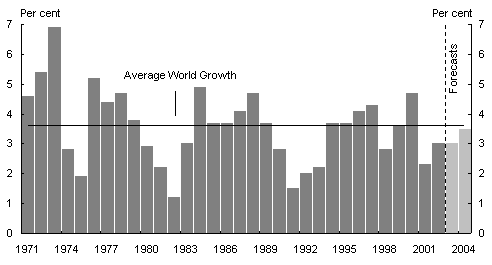
- World GDP growth rates are calculated using GDP weights based on purchasing power parity.
Source: National statistical publications, International Monetary Fund (IMF) and Treasury.
Many of the risks identified in the last Budget and at MYEFO have come to pass, including high oil prices and continued volatility in equity markets. Oil prices rose to very high levels in late 2002 and the first quarter of 2003 due to concerns about the war in Iraq, oil supply disruptions in Venezuela and Nigeria, low private sector oil stocks, strong demand for oil and low investment in the oil industry. While the price of oil fell as the uncertainty surrounding Iraq abated, it remains at relatively high levels. Notwithstanding recent falls, the full impact of the high price of oil over recent months has not yet been seen. Oil prices continue to present a downside risk to global economic growth prospects.
While the unfolding of events in Iraq resulted in a rally in equity markets, markets remain very volatile and have been in a long decline. Ongoing equity market weakness and volatility could impact on consumer and business expenditure via wealth and confidence effects.
These realised risks have been overlayed on some other major pre-existing risks.
- Global growth continues to rely excessively on developments in the United States (US), as domestic demand in Japan and the Euro area remains hampered by corporate and financial weakness and the slow pace of product and labour market reforms.
- The high US current account deficit and offsetting current account surpluses elsewhere risk a possible disorderly unwinding, which would result in a sharp adjustment to exchange rates and a disruption to growth.
- Concerns exist over the stability of the global financial system due to the vulnerability of the financial sectors in both Japan and the Euro area, and the significant vulnerabilities remaining in a number of emerging markets.
- Other risks include concerns surrounding the sustainability of house price growth in some developed countries, and deflationary pressures in a number of East Asian economies, both of which could impact on business and consumer activity.
Add to these tensions in the Korean Peninsula and the outbreak of SARS, and the picture is one of weak global prospects.
Set against the combined impact of all of these international risks are the very supportive fiscal and monetary policy settings in many economies. For example, in the US, official interest rates are at around 40-year lows, and the fiscal situation has moved from a surplus to a deficit, with a turn around of about 5 per cent of GDP over the last two years. As uncertainties abate, these very supportive macroeconomic policy settings should see the global economy continue to recover in the second half of 2003, before gathering more momentum in 2004. However, in the medium term, ongoing structural problems will continue to hamper sustained and balanced global growth unless decisive policy actions are taken.
Global inflation is expected to remain low in 2003, allowing macroeconomic policies to remain accommodative, although the effects of the run up in oil prices may temporarily raise inflationary pressures. Most advanced economies are experiencing low inflation, while deflation persists in Japan and some other East Asian economies.
Table 2: International GDP growth forecasts(a)(b)
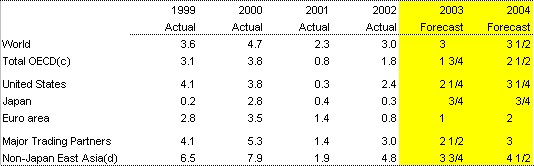
- Percentage change on previous year.
- Growth rates for World and the Euro area are calculated using GDP weights based on purchasing power parity, while growth rates for Major Trading Partners and Non-Japan East Asia are calculated using export trade weights.
- Total OECD comprises the United States, Japan, Germany, France, Italy, the United Kingdom, Canada, Australia, Austria, Belgium, the Czech Republic, Denmark, Finland, Greece, Hungary, Iceland, Ireland, Korea, Luxembourg, Mexico, the Netherlands, New Zealand, Norway, Poland, Portugal, Slovak Republic, Spain, Sweden, Switzerland and Turkey.
- Non-Japan East Asia comprises Korea, Singapore, Taiwan, Hong Kong, China, Indonesia, Malaysia, Thailand and the Philippines.
Source: National statistical publications, IMF and Treasury.
After the US economy emerged from the 2001 recession with some promising strength in early 2002, the economy hit a soft patch in the second half of the year, with falling equity prices and a very sharp fall in consumer confidence. This fed through to weak industrial production and retail sales, and consequently lower GDP growth. Overall, the US economy grew by 2.4 per cent in 2002.
The near-term outlook for the US economy is for continued recovery, albeit at a slower pace than earlier expected. However, there are increasing concerns over budgetary difficulties facing the US and the sustainability of its current account deficit, which increased to a record 5.2 per cent of GDP at the end of 2002. With the US economy performing poorly and world demand weak, and with the fiscal position deteriorating, it may become increasingly difficult to attract the capital inflows needed to fund the current account deficit. In this case, the burden of any unwinding of the current account deficit in the US would fall on the private sector, requiring higher saving and reduced expenditures.
Based on early estimates, the US economy grew by a sluggish 0.4 per cent (1.6 per cent annualised) in the March quarter of 2003. Consumption, residential fixed investment, and government expenditure contributed to growth, more than offsetting declines in inventories, investment in non-residential structures and equipment and software, and exports. Higher investment spending in the US is unlikely to occur until at least the second half of 2003, provided that uncertainties abate and sentiment improves. Should this occur, the very stimulatory policies already in place, together with strong productivity growth, advanced adjustment and a low inflation environment, should support investment and overall economic growth in the US. GDP growth in the US is expected to pick up moderately in 2004.
Japan's economy surprised on the upside in 2002 although trade and production data present a much weaker picture. Growth was entirely export driven, and this is expected to be the case in 2003, as domestic demand remains subdued. The recovery in household consumption in Japan evident during 2002 now appears to be fading, consistent with declining real incomes and employment. Investment has been showing some signs of bottoming, but is far from staging a full recovery as deflation continues. Overall, domestic demand in Japan remains seriously hampered by structural weaknesses and economic growth is expected to remain weak over the forecast period.
Specific risks to the Japanese outlook include the vulnerability of the financial sector, which is struggling with a large share of non-performing loans, very weak share prices and inadequate capital-asset ratios. Investors in Japan are also very sensitive to heightened instability in the Korean Peninsula.
GDP growth in Non-Japan East Asia was robust in 2002, driven by continued strong growth in China and a robust pick-up in Korea, although growth remained well below that achieved prior to the Asian financial crisis. Exports and consumption spending, stimulated by expansionary macroeconomic policies, supported growth, while investment remained restrained by risks surrounding the global economic outlook.
Looking forward, exports and domestic demand in Non-Japan East Asia are both expected to contribute to growth, but overall growth is expected to weaken across the region. Exports could falter in light of weaker global growth prospects and SARS is weakening domestic demand. While governments will seek to support economic activity, this is likely to be limited as interest rates in the region are already low and most governments (except Korea) are already running budget deficits.
The unexpected outbreak of SARS is disrupting life in many East Asian countries. Governments across East Asia and the international community more generally, have responded to limit the outbreak. The impact on the countries affected has been heavy, with both loss of life and major disruptions to economic activity. In particular, retail travel and other service industries have been hard hit. The impact on the travel industry already suffering from the fallout of the Bali bombings and the threat of further terrorist attacks could be particularly significant. Unless the spread of SARS is contained quickly, the overall economic consequences for the region could be substantial.
In addition to the general global risks, the outlook for the Asian region remains particularly vulnerable to stalling prospects in the information and communication technology sector and tensions in the Korean Peninsula.
The Euro area recorded weak GDP growth of less than 1 per cent in 2002 as the recovery that was expected in the second half of the year failed to materialise. Growth prospects in the near term remain weak. The area's weakness remains centred on Germany, which accounts for nearly a third of the output of the single currency zone. The German economy was stagnant in the December quarter 2002 and recent surveys suggest further weakening in early 2003. The prospects for Germany remain bleak, with industrial production, business confidence, and retail sales continuing to be weak, and the jobless rate at a three-year high.
Overall, domestic demand in the Euro area is likely to remain subdued. Additional fiscal stimulus in Germany and France is already at the limit prescribed by the Stability and Growth Pact, while rising unemployment and heightened uncertainties are likely to restrain consumption and investment over the short term. In addition, the recent appreciation of the euro has dampened exports, which have been the primary source of growth across the Euro area.
Investment in the Euro area is being hampered by financial sector weakness, with the faltering economy putting additional stress on the vulnerable financial system. In particular, severe weakness of the German banking and insurance sectors has already seen financial sector share prices plummet and threaten the stability of the Euro area's financial system. Moreover, structural rigidities in product and labour markets are hampering any sustainable recovery in consumption and investment.
In light of continued weakness and receding inflationary pressures in the Euro area, monetary policy has become more stimulatory. In addition, France and Germany have also called for a more relaxed interpretation of the Stability and Growth Pact to allow large deficit spending.
GDP in the United Kingdom (UK) grew by 1.8 per cent in 2002, somewhat better than in the Euro area. While growth prospects in the UK remain slightly better than in the Euro area, confidence in the UK declined in the March quarter of 2003 and the economy grew by a weak 0.2 per cent. Consumption spending, which has been supported by rising house prices, is expected to moderate, with household debt rising to record levels and weak equity markets reducing wealth.
The balance of risks to the global economic outlook remains predominantly on the downside. However, this needs to be set against monetary and fiscal policies that have been eased substantially around the globe. A quick resolution or abatement of some of the major uncertainties currently facing the world economy could easily see the recovery gather momentum more quickly than is currently expected. However, any cyclical pick up in growth is likely to be constrained in the medium term unless policy actions are taken to address ongoing structural problems.