



The outlook for the domestic economy
Key assumptions
The forecasts for the domestic economy are underpinned by several technical assumptions. The exchange rate is assumed to remain around the average level of recent months (a trade weighted index (TWI) of around 55 and a $US exchange rate of a little above 60c). Interest rates are assumed to remain around current levels. World oil prices ($US per barrel - West Texas Intermediate) are assumed to remain in the $US25-30 range over the next few months and then fall to around $US25 per barrel by June 2004, broadly in line with market expectations. The farm sector forecasts are based on an assumption of a return to average seasonal conditions in 2003-04.
Demand and output
In 2003-04, the Australian economy is forecast to grow by 3¼ per cent in year-average terms. Slower growth in non-farm production is expected to be more than offset by a rebound in farm production. Employment growth is likely to slow, after very strong growth in 2002-03, with the unemployment rate remaining around 6 per cent over the coming year. Inflation is forecast to decline to around the middle of the target band. The current account deficit as a percentage of GDP should narrow to around 5¼ per cent as the pace of growth of domestic demand slows and global conditions gradually improve.
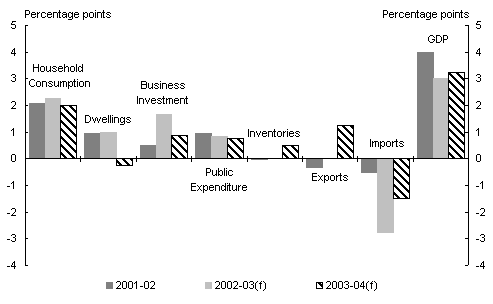
The solid outlook comes after another year in which the extraordinary resilience of the Australian economy has been demonstrated. This resilience - a consequence of sustained economic reforms - helped deliver solid growth despite a weak global economy and a very severe drought. GDP growth is forecast to be 3 per cent in 2002-03, unchanged from the forecast presented in MYEFO. The drought is forecast to directly subtract nearly 1 percentage point from GDP growth in 2002-03, with non-farm GDP growth forecast to be 4 per cent.
The solid GDP growth outcome expected for 2002-03 reflects very strong domestic demand. Gross national expenditure is forecast to grow by 5¾ per cent in 2002-03 in year-average terms, with net exports expected to subtract 2¾ percentage points from GDP growth. Growth in final domestic demand is forecast to slow to around 3 per cent in 2003-04, with slower growth in consumption and business investment and a fall in housing investment. A recovery in farm inventories will add to growth, while the net export subtraction is forecast to be around ¼ of a percentage point, with stronger exports and slower import growth supporting the turnaround (Chart 2).
Chart 2: Contributions to GDP growth(a)
- Adjusted for second-hand asset sales.
Source: ABS Cat. No. 5206.0 and Treasury.
Household consumption
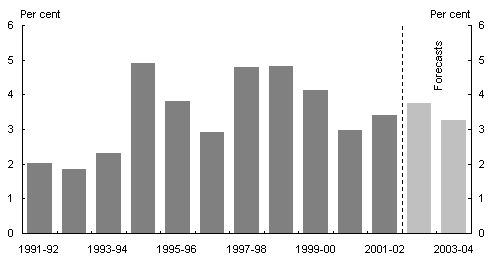
Household consumption growth is forecast to slow a little in 2003-04 to 3¼ per cent, following solid growth of 3¾ per cent in 2002-03 (Chart 3). This expected moderation reflects slower growth in employment and in wealth accumulation, and slower growth in household borrowing.
Chart 3: Growth in household consumption
Source: ABS Cat. No. 5206.0 and Treasury.
Consumer spending has grown solidly during 2002-03, underpinned by sustained income growth, rapid accumulation of wealth and low interest rates. Some slowing has been apparent through the year but this has likely been due to the combined effects of a number of temporary factors: the run-up in oil and petrol prices; drought-related food price increases; and lower farm incomes.
Household consumption growth in 2003-04 should continue to be supported by low interest rates and solid, albeit moderating, growth in household income. Some of the short-term factors that were a drag on consumption in 2002-03 may also start to abate. Oil prices have already fallen from pre-war highs and there are tentative signs that the drought may break in coming months. Offsetting this, however, the anticipated downturn in dwelling investment should reduce consumption growth in 2003-04, as some of the bring-forward of spending on housing-related durables in the last two years is unwound.
More importantly, some of the powerful underlying forces driving consumption growth may start to ease over the next year. After very strong growth in 2002-03, employment growth is forecast to slow through 2003-04, moderating the pace of household income growth, one of the main drivers of consumption spending.
The growth in wealth is also expected to slow. Over the past few years, household wealth has increased strongly, underpinning spending and household borrowing capacity. The increase in wealth, and new financial instruments that allowed improved access to unrealised wealth accumulation, supported and facilitated a substantial increase in household debt, as did historically low interest rates. These developments underpinned consumer spending, with consumption running ahead of disposable income for several years, and the household saving rate falling to current lows.
Going forward, a slower pace of wealth accumulation is likely to provide a moderating influence on consumer spending. House prices are unlikely to sustain the rapid pace of increase experienced over the past few years, and with equity prices subdued, the rate of increase in wealth is likely to slow. Against this backdrop, and with debt servicing costs around 6 per cent of disposable income, some consolidation of household balance sheets is in prospect over the next few years (Box 1).
Taken together, these influences should see the pace of consumption growth slow in 2003-04, to a little below that of household disposable income. There is a risk, however, that consumption could slow more than expected, particularly if overall economic conditions weaken. With households more heavily geared than in the past, they are likely to be more sensitive to changes in economic circumstances. For example, a deterioration in labour market conditions could increase debt-servicing burdens for some households with attendant effects on consumption. Adverse shifts in asset markets, such as a sharp correction in the housing market, could also see consumption weaken.
|
Box 1: Consumption and wealth |
|
|
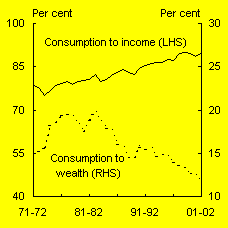
Household consumption has been a key driver of economic activity in recent years, growing at an annual rate of around 4 per cent over the past five years, well above its historical growth rate. One of the important drivers of consumption has been strong gains in household wealth. Real wealth has increased by around 45 per cent over the past five years. The sharp pick-up in wealth has funded higher spending and facilitated additional borrowing by households. Consumer spending has run ahead of income, although the increase in spending has not kept pace with the increase in wealth (Chart A). Chart A: Consumption, income and wealth
Source: ABS Cat. No. 5206.0 and Treasury. Household debt levels have increased
concomitant with the rise in wealth, with much of the increase going
into |
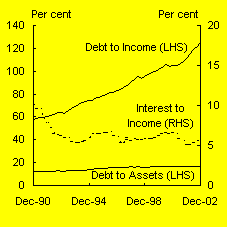
housing and, to a lesser extent, underpinning higher consumption spending. Total household debt has increased to 125 per cent of income, and 17 per cent of assets, and debt-servicing costs are around 6 per cent of income (Chart B). Households are vulnerable to adverse shifts in economic conditions - particularly changes in labour market conditions, interest rates and house prices. Chart B: Household debt
Source: ABS Cat. No. 5206.0, 5232.0 and Treasury. The above-trend pace of wealth accumulation is unlikely to be sustained. Accordingly, with economic growth slowing a little, households are likely to consolidate their balance sheets by bringing back spending growth to around or below the pace of income growth. It is possible, however, that households may rein in consumption more sharply than expected. |
Dwelling investment
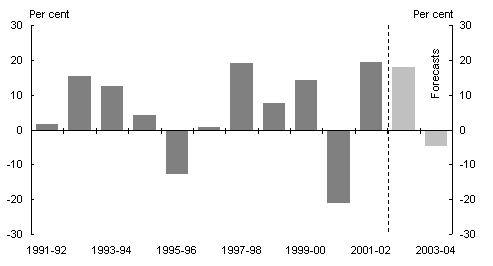
Dwelling investment is forecast to decline by around 5 per cent in 2003-04, following growth of around 18 per cent in 2002-03 (Chart 4). The expected fall in dwelling investment comes after a period of very strong growth in the construction of new dwellings and a solid pick-up in spending on alterations and additions. The prospect of a longer-than-expected period of low interest rates, strongly rising house prices and subdued returns from alternative investments have extended the current cycle for longer than anticipated.
Chart 4: Growth in dwelling investment
Source: ABS Cat. No. 5206.0 and Treasury.
Much of the strength in dwelling investment has come from the investor segment of the market, which has increased rapidly in recent years. Moreover, despite the prospect of substantial oversupply in some segments of the market - particularly the multi-unit sector - there are few signs yet of a substantial easing (Box 2). Rental vacancy rates are at relatively high levels and rents have weakened a little in the major markets. However, with interest rates low and continuing increases in dwelling prices, investment demand has remained firm. Some planned major inner-city projects have been cancelled but, to date, much of the planned work still appears to be proceeding. Building approvals for multi-unit dwellings increased strongly over the past year, while loan approvals to investors remain at high levels.
There remains considerable work in the pipeline in the medium-density sector. Projects in this sector also tend to take up to 18 months to complete. As a result, the expected downturn in activity in this part of the market may still be some time away. Nonetheless, there is now a substantial risk that the looming oversupply will see a sharp and protracted correction once sentiment turns. Heavily geared investors may come under increased financial pressure if yields fall further or prices decline. Any resulting distressed selling could exacerbate the price impact of the downturn.
In sharp contrast, growth in the owner-occupier segment of the housing market has been more muted as the bring-forward of activity associated with the additional grant available under the First Home Owners Scheme has been unwound through the year. Leading indicators suggest that owner-occupier housing activity is set to fall over the next year. The number of owner-occupier housing loan approvals for new construction has fallen by 17 per cent in the year to February 2003 and building approvals for new houses have fallen by 15 per cent in the year to March 2003.
Partially offsetting the expected decline in new dwelling investment, alterations and additions are forecast to continue to grow in 2003-04. Unlike the new dwelling segment of the market, there does not seem to have been the same bring-forward of renovation work. Indeed, there may be pent-up demand for alterations and additions, with the high levels of work on new houses and apartments crowding out renovation work in recent times. As capacity constraints in the building industry ease, some of the pent-up demand for renovation work is likely to be met. Work yet to be done on alterations and additions is currently at high levels. This should reduce the overall decline in dwelling investment. However, house price increases are likely to be more subdued next year and this may dampen demand for alterations and additions from investors seeking capital gains on renovated properties. A moderation in the pace of growth of income and wealth may also slow spending on alterations and additions.
|
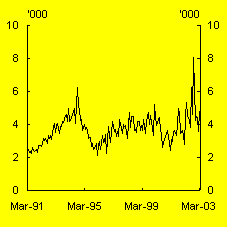
Dwelling investment has continued to grow strongly over the past year, and is expected to directly contribute around 1 percentage point to GDP growth in 2002-03. The increase has been largely driven by the strength in the medium-density market, which is dominated by investors. Investors have been motivated by the prospect of capital gains following substantial price rises in recent years, low interest rates and the potential negative gearing advantages of investment property. Poor short-term prospects for alternative investments are also likely to have seen increased investor interest in property. In addition, a range of new financial products has supported investor demand. While the bulk of investor funds have been used to purchase existing dwellings, a growing amount has Chart A: Medium-density building approvals
Source: ABS Cat. No. 8731.0. |
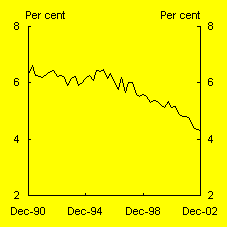
gone towards the construction of new dwellings (Chart A). After a period of strong growth in medium-density construction, signs of oversupply in the market are becoming apparent. Vacancy rates have continued to rise and rental yields have declined (Chart B). Chart B: Rental yields(a)
Source: Real Estate Institute of Australia and Treasury. However, the construction of medium-density dwellings, particularly the high rise apartments of four or more storeys in which investor interest has been concentrated, tend to have long lead-times to completion, typically between six and eighteen months. With a large number of apartments still to come onto the market, particularly in Sydney, Melbourne and Brisbane, there is a possibility of substantial oversupply and a sharp correction in prices and building activity. |
Business investment
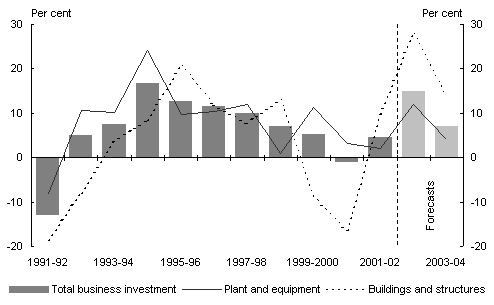
Business investment is forecast to increase by 7 per cent in 2003-04, following growth of around 15 per cent in 2002-03 (Chart 5). Overall, conditions are supportive of investment growth, but uncertainty clouds the near-term outlook.
Chart 5: Growth in new business investment(a)
- Excluding net purchases of second-hand public sector assets by the private sector.
Source: ABS Cat. No. 5206.0 and Treasury.
The fundamental drivers of business investment remain strong. Capacity utilisation is at high levels and the outlook for the non-farm economy, although moderating, remains solid. In addition, corporate profits have grown very strongly over the past year and interest rates are around historically low levels. Corporate balance sheets are generally sound.
There are also some special sectoral factors that should support business investment in 2003-04. These include ongoing strong growth in mining investment and the upgrade of the aviation industry's fleet of aircraft, which is expected to extend into 2003-04. A significant increase in infrastructure expenditure is also in train, especially in NSW, and much of this appears likely to be undertaken by the private sector.
Nevertheless, there is still considerable uncertainty around the outlook for business investment, with a number of downside risks. Heightened global uncertainty is likely to see firms scale back discretionary investment plans in the near term, with growth in plant and equipment investment expected to slow from a forecast 12 per cent in 2002-03, to around 4 per cent in 2003-04, despite the strong underlying fundamentals.
The latest Australian Bureau of Statistics capital expenditure survey showed that firms' first estimate of plant and equipment intentions for 2003-04 was a little below their first estimate for 2002-03. However, early estimates provide only a broad indication of likely outcomes. It is possible that as the year progresses, firms will become more confident and upgrade their investment intentions significantly. However, firms did not upgrade investment intentions by as much as would usually be expected as 2002-03 progressed. It is possible that investment intentions for 2003-04 will follow a similar path unless the current uncertainty dissipates quickly. Business confidence has generally held up reasonably well considering the global backdrop, but has weakened a little in recent months.
Investment in buildings and structures is expected to grow by 14 per cent in 2003-04, following growth of 28 per cent in 2002-03. The increase is expected to be driven by very strong growth in engineering construction, which is underpinned by a number of large mining and infrastructure projects. Unlike plant and equipment investment, large mining engineering construction projects typically look through short-term fluctuations in global economic activity. Infrastructure projects are also relatively unaffected by global conditions. The commencement of engineering construction work on major projects has increased the level of engineering construction work yet to be done to around $7 billion in December 2002. Several additional large projects, which are expected to commence in 2002-03 in the mining and transport and storage sectors, are also expected to support growth next year. Investment in new non-residential buildings is expected to moderate in 2003-04, with growth being driven by building activity in office and business-park construction.
Inventories
In 2003-04, investment in private non-farm inventories (excluding private marketing authorities) is expected to broadly keep pace with solid sales growth, with no net contribution to GDP growth. This follows an expected positive contribution to GDP growth of around ¼ of a percentage point in 2002-03 as the level of inventories is rebuilt. Nevertheless, the degree of uncertainty surrounding the international economic outlook is likely to influence decisions regarding investment in inventories, with businesses likely to hold off building up stocks until the outlook clears.
Farm and private marketing authority inventories are forecast to be rebuilt in 2003-04, assuming the drought breaks. This follows a sharp rundown in 2002-03, when existing stocks were used to augment drought-affected supplies. Investment in farm and private marketing authority stocks is forecast to contribute around ½ of a percentage point to GDP growth in 2003-04.
Public final demand
Public final demand (abstracting from second-hand asset sales) is expected to increase by around 3¼ per cent in year-average terms in 2003-04. This is a slight moderation in the pace of growth from 2002-03, reflecting slower growth in public investment at the Commonwealth, state and local levels.
The easing in public final demand in 2003-04 comes after an expected pick-up in 2002-03, in which growth is expected to be around 3¾ per cent in year-average terms. This above-average growth in public final demand partly reflects additional Commonwealth spending on the war in Iraq and national security. Increases in state and local government spending on insurance and superannuation expenses, along with additional expenditure on education, health, and public order and safety are also expected to contribute to growth in public final demand. Spending on infrastructure projects should also support demand.