



Net exports and the current account
Net exports
Exports are forecast to increase by 6 per cent in 2003-04, a modest rebound from the flat outcome expected in 2002-03. The mild recovery is expected to be underpinned by subdued global growth and an assumed breaking of the drought.
Over the past year, weak trading partner demand and the effects of the drought have seen export growth stagnate. The exchange rate has also appreciated, with the Trade Weighted Index increasing by around 8 per cent over the past year, adding to the drag on export growth.
Although some pick-up in exports is in prospect over the next year, conditions are still far from ideal. Nevertheless, there are welcome signs that the El Niño pattern has ended and that there will be at least average levels of rainfall over much of Australia in the coming year. While this should result in a recovery in rural production and exports, the outcome will also depend on a number of other factors: the timing of the rain; the distribution of rainfall; and subsoil moisture conditions. In the near term, further falls in farm production are in prospect.
In line with the assumed breaking of the drought, rural exports are expected to rise substantially in 2003-04. The rebound in rural exports is expected to be driven by a sharp rebound in broadacre crop production, reflecting both an increase in the area planted and a recovery in yields. However, irrigated crops are expected to show a more muted recovery in production, being constrained by ongoing low levels of water storage. In addition, the recovery in livestock production is also expected to be slower, with the herd rebuilding process taking a couple of years to complete (Box 3).
|
Box 3: Drought and farm production |
|
|
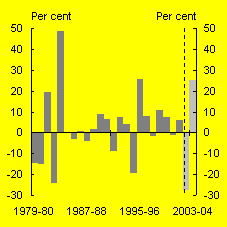
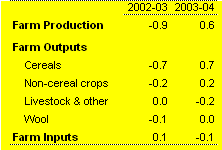
Measured in terms of its impact on the rural economy, the drought in 2002-03 is forecast to be the worst on record. Farm production is expected to decline by a record 27 per cent, directly subtracting 0.9 of a percentage point from GDP growth in 2002-03 (Chart A). The latest information from the Bureau of Meteorology suggests that the El Niño weather pattern has ended and more favourable seasonal conditions are likely in coming months. If the drought breaks, farm production is expected to rebound by around 25 per cent in 2003-04, contributing 0.6 of a percentage point to GDP growth. Chart A: Growth in farm production
Source: ABARE, ABS and Treasury. The rebound in farm production is likely to be led by a strong pick-up in crop production. The Australian Bureau of Agricultural and Research |
Economics (ABARE) forecasts cereal crop production to increase by over 50 per cent in 2003-04, contributing significantly to growth in farm production (Table A). Table A: Farm production(a)
Source: ABARE, ABS and Treasury. However, a less positive outlook for livestock and wool production will slow the pace of rural recovery. The drought saw a large reduction in the size of the livestock herd in 2002-03 and herd rebuilding is likely to take some time. Similarly, relatively low sheep numbers will reduce the scope for a recovery in wool production in 2003-04. In the past, droughts generally have been followed by periods of above-average production, so it is possible that the rebound will be greater than forecast. Tempering this optimism, though, is the fact that large parts of the country remain drought declared, there is limited availability of stored water and the timing and distribution of rainfall may be uneven. |
Exports of elaborately transformed manufactures (ETMs) and services are highly sensitive to economic conditions in Australia's major trading partners. Following recent weak outcomes, ETM exports are forecast to pick up a little over the course of 2003-04, in line with the expectation of only modest growth in Australia's major trading partners, and against the mild drag from the appreciation of the exchange rate.
Services exports are expected to show a weak recovery in 2003-04. Services exports are yet to fully recover from recent shocks, including the collapse of Ansett and terrorist attacks (Box 4). More recently, security concerns surrounding travel during the war in Iraq, and the outbreak of SARS, are likely to weigh heavily on the outlook for services exports.
Exports of non-rural commodities, which account for the largest share of Australia's exports, are forecast to pick up in 2003-04, despite subdued trading partner growth. This reflects incremental increases in mining capacity and solid demand from key buyers, despite increasing competition. The mining sector has enjoyed very high levels of profitability in recent years which, combined with high commodity prices in Australian dollar terms, has seen a boom in mining investment. However, major increases in new capacity are not expected to flow through to export volumes until at least 2004-05.
|
Box 4: The outlook for tourism |
|
|
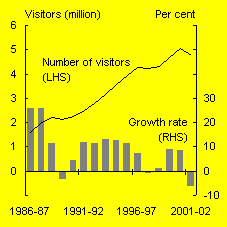
Inbound tourism experienced strong growth in 1999-2000 and 2000-01 (Chart A), supported by solid economic growth in Australia's major trading partners, a competitive exchange rate and a boost from the Sydney Olympic Games. Since then, conditions have deteriorated markedly, with a number of factors weighing on the sector, including an unwinding of the Olympics effect, the collapse of Ansett, a slowing in world growth, and terrorist attacks which have adversely affected traveller security and confidence. More recently, the war in Iraq and the outbreak of SARS have again demonstrated the sensitivity of travellers to adverse developments. Chart A: Short-term overseas arrivals
Source: ABS Cat. No. 3401.0. Near-term prospects for international travel remain poor, particularly with |
the weak world economy and ongoing concerns about health and security. In addition, the recent appreciation of the exchange rate may also have a negative impact on inbound tourism. As a result, services exports, which account for around 4½ per cent of the economy, and particularly inbound tourism, are expected to be a drag on economic growth in 2002-03. A modest recovery is expected in 2003-04, as global conditions gradually improve and the adverse effects of the war in Iraq and SARS subside. The staging of the Rugby World Cup in Australia in October and November 2003 should also provide a useful fillip. However, a turnaround in confidence in international travel, and a more robust recovery in world growth, will be important for a stronger recovery in tourism activity. A further episode of global weakness, a prolonged period of international tensions or a significant spread of SARS, could undermine the outlook further. Despite the poor prospects for inbound tourism, the outlook for domestic tourism, which accounts for around 76 per cent of the industry, remains sound. The domestic tourism sector is relatively less affected by international security issues and should benefit from an expected near-term switch from international to domestic destinations. |
Imports are forecast to increase by around 6 per cent in 2003-04, following growth of around 13 per cent in 2002-03. Slower growth of imports in 2003-04 largely reflects the expected slower growth of domestic demand. There is also likely to be a fall in aircraft imports. The aviation industry's upgrading of its fleet of civil aircraft is expected to continue into 2003-04, but expenditures are likely to be lower than in 2002-03. Imports of services, particularly tourism services, are likely to remain subdued over the forecast horizon because of health and security concerns. Working in the other direction, the appreciation of the exchange rate will tend to support import volumes in 2003-04.
Taken together, the trade forecasts imply that net exports will subtract around ¼ of a percentage point from economic growth in 2003-04, following an expected 2¾ percentage points subtraction from growth in 2002-03.
The key risks to the outlook for the external sector remain the uncertainty around prospects for Australia's major trading partners and the possibility of a continuation of the drought. A slower-than-expected recovery in world economic activity would see slower export growth and possibly weaker commodity prices. A higher exchange rate, a sharp fall in the terms of trade (which occurred in many past episodes of global weakness, although not recently), or reduced international travel could also see export growth falter. Over 20 per cent of domestic production is exported, so even a modest reduction in export growth rates would impact noticeably on aggregate GDP growth.
The other key risk relates to the possibility that below-average seasonal conditions will persist into 2003-04, extending the drought for another year. The National Climate Centre notes that the El Niño weather pattern has ended, although a continuation of the drought cannot be ruled out. In 2002-03, some of the effects of the drought on rural exports were buffered by a rundown of stocks, but with private marketing authorities' stocks being run down to support exports this year, this offset will not be available in 2003-04 if the drought persists.
The terms of trade
The terms of trade is expected to increase in 2003-04, supported by an ongoing decline in the price of imported goods. While export prices are likely to remain subdued, weak global economic conditions, competitive pressures and ongoing productivity improvements in information and communications technology goods (ICT) should continue to place downward pressure on international prices.
Commodity prices have remained firm over the past year with a small pick-up in the prices of some rural commodities offsetting the weakness in non-rural commodity prices, particularly base metal prices. Oil and gold prices have also increased, although prices have fallen somewhat in the past month. The prices of other exports have been subdued, in line with weak export demand. On the import side, prices have continued to decline (even abstracting from the effects of the appreciation of the currency) reflecting subdued world inflation and ongoing falls in ICT prices.
The good performance of the terms of trade during a period of global economic weakness has provided an important buffer for the economy. The cumulative increase in the terms of trade over the past four years has been over 10 per cent, with further increases expected in 2002-03 and 2003-04.
The current account
The current account deficit should narrow a little in 2003-04 to around 5¼ per cent of GDP, from around 5¾ per cent of GDP in 2002-03 (Chart 6). Most of the movement in the current account balance over the past year has been due to movements in the trade balance, which has widened sharply. The net income deficit is expected to widen a little this year, in line with the accumulation of net foreign liabilities associated with recent current account deficits. Interest rates remain low, however, helping to contain any increase in the net income deficit. The increase in the terms of trade has also slowed the increase in the current account deficit and should continue to do so over the next year.
The widening of the current account deficit reflects the desynchronised Australian and world economic cycles and the drought. The strong performance of the Australian economy has occurred at a time when many of Australia's trading partners are growing more slowly than usual. Strong imports, underpinned by high levels of investment and an appreciating exchange rate, are expected to contribute an amount equivalent to around 2 percentage points of GDP to the increase in the CAD in 2002-03. Of this, around ½ of a percentage point is expected to be due to aircraft imports. The drought is expected to contribute around ½ of a percentage point of GDP to the widening of the CAD in 2002-03 through lower rural commodity exports. Moreover, weak global demand is limiting the scope for manufactured and service exports.
In 2003-04, the CAD should narrow a little as a percentage of GDP. Import growth is expected to be lower and a gradual recovery in world demand and higher rural production should see a pick-up in exports.
Chart 6: Current account balance
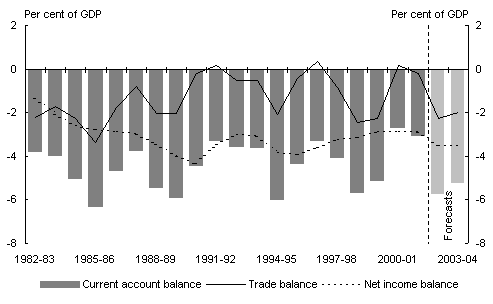
Source: ABS Cat. No. 5302.0 and 5206.0 and Treasury.
Labour market, wages and prices
Labour market
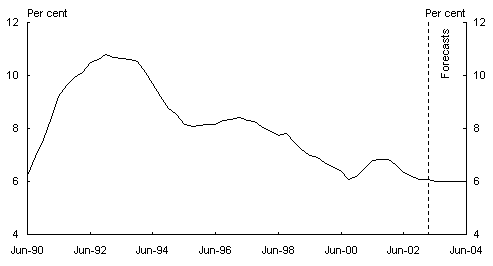
Growth in employment is expected to slow through 2003-04, in line with slower growth in the non-farm economy. Rural employment is forecast to pick up if the drought breaks, but a full recovery may take some time. Employment growth is forecast to be 1¾ per cent in year-average terms and 1½ per cent through-the-year to the June quarter of 2004. The expected moderation in employment growth is likely to see the unemployment rate remain around 6 per cent over the next year (Chart 7).
The expected slowdown in employment growth comes after very strong growth in the first half of 2002-03. Much of the strength appears to have been concentrated in retail and housing-related employment (Box 5).
Labour market leading indicators and business surveys of hiring intentions are broadly consistent with an expected slowing in the labour market. The ANZ newspaper job vacancy series, for example, is now showing a declining trend, although the ABS measure of vacancies is still rising. The labour-intensive residential construction sector and construction-related parts of the manufacturing sector are expected to slow from around mid-2003. This is expected to provide more impetus to a generalised slowing in employment growth. The expected gradual recovery in rural and regional employment should provide a partial offset.
Chart 7: Unemployment rate
Source: ABS Cat. No. 6202.0 and Treasury.
Wages
Wages growth is expected to be well contained in 2003-04, gathering pace a little in coming months in line with the recent tightening in labour market conditions, but steadying thereafter in line with the more subdued employment outlook and a steady unemployment rate. Average earnings on a national accounts basis are expected to grow by 4 per cent in 2003-04.
The slight pick-up in wage pressures in the early part of 2003 has been noted in recent business surveys, including the NAB and ACCI-Westpac surveys and in data on new enterprise agreements from the Department of Employment and Workplace Relations. Business liaison also points to some pick-up in wage pressures in the construction industry. However, overall labour market conditions do not appear to be overly tight and wage pressures are reported to be generally subdued. The increase in federal minimum award wages granted by the Australian Industrial Relations Commission following its Safety Net Review of wages may put upward pressure on wages growth, particularly if it flows through to increases in non-award wages.
Nevertheless, with inflation moderate, inflation expectations well in check, and labour market conditions unlikely to tighten much through the course of 2003-04, wage pressures generally should remain contained. With productivity growth expected to be solid, overall growth in labour costs should remain subdued.
|
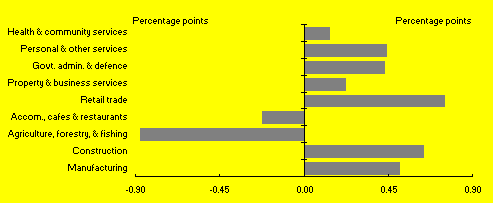
Australian employment increased by 3 per cent over the year to the March quarter 2003, compared with OECD employment growth of 0.3 per cent in the year to the December quarter 2002. Solid consumption spending led to around 70,000 new retail jobs over the past year, mainly in the personal and household goods retail sector. Almost half of the retail jobs created were full-time positions. Strong growth in dwelling and business investment drove large increases in employment in the labour- intensive construction industries. Almost 60,000 construction jobs were created in the year to the March quarter 2003, with over 42,000 additional full-time males employed. The strong jobs growth was centred in the construction trade services sector. In contrast, the drought has seen job losses of around 80,000 in the farm sector over the past year. |
Employment in tourism-related areas appears to have declined. Employment in accommodation, cafes and restaurants declined by around 20,000 over the year, most likely reflecting global weakness and uncertainty, and security concerns of international travellers. The recent outbreak of SARS has exacerbated tourism-related job losses. Employment growth is likely to ease over the next year and the composition of growth is likely to shift away from the housing construction industry, manufacturing and housing-related services. These sectors are particularly labour intensive, so economy-wide employment outcomes will be sensitive to how the housing cycle evolves. Employment outcomes will also be sensitive to the pace of recovery in rural and regional Australia, and to how adverse developments in the tourism industry play out. |
|
Chart A: Contributions to employment growth Through-the-year to March quarter 2003
Source: ABS Cat. No. 6203.0. |
|
Prices
Inflation is forecast to slow to 2¼ per cent in the year to June 2004, down from around 3¼ per cent expected in the year to June 2003, and within the medium-term inflation target band.
Inflation has been boosted over the past year by a number of one-off factors, in particular higher fuel prices, reflecting the substantial run-up in global oil prices, and by drought-related increases in food prices. There have also been substantial increases in housing costs and higher insurance premiums. Services prices have increased solidly, reflecting the strength of domestic demand and tighter labour market conditions, which have underpinned a slight pick-up in wages growth. These increases have been partly offset by subdued growth in import prices, reflecting weak global conditions and recently the appreciation of the Australian dollar. Headline inflation was 3.4 per cent in the year to the March quarter 2003, with measures of underlying inflation pointing to inflation of between 2 and 3 per cent through the year.
Looking ahead, inflation should decline once some of the temporary influences start to abate. While wages are expected to pick up a little in the first half of 2003, inflation expectations remain subdued and the pace of wages growth should ease over the course of 2003-04, in line with the anticipated easing in labour market conditions. With productivity growth expected to be solid, labour costs should remain well contained. The anticipated slowing in non-farm GDP growth in 2003-04 suggests that significant capacity constraints are unlikely to emerge over the forecast period, leaving little scope for generalised margin building.
The moderate outlook for inflation is also likely to be supported by external factors. The weak international environment is likely to hold down global inflation over the next year. This should reinforce other factors such as increased competition, productivity improvements (particularly for ICT goods) and substantial excess capacity, all of which are helping to constrain medium-term international price pressures. Oil prices are assumed to fall a little over the next year, in line with market expectations. The recent appreciation of the Australian dollar, if sustained, should also help to limit any increases in import prices in the near term.
Despite the positive outlook there is still a risk that inflation may not decline as expected, particularly if the current temporarily higher inflation starts to be reflected in inflation expectations and is incorporated into future wage claims. That said, the economy is expected to slow a little over the next year and with downside risks to the outlook it is also possible that inflation may temporarily fall even lower over the coming year.