



Transport and communication
Table 15: Summary of expenses
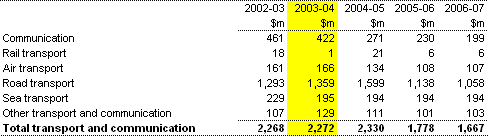
This function includes expenses from the following portfolios:
- Communications, Information Technology and the Arts;
- Industry, Tourism and Resources; and
- Transport and Regional Services.
Nature of expenses and major trends
Transport and Communication Function expenses support the infrastructure and regulatory framework for Australia's transport and communications sectors.
Expenses are expected to peak in 2004-05 and then decline over the forward years due mainly to movements in expenses in the Communication, Road Transport, Air Transport and Rail Transport Sub-functions.
Communication
This sub-function includes the expenses of the Australian Communications Authority and the National Office for the Information Economy, as well as initiatives and grant programmes associated with the past partial sale of the Government's shareholding in Telstra and in response to the Telecommunications Service Inquiry (Besley Report).
Expenses are forecast to continue to decline in 2003-04 and over the forward years due to the conclusion of programmes which were associated with the sale of 49.9 per cent of Telstra through two sales of shares in 1997 and 1999. Funding of $250 million was allocated to these programmes over five years from 1997-98 and a further $670 million over five years was allocated in 1999-2000 to improve telecommunications service standards and broaden access to telephone and internet services in rural, regional and remote Australia.
The decline in expenses is partially offset by funding announced as part of Backing Australia's Ability to support innovation in information technology and by the Government's response to the Besley Report, which will further strengthen telecommunications performance in Australia, particularly in rural and regional areas.
Rail transport
Expenses decline sharply in 2003-04 following the bringing forward of $8.9 million from 2003-04 into 2002-03 for the Alice Springs to Darwin Railway.
Expenses in 2004-05 relate to the finalisation of the Albury-Wodonga Bypass Project funded under the Upgrade of the Mainline Interstate Rail Track Programme. The conclusion of this programme at the end of 2004-05 causes the decline in expenses for this sub-function from 2005-06 onwards.
Air transport
This sub-function includes expenses for the operations of the Civil Aviation Safety Authority (CASA), the Provision of Aviation Infrastructure, and Noise Amelioration Programmes around selected airports. Funding under this sub-function peaks in 2003-04 and then declines over the forward estimates period.
The continuation of airport infrastructure upgrades at Melbourne Airport as part of Australia's response to Foot and Mouth Disease and other quarantine risks in 2003-04, contributes to the peak in funding in 2003-04. Completion of upgrades and reduction in activity under the Adelaide Airport Noise Amelioration Programme in 2003-04 contribute to the decline in expenses in 2004-05.
A pricing subsidy provided to Airservices Australia for the provision of location-specific air traffic control tower services has been extended to 2003-04 to support affordable transport access in regional Australia.
Air safety operations will continue to be enhanced through the CASA Improvement Programme. The regional aviation industry will continue to be assisted by the Government's payment of enroute air traffic control charges on regional Regular Public Transport aircraft with a maximum take-off weight of 15 tonnes or less, and on aeromedical aircraft, at a cost of $21 million from 2001-02 to 2004-05. Termination of this assistance and CASA's Improvement Programme in 2004-05 contribute to the decline in expenses in 2005-06.
Road transport
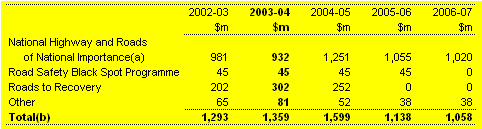
The Government funds the National Highway System and contributes to the capital cost of State/Territory roads that have been identified to be of national importance. The Government also funds the Federal Road Safety Black Spot Programme to reduce road accidents on Australian roads by targeting funding to those locations which are known to be of high risk for traffic accidents.
Special assistance of $1.2 billion over five years from 2001-02 is being provided directly to local councils through the Roads to Recovery Programme for the construction, upgrade and maintenance of local roads.
Expenses peak in 2004-05 mainly due to rescheduling of projects in the National Highway and Roads of National Importance Programme and the Roads to Recovery Programme announced in the 2002-03 Budget. The significant decline in expenses in 2005-06 reflects the conclusion of the rescheduled projects and the conclusion of the Roads to Recovery Programme in 2004-05.
The Government also provides untied funding to local government through Financial Assistance Grants that are identified for roads - see the General Purpose Inter-Government Transactions Sub-Function (Other Purposes Function).
Major components of the Road Transport Sub-function are outlined in further detail in Box 6.3 below.
|
Box 6.3: Components of Road Transport Funding Table 15.1: Trends in major components of the Road Transport Sub-Function
|
Sea transport
The key components of this sub-function include the Tasmanian Freight Equalisation Scheme, the Bass Strait Passenger Vehicle Equalisation Scheme and funding for the Australian Maritime Safety Authority.
Expenses decline in 2003-04 largely as a result of final Commonwealth contributions from the Federation Fund for the development of marine facilities in Jervoise Bay, Western Australia in 2002-03.
Other transport and communication
This sub-function covers expenses relating to the administration of relevant programmes in the Transport and Regional Services portfolio and the expenses for the construction of the Asia Pacific Space Centre on Christmas Island (through the Industry, Tourism and Resources portfolio). The fluctuation in expenses across this sub-function reflects the funding profile for this project, which peaks in 2003-04 and concludes in 2004-05.
Other economic affairs
Table 16: Summary of expenses
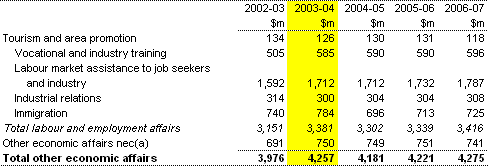
- The growth in Other Economic Affairs nec between 2002-03 and 2003-04 is largely attributable to adjustments in funding (and associated functional classification) between the Department of Environment and Heritage and the Bureau of Meteorology at the time that the Bureau of Meteorology became a prescribed agency in September 2002.
This function includes expenses from the following portfolios:
- Education, Science and Training;
- Employment and Workplace Relations;
- Environment and Heritage;
- Finance and Administration;
- Immigration and Multicultural and Indigenous Affairs;
- Industry, Tourism and Resources;
- Transport and Regional Services;
- Treasury; and
- Veterans' Affairs.
Nature of expenses and major trends
The Other Economic Affairs Function includes expenses on tourism and area promotion, labour market assistance, immigration, industrial relations and other economic affairs not elsewhere classified (nec).
Trends in expenses in this function are mainly attributable to increases in 2003-04 and 2006-07 in Job Network programme funding under the Labour Market Assistance to Job Seekers and Industry Sub-Function, and an appropriate expense allowance in 2003-04 for the offshore processing of unauthorised boat arrivals, and more comprehensive processing and checking of visa applicants and arrivals in Australia as a result of a changed business environment.
Tourism and area promotion
Commonwealth funding contributes to tourism research and analysis, policy development, international and domestic tourism marketing, and funding for specific tourism programmes and projects. These expenses are mainly incurred by the Australian Tourist Commission and some programme expenses administered by the Department of Industry, Tourism and Resources.
The decrease in expenses in 2006-07 is due to a number of programmes, including the See Australia Initiative and the Regional Tourism Programme, drawing to a close at the end of June 2006.
Labour and employment affairs
Vocational and industry training
Expenses largely cover wage subsidies and incentive payments to employers, and allowances to apprentices and trainees. Expenses also cover pre-apprenticeship and traineeship training for people who are disadvantaged in the labour market and strategic project funding to support the national vocational education and training system.
The Vocational and Industry Training Sub-function has previously experienced strong growth due to a rise in apprenticeship/traineeship commencements since 1997-98. The increase in commencements is due in part to the introduction of the New Apprenticeship System from 1 January 1998, and the introduction of new flexibilities such as user choice in selecting training providers. This trend is now expected to stabilise over the period 2003-04 to 2006-07 based on anticipated labour market trends.
Expenses on vocational education and training (mainly relating to the national Technical and Further Education system) are recorded under the Vocational and Other Education Sub-Function (Education Function).
Labour market assistance to job seekers and industry
The majority of expenses under this sub-function cover programmes aimed at helping people gain employment. This includes expenses under the following programmes: Job Network, Work for the Dole, Regional Assistance, Indigenous Employment, Area Consultative Committees and Return to Work. It also includes expenses incurred in New Apprentice Centres that provide information on New Apprenticeships options to job seekers and employers and by the Stevedoring Industry Finance Committee.
Overall expenses are expected to remain relatively stable but with significant growth in 2003-04 and 2006-07. The increase in 2003-04 is mainly attributable to additional funding under the Job Network programme and the Work for the Dole initiative, which will increase expenses under this sub-function by $75 million. Increases from 2005-06 are primarily attributable to additional funding estimated for the Job Network programme.
Industrial relations
The Industrial Relations Sub-function includes expenses associated with improving the industrial framework and its operation. These include the costs of advice provided by the Department of Employment and Workplace Relations, and operations of the Australian Industrial Relations Commission and the Australian Industrial Registry.
The sub-function also includes the General Employee Entitlements and Redundancy Scheme (GEERS) and the Special Employee Entitlements Scheme for Ansett Group Employees (SEESA). Both schemes are designed to assist employees who suffer a loss of employee entitlements as a result of their employer being insolvent.
The decline in expenses between 2002-03 and 2003-04 reflects the reduced level of expenses for SEESA in 2003-04, expense flows for which peaked in previous years. While these expenses have been recorded under this sub-function, according to GFS accounting standards, expenditure is expected to be neutral in its overall underlying cash impact as cash payments are balanced by receipts from the Air Passenger Ticket Levy which has been put in place to fund these arrangements.
Immigration
The Immigration Sub-function covers a significant proportion of the expenses incurred by the Department of Immigration and Multicultural and Indigenous Affairs (DIMIA) in administering Australia's immigration programme. This includes the management of the migration and humanitarian programmes, temporary entry programmes, and the enforcement of immigration law and citizenship programmes.
Expenses under this sub-function increase in 2003-04 for several reasons:
- An appropriate allowance for expenses ($22.7 million) in 2003-04 for the offshore processing of unauthorised boat arrivals. The 2002-03 estimate has been revised, on the basis of experience in the year to date, and is now based on the assumption that there will be no new arrivals in the year, whereas, for estimates purposes, there are assumed to be 1,000 arrivals in 2003-04 and all the forward years.
- Increased expenses of $4.9 million in 2003-04 announced as part of the A Safer Australia package, for the integration of DIMIA data processing systems.
- Increased expenses of $6.6 million in 2003-04 as part of the Government's International Education package.
- Increased expenses of $15.5 million for more comprehensive processing and checking of visa applicants and all arrivals in Australia. The expenses form part of the additional $97.8 million provided in the Budget as a result of the review of DIMIA's funding arrangements. The balance of the additional funding of $97.8 million does not contribute to the variance between 2002-03 and 2003-04 in this sub-function for two reasons:
- $65.5 million represents an extension of the increased expenses in both 2002-03 and 2003-04 for enhanced visa processing and the costs of removal of detainees; and
- $16.8 million represents the increased cost of Integrated Humanitarian Settlement Services. These expenses are classified to the Other Welfare Programmes Sub-function (Social Security and Welfare Function).
The increase in expenses is partially offset by savings in the costs of detention facilities achieved through closure of the Woomera Immigration Reception and Processing Centre ($10.7 million).
The reduction in expenses in the forward years is due to additional resources for International Education and visa processing being agreed for 2003-04 only, pending a detailed review of DIMIA's business processes and costs. Provision for funding for 2004-05 and beyond as a result of the review of DIMIA's business processes and costs is included in the Contingency Reserve - see Contingency Reserve Sub-function (Other Purposes Function).
Other expenses incurred by DIMIA associated with migrant settlement and indigenous affairs are reported under the Other Welfare Programmes and Aboriginal Advancement nec Sub-functions (Social Security and Welfare Function) and the Foreign Economic Aid Sub-function (General Public Services Function).
Other economic affairs (nec)
This sub-function covers economic services provided by the Commonwealth which are not included in other functional classifications. Expenses mainly comprise the operational costs of a number of advisory and regulatory agencies, including the Productivity Commission, the Australian Competition and Consumer Commission (ACCC), the Australian Securities and Investments Commission (ASIC), IP Australia, the National Competition Council, the Bureau of Meteorology, the Ionospheric Prediction Service and the Commonwealth Grants Commission. Also included in this sub-function are the Australian Government Analytical Laboratories, the National Standards Commission and the National Measurement Laboratory which will be amalgamated in 2003-04 to form the National Measurement Institute.
Expenses in this sub-function are expected to increase in 2003-04, partly as a result of the Australian Securities and Investments Commission receiving additional funding for the HIH Investigations and Litigation Taskforce, flowing from the outcome of the HIH Royal Commission. The decrease in expenses in 2006-07 is mainly due to the conclusion in 2005-06 of the small business assistance package administered by the Department of Industry, Tourism and Resources.
Other purposes
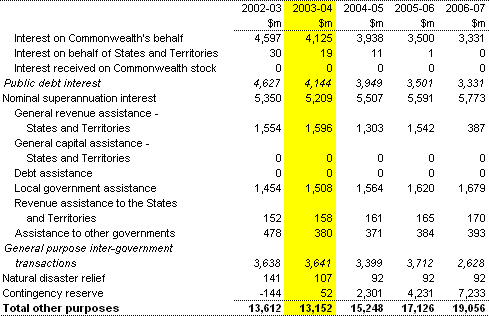
Table 17: Summary of expenses
This function includes expense from the following portfolios:
- Finance and Administration;
- Industry, Tourism and Resources;
- Transport and Regional Services; and
- Treasury.
Nature of expenses and major trends
The Other Purposes Function includes expenses incurred in the servicing of public debt interest, and assistance to the State and Territory governments and Local government. The function also includes items classified to natural disaster relief, the Contingency Reserve, and costs of asset sales.
Excluding the Contingency Reserve, Nominal Superannuation Interest and Natural Disaster Relief Sub-functions, the general trend is for a real decline in expenses over the Budget and forward years mainly associated with reduced debt-servicing costs or reduced Budget Balancing Assistance to the States and Territories as GST revenues increase.
The increase in the Contingency Reserve from 2003-04 over the forward years is largely due to the conservative bias allowance - an allowance that compensates for the trend in expenses on existing Commonwealth programmes to be underestimated by agencies in the forward years.
Public debt interest
This sub-function includes expenses relating to the cost of servicing the stock of Commonwealth debt incurred to meet budget financing and other borrowing requirements. All expenses relating to public debt interest are expenses of the Australian Office of Financial Management (AOFM), which is responsible for managing and reporting on the Commonwealth's net debt portfolio. This sub-function does not include interest on overpayment of tax and other interest not associated with borrowings.
Expenses on public debt interest are governed by the volume of outstanding Commonwealth debt, and the average cost of debt service (the net effect of interest and exchange rate movements), which is in turn influenced by the mix of debt instruments and the term structure of the debt. The balance of influence of these factors on total public debt interest expenses will vary over time.
Public debt interest expenses also include interest expenses on debt issued by the Commonwealth on behalf of the State and Territory governments. Since 1990 the State and Territory governments have been borrowing on their own behalf. These interest expenses are offset by payments from the State and Territory governments. Interest expenses on debt issued by the Commonwealth on behalf of the State and Territory governments are projected to decline as the debt is extinguished.
Expenses in this sub-function are forecast to decrease over 2003-04 and the forward years largely due to projected reductions in the volume of Commonwealth debt on issue.
Nominal superannuation interest
The Nominal Superannuation Interest Sub-function includes expenses relating to the cost of the accumulated and unfunded liability of the superannuation schemes provided by the Government for its civilian and defence personnel - including the Public Sector Superannuation Scheme (PSS), the Commonwealth Superannuation Scheme (CSS), the Military Superannuation and Benefits Scheme and the Defence Force Retirement and Death Benefits Scheme. The interest expenses reflect the cost of not fully funding the superannuation liability. The Government is viewed as compulsorily borrowing the funds and incurs a nominal interest expense.
The decline in estimated nominal superannuation interest expenses between 2002-03 and 2003-04 mainly reflects the impact of changes in military superannuation estimates, as recognised by the actuarial review of employer superannuation liabilities relating to the Commonwealth's military superannuation schemes, undertaken in August 2002. From 2004-05 onwards these expenses resume their tendency to increase over time in line with increases in the unfunded liability of the superannuation schemes.
Superannuation expenses relating to current year employment in relation to these schemes are included in the Government Superannuation Benefits Sub-function (General Public Services Function).
General purpose inter-government transactions
This sub-function includes grants and advances to the States and Territories and local government authorities, which are not classifiable to other functions. Detailed information on the Commonwealth's financial relations with State, Territory and local governments is provided in Budget Paper No. 3, Federal Financial Relations 2003-04.
The Commonwealth's estimates do not include GST payments to the States and Territories, as accrued GST revenues and associated payments to the States and Territories are treated as a state tax.
The General Revenue Assistance to the States and Territories component comprises payments made by the Commonwealth Government to the State and Territory Governments. These include Budget Balancing Assistance (BBA) paid to ensure that State and Territory budgets are no worse off as a result of taxation reform, and National Competition Policy Payments which are paid subject to satisfactory progress with the implementation of specific National Competition Policy and related reforms.
The Local Government Assistance component relates to the provision of assistance to local government authorities through general purpose Financial Assistance Grants and untied local road grants. The increase in expenses for local government assistance each year reflects the application of an escalation factor determined by the Treasurer with reference to the underlying movements in the CPI and population growth.
The Revenue Assistance to the States and Territories component includes payments to compensate the States and Territories for the loss of companies' fees and fines that are now collected by the Commonwealth.
The Assistance to Other Governments component consists primarily of Offshore Petroleum Royalties/Fees to Western Australia for administration of petroleum exploration and production leases within Commonwealth jurisdiction. This payment is expected to decline between 2002-03 and 2003-04 due to a projected reduction in production. The payment is expected to increase over the forward years, largely due to projected increases in production (including from the Yodel gas field) and projected increases in crude oil, Liquified Natural Gas (LNG) and Liquified Petroleum Gas (LPG) prices.
This component also includes compensation to the Australian Capital Territory for special fiscal needs arising from Canberra's status as the National Capital.
Expenses for the General Purpose Inter-Government Transactions Sub-function are projected to decrease over the years to 2004-05 and in 2006-07, largely due to projected increases in GST revenues causing corresponding decreases in BBA. BBA is projected to increase in 2005-06 as the loss of State and Territory revenue resulting from the abolition of debit taxes in that year will be included in the BBA calculation.
Natural disaster relief
This sub-function comprises expenses associated with natural disaster relief.
Under the Natural Disaster Relief Arrangements (NDRA), the Commonwealth reimburses part of the States' expenses on restoration payments and payments for other eligible disaster relief measures where the expenses exceed certain funding thresholds. A large part of NDRA payments are made as partial reimbursement for the relief of personal hardship and distress and the repair and restoration of essential State and local government assets.
Commonwealth assistance towards natural disaster relief reflects the unpredictability of these events in terms of incidence and severity. The peak in expenses in 2002-03 is driven largely by previous and current year disasters for which claims have been submitted by State Governments under NDRA in 2002-03. For example, claims from the 2001 Christmas bushfires in NSW have been submitted in 2002-03. Provision of funding for aerial firefighting assistance and contributions to the NSW, Victoria and Canberra bushfires appeals have also contributed to the peak in 2002-03. The forward estimates are based on a broad average of annual net payments over recent years, with additional funding being provided in 2003-04 to assist States and Territories to meet aerial firefighting needs.
Drought assistance is included within Rural Assistance Sub-function (Agriculture, Forestry and Fishing Function).
Contingency Reserve
The Contingency Reserve is used in budget estimates reporting to reflect anticipated events which cannot easily be allocated to specific agency or functional areas or where it is not appropriate to allocate to specific agencies or functions.
While the reserve ensures that aggregate estimates are as close as possible to expected outcomes, it is not appropriated in the Budget. Items in the Contingency Reserve will be allocated to specific agencies for appropriation and for outcome reporting closer to the time when they eventuate.
The Contingency Reserve affects the budget balances in the same manner as other expense categories. The Contingency Reserve is therefore not a reserve to fund unanticipated events or new policy decisions.
Items in the Contingency Reserve include:
- a regular conservative bias allowance to adjust for the historical tendency of forward year expense estimates for existing programmes to be understated in aggregate. The conservative bias allowance is intended to improve the accuracy of the forward estimates by increasing estimated expenses in each of the forward years;
- a provision for underspends in the current year, adjusting for the tendency of agencies to overestimate expenses for the current financial year;
- commercial-in-confidence and national-security-in-confidence items that cannot be disclosed separately in agency and functional categories; and
- the effect of economic parameter revisions received too late in the process to be allocated against individual agency or functional classifications. The effect of these revisions is included as an aggregate item. An example of a late parameter revision is the estimated impact of the Australian Industrial Relations Commission's Living Wage Case Decision released on 6 May 2003.
The Asset Sales component includes expenses associated with the Government's major asset sales and associated administration costs.
The estimates for 2002-03 and 2003-04 include funding for a range of previously announced asset sales, including the Sydney Basin Airports (other than Sydney Kingsford Smith Airport which was sold in 2002-03) and a scoping study of the Albury Wodonga Development Corporation. The estimates in the latter years relate to the assumed timing of the proposed sale of Telstra.