



Housing and community amenities
Table 10: Summary of expenses

- Refinement of the functional attribution of the departmental expenses of the Department of Transport and Regional Services has led to a reclassification. A portion of departmental expenses previously classified to the Urban and Regional Development Sub-function (Housing and Community Amenities Function) will now be classified to the General Services Sub-Function (General Public Services Function) and Other Transport and Communications Sub-Function (Transport Function).
- Refinement of the functional attribution of the departmental expenses of the Department of Environment and Heritage, previously classified to the Environment Protection Sub-Function will now be classified to the National Estates and Parks Sub-function (Recreation and Culture Function).
This function includes expenses from the following portfolios:
- Defence (Defence Housing Authority);
- Education, Science and Training;
- Environment and Heritage;
- Family and Community Services;
- Industry, Tourism and Resources;
- Transport and Regional Services;
- Treasury; and
- Veterans' Affairs.
Nature of expenses and major trends
Housing and Community Amenities Function expenses fund and support the Commonwealth's housing, regional development and environment protection policies and programmes.
Total expenses decline from 2002-03 to 2003-04 reflecting the conclusion of the additional First Home Owners Scheme grant and lower Commonwealth-State Housing Agreement (CSHA) base funding in the Housing Sub-function.
Generally, expenses decrease over the forward years. The reduction in expenses from 2003-04 to 2006-07 reflects the conclusion of funding provided for several regional development programmes.
Housing
This sub-function includes grants to the States and Territories under the Commonwealth-State Housing Agreement (CSHA) as well as the additional First Home Owners Scheme (FHOS) and the operations of the Defence Housing Authority (DHA).
The CSHA, in conjunction with contributions from the States and Territories, assists in the expansion and maintenance of the public rental housing stock by state and territory governments. The cessation in 2002-03 of the Goods and Services Tax (GST) transitional funding provided under the CSHA contributes to a reduction in expenses between 2002-03 and 2003-04.
The additional FHOS provided an extra grant of $7,000 to first home owners building or purchasing new homes between 9 March and 31 December 2001. The Commonwealth extended the grant at a rate of $3,000 between 1 January and 30 June 2002. Although the additional FHOS has ended, funding is provided in 2003-04 because some home owners are not paid until construction has been completed.
The DHA provides housing services for members of the Australian Defence Force and their families. DHA expenses remain relatively stable across the forward years.
Urban and regional development
This sub-function covers programmes that aim to support sustainable economic development of communities. It includes various regional development programmes administered by the Department of Transport and Regional Services, and the Small Business Interest Rate Relief programme administered by the Department of Industry, Tourism and Resources.
The new Regional Partnerships Programme will incorporate existing regional development programmes from 1 July 2003. Other programmes within this sub-function include the new Disaster Mitigation Australia Package, the Regional Flood Mitigation Programme and payment to the Australian Capital Territory for national capital water and sewerage services.
Expenses rise from 2002-03 to 2003-04, with the major contributing factors being an increase in funding for the Small Business Interest Rate Relief programme and increases in expenses for the Sustainable Regions programme and the commencement of the Disaster Mitigation Australia Package. From 2003-04 to 2004-05 expenses decrease by $30 million, largely due to the conclusion of the Rural Transactions Centres programme.
From 2004-05 to 2005-06 there is a reduction in expenses, primarily due to the completion of the Small Business Interest Rate Relief programme in 2004-05. The decline in 2006-07 is principally due to the conclusion of the pilot Sustainable Regions Programme in 2005-06.
Environment protection
This sub-function includes funding for the environment primarily through programmes funded as a part of The New Tax System - Measures for a Better Environment Package, which commenced in 2000-01, and through the Natural Heritage Trust (NHT). Also included are departmental expenses for the Department of Environment and Heritage (DoEH), the Australian Greenhouse Office (AGO) and the National Oceans Office (NOO), who administer most of the programmes within this sub-function. These programmes contribute to the sustainable management of the environment including greenhouse gas abatement, protection of the marine environment and promotion of sustainable development of environmental resources.
Departmental expenses for the DoEH and AGO make up the majority of expenses within this sub-function. Expenses peak in 2003-04 and decline steadily across the forward years mainly reflecting the expenditure profile of climate change programmes administered by the AGO.
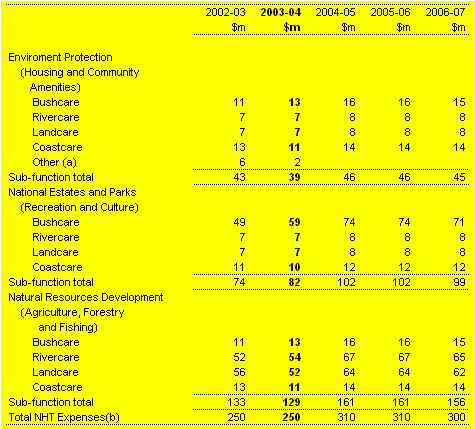
For other significant expenses on conservation and sustainable use and repair of Australia's natural environment see the National Estates and Parks Sub-function (Recreation and Culture Function) and the Natural Resources Development Sub-function (Agriculture, Forestry and Fishing Function). NHT funding, which is spread across these various sub-functions, is summarised in Table 10.1 in Box 6.2 below.
|
Box 6.2: Natural Heritage Trust Table 10.1 Natural Heritage Trust Expenses (across all functions)
|
Recreation and culture
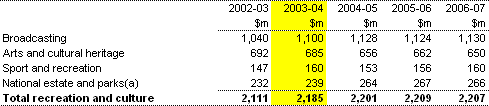
Table 11: Summary of expenses
- Refinement of the functional attribution of the departmental expenses of the Department of Environment and Heritage has led to a reclassification to this sub-function of expenses previously classified to the Environment Protection Sub-Function (Housing and Community Amenities Function), General Research Sub-Function (General Public Services Function) and Natural Resources Development Sub-Function (Agriculture, Forestry and Fishing Function).
This function includes expenses from the following portfolios:
- Communications, Information Technology and the Arts;
- Environment and Heritage; and
- Veterans' Affairs.
Nature of expenses and major trends
Recreation and Culture Function expenses support public broadcasting, the regulatory framework for Australia's broadcasting sector, cultural institutions, funding for the arts and film industry, assistance to sport and recreation activities, and the management and protection of national parks and other world heritage areas. This function also includes expenses relating to the protection and preservation of historic sites and buildings, including war graves.
Total expenses for the Recreation and Culture Function are relatively stable across the forward estimates period although there are some fluctuations within some sub-functions. Expenses for the National Estate and Parks Sub-function increase across the forward years mainly reflecting the expenditure profiles of the Sydney Harbour Federation Trust and the Natural Heritage Trust.
Broadcasting
The majority of expenses on broadcasting fund the Australian Broadcasting Corporation (ABC) and the Special Broadcasting Service Corporation (SBS). The ABC provides domestic and overseas radio and television services. The SBS provides a domestic multilingual radio and television service.
The trend for this sub-function shows a modest increase in expenses reflecting, in particular, the Government's support for the roll out of digital television by the ABC and SBS. This trend is tempered by the conclusion of programmes associated with the sale of 49.9 per cent of Telstra, including the Television Fund.
Arts and cultural heritage
The most significant component of this sub-function is the funding provided for the collection institutions including the National Library of Australia, the National Archives of Australia, the National Gallery of Australia, the Australian National Maritime Museum, the National Museum of Australia and the Australian War Memorial.
The Government also provides direct financial support for a wide range of arts, cultural and heritage organisations. These include the Australian Film, Television and Radio School, the Office of Australian War Graves, the Australian Film Finance Corporation Limited, the Australian Film Commission, Film Australia Limited, and the Australia Council. Funding for arts and cultural activities is also provided through the provision of grants from the Cultural Development Programme administered by the Department of Communications, Information Technology and the Arts (DCITA). Old Parliament House, the National Portrait Gallery, ScreenSound Australia and the National Science and Technology Centre (trading as Questacon) are also components of this sub-function.
The expenses for this sub-function generally decline in 2003-04 due to the cessation of expenses associated with the Federation Fund. The general pattern of decline in expenditure in the forward years for this sub-function is due to the cessation of the Book Industry Assistance Package and the Regional Arts Fund.
Sport and recreation
The Commonwealth provides financial assistance to encourage community interest and participation in sport and recreational activities and to assist elite Australian athletes competing at major sporting events such as the Commonwealth Games, the Olympic Games and the Paralympic Games. These funds are delivered through the Australian Sports Commission (ASC). The ASC promotes and facilitates the pursuit of excellence in sport, sports development and participation. This sub-function also includes funding to the Australian Sports Drug Agency which promotes a drug-free environment within Australian sports.
Backing Australia's Sporting Ability - A More Active Australia, announced in April 2001, provided increased base level funding for sport at all levels.
Funding stays relatively stable in real terms over the forward years. The increase in expenses in 2003-04 is due to funding being provided for a previously announced initiative to provide a shooting range in New South Wales.
National estate and parks
This sub-function covers funding provided for the management and protection of national parks and world heritage areas including Uluru-Kata Tjuta and Kakadu National Parks and the Great Barrier Reef. These activities are delivered by agencies within the Environment and Heritage Portfolio, which include the Director of National Parks, the Sydney Harbour Federation Trust, the Great Barrier Reef Marine Park Authority and the Australian Heritage Commission. The Natural Heritage Trust (NHT) provides additional funding for programmes addressing the management and protection of national wetlands and reserve systems and world heritage areas.
The increase in expenses from 2002-03 to 2003-04, and across the forward years, mainly reflects the expenditure profile of the NHT and expenses for the remediation and rehabilitation of Sydney Harbour Federation Trust sites. The increase also reflects the introduction and implementation of new cultural heritage protection arrangements under the 'Distinctively Australian' programme.
For other significant expenses on conservation and sustainable use and repair of Australia's natural environment see the Environment Protection Sub-function (Housing and Community Amenities Function) and the Natural Resources Development Sub-function (Agriculture, Forestry and Fishing Function). NHT funding, which is spread across these various sub-functions, is summarised at Table 10.1 in Box 6.2 appearing at the end of the Environment Protection Sub-function section.
Fuel and energy
Table 12 has been updated and is available for download in Portable Document Format.
Table 12: Summary of expenses

This function includes expenses from the following portfolios:
- Environment and Heritage;
- Industry, Tourism and Resources; and
- Treasury.
Nature of expenses and major trends
This function includes expenses on the Diesel Fuel Rebate Scheme (DFRS), the Diesel and Alternative Fuels Grants Scheme (DAFGS) and the Fuels Sales Grants Scheme (FSGS) as administered by the Australian Taxation Office (ATO). This function also includes expenses of the Australian Greenhouse Office (AGO) for programmes funded as part of The New Tax System - Measures for a Better Environment Package which commenced in 2000-01. Also included within this function are expenses for programmes relating to the production of alternative fuels such as ethanol, that are administered by the Department of Industry, Tourism and Resources.
Expenditure by the Commonwealth for this function is expected to increase across the forward estimates period due to higher demand for diesel and related fuels associated with the overall growth of the economy.
Fuel and energy
The DFRS provides a rebate to off-road users of diesel fuel. Recipients of the grants include the farming and mining industries, rail and shipping and remote power generation units that use diesel. The DAFGS pays grants for the business-related, on-road use of diesel and alternative fuels. The FSGS is a tiered grant scheme paid to distributors and retailers of petrol and diesel in non-metropolitan and remote regions. This function also includes expenses relating to the payment of grants for the production of biodiesel and for the biodiesel component of blended biodiesel and conventional diesel fuels, and the production of ethanol.
Also included in this function are programmes administered by the AGO including the Alternative Fuels Conversion Programme, the Renewable Energy Commercialisation Programme, the Remote Renewable Power Generation Programme and the Photovoltaic Rebate Programme. These programmes support the development and further use of renewable and alternative energy.
Programmes administered by the Department of Industry, Tourism and Resources, which provide production subsidies or grants in support of the development of alternative fuels, are also included in this function. Finally, also included are expenses relating to a Tax Compensation Deed in respect of company tax collected by the Commonwealth and Land Tax collected by New South Wales from Snowy Hydro Limited. The Department of Industry, Tourism and Resources will make the Commonwealth compensation payments for company tax to New South Wales and Victoria. Expenses for tax compensation payments are in proportion to the governments' shareholdings in Snowy Hydro Limited.
Agriculture, forestry and fishing
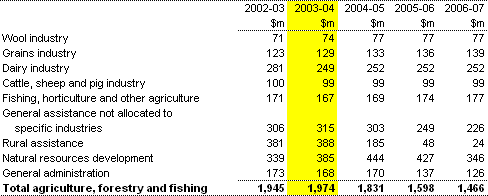
Table 13: Summary of expenses
- Refinement of the functional attribution of the departmental expenses of the Department of Environment and Heritage has led to a reclassification of expenses from the Natural Resources Development Sub-Function to National Estates and Parks Sub-Function (Recreation and Culture Function).
This function includes expenses from the following portfolios:
- Agriculture, Fisheries and Forestry; and
- Environment and Heritage.
Nature of expenses and major trends
Agriculture, Forestry and Fishing Function expenses support forestry, fishing, land and water resources management, quarantine services and contributions to research and development. Approximately half the expenses in this function are funded by levies and charges collected by the Government on behalf of industry.
Expenses decline progressively over the forward years primarily reflecting declining expenses within the General Assistance and Rural Assistance Sub-functions.
Wool industry
This sub-function consists of payments to Australian Wool Innovation Pty Ltd for research and development, commercial branding and technical assistance activities. These expenses are funded by a wool levy on producers, with a matching Government contribution for research and development of up to 0.5 per cent of the gross value of wool production per annum.
Expenses are expected to remain relatively stable over the forward years.
Grains industry
Expenses in this sub-function predominantly relate to Government support of the wheat industry. The wheat levy funds the commercial and regulatory activities of the Australian Wheat Board (International) Limited and the Grains Research and Development Corporation (GRDC). The Government also provides a matching contribution for research and development to the GRDC of up to 0.5 per cent of the gross value of wheat production per annum.
Expenses gradually increase over the forward estimates period in line with a projected post-drought recovery in production, which will increase the Government's contributions for research and development.
Dairy industry
The Government supports dairy industry promotion, administration, market support and research and development. The bulk of the expenses in this sub-function relate to levy-funded grants paid to the Australian Dairy Corporation (ADC) for the $1.93 billion Dairy Structural Adjustment Package. Dairy Australia Limited will replace the ADC and the Dairy Research and Development Corporation from 1 July 2003, bringing together the industry's research and development, marketing, and trade development activities.
Expenses are expected to remain stable over the forward years.
Cattle, sheep and pig industry
Expenses in this sub-function include contributions to the meat, livestock, lamb and pork industries, through Meat and Livestock Australia and Australian Pork Limited, for market promotion, research and development, and the control of livestock diseases. These expenses are funded primarily through industry levies, with the Government providing a matching contribution for research and development of up to 0.5 per cent of the gross value of meat and livestock production per annum.
Expenses are expected to remain stable over the forward years.
Fishing, horticulture and other agriculture
This sub-function includes expenses associated with the Australian Fisheries Management Authority (AFMA), the Fisheries Research and Development Corporation (FRDC), the Grape and Wine Research and Development Corporation (GWRDC), and Horticulture Australia Limited (HAL).
AFMA recovers costs from the commercial fishing industry through levies and fees, while the Government funds community service obligations. Industry levies also fund the activities of the FRDC, GWRDC and HAL. The Government provides a matching contribution for research and development activities in these industries up to a maximum of 0.5 per cent of the gross value of production in each industry.
Expenses are expected to grow only slowly over the forward years.
General assistance not allocated to specific industries
The expenses in this sub-function predominantly relate to the operations of the Australian Quarantine and Inspection Service (AQIS), and plant and animal pest and disease eradication programmes. AQIS conducts inspection services for the export and import of animals, animal products, plant and plant products, and the quarantine surveillance of arriving vessels, people and goods.
Expenses increase in 2003-04 due to enhanced quarantine border control initiatives and pest eradication programmes, but decline in the forward years with the expected completion of these activities.
Rural assistance
This sub-function includes expenses for Government support of rural producers and rural industry adjustment initiatives. The key expenses in this sub-function are the Agriculture - Advancing Australia (AAA) programmes, such as FarmHelp and FarmBis, complemented by rural industry assistance programmes, which provide funding to address specific events adversely affecting farmers. These programmes provide assistance to farmers through a variety of means such as income support, interest rate subsidies, grants for structural adjustment, financial counselling, training and innovation grants.
Policy decisions taken since the 2002-03 Mid-Year Economic and Fiscal Outlook (MYEFO) have increased estimated expenses in this sub-function. Major new policy decisions in this Budget for 2003-04 include additional drought assistance funding of $577 million from 2002-03 to 2004-05 inclusive, comprising $407 million in Exceptional Circumstances assistance to farmers, and a further $170 million in interim income support and interest rate subsidies. Most expenses for drought relief are met by the Department of Agriculture, Fisheries and Forestry, with the remainder being funded by other Commonwealth departments - the Department of Education, Science and Training (reported against the Vocational and Industry Training Sub-function (Other Economic Affairs Function)), the Department of Family and Community Services (reported against the Common Youth Allowance Sub-function (Social Security and Welfare Function)), the Department of Health and Ageing (reported against the Pharmaceutical Services and Benefits Sub-function (Health Function)), and the Department of Industry, Tourism and Resources (reported against the Urban and Regional Development Sub-function (Housing and Communities Amenities Function)).
Expenses for this sub-function decline progressively in the forward years due to the expected return to normal seasonal conditions in Australia.
Natural resources development
Expenses in this sub-function include water, land and forest management programmes which are administered by the Department of Agriculture, Fisheries and Forestry.
The trend in expenses for this sub-function reflects the funding profile of the Natural Heritage Trust (NHT) and the National Action Plan for Salinity and Water Quality (NAP).
Expenses for NHT and NAP are scheduled over the forward years to meet anticipated major project funding requirements emanating from Bilateral Agreements with the States and Territories.
Expenses for NAP have been reprofiled in the 2003-04 Budget. Resourcing of $42.7 million in 2002-03, $24.4 million in 2003-04 and $4.5 million in 2004-05, totalling $71.6 million, has been rescheduled to 2007-08.
For other significant expenses on conservation and sustainable use and repair of Australia's natural environment see the Environment Protection Sub-function (Housing and Community Amenities Function) and the National Estate and Parks Sub-function (Recreation and Culture Function). NHT funding, which is spread across these various sub-functions is summarised at Table 10.1 in Box 6.2 appearing at the end of the Environment Protection Sub-function section.
General administration
This sub-function comprises expenses relating to the administration of relevant programmes in the Department of Agriculture, Fisheries and Forestry.
Expenses remain relatively stable to 2004-05 but decline from 2005-06 due to the conclusion of a range of programmes.
Manufacturing and mining
Table 14: Summary of expenses

This function includes expenses from the following portfolios:
- Education, Science and Training;
- Foreign Affairs and Trade; and
- Industry, Tourism and Resources.
Nature of expenses and major trends
Expenses under this function relate to the mining, manufacturing and export sectors, and are designed to improve the efficiency and competitiveness of Australian industries. The major expenses in the Industry, Tourism and Resources portfolio include programmes specific to the mining, automotive, textile clothing and footwear (TCF) and pharmaceutical industries, a general programme providing research and development grants to small to medium enterprises and a programme of strategic investment incentives. Commonwealth assistance to exporters through the Foreign Affairs and Trade portfolio includes direct financial assistance for the development of export markets, information and promotional assistance, finance and insurance services, and the development of trade policy.
The increase in 2003-04 is mainly due to increased assistance under the Strategic Investment Co-ordinator initiative to attract projects to Australia with significant economic and employment benefits. The decrease in 2004-05 results from the Pharmaceuticals Industry Incentive Programme (PIIP) drawing to a close. This programme is to be replaced by the new Pharmaceutical Partnerships Program commencing in July 2004 which will provide $150 million over five years for a grants programme to encourage additional research and development by pharmaceutical companies in Australia.
In 2005-06 expenses decline due to the transitional effects arising from the conclusion of the current Automotive Competitiveness and Incentive Scheme (ACIS) on 31 December 2005 and the commencement of the new ACIS scheme from 1 January 2006. The further decrease in 2006-07 is due to reductions in the R&D Start and the Textile Clothing and Footwear Strategic Investment Programme (TCF SIP) programmes. R&D Start will be reviewed as part of a review of the Backing Australia's Ability programme. The Government will consider longer term arrangements for these programmes in the next year. Future TCF arrangements are currently being considered by the Productivity Commission.
Mining and mineral resources (other than fuel), manufacturing and construction
The main determinants of these expenses lie in the following programmes: ACIS, R&D Start, the Export Market Development Grants Scheme (EMDG), TCF SIP, Strategic Investment Coordination and the PIIP:
- ACIS provides import duty credits to registered automotive industry participants and is aimed at encouraging new investment and innovation in the automotive industry. ACIS is capped at $2 billion over five years to December 2005. A new scheme will commence on 1 January 2006 and will cost $4.2 billion over ten years.
- R&D Start provides grants to small to medium enterprises for research and development and the commercialisation of new products and technologies. Funding was increased and extended in the Government's innovation action plan Backing Australia's Ability, announced in January 2001, and will total $597 million over the four years 2003-04 to 2006-07.
- The EMDG Scheme pays cash rebates to small and medium sized Australian based businesses that have promoted their products in overseas markets.
- The TCF SIP is providing $678 million over the five years from 2001-02 through to 2005-06 through a competitive grants programme to promote investment and innovation in the industry and the development of sustainable jobs.
- The Strategic Investment Coordinator initiative aims to attract to Australia projects with significant net economic and employment benefits that would otherwise locate offshore.
- The PIIP is a competitive grants programme designed to promote greater investment in pharmaceutical research and development and production value added in Australia. This is a five year programme that concludes at the end of 2003-04. From 1 July 2004, a new pharmaceuticals industry programme will commence which rewards research and development only, costing $150 million over five years.
All activities relating to mineral fuels, and manufacturing relating to the production of fuel and energy, are classified in the Fuel and Energy Function.