



Education
Table 7: Summary of expenses
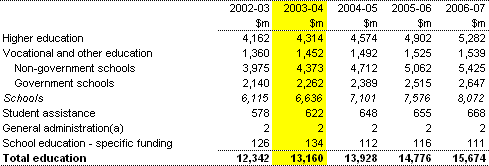
- Departmental expenses relating to International Education funding and schools previously allocated to the General Administration - Education sub-function have been reclassified to the Higher Education and School Education - Specific Funding sub-functions to more appropriately reflect the nature of this spending.
This function includes expenses from the following portfolios:
- Education, Science and Training;
- Family and Community Services;
- Immigration and Multicultural and Indigenous Affairs; and
- Veterans' Affairs.
Nature of expenses and major trends
Education expenses support the delivery of education services through higher education institutions; vocational education and training providers (including technical and further education institutions); and government (State and Territory) and non-government schools.
Expenses under this function also include the ABSTUDY scheme, Assistance for Isolated Children, income support for students aged twenty-five years and over through AUSTUDY, and relevant departmental costs within the Education, Science and Training portfolio.
Total expenses under the Education Function are estimated to increase by 12.4 per cent in real terms over the period from 2003-04 to 2006-07, or 4.0 per cent annually on average. The major drivers of this growth are:
- the announcement of $1.65 billion worth of policy decisions relating to higher education, school education - specific funding and international education;
- indexation of Commonwealth Government spending on schools (both government and non-government); and
- the effect of previously announced decisions - in particular the introduction of a new funding arrangement for non-government schools announced in the 1999-2000 Budget context , and Backing Australia's Ability - An Innovation Action Plan for the Future announced in January 2001.
Higher education
Expenses under this sub-function include Higher Education Operating Grants, the Research Training Scheme, the Institutional Grants Scheme and Superannuation Grants to Universities.
Higher education funding rises by about 4.9 per cent per annum in real terms from 2003-04 to 2006-07. The majority of growth in this sub-function is due to the introduction of the Higher Education Package with expenses of $1.5 billion over the period 2003-04 to 2006-07. The major elements of the package, including their impact across the forward estimates, are:
- $430.1 million for the Commonwealth Grant Scheme;
- $347.6 million for the conversion of existing marginally funded places to fully funded places;
- $122.6 million for assistance for regional universities;
- $161.8 million for Commonwealth Scholarships; and
- $138.5 million for a learning and teaching performance fund.
In addition, the International Education Package will increase Commonwealth General Government expenses by $112.8 million over the period 2003-04 to 2006-07, with $105.2 million relating to the Education Function. Major elements of the package include increased promotion of International Education, the establishment of International Centres of Excellence and an Offshore Quality Assurance programme.
Indexation of Commonwealth funding for higher education, which is based on the Higher Education Cost Adjustment Factor, also contributes to the increase in funding for this sub-function. The Higher Education Cost Adjustment Factor takes account of movement in both salary (Safety Net Adjustment) and non-salary (CPI) costs.
Under the Higher Education Package, the Commonwealth is also introducing new income contingent loan schemes for full-fee paying students at public and private institutions from 2005. These loans are financial assets which are recorded against the balance sheet rather than as GFS expenses.
Vocational and other education
Expenses in this sub-function include funding for vocational education and training provided to the State and Territory Governments under the Australian National Training Authority (ANTA) Agreement, which covers funding for both recurrent and capital purposes. The current agreement expires on 31 December 2003 and this budget includes a measure for a new agreement to apply from 2004, subject to negotiations with the States and Territories.
Other expenses in this sub-function include the Adult Migrant English Programme (which provides access to tuition in English as a second language for recently arrived migrants without functional English), national programmes that support the administration of vocational education and training, careers and transitions programmes for young people and skills development programmes.
Schools
The majority of expenses in this sub-function relate to funding provided by the Commonwealth to and through the States and Territories under the States Grants (Primary and Secondary Education Assistance) Act 2000 and through the quadrennial Schools Funding Agreements. The current agreement will expire in December 2004. To support high quality education in Australian schools, the Commonwealth will provide $5.6 billion in General Recurrent Grants to both government and non-government schools in 2003-04. The Commonwealth will also provide $346.8 million in 2003-04 to assist the States and Territories to improve and provide school capital infrastructure, particularly for the most educationally disadvantaged.
The Schools Funding Agreement also includes a number of targeted programmes such as the:
- Strategic Assistance for Improving Student Outcomes Programme ($384.1 million in 2003-04);
- English as a Second Language - New Arrivals Programme ($50.3 million in 2003-04); and
- Languages Other Than English Programme ($24.0 million in 2003-04).
Another major element within the sub-function is the Indigenous Education Strategic Initiatives Programme ($173.2 million in 2003-04) which provides supplementary funding assistance to pre-schools, government and non-government school systems, vocational education and training authorities and independent indigenous education providers to improve educational outcomes for indigenous people. This funding is provided under the Indigenous Education (Targeted Assistance) Act 2000.
Growth in the Schools Sub-function averages approximately 4.7 per cent per annum in real terms over the period 2003-04 to 2006-07. This primarily reflects the impact of the recurrent funding arrangements for non-government schools, based on the socio-economic status of the school community, which were announced in the 1999-2000 Budget context, and the effects of indexation arrangements for both government and non-government schools.
Student assistance
Expenses in this sub-function primarily include payments for AUSTUDY (income support for students aged twenty-five years and over) and for ABSTUDY (assistance to Aboriginal and Torres Strait Islander full-time secondary and tertiary students and some primary school students) and expenses associated with the Student Financial Supplement Scheme (SFSS) (a voluntary loan scheme for certain tertiary students).
Other expenses include payments under the Assistance for Isolated Children Programme (which provides financial assistance to the families of students who do not have reasonable daily access to an appropriate government school) and the Veterans' Children Education Scheme (which provides support services and financial assistance to eligible children (of veterans) at school and tertiary levels of education).
Growth in the student assistance function averages approximately 0.5 per cent per annum in real terms from 2003-04 to 2006-07. Growth in the student assistance function in 2003-04 and 2004-05 is largely attributable to higher AUSTUDY and ABSTUDY payments flowing from the repeal of SFSS from 1 January 2004.
For information on the Youth Allowance which replaced AUSTUDY for students aged under 25 years from 1 July 1998, see the Common Youth Allowance Sub-function (Social Security and Welfare Function).
General administration
The majority of expenses are associated with the administration of school and indigenous education programmes.
School education - specific funding
Expenses under this sub-function consist of programmes that target specific initiatives or are designed specifically for the benefit of certain groups, such as:
- the Quality Outcomes Programme;
- information for indigenous students and/or their parents on career and education options; and
- activities aimed at improving access, participation and outcomes for indigenous school and pre-school students.
The increase in 2003-04 largely reflects additional funding for the National Schools Drug Education Strategy.
Health
Table 8 has been updated and is available for download in Portable Document Format.
Table 8: Summary of expenses
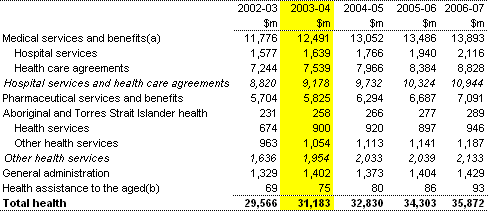
- The financial impact of premium growth on the forward estimates for the 30 per cent Private Health Insurance Rebate have been allocated to the Contingency Reserve.
- The bulk of Department of Health and Ageing and Department of Veterans' Affairs expenses for assistance to the aged are now classified to the Assistance to the Aged Sub-Function (Social Security and Welfare Function).
This function includes expenses from the following portfolios:
- Health and Ageing; and
- Veterans' Affairs.
Nature of expenses and major trends
The major purpose of Commonwealth health expenditure is to help ensure that all Australians have access to necessary health services through a choice of providers and without excessive price barriers.
Health Function expenses are expected to total around $31.2 billion in 2003-04 and grow on average by around 2.8 per cent per annum in real terms over the budget and forward years. This growth reflects a steady per capita increase in use of medical and pharmaceutical services over the period, increasing costs for the provision of medical services, and a continuing trend toward the use of newer and more expensive drugs under the Pharmaceutical Benefits Scheme (PBS).
Expenses related to health and ageing are likely to be the main contributor to increased Commonwealth Government spending in the future. Total Commonwealth health spending is currently around 4 per cent of GDP. Growth in this spending largely comes from increased use of new and expensive diagnostic procedures and medicines.
Medical services and benefits
This sub-function includes Medicare Benefits Schedule (MBS) rebates for general practitioner (GP) and specialist attendances ($8.7 billion in 2003-04) and the 30 per cent Private Health Insurance Rebate ($2.4 billion in 2003-04). It also includes funding ($1 billion in 2003-04) for the provision of health services to veterans and their dependants by the Department of Veterans' Affairs (DVA). Commonwealth programmes under this sub-function are intended to provide high quality health outcomes for people by enabling access to timely and appropriate health care services at reasonable cost (or, in the case of eligible veterans and their dependants, no cost).
Growth in this sub-function is largely explained by the increasing costs of medical services funded through Medicare, increasing per capita utilisation of medical services and general population growth and the impact of the Government's package A Fairer Medicare - Better Access, More Affordable.
The underlying growth in veteran expenditure in this sub-function is slowing over the forward years. The increasing mortality of the veteran community will cause a slowing in growth for the demand of these services in the medium term.
Health care agreements
To support free public hospital care under Medicare, the Commonwealth will provide $7.5 billion in 2003-04 to the States and Territories under the Australian Health Care Agreements (AHCA). The new Agreements will cover the period 1 July 2003 to 30 June 2008, and focus on securing matching growth from States and Territories and transparency of financial and performance reporting. AHCA funding is forecast to grow by 17 per cent in real terms over the life of the agreements. A proportion of the ongoing funding is subject to acceptance by the States and Territories of the terms and conditions of the new agreements. The Commonwealth announced its funding offer to the States and Territories on 23 April 2003.
Hospital services
The Hospital Services Sub-function includes funding for the provision of in-hospital treatment to eligible veterans and their dependants. Growth in expenses are due to an ageing and increasingly frail veteran community, leading to an increase in demand for hospital services.
The transitional grants to public and not-for-profit hospitals to ease the costs of transition to new Fringe Benefits Tax (FBT) arrangements (announced in the 2000-01 Budget) will conclude on 30 June 2003. The National Hospitals Demonstration Programme will also conclude in 2003-04.
Pharmaceutical services and benefits
Expenses for this sub-function include the PBS administered by the Department of Health and Ageing (DoHA), and the Repatriation Pharmaceutical Benefits Scheme (RPBS) administered by the DVA. Under these schemes, the Commonwealth provides assistance to patients to meet the cost of a wide range of pharmaceuticals.
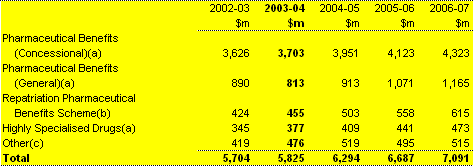
Expenses for this sub-function are forecast to increase from $5.8 billion in 2003-04 to $7.1 billion in 2006-07, or an average of around 5 per cent per annum in real terms. The growth in the forward years includes the impact of measures announced in the 2002-03 Budget to slow growth. It should be noted, however, that legislation to give effect to the 2002-03 Budget measure to increase the cost of patient co-payments, and reduce expenses accordingly, has not yet been passed.
Major components of the Pharmaceutical Benefits Sub-function are examined in more detail below.
|
Box 6.1: Pharmaceutical Services and Benefits Table 8.1: Trends in major components of the Pharmaceutical Benefits Sub-function
|
Aboriginal and Torres Strait Islander health
The Commonwealth funds a network of community controlled primary health care services for Aboriginal and Torres Strait Islander people. Commonwealth funding also supports a range of specialist services including mental and sexual health, and hearing services. The Commonwealth also works with State and Territory governments and other stakeholders in the planning and funding of Aboriginal and Torres Strait Islander specific health services.
Funding for Aboriginal and Torres Strait Islander health will grow at 5.5 per cent in real terms over the forward estimates period. This area of expenditure is subject to a review in the 2004-05 Budget.
Health services
Expenses under the Health Services Sub-function include funding for the provision of blood and blood products, population health programmes, and development of Mental Health Care strategies. From 1 July 2003, the National Blood Authority will manage the collection, production and distribution of blood and blood products in a new arrangement in which the Commonwealth contributes 63 per cent of the total cost and the States and Territories contribute 37 per cent.
Expenses for health services are forecast to grow only slowly over the forward years to 2004-05 and to decline slightly in 2005-06, in part due to the conclusion of the Alcohol Education and Rehabilitation Programme.
Other health services
Expenses under the Other Health Services Sub-function include medical research grants administered by the National Health and Medical Research Council (NHMRC), and funding for promotion of public health under the Public Health Outcome Funding Agreements between the Commonwealth and the States and Territories.
The increase in expenses for this sub-function is in part due to increased funding for health and medical research through the NHMRC. The increase arises from the Government's response to the Wills Review contained in the 1999-2000 Budget, in which the Government committed an additional $600 million over six years (from 1999-2000) to health and medical research.
The increases in Other Health Services funding which are population demand driven include the National Diabetes Services Scheme, stoma appliances and hearing services. Increases that are attributable to parameter changes include regional health services and community service obligations under the Hearing Services Programme.
General administration
Expenses under this sub-function include: programmes to support training and education of health workers; the development of acute and primary care strategies; and part of the general departmental expenses of DoHA and the Health Insurance Commission (HIC).
HIC operates under a purchaser-provider relationship with DoHA, DVA and other client agencies. It is responsible for the payments, under Medicare and other programmes (for example the Family Assistance Office), to the public and collates and publishes data on the MBS, PBS and RPBS. HIC also has a monitoring and enforcement role - for example, ensuring that providers of services are billing Medicare correctly and that pharmaceuticals are being prescribed in accordance with PBS criteria.
Health assistance to the aged
Expenses under this sub-function include the Community Nursing Programme and Community Care Grants administered by DVA. The Community Nursing Programme provides support for veterans, war widow(er)s and their dependants in improving their health and in regaining and maintaining an optimal level of independence in their homes. The growth in expenses reflects increasing demand due to the frailty of the veteran population, and the trend towards shorter hospital stays.
Social security and welfare
Table 9 has been updated and is available for download in Portable Document Format.
Table 9: Summary of expenses
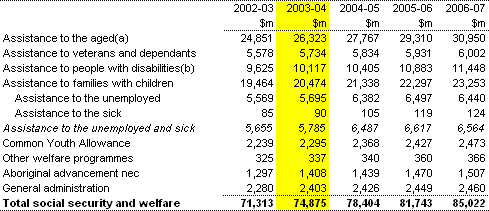
- The bulk of Department of Health and Ageing and Department of Veterans' Affairs expenses relating to assistance to the aged are classified to this sub-function.
- Assistance to People with Disabilities now includes CRS Australia administrative costs. Previously CRS Australia (formerly the Commonwealth Rehabilitation Service) was classified under General Administration.
This function includes expenses from the following portfolios:
- Attorney-General's;
- Family and Community Services;
- Health and Ageing;
- Immigration and Multicultural and Indigenous Affairs; and
- Veterans' Affairs.
Nature of expenses and major trends
Social Security and Welfare expenses primarily support the promotion of a fair and cohesive society while improving the capacity of families, communities and individuals to support themselves. The function includes services to the aged, services to the unemployed, assistance to people with disabilities, a variety of assistance to families with children, income support and compensation for veterans and their dependants, and advancement programmes for reconciliation and more generally for Aboriginal and Torres Strait Islander people.
Priorities within the Social Security and Welfare Function have moved away from universal provision of benefits to an approach to welfare assistance that emphasises prevention, early intervention, and mutual obligation in the provision of assistance to recipients.
Social Security and Welfare expenses are estimated to total around $74.9 billion in 2003-04 and grow moderately over the forward years. The major factors contributing to this growth are increases in expenses covering assistance to the aged, assistance to families with children and assistance to people with disabilities. The main driver for growth in these expense categories is the indexation of payments, including maintaining the single rate of Age Pension and Disability Pension at a minimum of 25 per cent of Male Total Average Weekly Earnings (MTAWE). In addition, demographic and social factors, such as the ageing of the population, will contribute to future growth.
Assistance to the aged
Expenses within this sub-function provide income support for aged people and their dependants as well as funding for residential aged care, community care for older Australians, and flexible care services for older Australians who live in regional, rural or remote areas.
The Age Pension contributes to the majority of the expenses in this sub-function and hence is the main contributor to growth. Growth in the Age Pension is being driven primarily by indexation, due to the Government's commitment to maintain the single rate of Age Pension at a minimum of 25 per cent of MTAWE, and to a lesser extent by increases in recipient numbers.
Growth in expenses for Community Aged Care Packages, Home and Community Care Packages and Residential Care is driven by the ageing of the population and associated costs of providing appropriate care for older Australians in a range of care settings.
Assistance to veterans and dependants
The expenses in this sub-function provide income support and compensation, in the form of pensions, to veterans and their dependants for incapacity or death resulting from war or defence service. The main contributors to expenses in this sub-function are the Service Pension, War Widows Pension and the Disability Pension administered by the DVA.
Increasing expenses in this sub-function reflect more widows becoming eligible for the War Widows Pension due to the increasing mortality of the veteran population and Disability Pension recipients moving to higher rates of disability due to ageing and increased frailty. This is partially offset by a decrease in Service Pension expenses that is reflecting the increasing mortality of the ageing veteran population. Growth in all three pensions slows in the medium to long term.
For other significant expenses on veterans see the Health Function - Medical Services and Benefits, Hospital Services, Pharmaceutical Services and Benefits and Health Assistance to the Aged Sub-Functions.
Assistance to people with disabilities
Expenses for this sub-function provide means-tested income support to people with disabilities as well as partners, parents and other carers of people with disabilities, assistance with employment-related transport costs and services which increase the independence and employment opportunities of people with disabilities. This sub-function includes payments such as the Disability Support Pension, the Wife Pension, disability employment assistance and contributions to the States and Territories under the Commonwealth State and Territory Disability Agreement.
Growth in the expenses for this sub-function is due largely to increasing Disability Support Pension payments resulting from the indexation of payments, including the Government's commitment to maintain the single rate of pension at a minimum of 25 per cent of MTAWE.
This pension payment has historically experienced strong growth in the number of recipients, partly associated with the ageing of the population. However, the 2002-03 Budget measure Recognising and Improving the Capacity of People with a Disability will, subject to the successful passage of legislation, reduce the number of new claims approved for the Disability Support Pension from 1 July 2003. Most unsuccessful claimants will move onto other more appropriate income support payments, such as Newstart Allowance, which is reported under the Assistance to the Unemployed and the Sick Sub-function. This movement will result in an increase in the expected growth of expenses in that sub-function. Existing recipients of the Disability Support Pension will not be affected by these changes.
Assistance to families with children
Expenses under this sub-function ensure that families with children receive financial assistance towards the support of their children. The majority of these expenses are paid through Family Tax Benefit (FTB) Parts A and B, Parenting Payments (Partnered and Single) and Child Care Benefit.
FTB Parts A and B provide means-tested financial assistance to families with the cost of raising children, while the Parenting Payment provides means-tested financial assistance to people who are primary carers of children. The Child Care Benefit payment provides assistance with the cost of child care for long day care, family day care, occasional care, outside school hours care, vacation care and registered care.
The growth in this sub-function is due to a combination of indexation of the payments (FTB and Child Care Benefit) by the CPI, increasing use of child care services by Child Care Benefit recipients and increasing Parenting Payment (Single) expenses. Parenting Payment (Single) expenses are increasing due to a combination of growth in new claims for this payment and indexation of the payment, which includes the Government's commitment to maintain the pension at a minimum of 25 per cent of MTAWE. However, growth in Parenting Payment (Single) is projected to slow after the Helping Parents Return to Work measure in Australians Working Together is implemented in September 2003.
Assistance to the unemployed and the sick
Income support is provided to persons who are unemployed, or unable to work because of temporary incapacity, and who have limited alternative means of support. The major payments made under this sub-function are Newstart Allowance, Partner Allowance, Mature Age Allowance and Sickness Allowance.
Expenses for this sub-function are expected to increase between 2003-04 and 2004-05, largely as a result of the 2002-03 Budget measure Recognising and Improving the Capacity of People with a Disability. Subject to the successful passage of legislation, this measure will result in a movement of claimants from Disability Support Pension, which is reported under the Assistance to People with Disabilities Sub-function, on to Newstart Allowance with related increases expected in Sickness Allowance. The closure of Mature Age Allowance and Partner Allowance to new entrants from 20 September 2003 will also contribute to growth in recipients for Newstart Allowance. The slight decline in real terms in expenses exhibited between 2004-05 and 2005-06 and the decline between 2005-06 and 2006-07 are driven by forecasts for unemployment benefit recipient numbers which show a decline between these two years.
Common youth allowance
Expenses under this sub-function relate to Youth Allowance, which is designed to provide income support payments to students under twenty-five years of age and unemployed people under twenty-one years of age. Receipt of the allowance requires recipients to engage in education, training, job search or other activities that contribute to society.
Expenses for this sub-function are driven by indexation of Youth Allowance and forecasts of youth unemployment and student numbers. While the forecast numbers of eligible full-time students are expected to remain stable, unemployment numbers are projected to fall. This trend is partially offset by increasing Youth Allowance payments associated with the repeal of the Student Financial Supplement Scheme (SFSS). Students on Youth Allowance will no longer be able to forgo part of their benefit entitlements to obtain an SFSS loan - see the Student Assistance Sub-function (Education Function).
Other welfare programmes
The major expenses for this sub-function are Special Benefit payments and Widow B Pension (delivered by the Department of Family and Community Services) and settlement services for migrants and refugees (delivered by the Department of Immigration and Multicultural and Indigenous Affairs). Increases in 2003-04 and across the forward years are due to expected increased expenses for Special Benefit, which provides income support payments to those in severe financial need who do not satisfy eligibility requirements for other payments. The number of Special Benefit recipients is expected to increase over the forward years as eligibility for other payments change, including the closure of entry to Partner Allowance and Mature Age Allowance from July 2003, and with the implementation of the Parent Migration Intake Measure initiative in July 2003.
This increase is partially offset by the reduction in expenses for Widow B Pension, which was closed to new claims in 1997. Widow B Pension is payable to previously married women who do not have dependent children and who were aged 50 years or more, or were sole parent pensioners aged 45 years or more, at 1 July 1987.
Aboriginal advancement (nec)
A wide range of programmes targeting economic, social and cultural outcomes for indigenous people are delivered within this sub-function. Many of the programmes are intended to supplement, support or accelerate the delivery of services to indigenous people where prime responsibility for service delivery rests with other Commonwealth agencies or State, Territory and Local Governments.
The majority of expenses relate to programmes previously delivered by the Aboriginal and Torres Strait Islander Commission (ATSIC), in particular the Community Development Employment Projects Scheme ($518.9 million in 2003-04) and the Community Housing and Infrastructure Programme ($257.8 million in 2003-04). Following the Government's decision to separate programme delivery from the priority and policy making role performed by the ATSIC elected arm, these programmes will in future be managed by a new agency: Aboriginal and Torres Strait Islander Services.
Expenses are expected to increase over the Budget and forward years. Growth within the Community Development Employment Projects Scheme of 550 participants per annum, together with the addition of 1,000 places in the 2003-04 Budget, contribute approximately 60 per cent of the increased expenses within this sub-function. Measures announced in the 2001-02 Budget targeting housing, native title and FBT supplementation for Aboriginal and Torres Strait Islander organisations explain the remaining growth of expenses over the forward years.
For other significant expenses on aboriginal programmes see the following sub-functions: Schools (Education Function), Aboriginal and Torres Strait Islander Health (Health Function), Housing (Housing and Community Amenities Function) and Labour Market Assistance to Jobseekers (Other Economic Affairs Function).
General administration
Expenses within this sub-function consist almost entirely of administration costs associated with the Social Security and Welfare Function spread across agencies, mainly Centrelink, the Department of Family and Community Services, and a proportion of expenses of the DoHA.