



General public services
Table 4 has been updated and is available for download in Portable Document Format.
Table 4: Summary of expenses
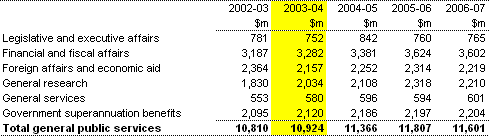
This function includes expenses from the following portfolios:
- Attorney-General's;
- Defence;
- Education, Science and Training;
- Employment and Workplace Relations;
- Environment and Heritage;
- Finance and Administration;
- Foreign Affairs and Trade;
- Health and Ageing;
- Immigration and Multicultural and Indigenous Affairs;
- Industry, Tourism and Resources;
- Parliamentary Departments;
- Prime Minister and Cabinet;
- Transport and Regional Services;
- Treasury; and
- Veterans' Affairs.
Nature of expenses and major trends
General public services include expenses on activities concerned with the organisation and operation of government. The function covers legislative and executive affairs, financial and fiscal affairs, foreign economic aid, general research, general services and government superannuation benefits.
Overall there is a moderate growth in the function over the forward estimates with growth in some sub-functions partly offset by declines in others. Growth in research grants under the General Research Sub-function contributes to the overall increase in expenses over the period. Other contributors to increases in the forward years are the preparations for the 2006 Census, the anticipated cost of a federal election in 2004-05, and the expected increases in foreign aid commitments in 2004-05 and 2005-06.
Legislative and executive affairs
Expenses under this sub-function cover: support services for Senators and Members of Parliament; the funding of elections; expenses of the various Parliamentary Departments; drafting of bills by the Office of Parliamentary Counsel; and expenses of the Department of the Prime Minister and Cabinet (including support services for former Governors-General and the Prime Minister's official residences), and the Office of the Official Secretary to the Governor-General.
The fall in expenses between 2002-03 and 2003-04 reflects the conclusion of the Royal Commission into the Building and Construction Industry and the Royal Commission into the Failure of the HIH Insurance Group as well as the conclusion of the National Security Awareness campaign. The subsequent rise in 2004-05 reflects the additional expenses expected to be incurred by the Australian Electoral Commission for the cost of a federal election expected in that year.
Expenses for the Parliamentary Departments are expected to rise slightly in 2003-04 reflecting enhanced security arrangements for Parliament House. Expenses are then expected to remain stable from 2004-05 to 2006-07.
Financial and fiscal affairs
These expenses are related to the collection of taxes (including customs duties), management of public funds and public debt, monetary and fiscal policy, and formulation and review of government budgets. They exclude expenses related to the collection of licenses, fees and fines that are associated with a specific function, and interest payments classified to the Public Debt Interest Sub-function (Other Purposes Function).
Expenses in this sub-function tend to increase across the years, largely due to the increase in expenses relating to the ATO, to improve its services and compliance, for which they received additional funding in the 2002-03 Budget, following the recommendations of an independent pricing review. This is partially offset by a decrease in expenses between 2002-03 and 2003-04 resulting from the Government's decision to wind-up Employment National during this period, as well as lower commitments relating to DASFLEET leasing contracts, which are anticipated to fall over the forward estimates as residual leases expire.
Other factors affecting the estimates in the forward years include increased funding for the Australian Bureau of Statistics in 2005-06 and 2006-07 for the 2006 Census and a one-off increase in 2005-06 in the Commonwealth's contributions to the State and Territory governments for debt redemption, representing a final payment of debt redemption grants.
Foreign affairs and economic aid
Foreign Affairs and Economic Aid Sub-function expenses include both aid and non-aid components primarily from the Department of Foreign Affairs and Trade (DFAT) and the Australian Agency for International Development (AusAID). The overseas aid component covers expenses for which the primary purpose is to fund concessional and non-concessional assistance to other countries. The non-aid component covers the expenses used for the operations of the foreign service, the conduct of foreign and international trade relations (excluding trade promotion activities) and contributions to international organisations not resulting in the recognition of a financial asset. For example, expenses associated with the United Nations (UN), including for its peacekeeping operations, would be attributed to this sub-function.
Fluctuations of expenses in the Foreign Affairs and Economic Aid Sub-function are generally driven by the timing and magnitude of commitments the Commonwealth makes to multilateral aid. The decrease in expenses in 2003-04 from 2002-03 results from the Commonwealth not expecting to enter into any new significant multilateral aid commitments during this period. Conversely, the increase in expenses in 2004-05 largely results from the expected commitment to the Initiative for Heavily Indebted Poor Countries, which is designed to support poor countries pursuing sustainable development and reducing poverty by providing debt relief. The subsequent increase in 2005-06 results from the Commonwealth's expected commitment to the Global Environment Facility, which is designed to help developing countries protect the global environment. The decrease in expenses in 2006-07 results from the Commonwealth not expecting to enter into any new major multilateral aid commitments during that period.
General research
The General Research Sub-function covers expenses associated with scientific knowledge and its application. This includes the expenses incurred by Commonwealth research authorities such as the Commonwealth Scientific and Industrial Research Organisation (CSIRO) and the Australian Nuclear Science and Technology Organisation (ANSTO). Also included are general research programmes, such as grants for research and research infrastructure in higher education institutions, grants provided through the Australian Research Council, Major National Research Facilities and contributions to Cooperative Research Centres.
General research expenses increase by an average real rate of 3 per cent per annum for the period 2002-03 to 2006-07. This increase is primarily attributable to increased funding provided by Backing Australia's Ability (BAA).
In 2003-04 the Government will be evaluating the BAA programme. A major science and innovation mapping exercise is also under way. In light of these processes, more detailed consideration of the BAA initiatives beyond 2005-06 will be undertaken in the 2004-05 Budget. Funding has, however, been provided in 2006-07 for several BAA initiatives which involve multi-year competitive grants and that require future funding certainty to ensure their continued efficient administration in 2003-04.
Programmes supporting research in specific sectors are generally included under the relevant function. For example, health research is included in the Other Health Services Sub-function (Health Function).
General services
The General Services Sub-function covers expenses relating to the administrative processes of government not classified elsewhere, including the provision of real property, centralised employee compensation (provided by Comcare) and centralised insurance arrangements for Commonwealth departments and agencies.
Comcare's expenses relate to the management of occupational health and safety, rehabilitation and workers' compensation claims management for the Commonwealth jurisdiction. Expenses increase marginally over the forward years to reflect small increases in expected workers' compensation claim costs.
This sub-function also includes expenses incurred by the Department of Finance and Administration in managing the Commonwealth's domestic property portfolio, providing insurance services to the Commonwealth Public Sector, and maintaining the financial regulatory framework for the Commonwealth.
Expenses for this sub-function are expected to remain stable across the forward estimates.
This sub-function also includes:
- expenses associated with the provision of services and infrastructure in the Indian Ocean Territories funded through the Transport and Regional Services portfolio - these expenses are expected to remain stable over the forward years; and
- expenses relating to the operations of the Australian Public Service Commission in the Prime Minister and Cabinet portfolio - these expenses are also expected to remain stable over the forward years.
Government superannuation benefits
The Government Superannuation Benefits Sub-function covers the Commonwealth's superannuation schemes for its employees, military personnel and Senators and Members of Parliament. The expenses include the accruing liability in relation to current year employment and the administration of the schemes.
The major Commonwealth civilian superannuation schemes are the Public Sector Superannuation Scheme (PSS) and the Commonwealth Superannuation Scheme (CSS), and the Parliamentary Contributory Superannuation Scheme for Parliamentarians. The Military Superannuation and Benefits Scheme and the Defence Force Retirement and Death Benefits Scheme cover military personnel.
Expenses under this sub-function are forecast to grow only relatively slowly over the forward years. The assumed impact of the closure of the PSS to new members and the introduction of choice from 1 July 2004 reduces estimated expenses for Commonwealth civilian schemes. This is offset by a matching increase in estimated expenses for external schemes. This sub-function does not include the nominal interest on the unfunded liabilities of the Commonwealth superannuation schemes. These expenses are included under Nominal Superannuation Interest Sub-function (Other Purposes Function).
Defence
Table 5: Summary of expenses

This function includes expenses from the following portfolio:
- Defence
Nature of expenses and major trends
Expenses in this function are within the Defence portfolio and support operations and the delivery of navy, army, air and intelligence capabilities and strategic policy in the defence of Australia and its national interests.
The main components of these expenses are:
- personnel costs (excluding superannuation liability), which include the payment of salaries and allowances to Defence military and civilian staff (totalling $6.6 billion in 2003-04);
- investment in specialist military equipment of $4.0 billion in 2003-04. This includes continuing projects like Airborne Early Warning and Control aircraft, Armed Reconnaissance helicopters and ANZAC ships, as well as new projects to be started in 2003-04;
- equipment maintenance costs and the acquisition of stores, including ammunition and fuel, required to maintain the operations of the Australian Defence Force (ADF); and
- housing for eligible ADF personnel and their families, largely comprising payment of rent to the Defence Housing Authority.
Total annual expenses for the Defence Function rise by $2.4 billion over the period to 2006-07. In real terms, the growth in expenses for this function is 2.2 per cent a year on average.
The growth and pattern of expenses mainly reflects:
- the influence of significant funding increases for investments in capability announced by the Government in Defence 2000 - Our Future Defence Force (the 2000 White Paper);
- variations in funding levels for major ADF deployments, most of which are due for completion by 2004-05;
- additional funding provided in this Budget to meet the costs of logistical support for specialist military equipment, the purchase of spare parts and for the purchase of ordnance for training; and
- changes in funding to compensate for price and foreign exchange rate movements, with the main influence being the recent appreciation in the Australian dollar.
Defence
The 2000 White Paper provided a long-term defence funding commitment. The Government committed to increases in underlying defence spending of $500 million in 2001-02, $1 billion in 2002-03 and an average of 3 per cent annually in real terms thereafter. This represents a total spending increase of over $27 billion in current prices over the decade 2001-02 to 2010-11.
The actual increase in spending year by year is affected by Government decisions subsequent to the 2000 White Paper to provide funding for particular purposes. The main variations in funding around the underlying long-term growth are:
- Reductions in funding (of over $100 million from 2002-03 to 2004-05) due to the winding down of the Defence Force commitment in East Timor;
- Changes in funding associated with phases of the War Against Terrorism. This includes reductions due to the completion of deployments under Operations Slipper and Damask to the Gulf and Afghanistan (which cost $194 million in 2002-03) and the impact of funding for operations and defence post-conflict rehabilitation activities in Iraq ($645 million over three years, including $421 million in 2002-03, $198 million in 2003-04, and $26 million in 2004-05);
- Funding provided in this Budget to meet logistics and support costs. The Government has provided additional funding of $1,145 million in 2002-03 and the Budget and forward years, including $101 million in 2002-03, $244 million in 2003-04, $286 million in 2004-05, $285 million in 2005-06, and $229 million in 2006-07;
- A revision to the estimate of funding needed in 2003-04 to compensate for the effects of price and foreign exchange rate movements. This revision is largely due to the recent appreciation in the Australian dollar. This has resulted in a reduction in estimated expenditure of approximately $100 million in 2003-04 below the funding provided for this purpose in 2002-03. Estimates of the impacts of forward year movements in exchange-rate related parameters are recorded against the Contingency Reserve rather than specific functions;
- The expansion of Australia's Special Forces counter terrorist capability by establishing a new Special Operations Command in the ADF. The new capability will cost $156.8 million over four years; and
- The acceleration of growth in ADF numbers. Funding of $102.8 million over three years will be provided for additional personnel to accelerate the achievement of the White Paper targets for higher ADF personnel membership.
Expenses related to the accruing superannuation liability for current Defence staff are shown in the Government Superannuation Benefits Sub-function (General Public Services Function) while the nominal interest on unfunded liabilities of the Commonwealth superannuation schemes is included under the Nominal Superannuation Interest Sub-function (Other Purposes Function).
Public order and safety
Table 6: Summary of expenses

This function includes expenses from the following portfolios:
- Attorney-General's;
- Foreign Affairs and Trade; and
- Prime Minister and Cabinet.
Nature of expenses and major trends
Expenses for the Public Order and Safety Function support the administration of the Federal legal system and the provision of legal services, including legal aid, to the community. Public Order and Safety expenses also include law enforcement activities and the protection of Commonwealth property.
As a result of the 12 October 2002 terrorist attacks in Bali, the Government will introduce new domestic security arrangements and programmes. This will include new funding for the Australian Federal Police (AFP), Australian Customs Service (Customs), Attorney-General's Department, the Australian Security Intelligence Organisation (ASIO) and the Australian Crime Commission (ACC).
Courts and legal services
Expenses under this sub-function include payments for Federal courts and tribunals. They also include expenses for the administration of bankruptcies by the Insolvency and Trustee Service Australia, operational expenses for the Office of the Director of Public Prosecutions, and the Commonwealth's contribution to funding for state legal aid commissions.
Expenses for the Courts and Legal Services Sub-function grow only slowly through to 2006-07.
Other public order and safety
This sub-function incorporates all other expenses on public order and safety activities.
Included under this sub-function are the operations of ASIO, the Australian Secret Intelligence Service, the Office of National Assessments, and the operations of the Office of the Inspector-General of Intelligence and Security. These agencies collect and assess information relevant to the protection of Australia against threats to its national interests and help provide counter-terrorist training and equipment.
Other agencies which are part of this sub-function include, but are not limited to, the AFP, the Australian Institute of Criminology, the ACC and the Australian Transaction Reports and Analysis Centre.
The Other Public Order and Safety Sub-function incorporates the Customs activities relating to the movement of people and goods across Australia's borders. The sub-function also includes Customs' Coastwatch unit which is responsible for the aerial surveillance of Australian Coastal and Fishing Zone areas to enable detection of smuggling, illegal entry, unauthorised fishing and quarantine breaches.
The elevated levels of expenditure associated with the new security environment will be increased in 2003-04 and will then decline in the following years as initiatives implemented following the 11 September 2001 and Bali terrorist attacks move beyond their establishment phase, thereby requiring lower levels of recurrent funding. These include initiatives announced in the 2002-03 Budget relating to aviation security, the identification of security threats, and increased capacity to respond to security threats.
A review of Australia's security capability following the events of 12 October 2002 resulted in the adoption of further domestic security programmes across a number of agencies including additional resources for increased security of overseas posts, airline liaison officers and a range of measures for security agencies.
Following the shootings at Monash University on 21 October 2002, the Council of Australian Governments agreed on 6 December 2002 to a national approach to restrict the availability and use of handguns, resulting in the national Handgun Buyback Programme. The buyback commences on 1 July 2003, peaking at $55.9 million in expenses in 2003-04, followed by a further $10.1 million in 2004-05 when the buyback concludes. This programme is reflected in the additional level of expenditure in 2003-04, and the decline in 2004-05.