



General government expenses
Reconciliation of expenses since the 2002-03 Budget
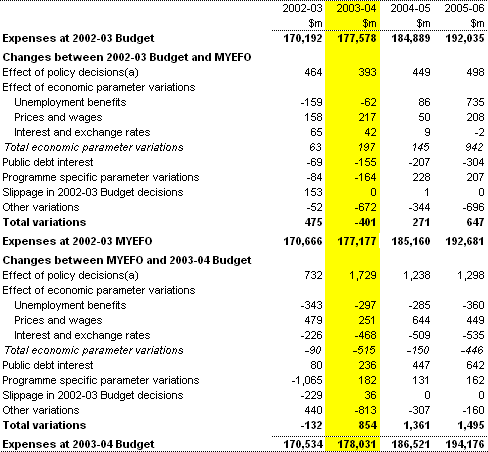
Table 2 provides a reconciliation of expenses estimates between the 2002-03 Budget, Mid-Year Economic and Fiscal Outlook 2002-03 (MYEFO) and the 2003-04 Budget, showing the effect of policy decisions and economic parameter and other variations.
Table 2: Reconciliation of expense estimates
- Excluding the public debt interest effect of policy measures.
Policy decisions
Policy decisions taken since the 2002-03 MYEFO have increased estimated expenses by around $1.7 billion in 2003-04. Major new expense policy decisions affecting 2003-04 include:
- an increase in Defence funding of $573 million in 2003-04 ($2.1 billion over five years) from 2002-03, including funding for Australia's contribution to the international coalition to disarm Iraq and post-conflict rehabilitation activities, and funding for maintenance and logistics support to sustain current high levels of preparedness;
- additional funding for drought relief in 2003-04 of $297 million, including income support and interest rate subsidies to assist farmers, small businesses and communities hardest hit by the drought. In total, the government expects to provide around $740 million in drought related financial support over the three years to 2004-05;
- increased spending of $160 million in 2003-04 to further enhance Australia's security arrangements, including upgrading the security of Australia's critical infrastructure and increased funding for Australia's intelligence agencies and protective security services;
- funding of $158 million in 2003-04 to improve the affordability and accessibility of medical services, under the A Fairer Medicare package; and
- additional funding of $66 million in 2003-04 (and $1.5 billion over the four years from 2003-04) to ensure the long-term sustainability of the higher education system.
Parameter and other variations
Parameter and other variations since the 2002-03 MYEFO have reduced estimated expenses in 2003-04 by around $0.9 billion. These include:
- a downward revision of $425 million in Defence expenses reflecting lower estimated Australian dollar acquisition costs associated with the recent appreciation of the Australian dollar;
- a fall in anticipated unemployment benefit expenses of $297 million, due to a reduction in the expected number of benefit recipients in 2003-04 following a lower than expected take up of benefits in 2002-03;
- a reduction in estimated Family Tax Benefit expenses of $231 million, largely due to the provision of higher income estimates by customers in 2002-03; and
- the regular draw-down of the conservative bias allowance reducing estimated expenses by around $875 million each year from 2003-04.
These variations are partly offset in 2003-04 by:
- increased personal benefits expenses of $343 million due to an upward revision to forecast Male Total Average Weekly Earnings, reflecting the Government's ongoing commitment to maintain selected pensions at 25 per cent of Male Total Average Weekly Earnings;
- increased superannuation related expenses of $316 million, largely resulting from an actuarial review of the Commonwealth's civilian superannuation schemes, which has led to an incorporation of factors such as the effect of redundancy costs, lower than previously estimated mortality rates, and an increased take-up of more generous early retirement options.
Role of Intergenerational Reports and Statement 6 The Charter of Budget Honesty Act 1998 requires that intergenerational reports be prepared and released approximately every five years. These reports are to assess the sustainability of current Government policies over a 40 year period (from time of publication), including taking into account the financial implications of demographic change. The most recent, and first, report was the 2002-03 Intergenerational Report (2002-03 Budget Paper No 5). Key themes in the 2002-03 report included, that:
Intergenerational reports provide a long-term focus on trends in government finances and their underlying determinants. Statement 6 provides a short to medium-term focus on expense trends and their underlying determinants. Consistent with this emphasis, much of Statement 6 focuses on year-on-year changes across the forward estimates. |
Expenses estimates by function
Table 3 sets out the estimates of Commonwealth general government expenses by function for the period 2002-03 to 2006-07.
Table 3 has been updated and is available for download in Portable Document Format.
Table 3: Estimates of expenses by function
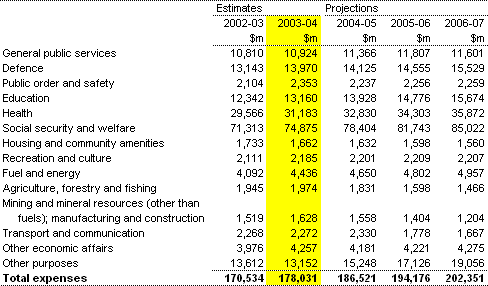
Major movements within the estimates of expenses by function between 2002-03 and 2003-04, and across the forward estimates, include increases in the following functions:
- Defence due to additional funding to support Australia's participation in Iraq, extra funding for maintenance and logistics support, and funding increases flowing from the Government's White Paper: Defence 2000 - Our Future Defence Force;
- Education reflecting the introduction of the Higher Education Reform package and the effect of indexation on Commonwealth schools funding;
- Health due to a steady increase in the use of medical and pharmaceutical services over the forward estimates period, increasing costs for the provision of medical services and a continuing trend towards newer and more expensive drugs under the Pharmaceutical Benefits Scheme;
- Social Security and Welfare due to the on-going effect of indexation of payments, as well as demographic and social factors which affect demand-driven programmes;
- Fuel and Energy reflecting increases in expenses for various fuel rebate and fuel grants schemes due to higher demand for diesel and other fuels as a result of increased levels of economic activity; and
- Public Order and Safety in 2003-04 due to initiatives to improve domestic security and the national Handgun Buyback Programme.
These effects have been partially offset by decreases in expenses over the forward estimates period for the following functions:
- Housing and Community Amenities due to the conclusion in 2002 of the additional First Home Owners Scheme, as well as the completion over the forward years of several regional assistance programmes, such as the Rural Transaction Centres Programme and the pilot Sustainable Regions Programme;
- Manufacturing and Mining due to the conclusion of various industry assistance programmes - for example the Textile Clothing and Footwear Strategic Investment Programme (TCF SIP);
- Transport and Communications due to the conclusion over the forward years of programmes designed to improve telecommunications service standards and broaden access to telephone and internet services in rural, regional and remote Australia and the conclusion of various road, rail and air transport initiatives - for example, the conclusion of the Roads to Recovery Programme in 2004-05;
- Agriculture, Forestry and Fishing, reflecting declines over the forward years as Exceptional Circumstances assistance to farmers and other drought relief measures decline with the expected return to normal seasonal conditions, and completion of enhanced quarantine border control initiatives;
Estimates presented in Table 3 above are more fully explained for each individual function below.