



Foreword
The Australian aid program advances our national interest by assisting developing countries to reduce poverty and achieve sustainable development. As outlined in my statement to Parliament in September 2002, Australian Aid: Investing in Growth, Stability and Prosperity, the program meets this objective through: an emphasis on promoting improved governance; assisting countries to access and maximise the benefits from trade and new information technologies; supporting stability through improved delivery of basic services; strengthening regional security; and promoting sustainable resource management. Recent world events, and a tight fiscal environment within Australia, reinforce these priorities and demand a flexible aid program that can respond quickly and effectively to emerging challenges confronting Australia's developing country partners.
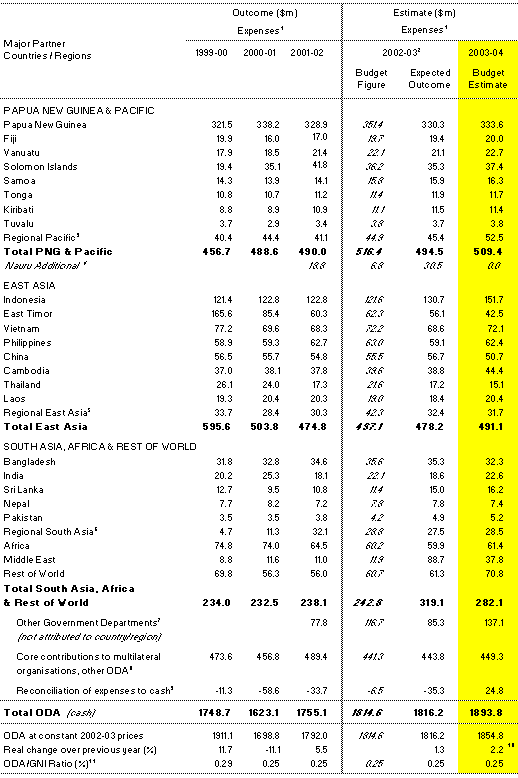
In 2003-04, the Australian Government will provide $1.894 billion as Official Development Assistance (ODA). This is an increase of $79 million over the 2002-03 figure of $1.815 billion. The ratio of Australia's ODA to Gross National Income (GNI) for 2003-04 is estimated at 0.25 per cent, placing Australia above the donor average which, in the latest year available (2002), is 0.23 per cent.
Promoting Regional Stability, Security and Economic Growth
Within the Asia-Pacific region, many countries are facing significant challenges to their stability and security. Conflict and instability impact directly on countries' development prospects. The aid program can, and does, provide a 'peace dividend' to encourage the cessation of hostilities and the start of constructive development. The threat of terrorism is also a major impediment to economic growth and development, reducing investment and business confidence, and impeding the delivery of effective government services. The Australian aid program will therefore continue to place a high priority on assistance to developing countries in the Asia-Pacific region, with a focus on good governance and enhancing partner governments' capacity to promote peace and manage non-military threats to security.
Key features of Australia's aid to the Asia-Pacific region in 2003-04 include:
- Increasing total aid flows to the Pacific to $176 million, a real increase of 4.3 per cent from the 2002-03 budget, with a continuing focus on good governance, peace building and strengthening capacity to deliver basic services to communities.
- The establishment of a Peace and Security Fund in the Pacific that will enable Australia to provide flexible and targeted assistance to directly address needs in post-conflict societies such as the Solomon Islands. The Fund, which will total $7.5 million in 2003-04, will also strengthen the broad security framework in the Pacific through initiatives to counter trans-national crime and terrorism.
- Substantially increasing total aid flows to Indonesia to $152 million to support improved governance and more effective delivery of basic services. Initiatives include increased support for counter-terrorism, a major program to improve the quality and accessibility of mainstream education services, and a package of measures to improve health services as a practical memorial to the victims of the Bali bombing. Australia will also provide substantial assistance for Indonesia's elections to be held in April 2004.
- Additional funding for regional counter-terrorism measures in East Asia. This includes activities in support of an APEC Leaders' initiative to halt terrorist financing, promote cyber security, and protect cargo, ships, aviation and people through improved border and customs controls.
- Continuing substantial support to Papua New Guinea to improve economic and public sector management, and maintain government services.
- To coincide with the International Year of Freshwater, an estimated $94 million will be provided in 2003-04 towards programs that enhance the sustainable management of water resources and services, with a focus on strengthening water planning and policy reform and improving access to water and sanitation services for the poor. Major new projects in water supply, sanitation, and water resource management will be implemented across the Asia-Pacific region, including in north-eastern India ($43 million) and Vietnam ($19.5 million).
Outside Australia's immediate region, the Australian aid program will continue to play a constructive role in international efforts to reduce poverty, especially in Africa. In 2003‑04 total aid flows to Africa are estimated to be $61 million, focusing on improved governance, including trade-related assistance to promote economic growth. The aid program will continue to respond flexibly to humanitarian needs, especially in southern Africa.
Responding to Humanitarian Crises
Emergencies and humanitarian crises will continue to place pressures on the aid budget. In 2003-04, funding for international humanitarian, emergency and refugee programs will increase to $132 million. This will further enhance the aid program's ability to respond quickly, flexibly and effectively to a range of humanitarian needs, within our region and around the world, especially those resulting from disasters and conflict.
The Government has indicated that Australia will make a strong humanitarian contribution, and play a significant and constructive role, in the reconstruction of Iraq. The Government has committed over $100 million to humanitarian relief and reconstruction. Early Australian assistance through international humanitarian partner organisations, especially UN agencies and the International Committee of the Red Cross, enabled them to respond quickly and effectively as humanitarian needs were identified in Iraq. Australia will have a longer-term focus on supporting the agriculture sector.
Australia will also continue to help those people in other parts of the world who are suffering from the effects of natural disasters, war and internal conflict. For example, Australia will continue to respond to food needs in Africa during the current severe famine. Australia will also provide peace building assistance to countries such as Afghanistan, Sri Lanka and the Solomon Islands.
Last year I initiated an International Refugee Fund to support programs of international agencies assisting refugees and internally displaced people. In 2003-04, this fund will continue to support programs of assistance to refugees and internally displaced people in the Asia-Pacific region.
Trade and Food Security
In 2003-04 the Australian aid program will support the objectives of the World Trade Organisation (WTO) Doha Development Round of multilateral trade negotiations by increasing trade-related assistance to developing countries by approximately 10 per cent. A package of trade-related assistance will include:
- contributions to the WTO Global Trust Fund established to ensure that developing country members of the WTO can take full advantage of the opportunities offered by the Doha Round of trade negotiations;
- additional funding to build south-east Asian countries' capacity in trade policy analysis and market access negotiations; and
- additional support for African regional trade initiatives, especially in agriculture.
Economic growth through trade liberalisation, particularly in agricultural products, is important in enhancing the food security of the world's poor. Latest estimates indicate that approximately 800 million people in the developing world are undernourished. Commencing in 2003-04, the Government is therefore pledging $1 billion of its ODA, over five years, to programs and initiatives that enhance the food security of people in the developing world.
A major threat to food security is the rapid decline in agricultural biodiversity, both from population pressure and land clearing, and the decreasing capacity of gene banks to conserve gene collections. In 2003-04, Australia is planning to join with other key donors in making a multi-year commitment of $16.5 million to the Global Conservation Trust (GCT). The nature and terms of Australia's engagement with the Trust are still under discussion. The GCT is a joint initiative of the Food and Agriculture Organisation and the Consultative Group on International Agricultural Research to provide secure funding for gene banks to conserve plant and genetic resources for food and agriculture around the world. This work is of great importance to developing countries, some of which have lost access to their national sources of seed stocks. It is also of significance to a country such as Australia which has a proud history of research associated with agricultural biodiversity.
Supporting Effective International Development Organisations
An important aspect of Australia's aid program is strengthening links with key international development organisations. I am particularly concerned that Australia work closely with those organisations that have a proven track record in supporting effective poverty reduction and development programs, are undertaking necessary reforms to enhance their effectiveness, and which demonstrate an appropriate focus on the Asia-Pacific region. To this end, I have increased funding to several UN agencies and the International Committee of the Red Cross. Additional targeted funding will also be available to these and other organisations through bilateral and regional initiatives.
Conclusion
The 2003-04 aid budget is a practical expression of Australia's commitment towards building a secure, stable and prosperous Asia-Pacific region. This budget enhances our capacity to respond quickly and effectively to emerging development challenges, both within our immediate region and internationally. This will ensure that Australia continues to make a valuable contribution to poverty reduction and sustainable development.

Alexander Downer
Table 1: Total Australian ODA flows to partner countries
Notes to Table 1
1 Shows total expenses, minus expenses to new multi-year liabilities (for example, the International Development Association (IDA) or the Heavily Indebted Poor Countries (HIPC) Initiative), plus cash payments for these multi-year liabilities. See Technical notes for more detail.
2 Total flow estimates for 2002-03 represent Budget Figures as estimated at May 2002 and Expected Outcomes as estimated at May 2003.
3 Regional Pacific includes multi-country and regional activities and small bilateral programs identified in Table 3.
4 Nauru Additional represents additional funding appropriated at Additional Estimates for 2001-02 ($18.8 million), and a New Budget Measure ($6.8 million) plus Additional Estimate funding in 2002-03 ($23.7 million).
5 Regional East Asia includes multi-country and regional activities and small bilateral programs identified in Table 3.
6 Regional South Asia includes multi-country and regional activities and small bilateral programs identified in Table 3.
7 Other Government Departments (OGDs) not attributed to country/region includes ODA eligible expenditure by OGDs that has not been allocated to a specific geographic area.
8 Core contributions to multilateral organisations, other ODA expenditure includes expense payments which cannot be attributed to a particular country such as payments to some UN and Commonwealth organisations, and Departmental expenditure. The ODA eligible components of cash payments to IDA, ADF, IFAD, GEF, HIPC and the MPMF are also included in this line item.
9 See Technical notes for an explanation of the relationship between expenses and cash.
10 Real per cent change over 2002-03 Budget Figure of $1,814.6 million.
11 See Technical notes for an explanation of the change in terminology from GNP to GNI.