



Chapter One: Focus of the aid program
The Australian aid program advances Australia's national interest by assisting developing countries to reduce poverty and achieve sustainable development. The program focuses on countries in the Asia-Pacific region where two-thirds of the world's poor live. This focus reflects Australia's strong engagement with and commitment to the region, its stability and its prosperity. While concentrating on East Asia, Papua New Guinea and the Pacific island countries, Australia's aid program is also engaged selectively in South Asia, Africa and the Middle East.
Practical support for governance and policy reforms underpins economic growth, creating better frameworks for private sector growth and supporting investments in infrastructure and people. By promoting development that is sustainable, Australia is making a major contribution to regional growth, security and stability.
In 2003-04, Papua New Guinea will continue to receive the largest single allocation of Australian aid. Aid program expenditure in the Pacific and East Asia will increase in comparison to 2002-03. Total flows to South Asia and Africa are expected to remain consistent compared with 2002-03.
Diagram 1: Total Australian aid in 2003-04
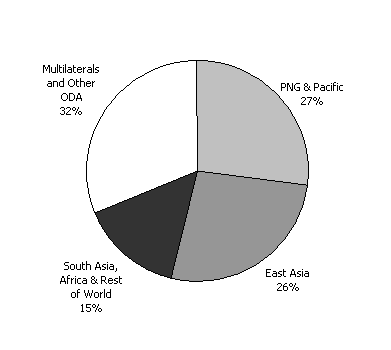
Note: 'Multilaterals and Other ODA' includes for example, expense payments which cannot be attributed to a particular country, such as payments to some UN and Commonwealth organisations and Departmental expenditure.
Diagram 2: Trends in total Australian aid by region
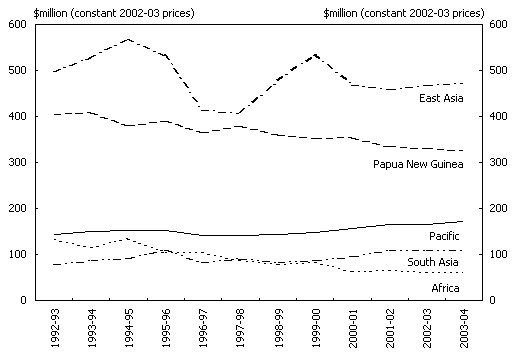
Note: Figures for 2002-03 and 2003-04 are estimates.
Diagram 3: ODA/GNI ratio of Australia and DAC weighted average
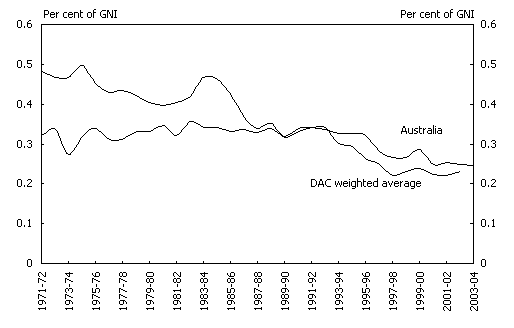
Note: DAC figure for 2002 is provisional
Key themes of the aid program
Australia's aid program serves the national interest by fostering growth, poverty reduction, peace and stability in the region and addressing trans-national threats to Australia's security. Five guiding themes shape Australia's efforts to assist developing countries to reduce poverty and achieve sustainable development. These themes provide a lens through which aid is programmed and implemented:
- Governance: promoting democratic and accountable government and effective public administration;
- Globalisation: assisting developing countries to access and maximise the benefits from trade and new information technologies;
- Human Capital: supporting stability and government legitimacy through improved basic services;
- Security: strengthening regional security by enhancing partner governments' capacity to prevent conflict, enhance stability and manage trans-boundary challenges; and
- Sustainable Resource Management: promoting sustainable approaches to the management of the environment and the use of scarce natural resources.
Diagram 4: Estimated sectoral breakdown of Australian aid 2003-04
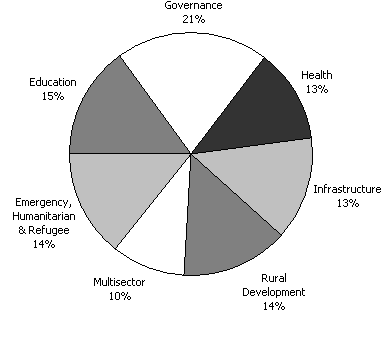
Note: 'Multisector' includes direct expenditure on areas such as gender, environment and food security
Supporting these themes are policy frameworks in key sectoral and program areas, notably: good governance; humanitarian assistance; peace, conflict and development; health; HIV/AIDS; food security; rural development; private sector development; human rights; information and communication technologies and environmental management.
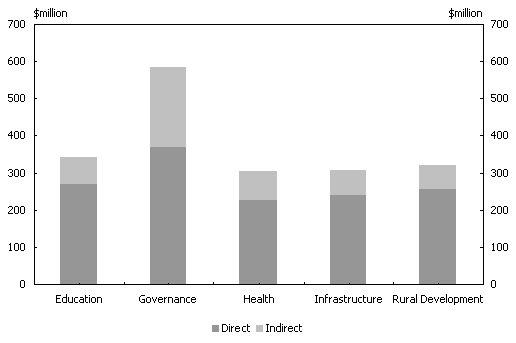
Diagram 5: Estimated expenditure by key sector 2003-04
Governance
The development of sound governance systems is fundamental to growth, stability and prosperity in all countries. Democratic and accountable government lays the foundation for effective community participation in development. Improved governance requires investments in effective institutions of government and public administration and enabling policy and regulatory frameworks. The benefits are seen in private sector growth and improving living standards. The development of good governance approaches is not restricted to central government agencies but also must be adopted by service delivery areas of partner governments, local administrations, civil society and the private sector.
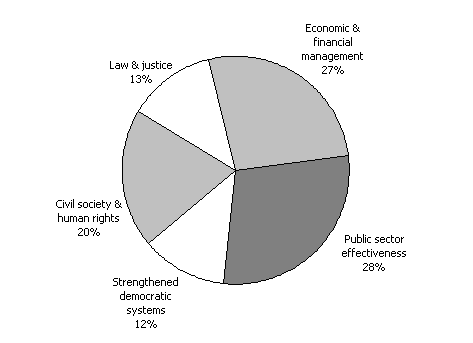
Australia is a strong advocate for good governance in the region. Australian assistance for improved governance focuses on five key aspects:
- improved economic and financial management;
- strengthened law and justice;
- increased public sector effectiveness;
- development of civil society; and
- strengthened democratic systems.
Governance activities comprise the largest component of the Australian aid program. In 2003-04, an estimated $370 million, or 21 per cent of total aid expenditure will support governance programs and activities that promote open and efficient markets; enhance competition; combat corruption; secure property rights and the rule of law; protect human rights; and encourage civil society participation.
Diagram 6: Estimated Australian assistance to the governance sector 2003-04
Australia has established responsive mechanisms in many partner countries to support improved governance. As well as building on the existing governance activities across the aid program, Australia will respond to growing reform agendas in China, Vietnam and Indonesia. Assistance to PNG and the Pacific islands will continue to focus on economic, legal and public sector reforms. The Pacific Media Initiative implements good governance principles by strengthening the capacity and building awareness of the responsibilities of journalists and media organisations.
A further focus of governance activities will be on tailored approaches to assist poor performing states in our region. Australia will implement a graduated range of engagement strategies and incentives that will encourage reform and help to reduce the effects of weak systems on the poor.
Globalisation
Australia is working to maximise the benefits and minimise the challenges presented to developing countries by globalisation. Technical assistance, capacity building and policy dialogue in trade, investment and information communication technologies are important in promoting active participation in the global community. The Pacific, Asia and Africa regional programs will increase efforts to facilitate open trading systems, encourage investments and economic reform, and strengthen developing country capacities to integrate in the global economy.
Information and communication technologies are crucial in our increasingly globalised world. Australia recognises that affordable access to information and knowledge is vital to development. Australia is implementing its commitment to the Virtual Colombo Plan (VCP) made in August 2001 of $200 million over five years to help bridge the digital divide by supporting the development and adoption of information technologies in developing countries. In 2003-04, the VCP will continue to strengthen the interactive Global Development Learning Network (GDLN). Australia's early leading role in the establishment of the network has helped to enlist broader international support for the content and facilities of the GDLN. The Development Gateway internet portal will also be expanded to create Australia's premier site on development. This site can be found at: <http://www.developmentgateway.com.au>.
Trade and Development
Trade liberalisation has the potential to lift millions of people out of poverty. If developing countries increased their share of world exports by five per cent, this would generate $677 billion per year - seven times as much as they receive in aid. As the World Trade Organisation's (WTO) Doha Development Round of multilateral trade negotiations approaches its mid-way point at the Cancun Ministerial Meeting in September 2003, trade-related assistance will remain critical for developing countries.
Between 1996-97 and 2002-03, aid funding for direct trade-related technical assistance and capacity building has increased by more than 55 per cent. Estimated expenditure will reach $31 million in 2003-04. A package of trade-related assistance will include:
- contributions to the WTO Global Trust Fund established to ensure that developing country members of the WTO can take full advantage of the opportunities offered by the Doha Round of trade negotiations;
- additional funding to build south-east Asian countries' capacity in trade policy analysis and market access negotiations; and
- additional support for African regional trade initiatives, especially in agriculture.
Trade-related support to developing countries extends beyond direct technical assistance. From 1 July 2003 Australia will provide tariff and quota free access for all goods produced in the 49 Least Developed Countries. These arrangements will also include East Timor.
Human Capital
The effective participation of all people in economic activity is fundamental to reducing poverty and achieving sustainable development. This 'human capital' dimension of development can only be sustained with reliable access to basic services, including water and sanitation, health care and education. Australia recognises and supports developing country efforts to improve basic services, along with access to key productive assets, such as land and credit, and support for women and children to participate fully in development. Basic service delivery is a central function of government. It enables governments to fulfill their key responsibilities to communities and individuals. This will generate greater state legitimacy and more effective responses to the needs of the poor.
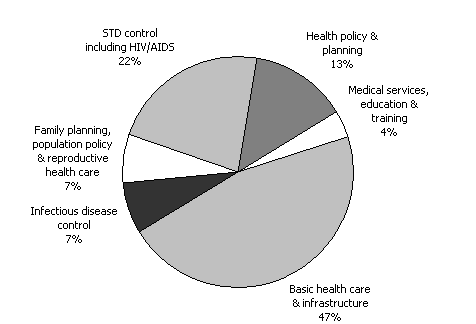
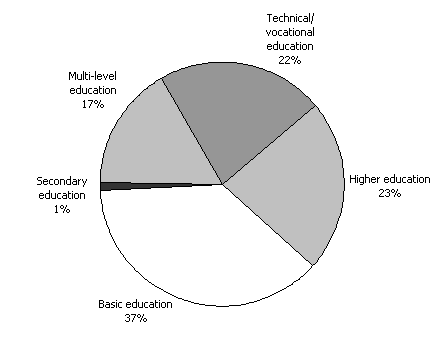
In 2003-04, the aid program will provide an estimated $270 million for education; $225 million for health; and $55 million to address gender equality. Activities will include:
- combating communicable and non-communicable diseases in the region through a combination of capacity building and direct service delivery;
- continuing the implementation of the $200 million, six-year HIV/AIDS initiative with $60 million to be allocated in 2003-04 including activities agreed at the HIV/AIDS Asia-Pacific Leadership Forum;
- strengthening institutional capacity in partner countries to improve literacy, numeracy, vocational and technical training, as well as providing around 1110 new scholarships for developing country students to study at Australian institutions, and around 240 new scholarships for PNG and Pacific islands students to study at their local and regional institutions;
- addressing violence against women, for example the Women's Crisis Centres in Fiji and Vanuatu and the South African gender violence program.
Diagram 7: Estimated Australian assistance to the health sector 2003-04
The Australian aid program will also provide an estimated $94 million of direct and indirect expenditure towards water-related activities in 2003-04. This will include promoting the sustainable use and allocation of water through strengthening policy, institutional arrangements and legal frameworks in partner countries.
Diagram 8: Estimated Australian assistance to the education sector 2003-04
Developing countries will need assistance in providing for the basic needs of the poor. The eight Millennium Development Goals stemming from the UN Millennium Declaration provide reference points on the global effort required for long-term poverty reduction. Australia, through supporting good governance and improving basic services in developing countries in the region, is contributing to the achievement of these goals.
Water in the aid program
Access to safe water and adequate sanitation is a critical development challenge. In Asia, two billion people do not have access to adequate sanitation facilities and around 700 million lack access to safe drinking water. Globally, more than 10,000 people die every day from preventable water-related diseases.
In March 2003, the Minister for Foreign Affairs launched 'Making every drop count', providing policy guidance to strengthen water management, legal, institutional and regulatory frameworks as well as improve delivery systems with developing country partners.
The Minister also announced several new commitments in relation to the policy. For example, Australia will support a program in South Asia worth $43 million over seven years. The South Asia Water Supply and Sanitation Reform Program, focusing on north-east India, will commence in the second half of 2003.
In addition, a new water research program will be established within AusAID during 2003-04. With initial funding of $1 million, the program will draw on Australian knowledge and expertise on water.
Security
Security is a human and economic development challenge. Conflict, disease, drugs and trans-national crime, illegal immigration and environmental degradation are just some of the security challenges confronting Australia's region. Poverty can create as well as exacerbate these forces. For example, an individual's vulnerability to disease and crime also undermines their ability to participate fully and productively in society. The Australian aid program's focus on poverty reduction in the region therefore makes an important contribution to the prevention of conflict and potential threats to security.
Besides providing direct humanitarian assistance, Australia seeks to enhance partner governments' own capacity to prevent conflict and manage non-military threats to security. The aid program works with partner countries to promote transparent, participatory and accountable systems of government and public administration. For example, the aid program supports bodies such as the Centre for Democratic Institutions to promote democratic systems and parliamentary processes in the Asia-Pacific region. More specifically, assistance is provided to deal with particular trans-national challenges, for example the spread of HIV/AIDS. Practical assistance is also provided to strengthen basic policing and the performance of law and justice systems.
Aid and counter-terrorism
Terrorism is a trans-national phenomenon that threatens peace, security and prosperity. The tragic events of 11 September 2001 and Bali in October 2002 emphasised the importance of a concerted response to terrorism. The Australian aid program is helping to build the capacity of developing countries in the region to respond effectively to potential terrorist threats. In 2003-04, the aid program will assist partner governments to:
- strengthen police, immigration, banking authorities, border and customs control to combat illegal movement of arms, money, people and substances;
- draft and enact legislation to combat illicit commercial ventures and trans-national crime, including money laundering, people smuggling and terrorism;
- improve the functioning of law and justice systems;
- promote peace building, conflict resolution and reconstruction in conflict affected areas;
- improve the quality of basic education, including the monitoring of education standards in non-state schools;
- implement the Nasonini Declaration on Regional Security in the Pacific, which includes a commitment to implement internationally agreed anti-terrorism measures, such as the United Nations Security Council Resolution 1373 and the Financial Action Task Force 8 Special Recommendations; and
- implement the APEC Leaders' Statement on Fighting Terrorism and Promoting Growth made in Los Cabos, Mexico in October 2002, where leaders committed to take measures to secure trade in the APEC region by protecting cargo, ships, aviation and people in transit, halt terrorist financing and promote cyber-security.
Sustainable Resource Management
Sustainable management of natural resources and sound agricultural practices are vital for long-term prosperity and poverty reduction in the Asia-Pacific region. Australian assistance works at numerous levels, including improving environmental resource management and governance and supporting the livelihoods of poorer rural communities.
In 2003-04, Australia will provide an estimated $95 million for activities to address environmental problems in developing countries. Australia will implement improved environment management guidelines developed to meet overseas aid provisions of the Environment Protection and Biodiversity Conservation Act 1999.
The aid program will also provide an estimated $255 million in support of rural development in partner countries. In particular, programs will be extended or enhanced in several countries in East Asia. For example, in 2003-04 a new four-year rural development program to improve agricultural production and increase rural incomes will commence in East Timor.