



Chapter Two: Papua New Guinea and the Pacific
Papua New Guinea
PNG development indicators
|
Country |
GNI per capita |
Access to water |
Life expectancy (years) |
Adult literacy |
|
|
Papua New Guinea |
1123 |
42 |
57 |
64 |
|
Source: GNI per capita: DAC, 2001; other indicators: Human Development Report, UNDP, 2002.
| Programmed activities Retirement benefits Estimated other ODA Estimated total aid flows |
$300.0 million
$14.0 million $19.6 million $333.6 million |
The aid program is a central, practical part of Australia's engagement with Papua New Guinea (PNG) and forms a critical part of our bilateral relationship. It plays a pivotal role in supporting both stability and the legitimacy of national government. The PNG bilateral aid program is Australia's largest, with an estimated annual expenditure of over $300 million.
There have been significant improvements in key social indicators in PNG since Independence in 1975. For example, life expectancy has risen and infant mortality has decreased. In addition, the number of children attending school has doubled in the last ten years. However, PNG still performs poorly compared with its Asian and Pacific neighbours on many of these indicators. Around one million people, a fifth of PNG's population, are living in poverty. Major challenges to development include the country's rugged topography, high population growth, weak governance capacity and an alarming increase in the incidence of HIV/AIDS. PNG's cultural context creates additional development challenges. It is probably the most ethnically fragmented country in the world. Under these circumstances, development outcomes are challenging to achieve and will only be realised over the long term, with leadership and sustained commitment by PNG itself.
In 2003-04, Australia will focus on addressing PNG's long-term development needs. Principle objectives will include enhancing the quality of governance in PNG, particularly with respect to the management of public expenditure; encouraging broad-based sustainable growth; and addressing the underlying causes of conflict and instability.
In addition, Australia is working closely with the World Bank, the Asian Development Bank and other donors to develop a coherent strategy of engagement with PNG which will result in a greater impact over the long term.
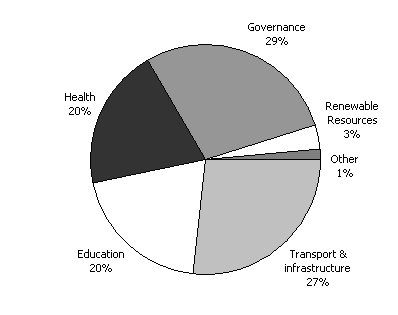
Diagram 9: Estimated breakdown of bilateral aid to PNG by sector 2003-04
Strengthening Governance
The Australian aid program will retain its focus on promoting good governance in PNG. In 2003-04, the main initiative of the governance program will be AusAID's participation with the World Bank and Asian Development Bank in the Government of PNG's Public Expenditure and Rationalisation Review. This review aims to design a range of fiscal reforms to remedy PNG's unsustainable public expenditure levels and an agenda of governance reforms to restore integrity to the public financial management system. Australia will continue to provide support to the strong relationship developed between the Australian and PNG Treasuries, through the Treasury Twinning Scheme. The Government of PNG's Financial Management Improvement Program will also receive support. More generally, Australia will provide assistance to the PNG Government to implement initiatives in public sector reform.
Australia will strengthen its focus on law and justice policy dialogue and reform in PNG, through a sector-wide approach that will foster local ownership. A newly appointed Justice Advisory Group (JAG), an expert monitoring and advisory body providing independent advice to both governments, will facilitate this process. The JAG will be complemented by a rolling program of assistance focusing on greater understanding and use of local systems. This will assist in improving sectoral coordination, strengthening the formal justice system and supporting innovative community approaches to crime prevention. The JAG will also ensure that Australia's interventions remain affordable in the context of PNG's declining national revenue.
Human Capital
Australia is committed to working in full partnership with the PNG National Department of Health to improve the planning, delivery and monitoring of health services. In 2003-04, Australia will be directly supporting delivery of essential services in rural areas, in particular providing medical supplies, health services for women and children, and refurbishment and equipment for health centres. In addition, Australia will work with PNG to address constraints to quality health service delivery, including improving human resource and organisational management in the sector. During 2003-04, Australia will also be developing the next major phase of health assistance to PNG, aiming to streamline health financing and improve government distribution systems for greater efficiency and allocation of resources. Flexibility to enable rewards and incentives for improved health management will be an important component of this assistance.
Increasingly, HIV/AIDS presents a threat to the health and welfare of PNG's population. An AusAID commissioned report concluded that if not checked, the HIV/AIDS epidemic in PNG will lead to major declines in economic and social indicators. For example, HIV/AIDS has the potential to reduce the labour force by 13 to 38 per cent by the year 2020 and increase PNG's budget deficit by 9 to 21 per cent. Australia has committed $60 million over five years to support PNG's response to the HIV/AIDS epidemic. These funds support initiatives to increase awareness and improve detection and treatment of sexually transmitted infections; provide care and support for people living with HIV/AIDS and their families; and improve PNG's capacity to respond to the challenges of the epidemic.
Australia will assist PNG's Education Reform Program in 2003-04. In addition to the existing projects which support basic education through curriculum reform, teacher training, and infrastructure development, a major new initiative will be introduced. The Education Capacity Building Project will support PNG government education reforms with a focus on policy, planning, management, human resource development, coordination and finance at central, provincial and district levels.
Sound infrastructure improves access to essential services and markets in rural areas where the majority of people live and is a major contributor to broad-based economic growth. Roads and airports therefore play a significant role in promoting nation building, political stability and communication, particularly given PNG's mountainous terrain and scattered population. In 2003-04, maintenance of key land transport will be the focus of Australian development assistance in the infrastructure and rural development sector. This is consistent with PNG needs at a time of severe under-funding of operations and maintenance. Australia and PNG will work in partnership with other donors to maximise the economic return of transport maintenance programs, via linkages to markets and services in rural areas. In 2003-04, assistance will be directed to the Highlands Highway, an important road network in the densely populated Highlands, as well as to bridge rehabilitation on major road networks.
The Australian aid program is also providing safe water and sanitation to the people of PNG. In partnership with local villagers and the Western Province Government, the South Fly Water Supply Scheme was successfully completed in November 2002. Large water tanks were transported and installed providing coastal villagers of the remote region with access to safe, clean drinking water. In 2003-04, a water supply project in Lae will design and construct a duplicate mains water supply pipeline along the Bumbu River, to provide a safe and reliable water supply to the population of Lae City. This activity will also benefit poor communities living along the new pipeline.
Bougainville
Australia will continue to assist in Bougainville's shift to an autonomous province and support long-term development goals of stability and economic growth. To date, the aid program has provided direct support and momentum to the peace process by funding peace talks, civilian peace monitors, legal advisers and weapons disposal, while maintaining essential service delivery. The challenge in 2003-04 will be to move the program into a new phase of establishing an autonomous Bougainville government with its own parliament, constitution and provincial administration within PNG.
In 2003-04, Australia will provide advice and support for the implementation of transfer of power arrangements from the national government as well as supporting finance and budget planning processes, planning for affordable services and reform of the public sector. Support will continue for essential service delivery in elementary and primary education, basic health care, community policing and road maintenance.
The Pacific region
Pacific regional development indicators*
|
Country |
GNI per capita |
Access to water |
Life expectancy (years) |
Adult literacy |
|
Solomon Islands |
1123 |
71 |
68 |
77 |
|
Fiji |
4122 |
47 |
69 |
93 |
|
Vanuatu |
2032 |
88 |
68 |
34 |
|
Samoa |
2942 |
99 |
69 |
80 |
|
Tonga |
2961 |
95 |
68 |
99 |
|
Kiribati |
1606 |
76 |
62 |
92 |
|
Nauru |
- |
100 |
58 |
95 |
|
Tuvalu |
- |
85 |
67 |
95 |
Source: GNI per capita: DAC, 2001 (except Nauru and Tuvalu); other indicators for Fiji, Vanuatu, Samoa and Solomon Islands: Human Development Report, UNDP, 2002; all other data: Pacific Human Development Report, UNDP, 1999.
*Development indicators from the Pacific are often unreliable and should be treated with caution.
In addition, they do not reflect the vulnerability of small island states.
| Estimated total aid flows to the Pacific in 2003-04 |
$175.8 million
|
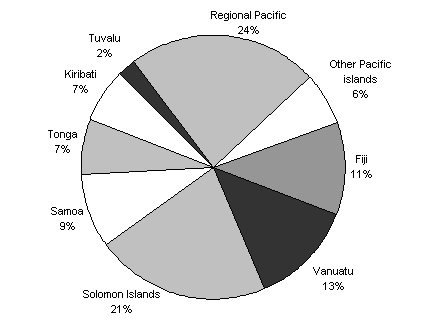
Diagram 10: Estimated total aid flows to the Pacific by country 2003-04
Regional overview of the Pacific
The nations of the Pacific region are notable for their cultural, physical, and political diversity. However, their remoteness from global markets, narrow economic and natural resource bases, and vulnerability to natural disasters constitute a daunting challenge in maintaining positive development paths in a dynamic global environment.
Pacific island economies tend to be characterised by a large and inefficient public sector, contrasting sharply with a weak and under-developed private sector. In many countries the majority of the population still derive their livelihood primarily from the informal sector. High population growth coupled with sub-standard infrastructure means that many governments face difficulty in providing adequate levels of services to their people, with health and education systems often stretched beyond capacity. More broadly, key positions across the public and private sectors suffer from severe shortages of trained personnel.
The serious effects of recent political instability and internal conflict, particularly in Melanesian countries, are making the task of poverty reduction and sustainable development even more difficult. Causal factors include ethnic tension, weak national cohesion, and capacity constraints in key governance institutions, particularly those dealing with law and order issues. Recently, trans-border issues such as money laundering, people smuggling and diseases (particularly HIV/AIDS), and the regional response to terrorism have become increasingly prominent.
Regional strategy
Australia maintains a close relationship with Pacific island countries and is committed to long-term engagement to assist with their national development efforts. Australia is one of the region's major donors and our goal is to assist Pacific island countries achieve the maximum possible degree of self-reliance. To achieve this, a new Pacific strategy has been prepared for 2003-06. Objectives include the provision of strong support for economic reform and strengthening governance; support for law and justice, democratic institutions and conflict resolution; and service provision, including in regional and provincial areas.
Australia continues to work closely with New Zealand to improve the effectiveness of aid to the Pacific through greater harmonisation of policies and procedures. Joint initiatives and processes will continue to be implemented with partner governments to ensure harmonisation.
Assistance to the Pacific
Solutions to Pacific island countries' development problems cannot be imposed from the outside. Establishing the frameworks for economic and social viability rests with Pacific Islanders themselves. Australia's aid program to Pacific island countries has been critical in supporting national unity and stability, in improving government capacity and in delivering essential services. The Australian Government will continue to assist in ways that support countries' own efforts.
Economic reform and Governance
Governance is at the heart of development issues in the South Pacific. Many countries in the region are grappling with government structures that are expensive and not well suited to deliver services to remote populations. Good governance and economic and financial reforms are essential if countries are to be economically viable and attract investment. During 2003-04, a significant proportion of Australia's bilateral aid to the Pacific island countries will continue to be directed to governance activities to support our major partners with economic, legal and public sector reform programs.
Australia's Pacific Policy and Management Reform Fund provides countries promoting reforms with the opportunity to access additional funds. During 2003-04, $15 million will be available as an incentive for programs to help reinforce and reward reform efforts in the region, as well as promote peace and nation building.
Australian support for private sector development is primarily channelled through organisations such as the South Pacific Project Facility, the Foreign Investment Advisory Service, the Pacific Islands Trade and Investment Commission and the Company Directors Training Program. These organisations assist with trade and investment advice and enhancing the performance of private sector enterprises in the Pacific.
The difficulties that small island developing states can face in dealing with trade liberalisation are a particular concern for the Pacific region. During 2003-04, Australia will continue to provide targeted assistance to enable economies to take advantage of increased global trade and economic integration. Specifically, Australia will focus on facilitating Pacific country participation in World Trade Organisation (WTO) deliberations and providing technical assistance in the areas of economic policy development, budgetary and financial management and public administration.
Regional Security
Australia places a high priority on regional peace, stability and security in the Pacific. Events of the past two years, particularly increased political instability and inter-ethnic conflict in Melanesia, have heightened the importance of peace and security issues in the Pacific. Functioning law and justice systems are important given the vulnerability of some countries within the region to illicit commercial ventures and trans-national crime, including money laundering, people smuggling and terrorism.
In 2003-04, the aid program in the Pacific will reflect this increased focus, with bilateral law and justice activities in Solomon Islands, Vanuatu, Fiji, Samoa, Tonga and Nauru. A priority is to improve the functioning of legal, justice and accountability institutions such as police forces, attorneys-general and courts. Bilateral assistance will continue to be provided for customs, immigration, border control and electoral activities in selected countries.
The establishment of a new Peace and Security Fund is a practical demonstration of Australia's support for regional stability. The Fund will enable Australia to provide flexible and targeted assistance to directly address needs in post-conflict societies such as the Solomon Islands. Totalling $7.5 million in 2003-04, the Peace and Security Fund will also strengthen the broad security framework in the Pacific through initiatives to counter trans-national crime and terrorism.
At the regional level, Australia is supporting various initiatives to enhance the rule of law and counter trans-national crime. The Pacific Judicial Education Program, which is a regional training project for lower-level and non-formally trained judges, magistrates and court officials, will continue, as well as law and justice-related training and scholarships to students from Pacific island countries. Australia is also facilitating Pacific island countries to implement the Nasonini Declaration on Regional Security, which includes a commitment to implement internationally agreed anti-terrorism measures, such as the United Nations Security Council Resolution 1373 and the Financial Action Task Force 8 Special Recommendations.
Human Capital
Delivering basic services to small but scattered populations remains a significant challenge throughout the Pacific. Australia's support is crucial - both in governance assistance to develop more effective systems, and practical help to maintain adequate standards of health and education services.
During 2003-04, the aid program will address needs in basic education as well as funding approximately 700 Pacific Islanders to undertake tertiary study in Australia and at regional tertiary institutions. Australia will work with the University of the South Pacific (USP) to improve tertiary education delivery through the USPNet communications network. USPNet links 12 Pacific island countries, with over 4,000 students expected to benefit. Improvement of the management and planning capacity of national education departments remains an important focal area, with projects under way in Samoa and Kiribati.
The Australian aid program will continue to provide support for Pacific island countries' national health reform and management, including the development of health information systems and training in Fiji, Samoa, Solomon Islands, Tonga and Vanuatu. At a regional level, funds will be provided to promote strategies to address non-communicable lifestyle diseases (for example diabetes and diseases related to substance abuse), and control of emerging diseases such as HIV/AIDS. Tertiary health services will continue to be enhanced through visits by volunteer medical specialists and assistance with the introduction of systems to maintain essential medical equipment.
The Pacific Children's Program will support Fiji, Samoa and Vanuatu to strengthen existing community-based initiatives and increase government commitment to child protection. In addition, Australia will continue to support women's crisis centres in Fiji and Vanuatu. Australia is also supporting the World Health Organisation and the United Nations Children's Fund (UNICEF) to implement an Expanded Program of Immunisation in the region.
Sustainable Resource Management
The Pacific faces a number of pressures on the environment with potentially significant impacts on the lifestyles and economic development of the region. Island ecosystems are diverse and remain vulnerable to a range of natural and human-created disasters. Australia is providing support for the management of hazardous waste, sea level and climate monitoring and adaptation to the potential impacts of climate variability and climate change.
Through support for the Pacific regional organisations, Australia assists Pacific island countries to manage their natural resources sustainably, particularly tuna and coastal fish stocks, food crops and forests. In particular, Australia is contributing to taro protection and forestry management initiatives as well as promoting aquaculture and the conservation of priority plant species.
Pacific regional organisations
Pacific regional organisations play an important role in allowing their island members to benefit from economies of scale in accessing technical and capacity building assistance. Australia is a key contributor to the Pacific Islands Forum Secretariat, the South Pacific Regional Environment Program, the University of the South Pacific, the Forum Fisheries Agency, the Secretariat of the Pacific Community, the South Pacific Applied Geoscience Commission and the Fiji School of Medicine.
Australian support is encouraging a more strategic approach in the implementation of programs by regional organisations. Their move to program funding will also provide an important step towards enhanced donor harmonisation in the Pacific. In 2003-04, Australian funding of Pacific regional organisations will address a number of key regional issues and development challenges including economic reform, trade facilitation, trans-national crime, HIV/AIDS prevention, plant quarantine, distance education, disaster preparedness and climate monitoring.
Bilateral programs
Solomon Islands
| Country program estimate Estimated other ODA Estimated total aid flows |
$25.0 million
$12.4 million $37.4 million |
The Solomon Islands Government is working to address the serious security, economic and social problems the country is currently facing. Restoring law and order, improving economic management, continuing to foster peace and reconciliation and providing for the basic needs of the community are all important challenges which need to be addressed.
In 2003-04, Australian aid to Solomon Islands will include ongoing assistance to the law and justice and health sectors; support for the newly established National Peace Council; development and implementation of a new community sector program; assistance to improving economic management; and increased scholarships.
Whilst the aid program must remain flexible and responsive to immediate needs in the post-conflict environment, in 2003-04 efforts will be focused on building a foundation for sustainable development, particularly through fostering civil society and longer-term potential to improve governance.
Australian support to the Solomon Islands Government continues to be contingent on Solomon Islands' commitment and progress in addressing the key challenges of restoring law and order and improving economic management.
Vanuatu
| Country program estimate Estimated other ODA Estimated total aid flows |
$15.0 million
$7.7 million $22.7 million |
The Australian aid program complements the Government of Vanuatu's own priorities, detailed in their Comprehensive Reform Program (CRP). The CRP seeks to contribute to growth and stability through better governance and service delivery. A focus will be on strengthening the law and justice sector, improving governance and supporting service delivery and rural development. During 2003-04, the program will be reviewed and assessed jointly by Vanuatu and Australia and a new country strategy will be agreed.
In 2003-04, the Vanuatu Police Force will receive further assistance from the Australian Government for the management and operational aspects of the organisation. This will complement existing support to the legal sector. Australian assistance will also enable rural communities to access funds for economic development activities. Implementation of existing projects will increasingly assist the Vanuatu Government to improve its service delivery in health and education in particular. Ongoing capacity building assistance is also being provided to the Ministry of Finance and the Public Service Commission in the areas of accounting and human resource and financial management.
Fiji
| Country program estimate Estimated other ODA Estimated total aid flows |
$14.5 million
$5.5 million $20.0 million |
New programs in education, law and justice and health will be the major focus for Australian assistance to Fiji in 2003-04. These long-term and responsive programs will be jointly planned and implemented with the Government of Fiji within the framework of its Strategic Development Plan 2003-05.
The law and justice program will strengthen the capacity of Fiji institutions to improve law and order and strengthen the rule of law. It will also complement efforts to support implementation of the Counter-Terrorism Memorandum of Understanding signed between the Governments of Australia and Fiji in March 2003. More effective health service delivery to rural areas will be achieved through support for both regional and central management of health services throughout Fiji.
Successful projects to be completed in 2003-04 include work to improve taxation services and taxpayer compliance. This has generated $145 million in additional revenue for Fiji over the past two years. A community health program on Taveuni Island will finalise the establishment of a fully functioning hospital in Waiyevo as well as the training of Ministry of Health staff and community leaders in the provision of preventative and curative rural health services.
Samoa
| Country program estimate Estimated other ODA Estimated total aid flows |
$11.8 million
$4.6 million $16.3 million |
In 2003-04, Australia's aid will support the Government of Samoa to implement its Strategy for the Development of Samoa 2002-2004. With Australian technical advice and training, Samoa has achieved a commendable record of economic stability and is building on public sector reforms to improve government efficiency and provide better services to the public.
A new phase of Australian assistance to the Samoan Police Service is expected to start in 2003-04. Australia will also assist in strengthening Samoa's border protection and quarantine facilities, introducing a computerised border management system in the Immigration Department and commencing construction of new quarantine facilities. Achievements in management reforms will be consolidated within the key service delivery departments of Health, Education and Agriculture.
Tonga
| Country program estimate Estimated other ODA Estimated total aid flows |
$9.0 million
$2.7 million $11.7 million |
Australia's assistance aims to reduce Tonga's vulnerability to poverty by strengthening public systems, stimulating economic productivity and improving living standards of at-risk groups. In 2003-04, the program will focus on supporting economic and public sector reform, health, education, tourism and natural resource management. Australia will provide continued support to the Ministry of Finance to strengthen its budgeting systems and improve financial and human resource management in the health system. Improved management of marine resources and in-shore fisheries on a sustainable basis will be supported and the Solid Waste Management Project will assist in improving Tonga's environment and living conditions.
Kiribati
| Country program estimate Estimated other ODA Estimated total aid flows |
$8.0 million
$3.4 million $11.4 million |
Australia's aid program to Kiribati currently focuses on human resource development, governance and health. With a number of activities recently completed or soon to be completed, development of a new country strategy for Kiribati will be a priority task in 2003-04. The Kiribati Ministry of Finance and Economic Planning will receive institutional strengthening assistance and continued support will be provided to the education sector by upgrading teachers' skills and developing learning materials. The Kiribati Customs Service will also receive assistance to improve its revenue collection capabilities and compliance procedures.
Nauru
| Country program estimate Estimated other ODA Estimated total aid flows |
$0.6 million
$3.3 million $3.9 million |
Australia is currently providing technical assistance and other aid, including commodities, to assist Nauru meet urgent and immediate problems with its service delivery and economic infrastructure. Particular attention is being given to improving the sustainability of service delivery in the health and education sectors. Australia is also working with the Government of Nauru and multilateral development partners to address Nauru's economic and development challenges, especially problems with government budgeting and financial management.
Tuvalu
| Country program estimate Estimated other ODA Estimated total aid flows |
$2.9 million
$0.9 million $3.8 million |
Australia supports Tuvalu's development priorities through both direct assistance and technical support for the Tuvalu Trust Fund. Australian assistance will aim at improving the education sector in particular. Better management and administration, curriculum development and teacher education at the primary and secondary level along with general vocational training will be supported. The aid program will also assist in human resource planning in Tuvalu.
Other island nations
| Country program estimate Estimated other ODA Estimated total aid flows |
$4.4 million |
Students from Federated States of Micronesia, Marshall Islands, Palau, Cook Islands, Niue and Tokelau will continue to receive assistance from Australia through scholarships enabling recipients to study at tertiary education institutions in the region.
In the Federated States of Micronesia, Marshall Islands and Palau, Australia will continue to support economic reform initiatives and border protection. In the Cook Islands there will be a focus on ensuring safe water supplies in the outer islands. Niue will receive capacity building assistance in the public service.