



Chapter Three: East Asia
East Asia
East Asia regional development indicators
|
Country |
GNI per capita |
Access to water |
Life expectancy (years) |
Adult literacy |
|
Indonesia |
1316 |
76 |
66 |
87 |
|
Vietnam |
794 |
56 |
68 |
93 |
|
Philippines |
2032 |
87 |
69 |
95 |
|
China |
1722 |
75 |
71 |
84 |
|
East Timor |
471 |
65 |
57 |
43 |
|
Cambodia |
523 |
30 |
56 |
68 |
|
Laos |
600 |
90 |
54 |
49 |
|
Thailand |
3813 |
80 |
70 |
96 |
|
Burma |
- |
68 |
56 |
85 |
|
Mongolia |
774 |
60 |
63 |
99 |
Source: GNI per capita: DAC, 2001; other indicators: Human Development Report, UNDP, 2002; East Timor GNI per capita: East Timor - Building Blocks for a Nation, UN common country assessment, 2000; East Timor all other indicators: East Timor - The Way Ahead UNDP 2002.
| Estimated total aid flows to East Asia in 2003-04 |
$491.1 million
|
Diagram 11: Estimated total aid flows to East Asia by country 2003-04
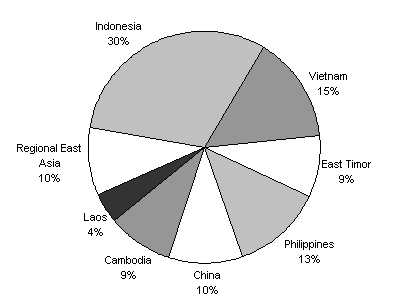
Regional Overview
Maintaining economic growth and a secure environment conducive to development and poverty reduction will remain a challenge for many East Asian countries in 2003-04. Economic growth across the region as a whole is expected to weaken slightly in the 2003 calendar year. Significant intra-regional variation will remain. For example, lower growth is likely in Indonesia and the Philippines than in Vietnam and China, and the outbreak of Severe Acute Respiratory Syndrome (SARS) is also impacting on some economies. East Asian countries will need to maintain the openness to global trade and investment that saw dramatic growth in the 1980s and early 1990s, and commit to improving their governance.
Most national economies in the region appear more robust now than in 1997, but continued reform will be essential to weather high levels of risk, attract investment and achieve long-term and sustainable growth. While many regional countries have achieved continuous current account surpluses and improved their foreign reserves since the 1997 financial crisis, public debt levels remain high and, in South-East Asia, private investment remains weak. Corporate and financial sector reform and strengthening law and justice systems will be needed to foster private sector development and investment. Australia will work with regional partners to improve governance, promote trade and investment and counter trans-national security threats such as diseases, drugs, illegal people movements and terrorism. Such threats require early, cooperative and coordinated interventions.
Regional programs
| Regional program estimate |
$29.9 million
|
Regional assistance programs support Australia's strong engagement with the Asia-Pacific Economic Cooperation (APEC) Forum and the Association of South-East Asian Nations (ASEAN). Regional program funding also complements Australian bilateral assistance to South-East Asian countries. In 2003-04, the program will promote good governance, trade and economic integration and security through support to address development challenges that cut across national borders. Assistance to the less developed members of ASEAN will be a priority. The program will strengthen capacity in areas such as customs, e-commerce, trade training, food quality, liberalisation of services, and counter-terrorism. Key mechanisms will include the APEC Support Program and the $4 million ASEAN Australia Development Cooperation Program.
Australia will work with regional partners through an expanded program of assistance to help them integrate with the international trading system. This regional project will build the capacity of countries to join and participate effectively in the World Trade Organisation (WTO) through training and assistance to strengthen analytical and research capabilities. A $3.5 million quarantine services project to build cooperation across ASEAN nations in managing animal and plant pests and diseases will also be designed and implemented.
To address major trans-boundary challenges, Australia will support a four-year $9.2 million project to tackle drug-related HIV transmission. This will include using 50 local trainers at four project sites across Burma, Vietnam and China. In addition, a three-year $9 million project will strengthen the capacity of anti people-trafficking units in Burma, Cambodia, Laos and Thailand to work together to prevent cross-border trafficking.
Other priorities will include capacity building in flood management and water monitoring in Cambodia, Laos, Vietnam and Thailand through the Mekong River Commission, and support to improve health insurance systems and social assistance for vulnerable children in Indonesia, Thailand, the Philippines and Vietnam.
Bilateral Programs
Indonesia
| Country program estimate Estimated other ODA Estimated total aid flows |
$121.0 million
$30.7 million $151.7 million |
Australia's national interest is best served by having a unified, prosperous and democratically strong Indonesia as a neighbour. This will be a major challenge as Indonesia struggles to return to high rates of economic growth and continue its difficult transition to democracy, decentralisation and economic stability - a transition that will span many years. Success will depend significantly on reducing the poverty and vulnerability that currently affects more than half of Indonesia's 210 million citizens.
Australia's aid program is supporting poverty reduction and sustainable development in Indonesia in four key areas: improving economic management; strengthening the institutions and practices of democracy; enhancing security and stability; and increasing the accessibility and quality of basic social services. In recognition of the importance of Australia's relationship with Indonesia, and the significant challenges it is facing, total Australian aid to Indonesia will increase by $30.1 million in 2003-04. This funding will support a range of important new initiatives.
In the wake of the Bali bombings, assistance will be provided to improve health services to the Balinese people as a practical, living memorial to the victims of the atrocity. Support will include the provision of a new intensive care centre at the Sanglah hospital, construction of a new eye clinic which will provide free treatment to the poor, and provision of training in health and medical disciplines.
A $10 million, four-year initiative will help Indonesia strengthen its counter-terrorism capacity through assistance to police, immigration, customs, transport and banking supervision agencies.
The incidence of poverty in Indonesia is heavily concentrated among those with little or no formal education. A major program in basic education will be developed to assist the creation of a well-resourced mainstream education system that prepares students to play a constructive role in society.
A new program to continue support measures for economic reform will be implemented. This will include financial sector restructuring and supervision, debt management, revenue enhancement and audit capacity building. The program will build existing support for the government bonds management centre, assist with the establishment of a 'large taxpayers' office and with the development of draft accountancy and valuation laws.
An integrated approach to poverty reduction in eastern Indonesia is also being developed. First steps will include helping the Government of Indonesia develop new approaches to poverty reduction and better district level governance. Australia will assist the Government of Indonesia to implement community-managed water supply and environmental health programs in selected districts in eastern Indonesia.
Australia will continue to support democracy in Indonesia through an expanded program of assistance for legal reform and human rights which will focus on judicial reform, the promotion and protection of human rights, support for community legal organisations and anti-corruption measures. Significant support will also be provided for the Indonesian elections in 2004, in which for the first time the President and Vice President will be directly elected.
Indonesia Program Overview
| Improve economic management | Strengthen the institutions and practices of democracy | Enhance security and stability |
Increase the accessibility and quality of basic social services |
|
|---|---|---|---|---|
| Key challenges for Indonesia |
|
|
|
|
| Major current activities |
|
|
|
|
| Emerging areas of support |
|
|
|
|
Vietnam
| Country program estimate Estimated other ODA Estimated total aid flows |
$59.4 million
$12.7 million $72.1 million |
Australia is finalising a new development cooperation strategy with Vietnam for 2003-07. Australia will help strengthen the governance of key market institutions and assist in improving the productivity of the rural poor in the Mekong Delta and Central Coast. Specific objectives in 2003-04 will include improving trade policies, providing better access to clean water and sanitation, and strengthening provincial government service delivery.
Vietnam plans to accede to the WTO by 2005. Capacity building in trade policy development, negotiation and implementation of agreements will thus be critical. In 2003-04, Australia will continue a two-year project with the Ministry of Agriculture and Rural Development to assist with domestic requirements of global trade agreements. Further trade-related assistance is planned for other sectors and ministries. Many of the 500 scholarships provided in 2003-04 will support Vietnam's adjustment to the new conditions created by future WTO accession.
The aid program will also focus on three water and sanitation projects in urban and rural areas, helping to meet the national goal of doubling access to clean water during the decade 2001-2010. The Cuu Long and the Three Delta Town projects in the Mekong Delta will provide over 750,000 urban and rural residents with access to clean water and sanitation facilities. The North Vam Nao Water Management Project will also protect 300,000 residents from floods as well as facilitate broader economic and social development. All of the projects provide substantial capacity building and institutional support components and encourage community participation in planning and management.
Philippines
| Country program estimate Estimated other ODA Estimated total aid flows |
$55.5 million
$6.9 million $62.4 million |
Australia's aid will continue to target the rural poor of the southern Philippines and support improvements in the policy, regulatory and institutional framework for poverty reduction at the national and provincial levels. In 2003-04, assistance will strengthen delivery of basic education, health and local government services, as well as improved land management and administration. The Philippines-Australia Governance Facility will concentrate assistance on key policy, regulatory and institutional issues in areas such as public expenditure management, trade policy reform and accountability systems. Australian aid will also support the Philippine Government's decentralisation program, both through assistance to selected national agencies and by working with communities and Local Government Units to improve local planning processes and service delivery.
Against a background of increasing instability in the southern Philippines, the Australian aid program will continue to support multilateral peace building, conflict resolution and post-conflict recovery efforts in Mindanao. This assistance will be complemented by bilateral assistance in health, education and rural development for the poorest regions of Mindanao. The innovative Basic Education Assistance to Mindanao (BEAM) program will continue to assist children, including those from Muslim and indigenous communities, to access education and training. Assistance will also be provided to over 300 farming communities to increase their productivity and incomes.
China
| Country program estimate Estimated other ODA Estimated total aid flows |
$40.0 million
$10.7 million $50.7 million |
In 2003-04, Australia's aid will support improved governance at national and local levels as well as poverty reduction and environmental rehabilitation in impoverished rural areas of western China. An important objective will be reaching agreement with the Government of China on the priorities and strategies for a significant new program of governance assistance, to be implemented from 2004. The program will build on work through the China Capacity Building Program, including activities for over 840 government officials in key areas of national reform, and the achievements of the Economics and Foreign Trade Training Project, which has provided training for more than 1,700 officials in support of China's WTO accession.
In the critical area of water resources, a $16 million project in Hebei Province will improve agricultural productivity for around two million people through demonstration of efficient water resource management planning and practices. Through the Yangtze River Flood Control and Management Project, an integrated flood management system for the upper and middle reaches of the Yangtze River will help reduce the loss of life, damage to property and other social disruption caused by flooding. Other key activities to receive support will include the China-Australia Human Rights Technical Cooperation Program; a $20 million vocational education and training project in Chongqing Municipality; a new $17 million basic health care and HIV/AIDS program for the Tibet Autonomous Region; and an HIV/AIDS program based in Xinjiang Province in China's far west.
Cambodia
| Country program estimate Estimated other ODA Estimated total aid flows |
$24.5 million
$19.9 million $44.4 million |
Cambodia is recovering after decades of turmoil and remains one of the world's poorest countries. Most of the poor survive on subsistence agriculture and Australia will help to improve the farming techniques of people in more than 86 districts across 13 provinces, increasing food security and improving crop and livestock production. Building on past successful Australian assistance, the aid program will also support the production and marketing of high quality rice seed, contributing to higher crop yields throughout the country.
In 2003-04, a new governance facility will be established to help address institutional weaknesses restricting private sector development and trade. As part of the Virtual Colombo Plan distance learning opportunities will increase with the establishment of a Global Development Learning Network centre in Phnom Penh. Australia will continue to fund a Criminal Justice Assistance project to reduce corruption in the legal sector, improve the competence of court officials and reduce rates of incarceration of juveniles and women for minor offences. Support will also be provided for land mine eradication and assistance with voter education for national elections in July 2003. Around 50 Cambodian students will study Masters level courses in Australia.
East Timor
| Country program estimate Estimated other ODA Estimated total aid flows |
$30.0 million
$12.5 million $42.5 million |
In 2003-04, Australia will be working closely with other donors to map out its strategy for supporting East Timor's post-independence National Development Plan. Australia will continue its comprehensive program of assistance in areas such as governance, rural development, health and water and sanitation. Australia's overall objectives in assisting East Timor are to reduce poverty and help lay the foundations for stable, effective and democratically accountable government and for prudent, sustainable management of anticipated Timor Sea oil and gas revenues.
Australia is making major investments in building the capacity of East Timor's government, especially in planning, finance, fisheries and the marine environment. A major capacity building facility is helping strengthen public administration and service delivery across key sectors of government. The facility will also help build links between the government, civil society and the private sector. Australia will expand its assistance to East Timor's Ministry of Planning and Finance especially in the budget and revenue area to help consolidate prudent financial management.
Australia will continue to participate in the multi-donor Transitional Support Program to assist the Government of East Timor to fund essential costs in the immediate post-independence period, before Timor Sea revenues become available. Australia will continue to work closely with the United Nations Mission of Support in East Timor and other donors in identifying opportunities to strengthen law and justice, particularly by building the capacity of the East Timor Police Service. A new four-year rural development program will aim to increase agricultural production and rural incomes in selected districts as well as improve access to water and sanitation services.
Laos
| Country program estimate Estimated other ODA Estimated total aid flows |
$13.0 million
$7.4 million $20.4 million |
Australia is working with Laos on a new 2003-07 development cooperation strategy. Human resource development is a central theme. In 2003-04, the aid program will complete a joint project with the Asian Development Bank to train over 1000 teachers (including 380 from ethnic minorities). In addition, over 80 Lao students will be provided scholarships to study in Australia. A joint land titling project with the World Bank will also be completed in 2003-04. The project is creating 39,300 private land title deeds and doubling Laos Government land revenue. In partnership with the International Centre for Tropical Agriculture, Australia will continue to improve livestock production and trial new seeds in 38 villages.
Thailand
| Country program estimate Estimated other ODA Estimated total aid flows |
$7.0 million
$8.1 million $15.1 million |
Thailand has emerged, following the setback of the 1997 Asian financial crisis, as a relatively prosperous and influential regional leader. Consequently, Australian aid to Thailand will reflect this transition. In 2003-04, the aid program will focus on regional trade and economic development as well as efforts to counter terrorism, the drug trade and people trafficking. The Thailand-Australia Government Sector Linkages Program will continue to strengthen the skills and knowledge base of Thai agencies and promote linkages with Australian government agencies. In 2003-04, the linkages program will provide assistance in customs, quarantine, competition policy and to the fledgling Thai Ombudsman's Office.
Burma
| Country program estimate Estimated other ODA Estimated total aid flows |
$3.0 million
$4.8 million $7.8 million |
Burma's economic and social development remains effectively frozen in the absence of democratic reform. New ideas and approaches are needed. This requires engagement by the international community. Australia's small bilateral aid program to Burma focuses on addressing the dire humanitarian crisis, particularly the health emergency that continues to engulf the country.
In 2003-04, the aid program will support Non Government Organisations as well as United Nations agencies in addressing the high prevalence of HIV/AIDS and the humanitarian needs of vulnerable groups, for example the 232,000 people returning to Northern Rakhine State from Bangladesh. The aid program will continue to fund the Burma Human Rights Initiative, with the next phase concentrating on practical approaches to improve human rights for women and children. A new small-scale pilot project to reduce nutritional anaemia among an estimated 31,000 women and children in Kungyangon township near Rangoon will also be initiated.
Mongolia
| Country program estimate Estimated other ODA Estimated total aid flows |
$2.2 million
$0.7 million $2.9 million |
A new Mongolia Capacity Building and Small Activity Facility will commence early in 2003-04. The Facility will strengthen the capacity of selected government agencies by providing targeted scholarships in support of their human resource development programs. Funding will also be provided through the Facility for small-scale community and good governance activities. Australia will continue to support the World Bank's UlaanBaatar Services Improvement Project to provide access to clean water and basic services to the urban poor.