



Chapter Four: South Asia, Africa and Other
South Asia
South Asia regional development indicators
|
Country |
GNI per capita |
Access to water |
Life expectancy (years) |
Adult literacy |
|
Bangladesh |
716 |
97 |
59 |
41 |
|
India |
890 |
88 |
63 |
57 |
|
Sri Lanka |
1606 |
83 |
72 |
92 |
|
Nepal |
484 |
81 |
59 |
42 |
|
Pakistan |
813 |
88 |
60 |
43 |
Source: GNI per capita: DAC, 2001; other indicators: Human Development Report, UNDP, 2002.
| Estimated total aid flows to South Asia in 2003-04 |
$112.1 million
|
Regional Strategy
South Asia contains nearly half of the world's most impoverished people. More than one-third of the region's 1.4 billion people live on less than US$1 per day. Australia's development cooperation with South Asia, while modest in comparison to our immediate region, is nonetheless an important contribution to supporting poverty reduction, economic prosperity and stability in the Asia-Pacific. Australia will assist South Asian countries in their efforts to promote good governance and improve basic service delivery at the state and community level, while responding, in line with our capacity, to humanitarian needs and emerging issues of mutual concern.
Australian assistance over the period 2003-07 will move towards delivering aid through more flexible and less resource intensive mechanisms, predominantly via international organisations, the Australian Development Scholarship program, Non Government Organisations (NGOs) and regional mechanisms. In 2003-04, up to 280 students from South Asia will be provided with scholarships to study at Australian tertiary institutions. Some selective, innovative bilateral activities in areas of strategic importance in India, Sri Lanka and Nepal will continue, for example, through ongoing Australian involvement in our long-standing, internationally acclaimed efforts to improve forest management in Nepal.
Diagram 12: Estimated total aid flows to South Asia by country 2003-04
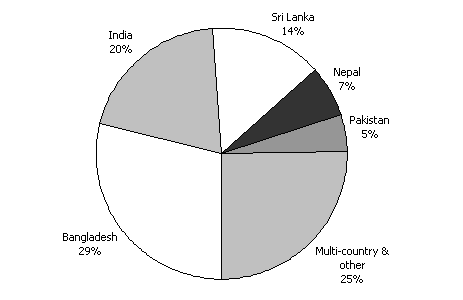
Bilateral Programs
Bangladesh
| Country program estimate Estimated other ODA Estimated total aid flows |
$20.7 million
$11.6 million $32.3 million |
Provision of wheat will support Bangladesh's efforts to achieve food security for up to 600,000 poor people. Better quality primary education will remain a key focus through Australia's support to UNICEF and work with other donors. Activities to support microfinance and mitigate the effects of arsenic will also benefit affected communities.
India
| Country program estimate Estimated other ODA Estimated total aid flows |
$14.0 million
$8.6 million $22.6 million |
Australia will support three major new activities in India in 2003-04. Technical assistance will be provided to the governments and communities of Shillong and Gangtok to improve water and environmental sanitation services for around 400,000 people. This is part of an innovative partnership program that includes the World Bank and the Asian Development Bank in efforts to improve regional water and sanitation services. With nearly one per cent of India's adult population (or four million people) estimated to be HIV positive, Australia will help reduce the spread of the epidemic in Delhi and in three north-eastern states. A new Public Sector Support Program will promote financial, health and education reform.
Sri Lanka
| Country program estimate Estimated other ODA Estimated total aid flows |
$6.1 million
$10.1 million $16.2 million |
Australia's aid program will support Sri Lanka's peace process by providing assistance to vulnerable communities in the north and south of the country. The aid program will focus on land mine awareness and clearance, food security, income generation and a new education and vocational training pilot program to assist over 100 former child combatants and their families.
As part of the Virtual Colombo Plan, Australia will assist Sri Lanka to use information and communication technologies as a means of integrating the conflict-affected areas into national economic, social and political life. Australia will continue working with UNICEF to reduce maternal and child mortality rates by up to 25 per cent by 2007. A new natural resource management project will strengthen the capacity of the Government, NGOs and communities to improve the livelihoods of up to 460,000 people living in the dry zone area of Sri Lanka.
Nepal
| Country program estimate Estimated other ODA Estimated total aid flows |
$5.0 million
$2.4 million $7.4 million |
Australia will continue to support sustainable natural resource management in Nepal. Rural livelihoods will be improved by enhancing income-generating opportunities. Australia will also continue to support Nepal's health program to reduce Vitamin A deficiency in the population. This successful project has averted around 230,000 potential deaths from vitamin deficiency related illness over the last decade.
Pakistan
| Country program estimate Estimated other ODA Estimated total aid flows |
$3.3 million
$1.9 million $5.2 million |
Australian assistance to Pakistan will continue to provide greater access to quality education for 30,000 primary school girls in Balochistan where female literacy rates in rural communities are among the lowest in the world. By funding the Fred Hollows Foundation to reduce the prevalence of avoidable blindness through prevention and treatment, Australian assistance will benefit over two million people from the poorest districts of Pakistan.
Other South Asian countries
| Country program estimate Estimated other ODA Estimated total aid flows |
$2.8 million
$0.3 million $3.1 million |
In addition to continuing support to scholarship students studying in Australia, the aid program will provide 20 new scholarships to the Maldives and Bhutan in recognition of their need for human resource development.
Multi-country programs
| Regional program estimate |
$3.5 million
|
Australia will address shared problems in the region by undertaking multi-country activities such as microfinance, reducing the effects of arsenic and reforming water and sanitation policies and practices. Capable South Asian NGOs will be supported in their efforts to improve conditions and opportunities for vulnerable people through the South Asia Community Assistance Scheme. The South Asia Governance Facility will support activities that address issues of mutual concern to Australia and South Asia such as promoting international trade.
Afghanistan
After years of conflict in Afghanistan, the long process of recovery, reconstruction and building a stable and secure future has commenced. Over two million refugees have returned and basic governance institutions are being established. In 2003-04, the Australian aid program will support the return and reintegration of displaced Afghans and contribute to improved food security, rural livelihoods and viable alternatives to opium growing by working with international partners on improved wheat varieties. Australia will also continue to support the eradication of land mines and assist in rebuilding governance institutions, including by providing economic advice to the Ministry of Finance. Civil society will be strengthened through support for Australian NGOs in Afghanistan. A small number of scholarships will also be offered.
Africa and Other
Africa
| Program estimate Estimated other ODA Estimated total aid flows |
$33.5 million
$27.9 million $61.4 million |
Africa faces enormous challenges in achieving economic growth and poverty reduction. The international community has mounted a concerted effort to assist. Australia will continue to play a modest and constructive role in Africa, while recognising that the bulk of our aid resources are necessarily focused upon the Asia-Pacific region. In 2003-04, Australia's aid program will target countries in southern and eastern Africa with some small-scale, selective engagement in other parts of Africa.
During 2002-03, severe drought affected many parts of the southern African region. An estimated 15 million people are considered to be at risk of starvation and Australia is responding by contributing humanitarian assistance. Australia has also responded to a similar crisis affecting countries in the Horn of Africa and will continue to monitor events in both areas should further assistance be warranted.
Assistance will increasingly be channelled through international organisations and NGOs with well-established expertise in Africa. The aid program will contribute to improving food security; basic water supply and sanitation; and addressing communicable diseases - particularly the HIV/AIDS epidemic which now affects about 29 million people in Africa. Up to 150 scholarships will assist in strengthening governance and service delivery in southern and eastern Africa in 2003-04. As part of the Virtual Colombo Plan, Australia will also support improved access for African students to university education through the African Virtual University.
Australia will continue to support capacity building for trade negotiators through the targeted interventions of the Africa Governance Fund. Increased funding will also be provided for African regional trade initiatives, especially in agriculture.
In South Africa, the aid program will continue to support local and national agencies implementing eight model land care projects. In addition, the Local Governance Partnership Project will deliver more productive working relations between provincial and local authorities, strengthened provincial local government associations, and provide demonstration projects to improve service delivery.
Middle East
In 2003-04, Australia will provide an estimated $37.8 million to parts of the Middle East to address urgent humanitarian priorities, rebuild livelihoods and promote stability and long-term growth. Australia will also work closely with the international community. Assistance will be delivered primarily through multilateral agencies and NGOs allowing the rapid and cost-effective disbursement of funding in a region where Australia's aid program does not have a major presence on the ground.
The humanitarian situation in the Palestinian Territories and surrounding countries continues to be of concern. The growth of and support for terrorist organisations in the region holds the potential to undermine development gains while threatening the security of the broader international community. In 2003-04, Australia will continue to work with multilateral agencies such as the United Nations Relief and Works Agency and NGOs in the Palestinian Territories and with Palestinian refugees. The priority will be strengthening access to basic education and community peace building activities. NGO programs will continue to work on preschool education, food security and training for community health workers.
Iraq
Australia is providing timely and practical assistance to peace and recovery in Iraq through the Australian aid program. The Australian Government is making significant contributions to meeting the humanitarian needs of those who have suffered from years of hardship. The Government has committed over $100 million to meet critical needs in Iraq, particularly in agriculture and food security, water and sanitation and health.
Australia is working through the United Nations Agencies, the International Committee of the Red Cross and Australian Non Government Organisations to meet urgent humanitarian needs. Australia is also actively engaged in reconstruction assistance, particularly through expert advice in the agriculture sector.
Direct Aid Program
The Direct Aid Program (DAP) is a small grants scheme used to fund humanitarian and small-scale development projects ancillary to Australia's development cooperation program. The DAP is delivered through Australia's diplomatic posts with over 40 posts currently drawing on the scheme. In 2003-04, the DAP will continue to focus on reducing basic humanitarian hardships and assist the poor in areas of community development, education, health and the environment. In 2003-04, $3.5 million will be provided through the program.