




GST revenue provision to the States
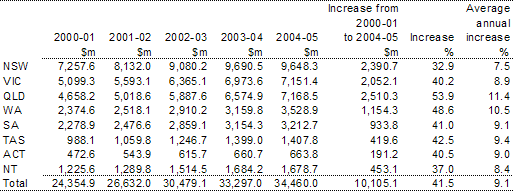
All GST revenue collected is received by the States. Consequently, they have a secure, growing and broad-based revenue source. States can spend the GST revenue according to their own budgetary priorities. The States’ GST revenue has grown significantly since its introduction in 2000-01 (Table 3).
Table 3: GST revenue provision to the States (cash), 2000-01 to 2004-05 (estimated)
GST revenue
Estimates of GST revenue in accrual terms for the years 2003-04 to 2006-07 are shown in Table 4. These estimates have been revised since the 2003-04 Budget and the Mid-Year Economic and Fiscal Outlook 2003-04 (MYEFO) to account for policy decisions and parameter variations.
Table 4: Reconciliation of GST revenue (accrual), 2003-04 to 2006-07 (estimated)
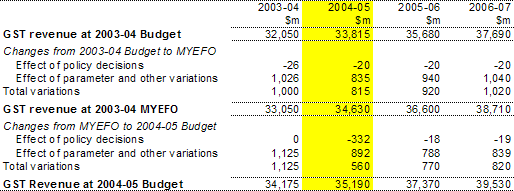
Estimated GST revenue in 2003-04 has been revised upwards by $1.1 billion in accrual terms, reflecting upward revisions in the consumption and dwellings forecasts.
The GST revenue estimate for 2004-05 has been revised up since MYEFO by $560 million, reflecting the flow-on effect of the stronger expected outlook for GST revenue in 2003-04. Some unwinding of this strength is expected in the forward years. Estimates of GST receipts in cash terms are shown in Table 5.
Table 5: GST receipts (cash), 2004-05 to 2007-08 (estimated)

GST revenue measures
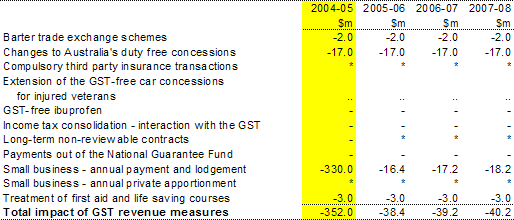
Policy decisions affecting GST revenue estimates include: the decision to allow taxpayers (mainly small businesses) that are voluntarily registered for GST to pay and lodge annually; changes to Australia’s duty-free concessions; changing the treatment of barter trade exchange schemes; and changing the treatment of first aid and life saving courses. The revenue effect of these GST measures is estimated for 2004-05 to 2007-08 (Table 6). Detailed information on each measure is in Appendix A.
The measure to allow annual payment and lodgement of GST is an important means of improving the operation of The New Tax System through reducing compliance costs for up to 740,000 small businesses and up to 30,000 non-profit organisations. Given the reduction in GST revenue in 2004-05 associated with this measure (because GST remitted by the eligible taxpayers will be deferred until 2005-06), the Australian Government will offer to fully compensate the States should each of them agree to the policy. This compensation will mean that the full financial impact of the measure will be taken by the Australian Government and none of the impact will affect the States.
Table 6: GST revenue measures since the 2003-04 Budget (estimated)
GST revenue provision
The Australian Government will distribute 2004-05 GST revenue among the States in accordance with the recommendations of the Commonwealth Grants Commission (CGC).
The CGC recommends relativities to calculate each State’s share of GST by applying the principles of Horizontal Fiscal Equalisation. Broadly, the CGC recommends relativities so that if each State made the same effort to raise revenue from its own sources and operated at the same level of efficiency, each State could provide services at the same standard.
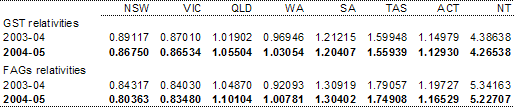
The CGC takes into account differences in States’ capacities to raise revenues and differences in the costs States incur in providing an average standard of government services. The CGC’s recommended relativities reflect these differences. GST relativities are shown for 2003-04 and 2004-05 (Table 7).
The CGC also recommends Financial Assistance Grants (FAGs) forgone relativities (Table 7), which are used for the calculation of each State’s Guaranteed Minimum Amount (Tables 11 and 12).
Table 7: GST relativities and Financial Assistance Grants forgone relativities, 2003-04 and 2004-05
Source: CGC Report on State Revenue Sharing Relativities 2004 Review.
The GST relativities are applied to state populations to determine a weighted population for each State. The Australian Government uses the weighted populations to distribute the GST revenue pool. Each State receives a share of the GST revenue pool equal to its weighted population share of combined GST revenue and unquarantined Health Care Grants, less its unquarantined Health Care Grants. This calculation determines the distribution of GST revenue in 2003-04 and 2004-05 (Tables 8 and 9).
Table 8: Distribution of GST revenue in 2003-04 (estimated)
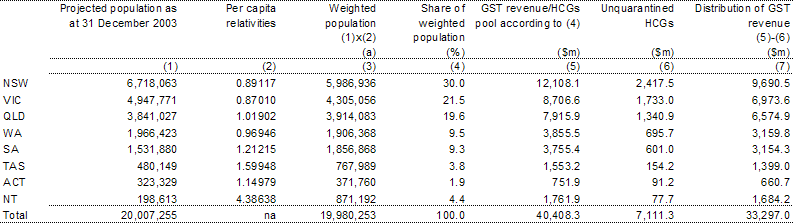
- Total weighted population differs from the total population in column (1) as the CGC calculates the per capita relativities using population numbers for 1997-98 to 2001-02, then rounds these figures.
Note: HCGs means Health Care Grants.
Table 9: Distribution of GST revenue in 2004-05 (estimated)
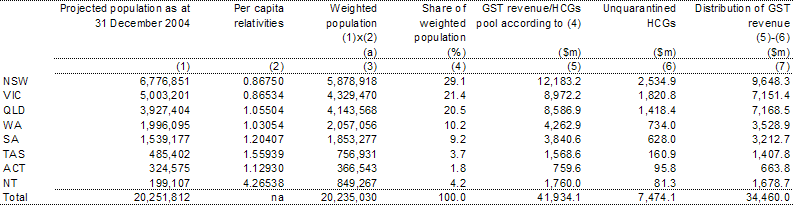
- Total weighted population differs from the total population in column (1) as the CGC calculates the per capita relativities using population numbers for 1998-99 to 2002-03, then rounds these figures.
Note: HCGs means Health Care Grants.
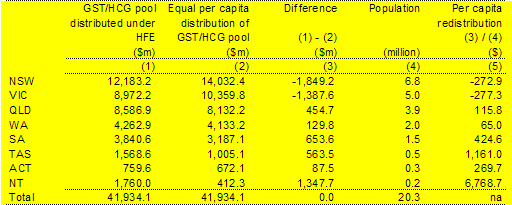
The Effect of Horizontal Fiscal Equalisation One way to view the effect of the Commonwealth Grants Commission’s (CGC) application of Horizontal Fiscal Equalisation is to compare each State’s distribution of the GST revenue/Health Care Grants pool using the CGC’s relativities with the distribution on an equal per capita basis. In 2004-05, approximately $3.2 billion (7.7 per cent) of the total GST revenue/Health Care Grants pool will be redistributed among the States, compared with an equal per capita distribution (Table 10). Table 10: Effect of Horizontal Fiscal Equalisation 2004-05
Note: New South Wales and Victoria receive less than equal per capita shares under the Horizontal Fiscal Equalisation arrangements because the CGC assessed their fiscal capacities to be relatively strong. For example, the CGC assessed that New South Wales has a relatively stronger capacity to raise revenue from land tax and stamp duty on property transfers and payroll tax, while Victoria has a relatively lower cost in providing state government services. The remaining States receive more than an equal per capita share of funding because the CGC assessed their revenue capacities to be lower and/or their costs of service delivery to be higher. The CGC finalised its five-yearly review into its methodology in February 2004, under terms of reference developed in consultation with all the States and Territories. The changes the CGC made to its methodology have been incorporated in its recommended relativities for 2004-05. |
Review of Horizontal Fiscal Equalisation Methodology At the March 2004 meeting of the Ministerial Council for Commonwealth-State Financial Relations, the majority of States and Territories, with the support of the Australian Government, agreed to a work programme to examine aspects of the Commonwealth Grants Commission’s (CGC) methodology for the allocation of the GST to the States. There was also majority agreement that the Australian Government and State and Territory Heads of Treasuries will undertake the work programme, and will draw on the expertise of the CGC. The work programme will include a consideration of whether the present approach is appropriate and necessary, the size and trend of the redistributions, simplification, and data issues. The work programme will not examine the underlying principles of horizontal fiscal equalisation. Arrangements are underway to establish a steering committee to oversee the review and report to Heads of Treasuries. A secretariat will support the steering committee. The Australian Government Treasury will lead the organisational arrangements for conducting the review, with representation from the States and the CGC. Additional funding of $1.3 million has been included in the budget for the secretariat (see Budget Paper No. 2, Budget Measures 2004-05 for a description of the measure). |