




Delivering more funding to the States
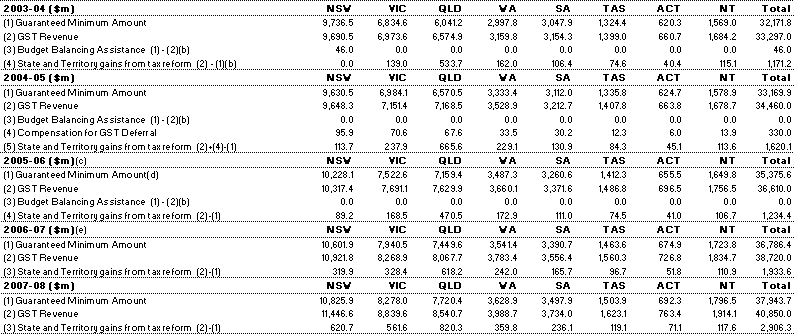
In 2004-05, all States will receive a windfall over the Guaranteed Minimum Amount (GMA). Including the compensation for the annual payment of GST (a measure which requires unanimous agreement from the States), the States will receive a total gain from tax reform of over $1.6 billion more than the GMA (Table 13). The GMA is an estimate of funding each State would have had available to it had tax reform not been implemented. Components of the GMA comprise estimates of Australian Government Financial Assistance Grants forgone, state taxes abolished by tax reform and other items. Narrow and inefficient state taxes that have been abolished include Financial Institutions Duty, stamp duty on quoted marketable securities, and accommodation taxes (bed taxes).
As the GST is a secure, growing and broad based revenue source, the States’ gain from tax reform is estimated to continue growing to over $2.9 billion by 2007-08 (Table 13). This means that the Australian Government’s tax reform will deliver to the States an extra $1.6 billion in 2004-05, growing to over $2.9 billion in 2007-08, to spend according to their own budgetary priorities. States can use this additional funding for essential community services such as hospitals, schools, public transport, roads and police, and to lower their tax burdens.
Under the Intergovernmental Agreement on the Reform of Commonwealth-State Financial Relations, the Australian Government guaranteed that in the transitional years after the introduction of The New Tax System in July 2000, each State’s budgetary position would be no worse off than had the reforms to Commonwealth-State financial relations not been implemented. To meet this guarantee, the Australian Government has paid Budget Balancing Assistance (BBA) to any State whose GMA exceeds its GST revenue entitlement.
On the basis of the Budget estimates, in 2003-04 only New South Wales requires BBA to ensure that it is no worse off. All other States are estimated to benefit from a total gain from tax reform of over $1.1 billion in 2003-04. As all States are expected to receive GST revenue in excess of their GMA from 2004-05, the Australian Government will no longer be required to provide BBA.
Tables 11 and 12 show the estimated GMA components, GST revenue entitlement and the BBA calculation for each State in 2003-04 and 2004-05. Table 13 shows the estimated GMA, GST revenue entitlement, BBA and gains from tax reform for each State from 2003-04 to 2007-08.
Table 11: Guaranteed Minimum Amount components, GST revenue provision and Budget Balancing Assistance in 2003-04 (estimated)
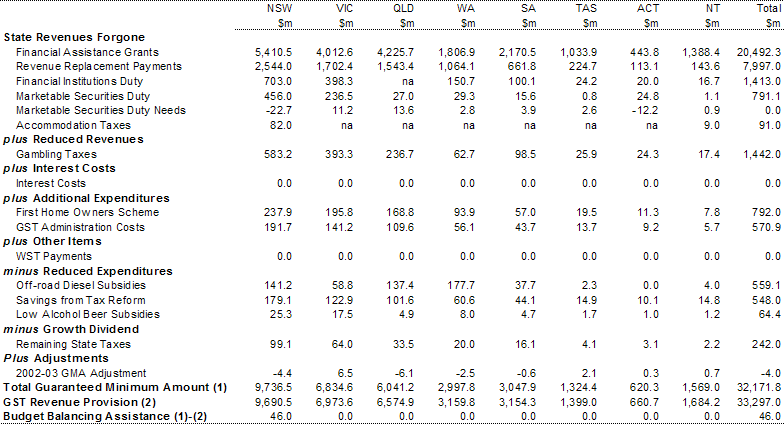
Table 12: Guaranteed Minimum Amount components, GST revenue provision and Budget Balancing Assistance in 2004-05 (estimated)
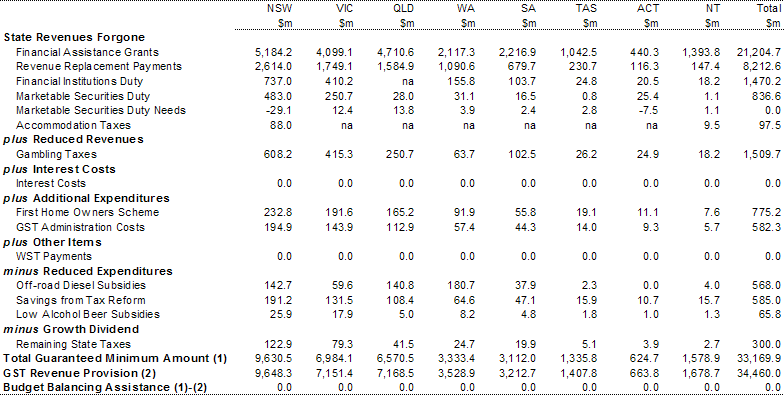
Table 13: Estimates of Budget Balancing Assistance and State and Territory gains from tax reform(a)
- Projections will be affected by variations in Guaranteed Minimum Amount components, GST revenue growth and recommendations by the Commonwealth Grants Commission on the distribution of GST to each of the States and Territories in future years.
- Where the difference between the Guaranteed Minimum Amount and GST Revenue (and vice versa) is less than zero, the reported amount is zero.
- In 2005-06 and beyond there may be small flow-on effects from compensation for the GST deferral which will be subject to negotiation with the States.
- As agreed at the 26 March 2004 meeting of the Ministerial Council for Commonwealth-State Financial Relations, bank account debits tax is to be abolished by 1 July 2005. The revenue forgone by the States and Territories is included in their Guaranteed Minimum Amount from 2005-06 to ensure the States are no worse off. Accordingly, State and Territory gains from tax reform decrease in 2005-06 compared to 2004-05. However, the estimates of Guaranteed Minimum Amounts do not contain reductions in the following state taxes: non-residential conveyances; non-quotable marketable securities; leases; mortgages, bonds, debentures and other loan securities; credit arrangements, instalment purchase arrangements and rental arrangements; cheques, bills of exchange and promissory notes, which are the subject of review by the Ministerial Council in 2005.
- The transition period in which the Australian Government guarantees that no State will be worse off due to tax reform expires on 30 June 2006.
Adjustments in 2003-04
GST revenue provision in 2003-04 has been adjusted to account for the final 2002-03 outcome (Table 1). In 2002-03 the final GST cash collections outcome was $57 million higher than the amount determined by the Commissioner of Taxation in June 2003 and provided to the States in 2002-03 under the terms of the A New Tax System (Commonwealth-State Financial Arrangements) Act 1999 (the Act).
Consistent with the provisions of the Act, the amount of GST revenue determined by the Commissioner and provided to the States in 2003-04 will take account of this variation. The BBA entitlement for New South Wales for 2003-04 has also been calculated to account for this variation (Table 11).
Adjustments in 2004-05
Consistent with the terms of the Intergovernmental Agreement on the Reform of Commonwealth-State Financial Relations, the Australian Government has advanced BBA to the States in four quarterly instalments in 2003-04. These advances were based on the estimated BBA entitlements of the States at the time of each advance. The upward revision to GST revenue estimates and the downward revision to GMA in the Budget have resulted in lower than previously estimated BBA entitlements of the States. Based on current estimates, the advances to the States in the year to date exceed the States’ entitlements to BBA in 2003-04 by $397 million (Table 14).
Consistent with the provisions of the Act, the Australian Government will deduct the amount of excess BBA paid in 2003-04 from payments to be made to the States under the Act in 2004-05. The final amount to be deducted from State payments in 2004-05 will be known when the final determination of each State’s BBA entitlement is made under the Act in June 2004.
Table 14: Overpayment of Budget Balancing Assistance in 2003-04 (estimated)

Residual Adjustments
The Australian Government has introduced a mechanism to ensure that all States receive their appropriate payments under the Act as they come off BBA. It came into effect when the A New Tax System (Commonwealth-State Financial Arrangements) Amendment Act 2004 received Royal Assent on 23 March 2004.
Residual adjustments will give effect to any underestimate or overestimate of payments in a previous financial year that, prior to the amendments, could not be paid or reclaimed using existing mechanisms under the Act.
Queensland and the Northern Territory no longer required BBA in 2002-03. The residual adjustment amounts for 2002-03 will reflect an underestimate of payments in 2001-02. As the legislative requirements were not in place last year, these adjustments will be paid in 2003-04.
Current estimates show that Victoria, Western Australia, South Australia, Tasmania and the Australian Capital Territory will no longer require BBA in 2003-04. Based on the current estimates, the residual adjustment amounts for 2003-04 will reflect an overestimate of payments in 2002-03.
As final payments for 2003-04 will not be known until the June 2004 determinations, it will not be known until after that time whether a residual adjustment for 2004-05 will be needed.
Table 15 shows estimates of the residual adjustment amounts that will be paid in 2003-04.
Table 15: Residual adjustment amounts for 2002-03 and 2003-04 (estimated)
