

OUR CITIES
More than 17 million Australians live and work in cities and towns. Urban sustainability challenges include issues such as ozone protection, air quality, waste, chemicals, housing, roads and airport noise. Addressing these issues involves cooperation among governments, industry and the community.
The Environment Protection and Heritage Council, a national council of government ministers, has achieved an encouraging level of shared responsibility among the Australian Government and State and Territory governments on nationally significant environment protection and heritage issues. Air quality, chemicals policy, waste management and national heritage policy are areas the Government will achieve major outcomes through the Council in 2004-05. The Council’s activities include the Air Toxics National Environment Protection Measure, a water efficiency labelling scheme and improved chemicals management.
The Australian Government promotes sustainability in local government through funding and support for the International Council for Local Environmental Initiatives, Cities for Climate ProtectionTM and Water Campaigns, and local government natural resource management facilitators.
Extending ozone protection
Stratospheric ozone depletion is a major global environmental challenge. For Australians, it also has serious health implications through increased exposure to UV rays and the resultant increased rates of skin cancer and eye cataracts.
The Government has continued Australia’s commitment to working with the international community to repair and preserve the ozone layer by amending the Ozone Protection Act 1989 to the Ozone Protection and Synthetic Greenhouse Gas Management Act 1989. The amendments control the end-use of ozone-depleting substances, and extend the existing system governing the import, export and manufacture of ozone depleting substances to synthetic greenhouse gases where they are used as alternatives to ozone depleting substances. It is projected they will further reduce Australia’s greenhouse gas emissions by the equivalent of six million tonnes of carbon dioxide in 2010.
The Government will continue to work closely with industry to develop consistent national standards for the safe and responsible handling of these substances, replacing the existing State and Territories systems.
Australia is also working to address ozone protection issue in the multilateral arena through the implementation of our commitments under the Montreal Protocol on Substances that Deplete the Ozone Layer, which Australia ratified in 1989.
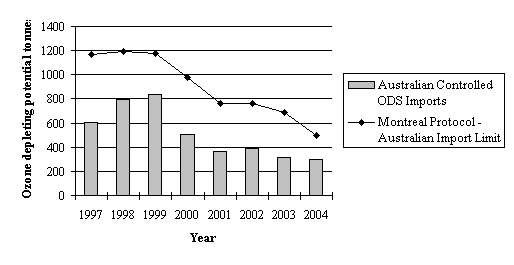
Chart 3.2 Volume of controlled ozone depleting substances (ODS) imported into Australia compared to Montreal Protocol obligations.
Improving air quality
With more than two million Australians suffering from asthma and hundreds of thousands of others affected by other respiratory disorders, poor air quality can have a major impact on the economy, our quality of life and the visual appeal of city skies.
The Australian Government has led national standards setting for air quality to provide protection against air pollution. The State of the Environment Report 2001 found that air quality had markedly improved for most pollutants in our capital cities since 1996.
An important step in the continuing development of national standards is the Air Toxics National Environment Protection Measure (NEPM), which was agreed by the Environment Protection and Heritage Council at its April 2004 meeting. The NEPM will set monitoring investigation levels for five hazardous air pollutants and facilitate the data collection for the development of air quality standards for these pollutants at their review in 2011.
The Government is also participating in a review of sulphur dioxide standards, and preparatory work for a review of ozone standards, under the Ambient Air Quality NEPM.
Work continues to target two of the main contributors to urban air pollution - motor vehicles and wood heaters.
A package of stringent vehicle emissions standards for cars, buses and trucks is being introduced from 2002 to 2006. These standards will lead to much lower levels of smog forming pollutants and particulate emissions from new vehicles.
National standards for petrol and diesel came into effect on 1 January 2002 under the Fuel Quality Standards Act 2000. In 2003-04 the petrol standard was tightened further to limit the content of smog-forming olefins; and ban the groundwater pollutant methyl tertiary-butyl ether (MTBE). Standards were developed for biodiesel and LPG. Ethanol in petrol was capped at 10 per cent and a labelling requirement for fuels containing ethanol was introduced.
Future work includes a review of existing vehicle emissions and fuel standards with a view to the development of next generation fuel standards beyond 2006, and consideration of the need for standards for alternative fuels such as Compressed Natural Gas, diesohol and ethanol.
The Diesel NEPM reduces pollution from diesel vehicles by encouraging the maintenance of diesel engine performance against emission standards. The Government has supported this NEPM through funding, including over $6 million to New South Wales and approximately $1 million to Brisbane City Council, to improve diesel vehicles’ emissions performance. By December 2003, over 4000 tests had been performed on more than 2000 vehicles in NSW and Victoria, with 200 vehicles repaired and re-tested. Of the high emitting vehicles that were repaired, particulate emissions improved by an average of more than 30 per cent. Negotiations with South Australia for a vehicle testing facility are close to finalisation. Agreements with Western Australia, Tasmania and Victoria are planned for 2004-05.
In July 2003 the Government announced its intention to provide a capped amount of $37.6 million to fund one-off capital grants for projects that provide new or expanded biofuels production capacity. The programme aims to increase the availability of biofuels for the domestic transport market. Feedstocks must be from renewable sources or biomass waste products.
An Internet based Green Vehicle Guide, expected to be on-line by the end of May 2004, will inform consumers about the greenhouse and air pollution performance of new models and give an overall star rating.
The Government is also encouraging alternative means of transport where practical. Cycling just 10 kilometres each way to work instead of driving saves about $770 in transport costs and 1.3 tonnes of greenhouse gas emissions each year. The Government has provided $2.4 million over two years for the installation of secure bicycle lockers at railway and bus stations. With the likely installation of over 3000 lockers, the new CycleConnect Programme, launched in February 2004, will encourage the use of bicycles in place of a proportion of motor vehicle trips.
Grants under the Launceston Woodheater Replacement Programme have resulted in more than 2,000 woodheaters being replaced with cleaner forms of heating. These efforts, coupled with other initiatives and milder weather conditions, resulted in only 18 days when the national air quality standard was exceeded as a result of woodheater emissions in 2003 - a 36 per cent reduction from 2001.
The National Woodheater Audit Programme has identified that the majority of the woodheater models tested failed to comply with the Australian standard on woodheater emissions. A national action plan is being developed with industry to deal with the issue before the 2004 winter and a follow up audit of all woodheater models, jointly funded by government and industry, is planned over the next two years.
Sustainable cities
The design, planning, construction and operation of the built environment is fundamental to the productivity and competitiveness of Australia’s economy, the quality of life of Australia’s people and the sustainability of the continent.
To encourage greater community participation in planning our cities, suburbs, towns and regions, the Australian Government has proclaimed 2004 as the Year of the Built Environment. A focus of the year is to encourage a built environment that is sustainable, energy efficient, safe, healthy and comfortable.
In 2003-04 the Government introduced the Sustainable Cities Programme to complement the Year of the Built Environment. The $40 million, five-year programme is designed to ensure understanding of, and action for, sustainable Australian cities. In 2004-05 the Government will provide:
- $4.1 million for the environment protection programme to continue the development of national standards and increase compliance and enforcement activities in areas such as air quality, fuel quality, the management and control of chemicals, pollutants, hazardous waste and ozone depleting substances; and
- $2.4 million for the urban environment programme, giving priority to national initiatives to address water quality, environmental information and education, air quality, renewable energy, chemicals, and waste management.
In September 2003 the Government approved the development of a water efficiency labelling scheme for all the major domestic water-using appliances, including toilets, showerheads, washing machines and dishwashers, based on the successful five star energy-label scheme. The 2003-04 Budget provided $2 million over five years, as part of the Sustainable Cities commitment.
The Australian Government is also working with governments, industry, research bodies and the community to promote environmental and economic opportunities in the re-use of wastewater and storm water.
Partnerships with industry
Industry has risen to the challenge of meeting the triple bottom line - sustainable economic, social and environmental development – by entering into partnerships with the Government to reduce greenhouse gases and other emissions, to cut waste and to save money through more efficient use of resources.
The Government is working in partnership with over thirty industry associations to develop and promote eco-efficiency tools to their members. Through these Eco-Efficiency Agreements, the Government is helping businesses develop more environmentally and economically efficient business practices: in short, by 'doing more with less'. Activities under these agreements will continue to enhance the sustainability of Australian industry.
The Government continues to build partnerships with the finance and industry sectors to raise awareness of long-term environmental factors and risks in investment decision-making. An online library of Australian corporate sustainability reports and a survey of companies' triple bottom line reporting will help inform investors who are interested in long-term company performance and risk. These programmes reinforce the business case for sustainability and build capacity for companies to manage, measure and report on their environmental performance.
In April 2004 the Government finalised the National Australian Built Environment Rating System. This enables building owners, users and tenants to rate the environmental performance of existing buildings and promotes investment in sustainable buildings. In consultation with industry and a range of stakeholders (including the Australian Building Codes Board and Standards Australia), the Government is assessing the feasibility of incorporating sustainability considerations into national building codes and standards, and determining the reforms required to 'green' such codes and standards.
Reducing and re-using waste
Every year in Australia, over 20 million tonnes of waste is sent to landfill. The Australian Government works through the Environment Protection and Heritage Council to reduce the environmental impact of nationally significant wastes, such as consumer packaging and paper, plastic bags, electrical and electronic waste and used tyres.
Under product stewardship approaches, responsibility for wastes is shared with industries which are expected to be more active in avoiding problems and designing solutions. Australian industry has been quick to learn that cutting waste can lead to big savings through reduced resource usage and lower waste management costs.
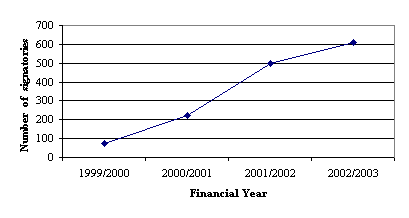
The National Packaging Covenant, one of the first stewardship agreements, is nearing the end of its five-year term. The Covenant has attracted an unprecedented number of industry and government signatories – 630 over four years – and has generally taken a cooperative life-cycle approach to managing packaging waste. The Covenant was recently extended on an interim basis to April 2005 to allow for broad consultation between all stakeholders on future approaches to packaging waste.
Chart 3.3 Total number of companies signatory to the National Packaging Covenant
The community uses 6.9 billion plastic bags each year. In October 2003, the Environment Protection and Heritage Council agreed to measures to reduce the impact of plastic bags, including a voluntary industry Code of Practice. The Australian Retailers Association and major supermarket chains such as Coles and Woolworths have committed to reduce the use of plastic bags by 50 per cent by the end of 2005 and to increase recycling by between 15 to 30 per cent. Environment Ministers have called for lightweight HDPE bags to be phased out by 2008.
An awareness raising campaign will educate the public about the environmental hazards of the inappropriate disposal of used oil, inform oil users about the Product Stewardship Arrangements for Waste Oil Programme, and encourage the use of new collection facilities. The Programme provides incentives to increase the uptake, recycling and reuse of used oil. The amount of used oil collected has increased by 33 per cent since the Programme commenced in January 2001. This is an estimated 81 per cent of total recoverable used oil. Almost $10 million has been distributed in grants to local governments and state-based agencies to establish collection facilities throughout Australia. Over seven hundred facilities will be established by the completion of the Programme.
Responsible chemicals management
ChemCollect was a three-year national programme, which addressed the improper disposal and management of agricultural and veterinary chemicals - a risk to the environment, human health and Australia’s rural export industry. The programme was very successful, collecting approximately 2000 tonnes of unwanted or unregistered chemicals, significantly more than the original target of 1200 tonnes. Governments funded ChemCollect on the basis that industry would ensure that no further funding was required.
ChemClear, a joint initiative involving Avcare (the National Association for Crop Protection and Animal Health), the Veterinary Manufacturers and Distributors Association and the National Farmers' Federation, will build on ChemCollect’s success. ChemClear will provide farmers with a disposal service for unwanted registered agricultural and veterinary chemicals. Trials began in early 2004.
The National Medicines Disposal Programme uses the national community pharmacy network to collect expired and unwanted medicines from consumers. Disposal by high-temperature incineration avoids the significant environmental health hazards of disposal through the sewerage system and landfill. From July 2002 to June 2003 an average of 30 tonnes per month of returned medicines was collected - a 27 per cent increase over the previous year.
The Government has in place a national framework to ensure that the environmental risks of industrial, agricultural and veterinary chemicals are reduced. The National Industrial Chemicals Notification and Assessment Scheme and the Australian Pesticides and Veterinary Medicines Authority assess new and existing chemicals to identify the potential risks of their exposure to the environment, providing governments, industry and the community with the right tools to reduce and manage those risks.
Housing and infrastructure
The Community Housing and Infrastructure Programme contributes to improving the environmental health of Aboriginal and Torres Strait Islander communities by providing housing, infrastructure and municipal services.
Since 1995 the National Aboriginal Health Strategy has provided approximately $800 million for large-scale environmental health infrastructure projects.
All Australian Government funded road projects on National Highways and Roads of National Importance have environmental assessments at the planning stage. In addition, all Australian Government funded road projects have environmental management plans to limit, mitigate, or counterbalance their environmental impacts.
The Government is addressing aircraft noise issues through a range of initiatives. The Adelaide and Sydney Airports Noise Amelioration Programmes fund insulation of eligible residences and public buildings in areas of high aircraft noise.
Environmentally responsible government
The Government leads by example when it comes to environmentally responsible actions. Australian Government activities are largely office-based, but can impact on land, air, water and biodiversity. The Government is also a major landholder and a significant purchaser of goods and services worth $16 billion each year.
The Government continues to promote the adoption of environmentally sustainable practices by its own agencies. At least 28 departments and agencies had an Environmental Management System in place at the end of December 2003, with another 19 under development. Five have certified Environment Management Systems, with at least 14 planning to seek certification for at least one major site.
Activities undertaken by government agencies include energy efficiency and waste minimisation measures. A wide range of material, including paper, cardboard, glass, printer cartridges, and fluorescent tubes, is recycled.
The Department of Family and Community Services released its first Triple Bottom Line Report in 2003. Other agencies, including the Department of the Environment and Heritage, are developing reports on their environmental, social and financial performance.
The Government is investigating and implementing measures to save and re-use water in its operations. The Department of Defence released its Sustainable Water Management Strategy in February 2004. Initiatives to improve Defence’s water management include water audits, and water conservation measures, such as using water efficient appliances and investigating the potential for re-using greywater.
As a manager of extensive training sites, the Defence Department also contributes to biodiversity conservation through the management of endangered species, feral, weed and overabundant species and native flora and fauna. Defence also aims to comply with environment legislation and policies which apply to its operations in marine areas and to minimise adverse impacts as far as practicable. Key considerations include the potential impacts of naval activities in the marine environment, including on cetaceans, pollution control, and management of biofouling and introduced marine species.


