
OUR COASTS AND OCEANS
Australia is responsible for a marine area of 14 million square kilometres - almost twice the size of our mainland.
This area is home to some of the world’s most diverse ecosystems with more than 80 per cent of marine species unique to these oceans. These ecosystems are also rich in resources, with marine industries generating more than $30 billion annually.
Our marine areas are in relatively good condition, but are under increasing pressure both from marine industries and the impacts of activities in coastal areas.
Safeguarding the Great Barrier Reef
The Great Barrier Reef World Heritage Area is a nationally and internationally significant area with outstanding environmental, social and economic values. Within the Great Barrier Reef catchment, tourism contributes an estimated $4.3 billion dollars every year and recreational fishing and boating contribute $240 million every year.
The Government continues to address the critical issues affecting the Great Barrier Reef Marine Park with $261.2 million spent since 1996.
The 2004-05 Budget provides an additional $30.3 million for initiatives relating to the Great Barrier Reef.
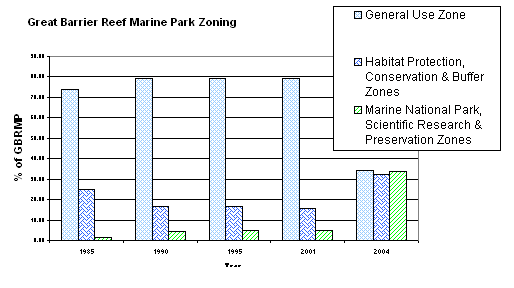
The new Zoning Plan for the Great Barrier Reef, which comes into effect from 1 July 2004, will ensure the protection of the Reef for future generations. A seven-fold increase in protected zones and marine sanctuaries - from 4.5 to 33.3 per cent - within the Great Barrier Reef Marine Park will create the largest network of marine protected areas in the world.
Recognising that a programme of this scale will have unavoidable impacts, the Australian Government has developed a structural adjustment package for commercial fishers and others who may be adversely impacted by the implementation of the Plan. The 2004-05 Budget allocates $10.2 million over two years for this package.
The package includes funds for education and provision of information to the public, tourists and industry on the newly protected areas of the Reef, additional resources for enforcement and compliance activities, a water quality monitoring programme associated with the Reef Water Quality Protection Plan and assistance to tourism operators to implement a programme to control Crown of Thorns Starfish outbreaks.
Chart 3.4: Variation in Zoning of the Great Barrier Reef Marine Park
Protecting Reef water quality
Over the last 150 years the land catchment areas adjacent to the Reef have been changed by urban development, agriculture, tourism and mining. Sediments, nutrients and other pollutants from land-based sources are affecting the inner reefs and seagrass areas of the Reef. Although the vast majority of the 2900 reefs that make up the Great Barrier Reef are in good condition, some of the 450 inshore reefs are showing impacts consistent with a decline in water quality.
The Reef Water Quality Protection Plan, announced by the Australian and Queensland Governments in December 2003, aims to minimise pollutants and reduce their entry into the Reef.
The Australian Government is also working closely with the Queensland Government to develop and implement the Great Barrier Reef Coastal Wetlands Protection Programme. Funding was announced in the 2003-04 Budget.
The draft Natural Heritage Trust Bilateral Agreement between the Australian and Queensland Governments recognises the importance of conserving and restoring wetlands throughout Queensland. The programme is being developed in parallel with the Great Barrier Reef Coastal Wetlands Protection Programme.
A national approach to coastal issues
The Australian Government has led State and Territory governments to identify coastal issues that would benefit from national cooperation. These include the sustainable use of coastal resources, the impacts of climate change and threats from introduced marine pests.
Australian, State and Territory government Ministers endorsed a Framework for a National Cooperative Approach to Integrated Coastal Zone Management in October 2003 and are now developing a Coastal Implementation Plan. Consultations with key stakeholders such as coastal communities and local governments will be held over the next few months. The Plan is due for completion in October 2004.
Improving coastal water quality
Water quality hotspots are areas where pollution has caused serious environmental decline. Most hotspots are in or near urban areas but some are in regions such as the Great Barrier Reef and the Gippsland Lakes. The Coastal Catchments Initiative aims to reduce pollutant discharges to identified coastal water quality hotspots.
Water Quality Improvement Plans are prepared for these hotspots for accreditation by the Australian Government, incorporation into regional plans and funding through investment strategies.
Financial assistance agreements are in place to develop plans, and in some instances to undertake interim water quality projects, for the Peel Inlet – Harvey Estuary System in Western Australia, Adelaide’s Port Waterways in South Australia, the Derwent Estuary in Tasmania and waterways in the Douglas Shire in Queensland. Further financial agreements, plans and water quality projects are anticipated.
Regional marine planning
Australia's first regional marine plan, which covers the southeast of Australia’s marine region, will be launched in 2004. This is a world first initiative that integrates the conservation and sustainable use needs of an area of over two million square kilometres, an area with unique biodiversity and ecosystems which also supports vitally important marine industries.
Work is progressing on the northern regional marine plan and initial steps have been taken towards the development of a marine plan in the southwest of Australia.
Regional marine planning is underpinned by an extensive scientific programme which supports an ecosystem-based approach to the management of Australia’s marine resources.
A national approach to integrated oceans management
The Australian Government is leading State and Territory governments to enhance cooperation across jurisdictions and increase Australia’s ability to develop our marine resources in an ecologically sustainable manner.
Australian, State and Territories natural resource ministers released a Joint Statement on Integrated Oceans Management in October 2003. A broad based committee has been established to make recommendations on national principles to guide intergovernmental decision-making and cooperation. The Natural Resource Management Ministerial Council is expected to consider these recommendations in October 2004.
High seas biodiversity conservation
Australia continues to pursue improved high seas biodiversity conservation and sustainable management through various international fora. The Government hosted a major international meeting on governance of the high seas in mid 2003 and is developing a range of policy options to address sustainable management of the ocean ‘commons’.
Australia continues to work closely with Pacific Island countries on their oceans policy and with APEC members on a number of oceans issues, in particular, introduced marine pests and integrated management.
Sustainable fisheries
The Government will provide $47.9 million in 2004-05 and $41.4 million in 2005-06 to the Australian Customs Service and the Department of Agriculture, Fisheries and Forestry to strengthen Australia’s patrol capability in the Southern Ocean. Increased surveillance and enforcement in Australia’s Fishing Zone at Heard Island and McDonald Islands will assist in ensuring the long-term sustainability of Patagonian Toothfish stocks and dependent and associated species. Between August 2003 and February 2004 two vessels fishing illegally for the Patagonian Toothfish in Australia’s sovereign waters were successfully pursued and apprehended.
The Government continues to make substantial progress in completing the strategic assessment of fisheries under the EPBC Act. The assessment of these fisheries is changing management practices across Australia’s commercial fisheries with a shift from species management to an ecosystem-based fisheries management approach. Approved management plans provide certainty for fishery operators, processors and exporters.
Australia is committed to the sustainable management of global tuna stocks. Australia continues to participate strongly at meetings of regional fisheries management organisations to ensure sustainable conservation and management processes for tuna and tuna-like species.
In 2003 the Commission for the Conservation of Southern Bluefin Tuna agreed to national allocations for the first time since 1998. This is a major step towards the sustainable management of the global southern bluefin tuna stock. Australia pressed strongly for the establishment of a Scientific Research Programme under the control of the Commission. The Programme will develop a management procedure to underpin future decisions, including total allowable catch setting. The procedure is expected to be in place in late 2004.
Marine protected areas
An extensive network of Commonwealth marine protected areas contributes to the national representative system of marine protected areas and the protection and sustainable use of Australia’s coasts and oceans. Since 1996, 25 million hectares of Commonwealth marine protected areas have been added to the national system.
Chart 3.5 Commonwealth Marine Protected Areas 1982 - 2003 (Total area managed under EPBC Act)
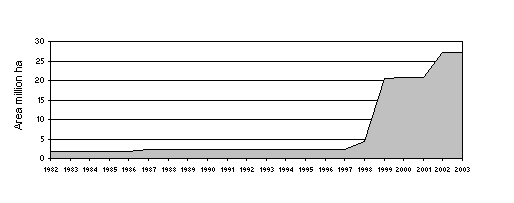
New reserves declared include the Great Australian Bight Marine Park, Tasmanian Seamounts Marine Reserve, Macquarie Island Marine Park, Lord Howe Island Marine Park, Cartier Island Marine Reserve, and Heard Island and McDonald Islands Marine Reserve. The six new marine reserves represent over a ten-fold increase from pre-1996 levels.
The regional marine plan process will result in the declaration of a comprehensive set of new marine protected areas in the southeast marine region. A reporting strategy will demonstrate their contribution to biodiversity conservation.
Protecting marine species
Australia promotes international action to protect cetaceans (whales, dolphins and porpoises) by pursuing a permanent international ban on commercial whaling, an end to “scientific” whaling and the creation and retention of whale sanctuaries.
Australia is active in the International Whaling Commission, the primary forum in which whale protection is pursued. At the Commission’s annual meeting in July 2004 Australia will aim to ensure that a global moratorium on commercial whaling is maintained, and the Southern Ocean Sanctuary is retained. Australia will again pursue the establishment of a South Pacific Whale Sanctuary.
Australia is working in the South Pacific to encourage domestic and regional protection for cetaceans. Australia encourages South Pacific countries to establish whale sanctuaries in their Exclusive Economic Zones and to coordinate cetacean conservation measures at a regional level.
Australia was instrumental in organising the second workshop on a regional arrangement to conserve marine mammals under the Convention on Migratory Species, held in Samoa in March 2004. The outcomes of the meeting included a proposal to develop a memorandum of understanding to dentify key actions to restore the conservation status of marine mammals in the region.
Australia has also pursued domestic and international initiatives for the conservation of albatrosses and petrels. Conservation of these highly migratory species cannot be achieved by one country acting independently of other nations that share the same species populations. Australia encourages other countries to take actions on an international level to complement policy and actions taken nationally.
Australia played a leading role in the development of the Agreement for the Conservation of Albatrosses and Petrels which entered into force on 1 February 2004. There is now strong international commitment to protect albatrosses and petrels. Australia will host the first Meeting of Parties in 2004-05.
The recovery of 23 species (21 albatross and two giant petrels) listed under the EPBC Act was supported through a recovery plan, and the mitigation of bycatch in longline fisheries, a key threatening process for seabirds.
Preventing and managing introduced marine pest incursions
In the marine environment, about one in six of the up to 300 introduced marine species in Australian coastal waters is likely to become a pest. The potential cost to the nation is enormous, impacting on fisheries and aquaculture production, human health, shipping and ports, tourism, coastal amenity, and species and ecosystem health and diversity.
An intergovernmental agreement on legislative and funding responsibilities under the National System for the Prevention and Management of Introduced Marine Pest Incursions is expected to be concluded in mid 2004.
In 2004-05 the development of a management regime to help stop marine pests entering Australian waters through ships’ ballast water and fouled hulls will continue. Over the four years to 2005-06, $4.6 million is being spent on this task.
In 2004-05 a system for managing coastal ballast water, linked to the existing system for managing international ballast water, will be ready for implementation.


