




Section 2: Outcomes and outputs information
Outcomes and output groups
The map below shows the relationship between government outcomes and the contributing outputs for the Australian Taxation Office (ATO). Financial detail for Outcome 1 by output appears in Table 2.1 while non-financial information for Outcome 1 appears in Table 2.2.
Output cost attribution
The ATO uses a process of cost centre mapping to estimate its actual costs incurred on each of the five outputs.
Mappings are based on cost centre manager estimates. The costs of corporate services and facilities, for example accommodation and information technology, are attributed to cost centres using relevant cost drivers. The cost drivers generally represent resource usage or headcount (where costs incurred directly relate to the number of staff). Corporate overhead and some information technology related costs are not attributed to cost centres but are instead attributed to outputs as a final step in the costing process.
The price of outputs outlined in Table 2.1 are based on the estimated 2003-04 result, adjusted for planned movements in 2004-05.
The ATO is currently reviewing its cost attribution processes for 2004-05.
Map 2: Outcomes and output groups
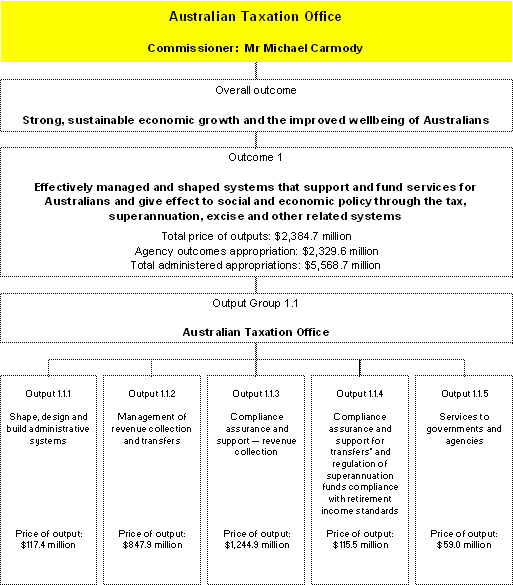
* Transfers — movement of money that is not revenue for example tax offsets, grants, super guarantee vouchers and benefits distribution.
Changes to outcomes and outputs
There are no proposed changes to the outcome or outputs.
Outcome 1 — Description
Effectively managed and shaped systems that support and fund services for Australians and give effect to social and economic policy through tax, superannuation, excise and other related systems.
The single government outcome relating to the ATO properly reflects the nature of the services of the ATO. It provides an integrated platform for a viable and sustainable revenue administration. This is achieved through ensuring:
- effective and efficient administrative design for systems the ATO administers, consistent with policy intent and meeting community needs;
- an effective relationship and communication with taxpayers and Government;
- cost-effective collection of tax, transfers of revenue (to other agencies) and delivery of benefits through the tax system;
- compliance behaviour is maintained through providing comprehensive education and support services to the community and developing compliance strategies to address compliance risks;
- community confidence is maintained through working in partnership with the community to foster community ownership of the tax system and providing timely and professional service;
to enable Government to deliver on social and economic policy. The integrated approach enables cost-effective delivery of both revenue and transfers.
Measures affecting Outcome 1
AusLink — redirection of funds from the Fuel Sales Grants Scheme
The Government will cease the Fuel Sales Grants Scheme from 2006-07 and redirect funding to the new land transport infrastructure programme — AusLink. This funding will be allocated to improve roads in outer metropolitan, rural and remote areas.
See also the related expense measure AusLink — National Land Transport Network in the Transport and Regional Services portfolio.
Australian Taxation Office — taxation and superannuation compliance
The Government will provide additional funding of $326.4 million over four years to the Australian Taxation Office to better educate taxpayers, raise the level of voluntary compliance with taxation obligations, and undertake additional compliance activities such as reviews and audits which will result in increased revenue.
The activities will focus on areas of: employer obligations; businesses with annual turnover of between $2 million and $100 million (in particular those with an annual turnover of more than $50 million where evidence indicates financial arrangements are becoming more complex); individual taxpayer obligations in the areas of capital gains tax, rental deductions and high risk refunds; leveraging compliance through tax agents; and superannuation.
Additional revenue in superannuation guarantee payments on behalf of employees will also be recouped and the majority of the 4.6 million ‘lost’ superannuation members’ records will be matched with Tax File Numbers for the purpose of re-attaching them to their entitlements. The return of these superannuation guarantee entitlements to the individuals’ superannuation funds will be reflected in increased administered expenses.
Incentives for saving for retirement — enhancement of Government superannuation co-contribution scheme
The Government will enhance the superannuation co-contribution scheme by increasing the maximum co-contribution, giving $1.50 for every $1 of personal contribution, and by raising the income thresholds so that more employees will qualify under the scheme. These changes will apply for personal contributions made from 1 July 2004.
The maximum Government contribution will be increased under the new arrangements from $1,000 to $1,500. The Government will pay $1.50 for every $1 of contribution up to the co-contribution maximum.
The income level up to which the maximum co-contribution applies will be increased from $27,500 to $28,000. For incomes above $28,000, the maximum co-contribution will reduce by 5 cents for each dollar of income, and phase out completely at an income of $58,000. The co-contribution currently phases out at an income of $40,000.
This measure will increase the incentive for people to save for their retirement through the superannuation system.
More help for families — changes to Family Tax Benefit Part A — lump-sum payment and reduction in the taper between maximum and base rates
The Government will make two changes to Family Tax Benefit Part A (FTB(A)).
There will be an increase in the rates of FTB(A) of $600 per child to be paid as a lump sum upon reconciliation of entitlement, commencing in respect of the 2003-04 financial year. The lump sum represents an increase in the maximum and base rates of FTB(A) per child of $600 per annum.
The lump sum will be paid to families as part of the reconciliation of FTB entitlement that normally takes place after families lodge their tax returns. If required, any family assistance overpayments received by the family will be offset against the lump-sum payment, with the remainder payable to the family.
Currently, once the income of families with dependent children exceeds $31,755 per annum, their FTB(A) reduces from the maximum rate, at a rate of 30 cents for every extra dollar of income, until the base rate of payment is reached. From 1 July 2004, the taper rate that applies to this reduction will be reduced to 20 cents in the dollar.
More help for families — changes to Family Tax Benefit Part B — increase in threshold and reduction in taper
The Government will relax the income test for Family Tax Benefit Part B (FTB(B)). From 1 July 2004, the amount that a secondary earner can earn each year before their FTB(B) starts to be reduced will be more than doubled to $4,000. At the same time, the rate at which FTB(B) is withdrawn once this income limit is exceeded will be reduced from 30 cents to 20 cents for every extra dollar of income.
More help for families — protect Family Tax Benefit Part B for secondary earners returning to the workforce after the birth of a child
The Government will change Family Tax Benefit Part B (FTB(B)) to benefit a parent returning to work after the birth of a child. From 1 July 2005, where the secondary earner (usually the mother) returns to work, income from employment will not be counted against their eligibility for FTB(B) already received. That is, they will keep the FTB(B) already received prior to re-entering the workforce. This option applies once in relation to each child.
More help for families — introduction of Maternity Payment and abolition of Baby Bonus
The Government will introduce a new universal Maternity Payment payable to families at the time of the birth of a new child. The Maternity Payment will be introduced on 1 July 2004 and will provide $3,000 to families for each new child born after this date.
This new payment will incorporate the Baby Bonus, which will be phased out.
Claims for the Baby Bonus can continue to be made in respect of children born (or for whom legal responsibility is otherwise gained) prior to 30 June 2004. Claims will be able to be made for the full five year entitlement.
Oil recycling — new category of grant
The Government has amended the Product Stewardship (Oil) Regulations 2000 to provide oil recyclers who produce blended light fuel oil with a new grant of 9.557 cents per litre of oil recycled, with an expected cost of $2.2 million over three years (including $0.3 million in 2003–04).
The new grant fully offsets the impact of changes that took effect from 1 February 2004, when support for this activity moved from concessional treatment under the excise system to delivery under the Energy Grants (Credits) Scheme. The new grant meets the Government’s intention that oil recyclers not be disadvantaged by the removal of the excise exemption and that an equivalent level of support for this oil recycling activity continues.
Refundable Film Tax Offset — extension to episodic television
The Government will provide $12 million over three years from 2005–06 to extend the application of the existing Refundable Film Tax Offset to the production of television series.
The Refundable Film Tax Offset currently provides a rebate of 12.5 per cent of eligible film production costs in cases where qualifying Australian expenditure exceeds $15 million.
State, territory and local government organisations — transitional grants as compensation for lost access to a fringe benefits tax concession
The Government will provide transitional grants totalling $80 million over four years to certain organisations which had been endorsed by the Commissioner of Taxation as public benevolent institutions but were found to be ineligible for this status following a recent comprehensive review by the Australian Taxation Office. The funding will support these organisations in recognition of the loss of the fringe benefits tax (FBT) exemption of up to $30,000 of the grossed up taxable value per employee which these organisations had been accessing as public benevolent institutions.
The transitional grants recognise the potential impact on State and Territory and local governments of increases in employment costs for around 350 organisations.
The transitional grants will include support for certain public ambulance services that had been accessing an FBT exemption of up to $30,000 of grossed up taxable value per employee as public benevolent institutions. A recent court decision found that some of these organisations were ineligible for this concession. The Government subsequently announced that it would make an FBT exemption of up to $17,000 of grossed up taxable value per employee available to all public ambulance services, consistent with that available for public and not-for-profit hospitals. The grants will support organisations in the transition to the lower FBT exemption.
The Government will also provide additional funding of $2.3 million over four years to the Australian Taxation Office to administer the grants described above.
See revenue measure Fringe Benefits Tax — ensuring concessions are available for public ambulance services in the Treasury portfolio.
Superannuation — new qualifying criteria for Government Co-contribution Scheme
The Government will broaden the eligibility criteria for the Superannuation Co-contribution Scheme for low-income earners, at a cost of $195 million over four years.
The broadened eligibility criteria replace the existing requirement that eligible participants receive employer superannuation contributions with a requirement that at least 10 per cent of an individual’s income is earned as an employee. For example, this will include people who earn less than $450 per month and are not eligible for employer superannuation support.
Further information can be found in the press release of 14 March 2004 issued by the Minister for Revenue and Assistant Treasurer.
See also the related expense measure titled Superannuation co-contribution implementation campaign in the Treasury portfolio.
Superannuation co-contribution implementation campaign
The Government will provide $8.2 million in 2004-05 for the expansion of the Australian Taxation Office’s communication and marketing campaign to reach and inform eligible recipients of the Superannuation Co-contribution Scheme.
See also the related expense measure titled Superannuation — new qualifying criteria for Government Co-contribution Scheme for the Australian Taxation Office in the Treasury portfolio.
Outcome 1 — Resourcing
Table 2.1 shows how the 2004-05 appropriations translate to total resourcing by Output for Outcome 1, including administered expenses, revenues from government (appropriations), revenue from other sources, and the total price of outputs.
Table 2.1: Total resources for Outcome 1 ($’000)
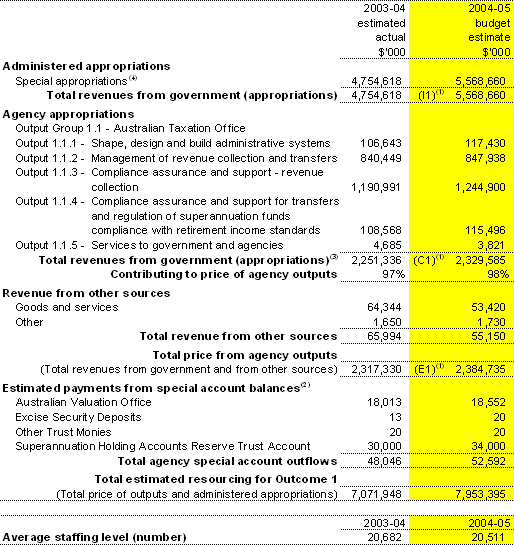
- C1, E1 and I1 show the links back to Table 1.1.
- Special account inflows and outflows are shown in further detail in Table 1.6 Estimates of special account flows and balances. Please note that these figures are cash based and exclude transactions between the Australian Valuation Office and the Australian Taxation Office.
- This amount is higher than the 2003-04 Portfolio Additional Estimates Statements (PAES) figure due to the approval of funding subsequent to PAES. The accrual appropriation is recognised in 2003-04 and the cash will be included in the 2004-05 Appropriation Bill No. 2 as funding for previous years’ outputs.
- The amount showing for administered special appropriations represents appropriations to deliver ATO programmes. Amounts disclosed under special appropriations do not include the expenditures to pay refunds under the tax system.
Outcome 1 — Contribution of outputs
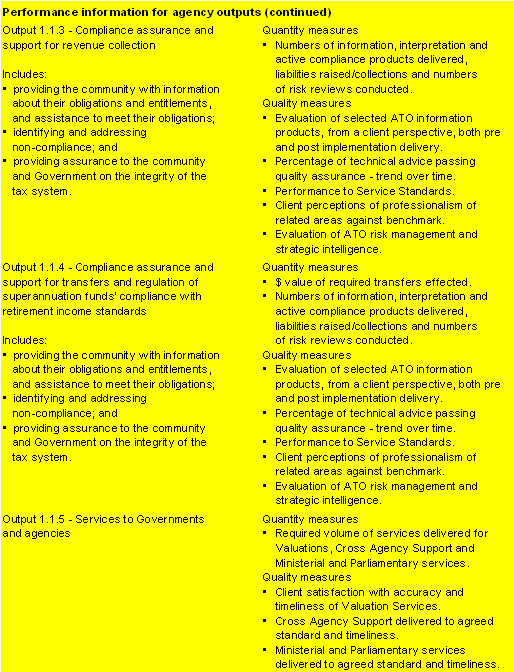
Table 2.2 details the performance indicators used to assess our achievement of Outcome 1, and shows the link between the outputs and the outcome.
There are five distinct outputs that contribute to Outcome 1:
- Output 1.1.1: reflects the ATO’s role in effectively shaping the systems to give effect to the legislation administered by the organisation;
- Output 1.1.2: represents the operational aspects of managing the tax, superannuation and excise systems;
- Output 1.1.3: represents the processes required to assure and support compliance with tax obligations, providing the community with information and assistance;
- Output 1.1.4: represents the processes required to assure and support compliance with transfers and superannuation obligations administered by the ATO, providing the community with information and assistance; and
- Output 1.1.5: reflects the range of services the ATO provides to the Treasurer, the Minister for Revenue and Assistant Treasurer, the Parliament and to other APS agencies.
Performance information for Outcome 1
Table 2.2: Performance information for Outcome 1
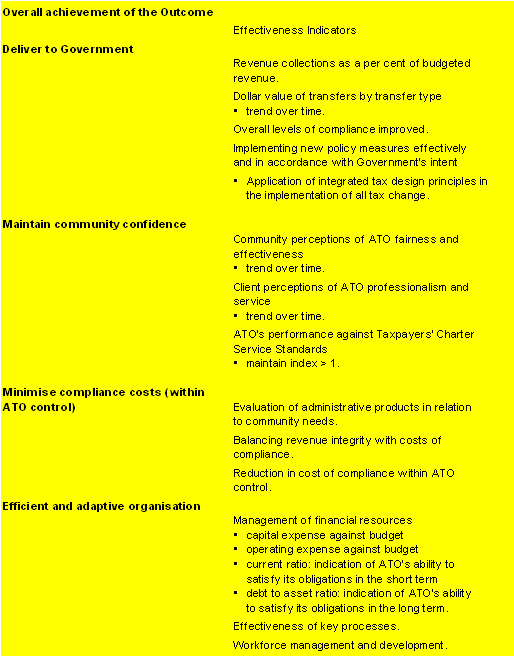
Table 2.2: Performance information for Outcome 1 (continued)
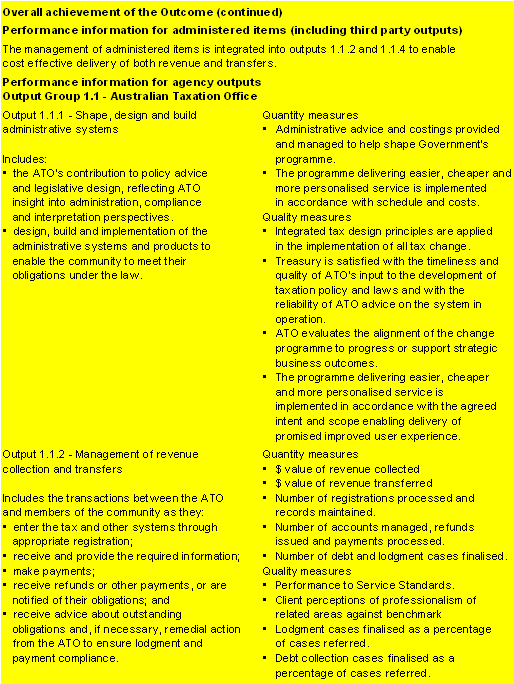
Table 2.2: Performance information for Outcome 1 (continued)
Evaluations
The Australian National Audit Office and ATO Internal Audit have a rolling programme of issues that are audited during the financial year. Other issues are evaluated within the ATO during the financial year as required. Results of evaluation will be shown in the ATO Annual Report.