




Section 3: Budgeted financial statements
The budgeted financial statements will form the basis of the financial statements that will appear in the Australian Taxation Office (ATO) 2004-05 Annual Report, and for the input into the Whole of Government Accounts. The financial statements should be read in conjunction with the accompanying notes.
These budgeted financial statements and administered notes are consistent with the forms of financial statements specified under the 2003-04 Finance Minister’s Orders ‘Requirements for the Preparation of Financial Statements of Australian Government Entities’.
Analysis of budgeted financial statements
Budgeted agency statement of financial performance
The ATO is budgeting for an operating loss of $35.0 million in 2004-05 after income tax equivalents payable by the Australian Valuation Office (AVO). The operating loss allows the ATO to progress its corporate improvement program aimed at making the tax experience easier, cheaper and more personalised for taxpayers while maintaining compliance and current taxpayer services.
Operating Revenues
Total agency revenue is estimated to be $2,384.7 million and consists of $2,329.6 million in appropriation and revenue from other sources of $55.2 million. This is an increase of $67.4 million from the 2003-04 estimated actual.
This rise in revenue is primarily an increase in appropriation as a result of Budget measures shown in Table 1.2.
Operating Expenses
Total expenses are estimated to be $2,419.5 million. This is an increase of $103.0 million from the 2003-04 estimated actual.
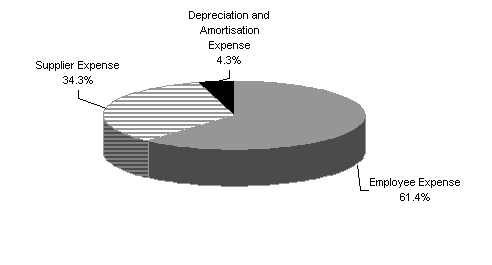
Operating expenses consist of $1,485.0 million in labour expenditure, $829.8 million in supplier expenditure and $104.7 million in depreciation and amortisation, as illustrated in the following chart.
Budgeted total agency expenses 2004-05
The following movements have taken place since the 2003-04 Additional Estimates:
- Labour has increased by $70.2 million, largely attributable to:
- Taxation and superannuation compliance measure leading to increased workloads. The work targets several high risk areas which by their very nature are labour intensive, for example Capital Gains Tax (CGT) individuals, Small to Medium Enterprise debt ($31.4 million);
- The ATO will run at an operating loss in 2004-05 to continue implementing the corporate improvement program aimed at making the tax experience easier, cheaper and more personalised for taxpayers ($32.6 million);
- Costs associated with the implementation of superannuation co-contribution measures due to an increase in the number of eligible recipients and an expanded education and media campaign ($2.0 million); and
- Administration and implementation costs associated with transitional grants as compensation for lost access to a fringe benefits tax concession measure ($0.6 million).
- Supplier expenses have increased by $24.6 million, largely attributable to:
- Taxation and superannuation compliance measure ($13.9 million);
- Superannuation co-contribution measures ($6.2 million);
- Comcover supplementation for increased premiums ($0.7 million); and
- transitional grants as compensation for lost access to a fringe benefits tax concession measure ($0.3 million).
Parameter Adjustments
There was a further reduction in appropriation of $2.2 million as a result of applying the revised economic parameters. Labour accounts for $1.4 million while the remainder of the reduction is in supplier expenditure.
Budgeted agency statement of financial position
In 2004-05 the ATO’s equity position will be negative $50.7 million. This is a decline of $35.0 million from 2003-04 as a result of the approved operating loss.
Assets
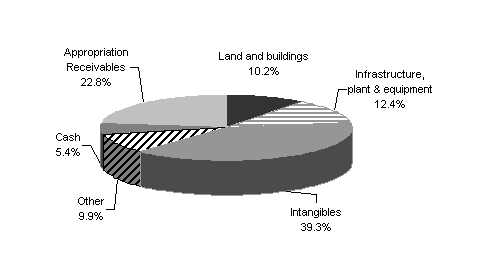
The ATO’s assets are predominantly non-financial assets.
In 2004-05 the ATO will be maintaining its commitment to long term improvement, investing $120.2 million in capital.
A significant proportion of the ATO’s capital investment is directed toward the development or improvement of internally developed systems and software in support of the ATO’s intention of making people’s experience with the revenue systems easier, cheaper and more personalised.
Budgeted total agency assets 2004-05
Liabilities
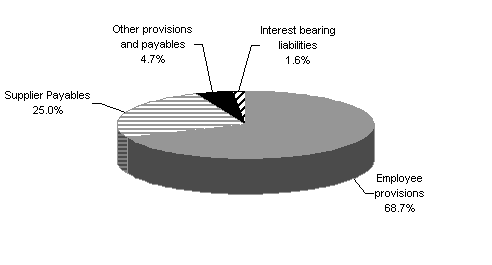
The ATO’s liabilities are predominantly employee entitlements. There is no significant movement in total liabilities from 2003-04.
However, there is a reduction in employee entitlements offset by an increase in supplier payables. The reduction in employee entitlements is due to the timing of the final pay day. The increase in supplier payables is attributable to the measures impacting supplier expenses, identified above under the heading ‘Operating Expenses’.
Budgeted total agency liabilities 2004-05
Agency financial statements
Budgeted agency statement of financial performance
This statement provides a picture of the expected financial results for the ATO by identifying full accrual expenses and revenues, which highlights whether the ATO is operating at a sustainable level.
Budgeted agency statement of financial position
This statement shows the financial position of the ATO. It enables decision-makers to track the management of the ATO’s assets and liabilities.
Budgeted agency statement of cash flows
This statement identifies expected cash flows from operating activities, investing activities and financing activities.
Agency capital budget statement
This statement shows all proposed capital expenditure funded either through the Budget as appropriations or from internal sources.
Agency non-financial assets — summary of movement
This statement shows the movement in the ATO’s non-financial assets over the budget year.
Notes of administered activity
Details of transactions administered by the ATO on behalf of the Australian Government are shown in the following notes to the financial statements.
Note of budgeted administered financial performance
This note identifies the main revenues and expenses administered on behalf of the Australian Government. It also discloses administered revenues from government and transfers to the Official Public Account.
Note of budgeted administered financial position
This note shows the assets and liabilities administered on behalf of the Australian Government.
Note of budgeted administered cash flows
This note shows cash flows administered on behalf of the Australian Government.
Table 3.1: Budgeted Agency Statement of Financial
Performance
for the period ended 30 June
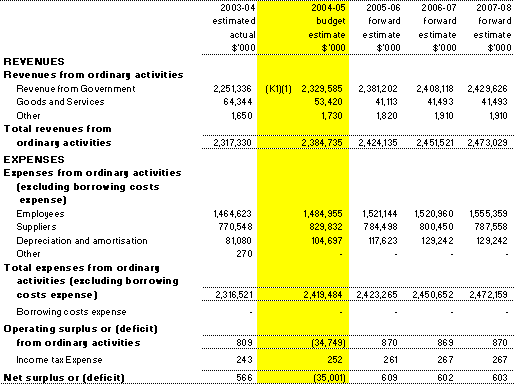
- K1 shows the link back Table 1.1.
Table 3.2: Budgeted Agency Statement of Financial
Position
as at 30 June
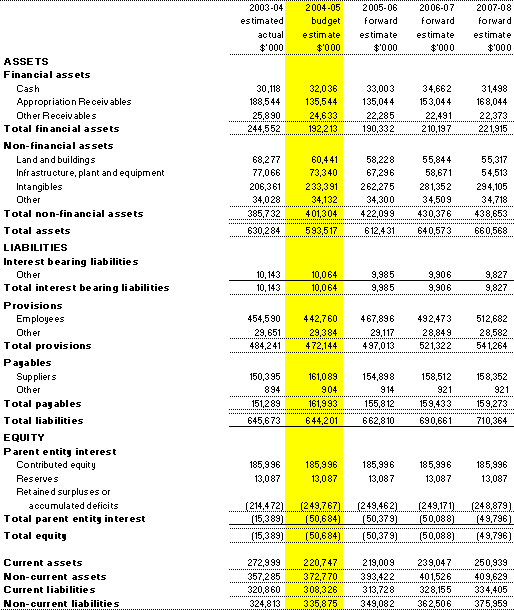
Table 3.3: Budgeted Agency Statement of Cash Flows
for the period ended 30 June
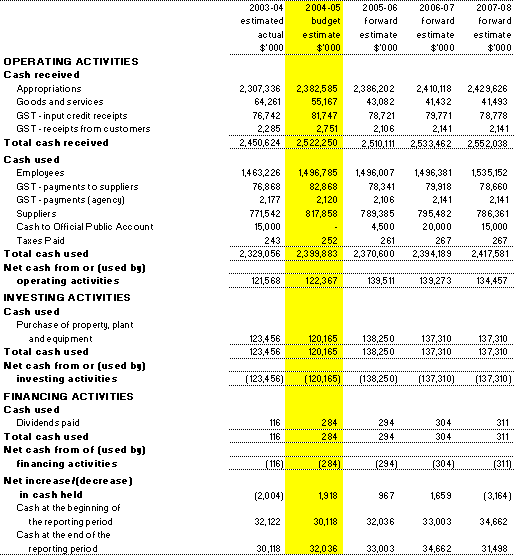
Table 3.4: Agency Capital Budget Statement
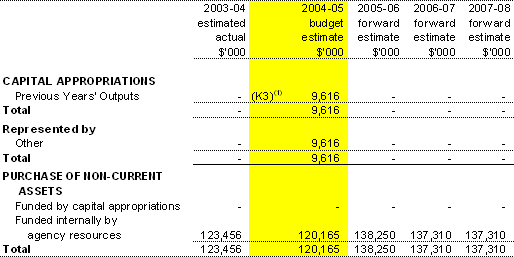
- K3 shows the link back to Table 1.1.
Table 3.5: Agency Non-financial Assets —
Summary of Movement
(Budget year 2004-05)
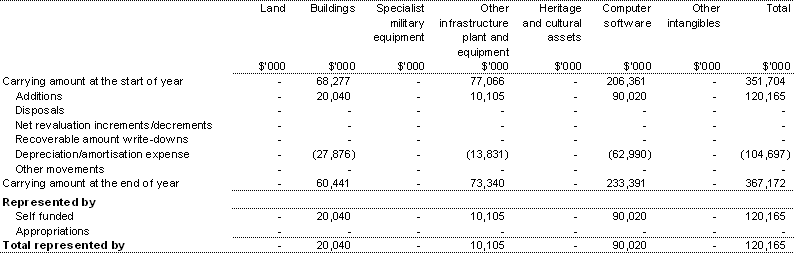
Table 3.6: Note of Budgeted Financial Performance Administered on behalf of Government for the period ended 30 June
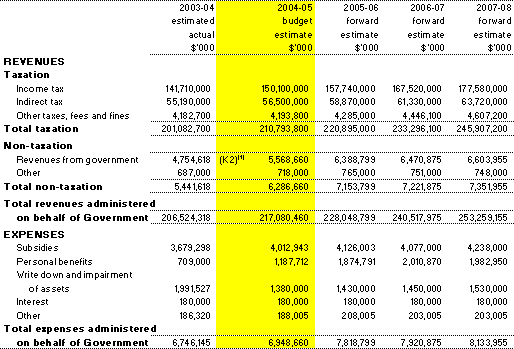
- K2 shows the link back to Table 1.1.
Note: The amount showing for revenues from government represents special appropriations to deliver ATO administered programs and benefits. This amount does not include amounts to pay taxation refunds. Total taxation revenue is shown net of taxation refunds. There are amounts included in other non-taxation revenue which in previous budget papers may have been disclosed as taxation revenues.
Table 3.7: Note of Budgeted Financial Position Administered on behalf of Government as at 30 June
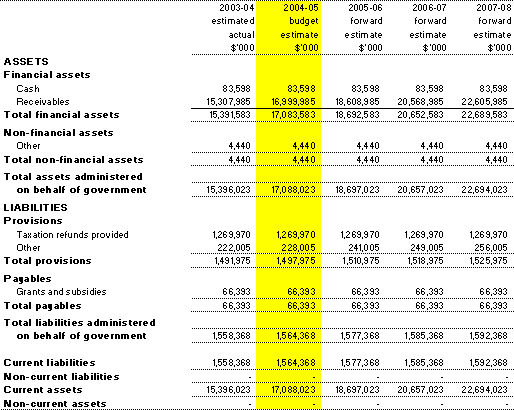
Table 3.8: Note of Budgeted Administered Cash Flows
for the period ended 30 June
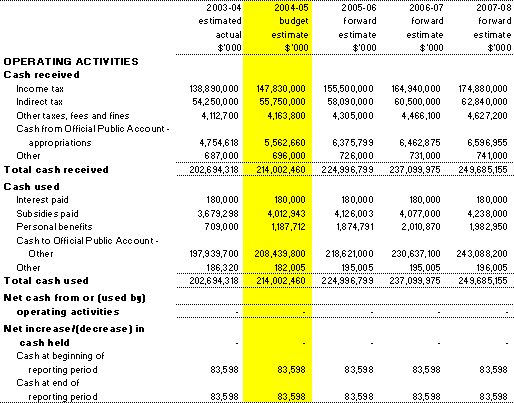
Note: The amount showing for administered appropriations represents appropriations to deliver ATO administered programmes and benefits. This amount does not include amounts to pay taxation refunds. Taxation receipts are shown net of taxation refunds.
Notes to the financial statements
Basis of accounting
The budgeted financial statements have been prepared on an accrual basis.
Notes to the agency statements
Details of agency items in the financial statements included in Table 3.1 to 3.5 have been prepared in accordance with the requirements and guidance for the preparation of financial statements.
The budget statements and estimated forward years have been prepared to reflect the following matters.
Australian Valuation Office
The Australian Taxation Office’s agency budget statements are consolidated to include the financial operations of the Australian Valuation Office.
Cost of administering goods and services tax
Agency statements include the estimated costs of administering the goods and services tax pursuant to the ‘intergovernmental agreement on the reform of Commonwealth-State Financial Relations’, the GST revenue is collected on behalf of the states and territories which agree to compensate the Australian Government for the agreed GST administration costs.
The recovery of GST administration costs are reported under the Department of the Treasury.
Notes to the administered statements
Details of administered items in the financial statements included in Tables 3.6 to 3.8 have been prepared under the Tax Liability Method (TLM) of revenue recognition, consistent with the Australian Government’s recognition of taxation revenue. Under TLM, taxation revenue is recognised at the time a taxpayer makes a self-assessment or when an assessment of a tax liability is raised by the Australian Taxation Office or the Australian Customs Service. This method retains some elements of cash revenue recognition, for example, when a cash payment occurs prior to an assessment being raised.
The budget statements and forward years have been prepared on the basis noted below and to reflect the following matters.
Recognition of taxation revenue
Since 1999-2000 administered taxation revenue has been brought to account on a year by year basis where:
- the client or the client group can be identified in a reliable manner;
- an amount of tax or other statutory charge is payable by the client or client group under legislative provisions; and
- the amount of the tax or statutory charge payable by the client or client group can be reliably measured, and it is probable that the amount will be collected.
This recognition policy does not include the following items as revenue of the period:
- estimates of future collections or refunds from individuals in respect of income tax returns to be lodged for the current financial year ended at 30 June;
- estimates of instalments of tax and final payments for companies due after 30 June;
- estimates of final amounts for petroleum resource rent tax due after 30 June; and
- actual payments for Pay As You Go, GST, excise and withholding taxes for amounts collected or withheld in June but not remitted to the Commissioner until July.
Items recognised as reductions to taxation revenue
The following items are recognised as reductions (increases) to taxation revenue and not as an expense:
- refunds of revenue; and
- increase (decrease) in movement of provision for credit amendments.