



Overview
The rebalancing of economic growth in Australia from domestic to external sources that was foreshadowed in the 2004‑05 Budget is occurring slowly. Real GDP growth is forecast to be 2 per cent in 2004-05, lower than the forecast presented in the Mid-Year Economic and Fiscal Outlook 2004-05 (MYEFO). Dwelling investment and consumption growth slowed in the second half of 2004, after having experienced rapid growth in recent years. Export growth has also been slower than expected given the strength of world economic conditions. This largely reflects a continued high exchange rate, and the long lead times required to increase production in the mining sector and to expand export capacity. Despite slow growth in export volumes, high commodity prices provided a substantial boost to domestic income in 2004-05.
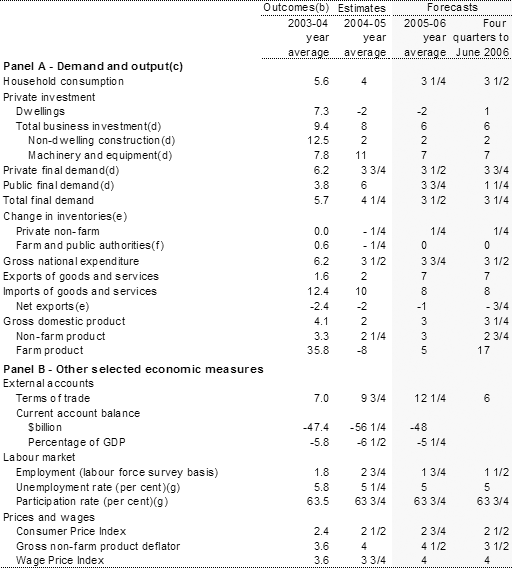
In 2005-06, the rebalancing of growth from domestic to external sources is expected to continue, with economic growth forecast to strengthen to 3 per cent. Gross national expenditure is expected to grow solidly, albeit slower than the very high average rate seen since 2001-02. Growth in household consumption and dwelling investment is expected to moderate, while business investment and public demand are forecast to grow at around trend rates.
Exports are expected to be an important contributor to growth in 2005-06. The mining sector invested around A$20 billion over 2003 and 2004 to boost capacity, which should be reflected in significant growth in non-rural commodity exports over the coming year. Rural exports are forecast to grow modestly in 2005-06, with growth restrained by a smaller grain harvest. Solid growth is expected in other categories of exports, supported by a strong world economy, but still affected by the high exchange rate.
The current account deficit (CAD) is forecast to narrow in 2005-06. The combination of increased export volumes and prices should lead to a markedly smaller trade deficit. The reduction in the CAD will be somewhat smaller than the reduction in the trade deficit because part of the additional income from higher commodity prices will accrue to foreigners. Payment of additional income abroad will increase Australia’s net income deficit.
Employment growth is forecast to ease towards trend in 2005-06, following the period of slower GDP growth in 2004. Unemployment is expected to remain around its current rate through 2005-06. Wage growth is forecast to remain moderate although, with the unemployment rate at a 28-year low, some localised wage pressures have begun to appear in particular industries and geographic areas. Inflation is expected to remain moderate in 2005-06.
The world economy is forecast to remain strong over the next two years. World economic growth is forecast to be 4¼ per cent in 2005 and 4 per cent in 2006. This is a little below the very brisk growth rate of 5.1 per cent in 2004. High oil prices and the effects of tighter macroeconomic policies, particularly in the United States and China, are contributing to the modest slowing. World inflationary pressures are expected to remain contained. There is little evidence yet that higher commodity prices are leading to significant second-round price increases in the major industrialised countries.
In the domestic economy, household consumption growth is expected to moderate to 3¼ per cent in 2005‑06, supporting a modest rebuilding of household saving. A substantial slowdown in the accumulation of housing wealth, following several years of very strong growth, and the recent increase in official interest rates will restrain consumption. High petrol prices are also expected to continue to retard consumption growth. Partly offsetting these factors, consumption will be supported by the effects of past increases in non-housing wealth, particularly share prices, and continued solid growth in household incomes. Household incomes will benefit from continued employment growth and income tax cuts, although some portion of the tax cuts is likely to be saved.
Dwelling investment fell in the second half of 2004 after growing by almost 50 per cent in the three years to 2003-04. Dwelling investment is expected to fall by 2 per cent in 2005‑06 as the recent increase in official interest rates and falls in house prices combine to dampen activity, particularly in the investor sector. However, the current housing downturn is expected to be muted compared with past cycles, with dwelling investment supported by a strong labour market and solid underlying demand for new dwellings.
Business investment is expected to again grow solidly in 2005-06. The growth in business investment in recent years has been broadly based, with the mining sector a particularly important contributor. The investment environment remains favourable, with high capacity utilisation, a relatively low cost of capital and very strong corporate balance sheets.
Public final demand should grow at a solid rate of 3¾ per cent in 2005-06, with strong growth in public investment and slowing growth in public consumption.
Australia’s net export position is expected to strengthen in 2005-06, reflecting a rebalancing of growth from domestic to external sources. Exports are forecast to grow by 7 per cent in 2005-06, after a period of sluggish growth since 2001-02. Modest growth in exports through this period has reflected the various economic shocks buffeting the Australian economy, a slow investment response to rising terms of trade and the high exchange rate since late 2003. Growth in imports is expected to ease to 8 per cent in 2005-06, in line with moderating growth in gross national expenditure.
The increase in world demand for raw materials, and limited world supply response, has resulted in markedly higher commodity prices (see Box 1). As a result, Australia’s terms of trade are forecast to increase by 12¼ per cent in 2005-06, building on the 9¾ per cent increase expected for 2004-05. With an increase in the terms of trade and stronger export growth, the current account deficit is expected to narrow to 5¼ per cent of GDP in 2005-06.
Higher export prices are likely to result in very strong nominal GDP growth. Nominal GDP is forecast to grow by 7½ per cent in 2005-06. Corporate profits are likely to increase significantly in 2005‑06 as mining companies benefit from higher export prices.
Employment growth is expected to moderate to 1¾ per cent in 2005-06, in line with recent slower GDP growth. The unemployment rate fell to 5.1 per cent in December 2004, the lowest rate in close to three decades. The unemployment rate is forecast to remain around 5 per cent, on average, over 2005-06. Rates of workforce participation are expected to remain broadly unchanged, albeit at high levels.
Inflation is expected to remain within the target band, with the Consumer Price Index forecast to increase by 2¾ per cent in 2005‑06 as petrol prices remain high in the near term. This pressure is expected to moderate through 2005-06, with inflation forecast to be 2½ per cent through the year to the June quarter 2006. The cyclical slowing in labour productivity in 2004‑05 is expected to have only a modest flow-through to consumer prices. There is no evidence that higher oil and other commodity prices are leading to significant second-round increases in consumer prices, although this remains a risk.
Wage growth is expected to increase modestly in 2005-06, with the Wage Price Index forecast to grow by 4 per cent. With the unemployment rate at a 28-year low, some localised wage pressures have appeared in particular regions and occupations. However, relative wage adjustment is an important signalling mechanism in a high employment economy and there is little evidence of generalised wage pressures or skill shortages. This is likely to remain the case as the economy passes through a period of more moderate employment growth.
A key risk to the economic outlook is the effect of the significant rise in Australia’s export prices, which is forecast to take the terms of trade to their highest level since the early 1950s. The way in which mining companies respond to this additional income — by investing it, saving it or returning it to shareholders — will be important for the outlook.
Higher export prices are expected to have only a limited effect on household finances, primarily through equity holdings in mining companies. It is unlikely that higher export prices will result in significant growth in wages outside the mining sector itself, or have a major impact on aggregate employment growth across the economy. However, if these effects are greater than anticipated, then it is possible that resulting higher household incomes would lead to higher household consumption than currently forecast.
Higher export prices are not expected to result in a significant increase in investment by mining companies in 2005‑06 over that which has already been announced. While it is possible that companies might invest more quickly than anticipated in response to high commodity prices, this upside risk is offset somewhat by the likelihood that commodity prices will fall beyond the present forecast period. As a substantial increase in supply is forthcoming from more recent investment in many countries, it is likely that commodity prices will retrace significantly in the medium term. This raises some issues for the projections of nominal GDP in 2006‑07 and beyond. These issues are discussed in more detail in Box 7.
High commodity prices, particularly high oil prices, also present a downside risk for economic growth. Oil prices directly affect petrol prices and indirectly affect the prices of many other goods and services. High prices for iron ore affect steel prices and the cost of engineering and building construction. If oil prices increase further, this would present a downside risk to the forecasts for GDP growth in the near term. In the medium term, Australia would benefit from higher commodity prices as a net energy and mineral exporter and this would most likely boost economic growth.
Previous budget discussions of the economic outlook have identified a risk to consumption growth from the increasing level of household debt. In aggregate, there is no evidence that households are having difficulties servicing their current debt and, with consumption and dwelling investment both expected to slow, it is likely that households will take on debt at a slower rate through 2005-06. Nevertheless, there remains a possibility that households will seek to rebuild their saving to a greater extent than anticipated, leading to lower consumption growth than forecast.
While the risks around developments in the housing sector appear to have abated somewhat since the 2004‑05 Budget, there remain concerns in particular market segments. Overall, it appears that house prices fell modestly over 2004. The likely outcome is that house prices will remain broadly flat in 2005‑06 as the housing market continues to adjust to lower rates of turnover. While this adjustment is expected to be orderly, if house prices were to fall further then this would put downward pressure on consumption growth.
With the unemployment rate at its lowest level in a generation, there is a risk that the tight labour market could lead to wage increases across the economy that are greater than is justified by productivity growth. This would put upward pressure on unit labour costs and inflation. Measures to increase workforce participation outlined in this Budget should help to reduce this risk over the medium term.
As is normal practice, the forecasts for the rural sector are predicated on an assumption that average seasonal conditions will prevail in 2005-06. The actual timing and distribution of rainfall through 2005 will have an important influence on rural production and exports in 2005-06, as will the lingering effects of dry weather in recent years.
The near-term risks for the world economic outlook appear to be balanced. But some medium-term downside risks remain, largely centred on different growth profiles across major economies, and associated fiscal and current account imbalances. While these imbalances may persist for some time without significant adverse consequences, they increase the vulnerability of the world economy to destabilising changes in financing flows.
Table 1: Domestic economy forecasts(a)
- Percentage change on previous year unless otherwise indicated.
- Calculated using original data.
- Chain volume measures.
- Excluding transfers of second-hand assets from the public sector to the private sector.
- Percentage point contribution to growth in GDP.
- For presentational purposes, inventories held by privatised marketing authorities are included with the inventories of the farm sector and public marketing authorities.
- The estimate in the final column is the forecast rate in the June quarter 2006.
Source: Australian Bureau of Statistics (ABS) Cat. No. 5206.0, 5302.0, 6202.0, 6345.0, 6401.0, unpublished ABS data and Treasury.