



The outlook for the international economy
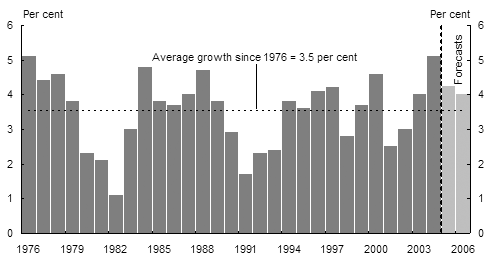
The world economy grew by 5.1 per cent in 2004, its fastest rate in close to 30 years and around ½ of a percentage point higher than expected at MYEFO. Strong growth was recorded across most regions, with emerging markets, in particular, benefiting from low world interest rates combined with strong demand and high prices for their commodity exports.
After peaking in the early part of 2004, world growth eased over the remainder of the year and into 2005 as the effects of high oil prices and tighter policy, particularly in the United States and China, took hold. However, with conditions in the world economy expected to remain favourable, growth is expected to stabilise at the still-solid rates recorded in the latter part of 2004, although the pattern of growth across countries is likely to be more unbalanced than previously anticipated.
World GDP growth is forecast to ease to 4¼ per cent in 2005 and 4 per cent in 2006 (see Chart 1). Growth in Australia’s major trading partners is expected to ease from 4.9 per cent in 2004 to around trend rates of 3¾ per cent in 2005 and 2006.
Chart 1: World GDP growth(a)
- World GDP growth rates are calculated using GDP weights based on purchasing power parity.
Source: International Monetary Fund and Treasury.
World inflationary pressures are expected to remain muted. To date there has been little evidence of significant second-round effects from higher oil and other commodity prices in the major industrialised economies. In part, this reflects competitive product and labour markets and the success of macroeconomic policy in establishing well-anchored inflation expectations.
Risks to the outlook appear broadly balanced in the near term, although the persistence of global imbalances — reflected in current account positions — has increased the underlying vulnerability of the world economy over the medium term.
A downside risk to world growth stems from the increasingly unbalanced nature of the current expansion. The easing of world growth in the second half of 2004 was particularly evident in Japan and the euro area, while other major regions continued to grow strongly. This heightens the world economy’s exposure to developments in a few key economies, particularly the United States and China.
Unbalanced growth, if sustained, is likely to exacerbate already large current account imbalances around the world, increasing the risk of a disorderly adjustment in financial markets. The US current account deficit was a record US$666 billion in 2004, equivalent to two-thirds of the aggregate current account surpluses in the rest of the world. These imbalances are attributable to a number of factors, including insufficient saving in the United States (particularly by the public sector), disappointing growth in Japan and the euro area (reducing their attractiveness relative to the United States as a destination for global capital), and a degree of under-investment in some East Asian countries (resulting in large and continuing current account surpluses in that region).
A gradual and orderly unwinding of these imbalances remains the most likely path of adjustment in the medium term. This would require a combination of fiscal consolidation in the United States, further US dollar depreciation and an improvement in the growth performance of Japan and the euro area. The depreciation of the dollar to date has been relatively steady and the normalisation of interest rates in the United States should also provide impetus for increased private saving, particularly if house price growth slows.
While the policy prescriptions required to rebalance the world economy are understood, little progress has been made in implementing them, suggesting that imbalances will continue to deepen in the near term. The longer policy action is deferred, the more exposed the United States and the world economy will be to a sudden change in sentiment regarding the relative risk and reward from holding US dollar assets. Such a change in investor sentiment could result in an abrupt and disruptive adjustment to exchange rates and interest rates.
Of more immediate concern are continued high and volatile oil prices. While the benchmark West Texas Intermediate price has moderated from the record nominal high of over US$57 per barrel in early April, it remains high by historical standards. To date, high oil prices have had a limited impact on world economic growth and core inflation. However, with oil prices expected to remain high in the medium to longer term, there remains the possibility that they will feed into inflation expectations more than currently expected. This risk is greater given that excess capacity in some major economies, including the United States, has been largely unwound over 2004. A sharp increase in inflation expectations could be particularly damaging for world growth given the unusually low level of US long-term interest rates and historically low risk premia on corporate and emerging market debt.
On the upside, world growth over the past few years has consistently been stronger than anticipated. The factors that have underpinned this — accommodative monetary policy, healthy corporate balance sheets and benign financial market conditions — remain in place. As a result, the current economic expansion could prove more resilient than currently envisaged.
Table 2: International GDP growth forecasts(a)
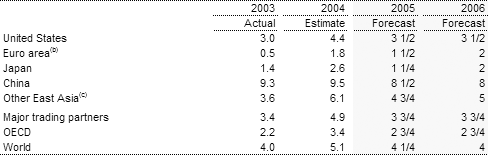
- World, OECD and euro area growth rates are calculated using GDP weights based on purchasing power parity. Calculations for major trading partners and other East Asia use export trade weights.
- 2004 estimate adjusted for the number of working days.
- Other East Asia consists of Korea, Singapore, Taiwan, Hong Kong, Indonesia, Malaysia, Thailand, and the Philippines.
Source: Various national statistical authorities, International Monetary Fund and Treasury.
Economic growth in the United States evolved largely as expected through 2004. Growth remained solid, but moderated as excess capacity in the economy narrowed and policy settings moved toward more neutral levels. Concerns about the labour market, which had been slow to recover from the 2001 recession, abated somewhat, with solid, albeit intermittent, gains in employment.
Domestic demand in the United States is expected to rebalance progressively away from household consumption toward business investment in 2005. The business sector, which has rebuilt its financial position in recent years, is expected to continue to invest strongly in 2005 and 2006. Conversely, households, which have spent well ahead of growth in income, driving the household saving rate to record lows, are expected to consolidate their finances. While household income will be supported by the ongoing recovery in the labour market, the high level of household debt makes consumption sensitive to increases in interest rates and fluctuations in income. A risk remains that US households may move abruptly to consolidate their financial position, particularly if financial market conditions tighten sharply.
Inflationary pressures in the United States are expected to remain in check over the forecast period, with inflation expectations well-anchored and the monetary tightening cycle now well underway. However, with the labour market expected to tighten further, productivity growth slowing from cyclical peaks, and higher oil and other commodity prices, growth in unit labour costs could be stronger than expected.
After growing strongly toward the end of 2003 and in the early part of 2004, Japan’s economy contracted in the middle of 2004 and posted only moderate growth in the December quarter. However, there are concerns about the quality of national accounts data, which have been subject to frequent and large revisions. Partial data indicate a more moderate easing in growth over the course of 2004.
Fundamentals in the Japanese economy have improved significantly in recent years, suggesting a continuation of growth in the period ahead. Structural reforms have improved business sentiment and corporate profits and the unemployment rate has fallen to near six-year lows. Deflation, which has weighed on consumer and business confidence in recent years, eased in 2004 and is expected by the Bank of Japan to end in early 2006.
China’s economy grew at its fastest rate in almost a decade in 2004, contributing strongly to world growth and demand for commodities (see Box 1). However, concerns remain about the sustainability of the expansion, and the efficiency of the investment underpinning it. Authorities continued to use a combination of market instruments and administrative controls to tighten monetary conditions over the course of 2004 and there are signs that these measures are having an effect. While investment remains unsustainably high as a share of GDP, it has moderated somewhat. Growth in other key indicators, including industrial production, money supply and credit, eased in 2004. These data suggest that economic growth will slow to a more sustainable rate of around 8 per cent, although there remains considerable uncertainty about the timing and extent of the slowing.
The strength of the Chinese economy has led to external calls for greater flexibility in its exchange rate, particularly from the United States. However, a more flexible Chinese exchange rate is likely to have only a limited impact on global imbalances. Broader liberalisation of the capital account should be approached cautiously and coincide with a further strengthening in the Chinese financial system. These reforms, if complemented by ongoing structural reforms elsewhere in the economy, would provide a sound footing for balanced growth in the long term.
The rest of East Asia also grew strongly in 2004, underpinned by strong external and domestic demand. However, growth appears to have peaked, with regional economies (except Indonesia) expected to grow at a slower pace in 2005 and 2006. This reflects easing export growth due to more moderate world demand and a slowing in the global information and communication technology cycle. That said, the outlook for domestic demand remains positive, and should support still-solid growth in the region. The notable exception is Korea, where domestic demand remains weak following the bursting of the household credit bubble in 2003, although more recently, there have been signs of a pick-up in consumer and business confidence.
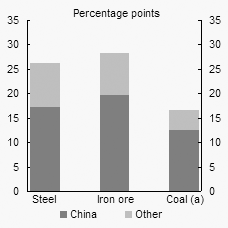
| The world economy grew rapidly in 2004. The composition of growth was weighted heavily towards the United States and China. Together these two countries contributed 2.2 percentage points to world growth of 5.1 per cent in 2004. The United States and China are major commodity users. Their strong output growth saw a significant increase in demand for commodities such as oil, iron ore and coal. In particular, China’s emergence as a major commodity importer has had a significant impact. For example, over the period 2001 to 2004, China was responsible for 70 per cent of the world increase in iron ore consumption (Chart A). Chart A: Growth in world commodity consumption, 2001 to 2004
Source: AME Mineral Economics and BP Statistical Review of World Energy. |
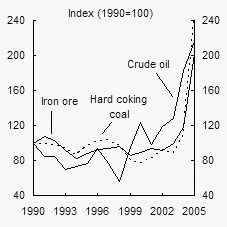
The rapid rise in commodity prices (Chart B) has generated significant benefits for commodity exporters like Australia, Canada, the Middle East, Russia and South Africa. Chart B: Commodity prices (US$)(a)
Source: ABARE, Thomson Financial and Treasury. Investment in exploration and production has increased in response to the sustained commodity price rise. As a consequence, despite continued strong demand, commodity prices are likely to ease somewhat as additional world production comes on stream. However, if world demand were to falter, there is a risk that commodity prices could fall further than anticipated. |
Growth in the euro area slowed sharply in the second half of 2004, with the combination of euro appreciation and high oil prices undermining the modest recovery that had taken place since the middle of 2003. Looking forward, growth is forecast to pick-up from recent levels, albeit at a more moderate pace than previously expected. The favourable world economic outlook will continue to underpin exports, despite the appreciation of the euro. Solid corporate profitability should see an improvement in the labour market, supporting a rebound in consumer spending.
The risks to this outlook, however, are skewed to the downside and reflect long-standing structural weaknesses. While some progress has been made on pension, health care and labour market reform in Germany and France, and on pension reform in Italy, more needs to be done. Reforms to lift labour force participation and productivity are particularly important in the face of rapidly ageing populations.
The United Kingdom economy grew strongly over the course of 2004, although recent data suggest that monetary policy tightening during that year is beginning to have an effect. The outlook is for growth to remain steady at recent, more moderate, rates.