



The outlook for the domestic economy
Key assumptions
The forecasts for the domestic economy are underpinned by several key technical assumptions. The exchange rate is assumed to remain around the average level of recent months (a trade weighted index of around 64). Interest rates are assumed to remain at current levels. World oil prices (West Texas Intermediate) are assumed to remain broadly unchanged through 2005-06, consistent with market expectations. The farm sector forecasts are based on an assumption of average seasonal conditions in 2005-06.
Demand and output
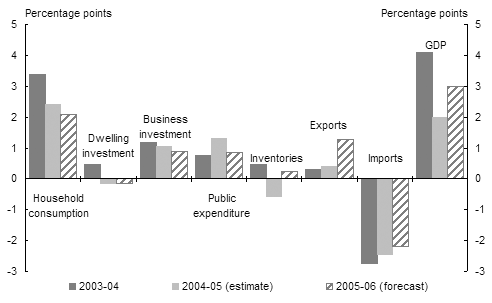
The rebalancing of growth from domestic to external sources that was foreshadowed in the 2004‑05 Budget is occurring slowly and remains the most likely path for the economy in the period ahead. In the second half of 2004, gross national expenditure growth slowed, but export growth failed to pick up significantly, leading to a slowing in GDP growth from the very strong rates of recent years. GDP growth is expected to be 2 per cent in 2004‑05 (see Chart 2). In contrast with moderate GDP growth, national income is expected to grow strongly, reflecting increased export prices.
Chart 2: Contributions to GDP growth(a)(b)
- Excluding transfers of second-hand assets from the public sector to the private sector.
- All charts in the domestic economy outlook section use seasonally adjusted data unless otherwise specified.
Source: ABS Cat. No. 5206.0 and Treasury.
GDP growth is forecast to strengthen to 3 per cent in 2005-06. Household consumption is expected to make a smaller contribution to growth, while dwelling investment is again expected to detract from growth after the high level of construction activity in recent years. The contribution to growth from business investment is expected to remain solid. Public expenditure will contribute solidly across the forecast period. Imports are expected to detract less from growth, broadly in line with the developments in the domestic economy. Exports are forecast to make a larger contribution to growth in 2005-06, particularly as additional capacity comes on stream in the resources sector.
Non-farm GDP is forecast to grow by 2¼ per cent in 2004-05, strengthening to 3 per cent in 2005-06. Farm GDP is expected to fall by 8 per cent in 2004-05, largely reflecting generally dry conditions and the late arrival of spring rains in some areas, before increasing by 5 per cent in 2005‑06 on the assumption of average seasonal conditions.
Household consumption
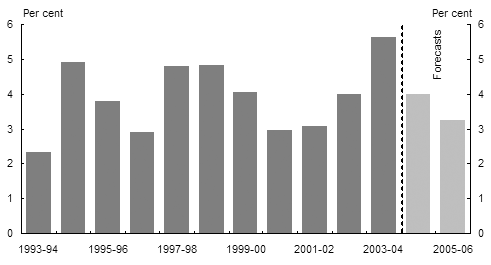
Household consumption is forecast to grow by 3¼ per cent in 2005-06, down from the 4 per cent growth expected for 2004‑05 and below the rapid rates of growth recorded in recent years (see Chart 3).
Chart 3: Growth in consumption
Source: ABS Cat. No. 5206.0 and Treasury.
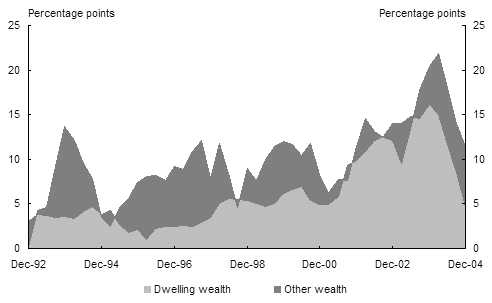
Household income has grown steadily over the past decade, supported by increases in employment and real wages. However, the growth in income over the past decade has been insufficient to explain all of the increase in consumption. The other major contributing factor has been an increase in household wealth. Through the 1990s, higher wealth generally took the form of higher equity prices, although higher house prices have been the more important factor in recent years (see Chart 4). These increases in wealth have seen consumption grow by more than income on average and, as a result, the household saving ratio has fallen. Australia’s changing demographic profile, and the lower demand for precautionary savings in a stable and prosperous economic environment, may also have affected saving behaviour in the past decade (see Box 4).
Households are expected to increase their consumption by less than the increase in their income over 2004‑05 and 2005-06. Accordingly, the rate of household saving is expected to increase, albeit by a modest amount. Recent data provide evidence that a rebuilding of household saving may have already commenced. Household nominal net disposable income increased by 6.9 per cent through the year to the December quarter 2004, while nominal consumption expenditure increased by a more moderate 5.4 per cent. It appears that some households saved the additional income from the 2004‑05 Budget measures that reduced income taxes and increased the financial assistance to families with children. This trend is likely to continue with further income tax cuts and measures to support saving in the 2005‑06 Budget.
Chart 4: Contributions to growth in nominal household wealth(a)
- Percentage point contribution to through-the-year growth.
Source: Treasury.
The expected easing in household consumption, and the consequent increase in saving, is partly the result of the substantial slowdown in house price growth over the past year. Although there can be large differences between the various measures of house prices, this slowdown was evident across all of the major data sources. For example, the Australian Bureau of Statistics’ measure of established house prices grew by 18.9 per cent over 2003, but only by 2.7 per cent over 2004. If households seek to rebuild their saving more quickly in response to these developments, then household consumption growth would be lower.
One factor that has offset the lower growth in housing wealth is the large growth in non-dwelling wealth over the past few years. The ASX200 share price index increased by more than 30 per cent in the two years to April 2005. This increase partly reflects the improved prospects of resource companies following substantial increases in world commodity prices — the resources component of the ASX200 increased by more than 80 per cent over the same two-year period.
Aside from lower growth in housing wealth, other factors that are likely to slow household consumption over the forecast period are the increase in official interest rates in March 2005 and high petrol prices. The forecasts assume that oil prices remain broadly unchanged over 2005‑06 and, therefore, that petrol prices stabilise. But there is a risk that oil prices increase and put further pressure on consumption spending.
Dwelling investment
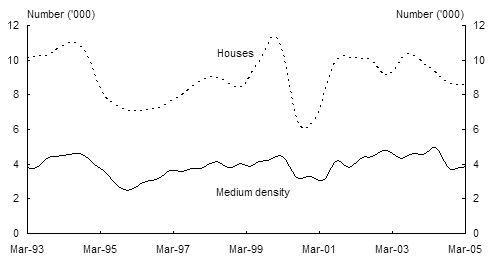
Dwelling investment is forecast to fall by 2 per cent in both 2004‑05 and 2005-06, after very strong growth over the previous three years. Dwelling investment fell in the second half of 2004 and forward indicators of activity in the housing sector, such as dwelling approvals, suggest that this modest downward trend will continue in coming months (see Chart 5).
Other partial housing sector indicators point to lower activity. In late 2004 and early 2005, the number of monthly finance commitments for the construction or purchase of new dwellings by owner-occupiers was running around 15 per cent below its most recent peak in October 2003. Much of the speculative activity in the investor market also appears to have passed, with the value of investor finance falling significantly over the same period.
Thus far, the current housing cycle is unwinding in an orderly manner, with a gradual fall in housing activity levels across much of the country and house prices stabilising or falling a little. The risk of a sharp fall in house prices appears to have abated since the 2004‑05 Budget. However, the rental yields on investment properties are still very low, suggesting that house prices may fall further in real terms. It seems likely that this adjustment will continue to occur gradually, without causing significant disruption to household finances. However, there remains a risk that a prolonged period of falling or flat house prices may lead households to rein in consumption expenditure more than expected.
There is no evidence of a widespread oversupply of new housing. Consistent with favourable economic conditions, the current downturn in housing activity is expected to be relatively shallow, although it is likely that medium density construction activity in the larger cities will continue to fall through 2005-06.
Chart 5: Private dwelling approvals
Source: ABS Cat. No. 8731.0 (trend data).