



Improving participation and sharing Australia’s prosperity
Households contribute to and share in the benefits of an increasingly prosperous Australia.
The entire community benefits from the output produced through work. This is true whether work is for an income or not. Many people gain a sense of worth from their work and enjoy greater opportunities for social engagement, which enhance both mental and physical wellbeing. Though not normally recorded in economic statistics, unpaid work within the home and by unpaid carers and volunteers contributes significantly to the community. Voluntary work is also an important path to paid employment for many people. Almost one‑third of Australian adults undertake some form of voluntary work, contributing an average of more than 3 hours per week (ABS 2001). It is through paid work, however, that most people support their pre‑retirement lifestyles and save for retirement, while contributing to measured economic growth.
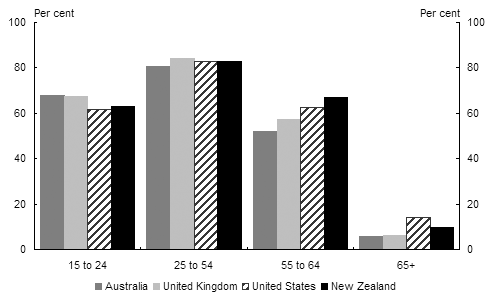
The ageing of the population will slow the growth in living standards in coming decades unless productivity growth and labour force participation rates increase. Australia’s overall labour force participation rate, the 12th highest in the OECD, remains modest by international standards (OECD 2004a). Labour force participation in Australia decreases markedly in older age groups. Some people retire or leave the workforce in their forties and fifties. While declining participation is consistent with the trend in other OECD nations, total participation in Australia for those aged 55 years and older is lower than the OECD average and well below that in the United States, United Kingdom and New Zealand (Chart 7).
Chart 7: Labour force participation rate by age, 2003
Source: OECD (2004a).
While the nature and extent of workforce participation is largely a matter of individual choice, such choices may be distorted by disincentives or obstacles to participation that impose unnecessary costs on individuals and society. Since 1996, the Australian Government has implemented a range of policies to support an individual’s choice to engage in the labour force and remove disincentives to such participation. Among those policies are workplace relations reform, increasing assistance with child care, reforms to the income support and family assistance systems, income tax reductions and changed superannuation arrangements. Those reforms have helped improve participation rates.
Going forward, the ageing population will require even higher rates of participation. The Australian Government has identified three broad categories of policy reform that should promote higher participation rates:
- strengthening an individual’s capacity to work through better health and education;
- improving incentives and removing barriers to undertake work, through welfare reform and creating more flexible and adaptable retirement income arrangements; and
- increasing the flexibility of the labour market, to facilitate greater employment options and encourage job creation.
While the full benefit of many of those reforms may not be measured for some time to come, they underpin and set the tone for ongoing efforts required to sustain current growth rates in Australia’s standard of living.
Strengthening capacity
Education and training systems provide the skills and flexibility the workforce needs to meet the requirements of an increasingly dynamic and complex economy. Illness and injury, on the other hand, reduce workforce participation and limit lifestyle choices and overall wellbeing.
A skilled workforce
Education plays a critical role in allowing people to participate more fully in society. Education also has costs in terms of both the financial cost of acquiring the education and the time that students otherwise could have spent working or enjoying leisure. As with any investment, more is not always better. Education will be most effective when individuals and societies invest in the right people, the right skills and at the right time.
Australians have been investing steadily more time and effort into education (Box 2). Surveys suggest that higher levels of education and training are likely to increase labour force participation over time. In 2001 the labour force participation rate for people aged 25 to 64 with post-school qualifications was 85 per cent, but only 63 per cent for people who had no post-school qualifications (ABS 2003). Unemployment rates are also far lower for people with post-school qualifications.
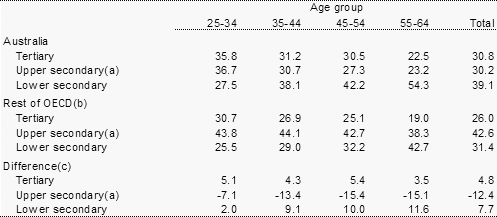
Box 2: Australia’s qualifications profile Australians have become more highly qualified over the past few decades (Table 1). While older Australians are less likely to have been educated beyond lower secondary school than their peers within the rest of the OECD, the qualifications profile for younger Australians is very similar to their OECD counterparts. Australia’s overall qualifications profile is hollow in the middle. Fewer Australians complete upper secondary education than in the rest of the OECD, while more Australians hold either tertiary or only lower secondary qualifications. However, the qualifications profile for 25 to 34 year olds suggests this may be changing. Current upper secondary retention rates suggest that younger cohorts will be at least as well-qualified as 25 to 34 year olds are today. Table 1: Highest qualification obtained, per cent by age group, 2002
Source: Australian Government Treasury calculations based on OECD (2004a). |
Education and training also support high levels of productivity. More highly trained employees are likely to be more innovative, developing and using new ideas and technology that can lead to new and better products or more efficient ways of working.
The Australian Government has implemented initiatives in recent years aimed at improving educational and skill attainment across all age groups. Ongoing reforms have enhanced greatly the scope, consistency and labour market responsiveness of the vocational education and training system. Participation in vocational education and training has grown strongly.
The Australian Government is building on earlier initiatives by establishing 24 Australian technical colleges, expanding school-based new apprenticeships, increasing pre-vocational training places and increasing income support for new apprentices.
The Australian and state governments are negotiating new vocational education and training agreements to increase the flexibility of the training system. Planned reforms include removing impediments to user choice so that employers and employees have greater freedom to choose the training organisation that best suits their needs. Reforms also are designed to improve the responsiveness of the training system to emerging skill shortages by creating 20,000 new targeted training places.
Even so, sometimes shortfalls in the supply of skilled workers may emerge for which the optimal solution may be targeted immigration. At such times, skilled migration is a useful complement to education and training initiatives. Skilled migration provides a rapid boost to the national skills pool, whereas education and training initiatives take longer to deliver skilled workers to the labour market. Accordingly, the Government will increase skilled migration in 2005‑06 by 20,000, delivering a total skilled migration intake of 97,500.
A healthy workforce
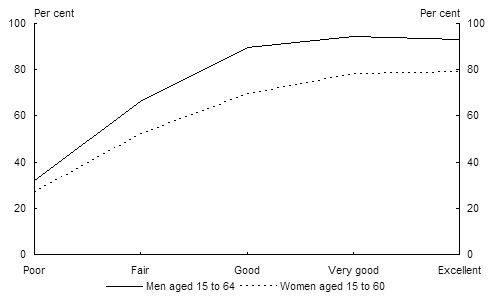
In general, healthier people are likely to be more productive and have higher labour force participation rates, leading to potentially higher disposable incomes, wealth and general wellbeing (Chart 8). Healthier people are also more likely to respond positively to incentives to remain in the labour force beyond traditional retirement ages, participate in voluntary positions within the community upon retirement and require less assistance later in life. Deteriorating health is often associated with early retirement.
Employers also benefit from healthier workforces, not only through increased labour force participation and productivity, but from the reduced costs of lower rates of absenteeism due to ill health or disability. The community benefits from the fewer resources needed for health care and more widespread community engagement.
Chart 8: Labour force participation rate by health status
Source: Cai and Kalb (2004).
Chronic diseases, such as heart disease, cancer and diabetes directly reduce the wellbeing of sufferers and their carers, and have an adverse effect on the prosperity of the community through reduced participation and productivity. Those diseases are among the leading causes of death in Australia, yet many of them have preventable risk factors related to lifestyle, including tobacco use, excess consumption of alcohol, unhealthy diet and physical inactivity.
Australians are living longer, but have more health concerns. While life expectancy at birth increased from around 73 years in the latter half of the 1970s to 80 years in 2001, the proportion of Australians reporting long-term health conditions rose from 45 per cent to 78 per cent over this period (ABS 2002, 2004c; Australian Institute of Health and Welfare 2000). The trend is partly due to the increasing prevalence of lifestyle-related diseases and partly due to the development of treatments that alleviate previously fatal conditions.
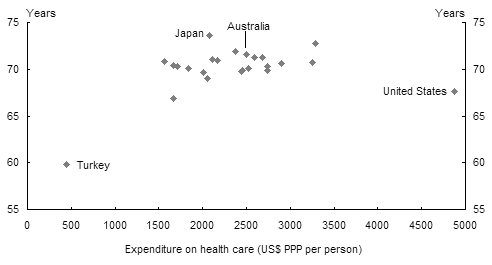
Similar developments have increased health care expenditure in most OECD countries in recent decades. However, perhaps surprisingly, the level of health expenditure across OECD countries is not strongly correlated with the health of their populations (Chart 9). Australians enjoy longer, healthier lives than the populations of many countries, such as the United States, that spend more on health care. This suggests that better health outcomes are not necessarily the result of more expenditure and that factors such as the structure of the health system and active and healthy lifestyles can be more important.
Chart 9: Healthy life expectancy and health
care
in 24 OECD countries, 2001
Source: OECD (2004c); and WHO (2002).
Ultimately, individuals, families and communities make the lifestyle choices that can lead to the development of chronic disease. Governments cannot proscribe choices, but they can provide incentives and sanctions to encourage healthier lifestyle choices. For example, governments have imposed high excises on tobacco and restricted where people are permitted to smoke. In other areas there may be limited scope for incentives or sanctions, but governments have a role to provide relevant health promotion information. Governments also can aim to have a broad range of policies and programmes — including public transportation, parks, school curricula, town planning, as well as the health care system — that support healthy lifestyle choices.
The most cost-effective approach to many chronic illnesses is likely to be a population strategy that raises awareness, changes social attitudes and improves lifestyles, thereby removing or reducing the underlying causes that make the disease common (WHO 2002, 2004). With changing community attitudes, the maintenance of healthier lifestyles becomes easier for any particular individual as the healthier behaviour becomes more common place (Rose 1985, 1994).
The 2004 Building a Healthy, Active Australia package aims to promote better population health by encouraging children to adopt healthy habits for life. Analyses by Rose and the WHO suggest such programmes are likely to be even more effective in changing social attitudes were they extended to involve families and the entire community.
Improving incentives and removing barriers
While decisions to participate in the paid or unpaid workforce are necessarily personal they have impacts on the wellbeing of the nation through the relationship between participation, economic growth and prosperity. These decisions are influenced by provision of income support, tax arrangements, retirement incomes policies and other incentives and barriers to participation.
Income support systems provide a social safety net. They also should aim to recognise an individual’s desire to work by encouraging, promoting and assisting them to seek out and participate in paid work to the extent they are able. The challenge for government is to balance the set of incentives, assistance and requirements in such a way as to avoid creating cycles of dependency, while maximising the voluntary participation of people with diverse capacities and availabilities for work.
While labour force participation is currently at historic high levels, there is room for further improvement. Of the 14 million people aged 15 to 64 years, only about 10 million are currently in the labour force. Around 2.7 million receive income support, including sole parents, the unemployed and recipients of the Disability Support Pension (DSP).
Welfare system reforms and income tax reductions have improved the incentives to participate for most income support recipients. The 2004‑05 More help for families package improved incentives for people to participate in the workforce. The 2001‑02 Australians Working Together package included reforms to assist out-of-work people back into the workforce. They included introducing working and training credits, mutual obligation requirements for some job seekers and initiatives targeting parents, the mature aged, indigenous Australians and people with disabilities. Many of these groups of people have lower than average participation rates.
Despite the progress to date, more could be done to match incentives with individuals’ capacities to contribute. Currently, only around one in six income support recipients are required to look actively for work. While a proportion of the remainder are involved in other important activities, such as education and family-related commitments, more income support recipients could participate in the labour market. This would improve the longer-term economic and social wellbeing of the individuals concerned and add to the prosperity of the community.
The OECD (2005a) has noted that the DSP, in part due to its generosity, may be used by some as an early retirement vehicle. It is paid at the same rate as the Age Pension and is significantly higher than unemployment benefits. More than 40 per cent of all DSP recipients in June 2004 were aged 55 or older, with just over 20 per cent of all recipients aged 60 or older.
In this budget, the Australian Government introduces additional reforms to the income support system to encourage further labour force participation. The further reform of the welfare system in this budget focuses on assisting those who have the capacity to work to do so, while maintaining an appropriate level of assistance to provide a minimum standard of living. The reforms achieve this through a balance of financial incentives, obligations to look for work and a broad-ranging package of services to assist those who have been out of the workforce for an extended period.
An individual’s decision to participate in the labour force is affected by both the additional income tax paid and the withdrawal of income support payments through income testing arrangements. Taken together, the interactions are described as effective marginal tax rates (EMTRs), although of course they are not actual tax rates.
EMTRs have fallen in recent years largely through reduced income tax rates and reduced family assistance taper rates. The changes particularly assist women wishing to re-enter the workforce after having children. In addition, the increase in thresholds for the top marginal tax rates has improved incentives for some workers to take on additional work, seek promotion and invest in further skills.
In this budget the Government has taken further steps to reduce EMTRs through relaxation of the income test for Newstart Allowance. This will reduce the current 70 per cent withdrawal rate to 60 per cent and increase the range of income over which the 50 per cent withdrawal rate applies.
With an ageing population, any improvement in the labour force participation of mature age workers will help sustain growth and prosperity. Governments can encourage and support individual choices to stay in the workforce beyond traditional retirement age.
It is very difficult to reverse retirement decisions, once taken (OECD 2003). Policy may more effectively encourage people still in the workforce to delay retirement. Consistent with this, the Australian Government has introduced a number of initiatives to encourage older workers to remain in the workforce, including tailored services to assist mature age job-seekers to find new employment and flexible assistance to help parents, carers or mature age people to find work. It also has removed the restriction on access to superannuation by those still in employment, enabling older workers to move gradually into retirement by supplementing reduced employment earnings with their superannuation entitlements. For workers older than 55 years the Australian Government has introduced the Mature Age Worker Tax Offset that provides an annual tax rebate of up to $500 on earned income.
Together those reforms are likely to have contributed to the recent increase in the labour force participation rates of those aged 55 years and older.
Enhancing flexibility
Through reform, what was a highly centralised and regulated workplace relations system in Australia has moved to one more focused on agreement making at the workplace or enterprise level. Today, only around 20 per cent of workers have their pay and conditions set directly by awards (ABS 2005d). This significant change has increased enterprise flexibility and competitiveness and has contributed to the Australian economy’s strong employment and economic growth over recent years.
Employees also can more easily negotiate working arrangements that suit their other commitments or lifestyle choices. The number of people choosing to work part-time has increased rapidly and this trend is likely to continue as the population ages.
The reforms provide a firm foundation, but there remains significant scope to do more. Greater flexibility in employment arrangements and conditions would promote workplace productivity and allow employers and employees to tailor wages and conditions to their specific skills and needs. This creates greater opportunities for people to find jobs, increase their incomes and respond positively to changing industry demands for labour.
The Australian Government has proposed further changes to workplace relations that reduce the degree of regulation around the termination of employment, address pattern bargaining, streamline agreement-making processes and simplify awards to promote workplace agreements.