



Being more productive
Productivity growth is central to determining future living standards. Productivity growth is about getting more out of the finite resources available — working smarter, not harder. Increased productivity will provide more and higher quality goods and services and greater choice for Australians.
Australia’s productivity growth will depend both on the development of technology throughout the world that expands the productivity potential for all countries and continued improvement in domestic performance that will see Australia move closer to the productivity potential inherent in world best practice.
There is good reason to be optimistic about future productivity growth. International productivity potential may continue to expand rapidly through ongoing improvements in technology, including information and communication technologies. Strong competition and increasing openness to international trade and investment will encourage Australian businesses to make best use of such developments. Such growth can be supported through appropriate infrastructure provision, sound governance arrangements in both the private and public sectors and efficient management of our natural resources.
Despite recent strong productivity growth, Australia remains well below international productivity potential. In aggregate, Australian workers produce only around 80 to 85 per cent as much per hour as their peers in the United States (Groningen Growth and Development Centre and The Conference Board 2005). While the aggregate data mask significant sectoral differences, it is clear that a range of policy reforms could help Australia close this gap further.
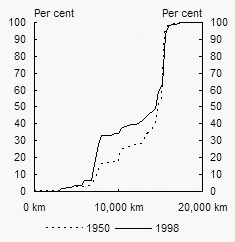
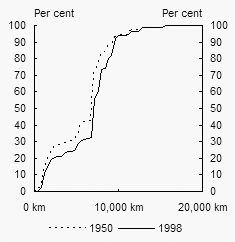
However, it needs to be recognised that a number of factors peculiar to Australia are likely to hinder the ability to close the gap entirely. Geography affects economic success. Australia’s small and dispersed population limits our exploitation of economies of scale, reduces the intensity of competition and increases transport costs compared with larger and more concentrated markets (Box 1). Distance and population will inevitably constrain Australia in achieving world-leading productivity performance in at least some industries and, hence, in aggregate GDP per person. Nonetheless, significant improvements can still be made with the right policies and economic environment.
Enhanced international integration and engagement
Higher productivity can be achieved by specialising in the industries to which Australia is best suited and by achieving economies of scale and scope. A small population and the costs of trading both within Australia and with major international markets constitute key economic hurdles to Australia achieving world-best levels of productivity (Box 1). Effective international integration can help reduce the limiting effects of Australia’s geography and relatively small population.
Australia has taken significant steps to liberalise cross-border movement in goods and services, capital and people. This has resulted in:
- access to cheaper and better inputs and final goods and services;
- more efficient allocation of natural, man-made and human resources, with greater specialisation in areas of comparative advantage;
- access to international financial markets to fund investment, smooth consumption and expenditure over time, and share risks;
- transfer of skills and technology; and
- increased competition, promoting innovation and dynamic efficiency.
While increased global integration opens new opportunities for exchange, it also raises the need to manage new risks, including international economic and financial shocks, international crime, terrorism and contagious diseases.
As a small, open economy, Australia has a strong interest in the development of rules-based multilateral systems governing such areas as trade, investment, taxation, financial regulation, terrorist financing and money laundering. However, bilateral and regional integration is becoming increasingly important within East Asia. This region accounts for around half of Australia’s trade (ABS 2005e) and its importance to the world economy has increased considerably over recent decades. The trend will continue as China and other emerging Asian economies continue to develop rapidly.
For Australia, the shift toward regionalism and bilateralism within Asia, most notably in trade policy, raises difficult questions about the appropriate balance between multilateral, regional and bilateral engagement. Nevertheless, a well-considered approach to regional and bilateral engagement can complement multilateral arrangements. When entering bilateral and regional agreements, it is important to focus on maximising potential gains and not adding unduly to the complexity of international trade and investment rules. The benefits of international trade and investment are best achieved when accompanied by reductions in behind-the-border barriers to new entrants, whether foreign or domestic.
Maintaining and investing in Australia’s infrastructure
Infrastructure plays a key role in facilitating economic activities and contributing to Australia’s general wellbeing. Both labour and capital rely upon access to efficient infrastructure to underpin their productivity. Over the past 20 years, Australian governments have implemented wide-ranging reforms to boost productivity in infrastructure sectors and contribute to economic growth. The recent Review of National Competition Policy Reforms (Productivity Commission 2005b) found that productivity gains in the six major infrastructure sectors that underwent most reform since 1990 permanently added 2.5 per cent to GDP. For example, output per worker in electricity, gas, urban water, telecommunications and rail freight more than doubled over the 1990s. Productivity gains have lowered prices and raised average incomes.
In the process of reform, governments have had to grapple with complex issues of ownership, regulation and contract arrangements, and to develop sound decision-making frameworks to encourage appropriate investment decisions. Despite significant progress, challenges remain in many areas.
Given its nature, infrastructure often requires some form of government involvement — this may be in the form of direct provision, planning and coordination of networks, or regulation of monopoly assets. Where government provision is necessary, effective investment decision-making should involve sound cost-benefit analysis.
Many governments here and abroad have privatised some infrastructure businesses, such as in the energy, transport and communications sectors, that generated sufficient revenue to be financially viable. In those cases, the focus for governments has shifted from that of ownership to facilitating vigorous competition or, where that is not possible, regulating prices charged by monopoly networks.
Some governments have retained ownership of assets in key sectors together with regulatory responsibility and political accountability. The conflict between those roles can put at risk effective pricing and investment decisions. Government intervention is still preventing prices from reflecting the true economic cost of production in some infrastructure service markets.
For example, some state governments in Australia are discouraging potential new private-sector investors by continuing to own electricity assets, cross-subsidising their generators and retailers, and capping retail prices (Productivity Commission 2005b). Few infrastructure facilities utilise time of day or congestion pricing for infrastructure services. Further, most rural and urban water prices currently do not take account of the value of water in alternative uses and water trading regimes are in their infancy.
Regulated price setting at the appropriate level is always a difficult process. Depending on how prices are set, suppliers may invest too much or too little in infrastructure. Either case can lead to inefficient use of scarce resources — reducing the resilience and reliability of networks and lowering overall productivity and economic growth. Moreover, infrastructure choices can be distorted between competing industries. Promoting competitive infrastructure markets is desirable, where feasible, as it promotes efficient use of, and investment in, infrastructure and reduces the need for regulated pricing. New entrants and effective competition between existing players also can play a critical role in lifting productivity and stimulating the introduction of innovative new technologies, services and practices in the provision of infrastructure.
As noted in Statement 3, global demand for resources has increased significantly over recent years. Supply responses typically have lags because of the large fixed costs inherent in mining projects and significant volatility in commodity prices. There has consequently been little spare capacity to meet increased demand and prices have increased significantly. In response to rising prices, Australian mining investment has surged and the resulting increase in output has begun to lift export volumes.
As a result, the resource boom has put pressure on the capacity of some key east coast rail lines and ports. However, concerns have also been expressed about systemic, long-term capacity constraints emerging in electricity, rural and urban water and interstate freight and urban passenger road and rail networks (Business Council of Australia 2005; Productivity Commission 2005b).
Despite the many productivity and cost gains delivered during the past two decades, a further set of initiatives could build on these gains. Such initiatives could encourage competition, improve incentives for investors to install appropriate new infrastructure facilities and encourage their more efficient use. Successful reforms could boost national productivity significantly. In 2005 the Council of Australian Governments will review ongoing arrangements for National Competition Policy. The Australian Government initiated the Productivity Commission review to inform this process.
The role of government
Governments alone cannot resolve every problem and achieve every political, economic and cultural objective of society. In most cases private markets, individuals and communities will be better placed to meet the objectives they are seeking. In some instances governments are best placed to act, while other cases will require public and private cooperation.
As such, governments face a continuing challenge in defining the scope of their roles and in performing efficiently and effectively. Yet Australia’s prosperity depends on the sound use of scarce resources in both the public and private sectors.
Governments can support productivity growth in the broader economy through efficiently managing public sector agencies to deliver services to the public in an effective manner. They also have a role in improving the efficiency of private markets by setting regulations that provide a framework for, and secure confidence in, market operations. Competitive forces will continue to drive ongoing productivity improvements. In Australia’s federal system of government the rate of productivity growth in both the public and private sectors also depends on the effectiveness with which the three levels of government work together.
By establishing sound frameworks for decision-making and resource allocation, well-governed institutions and markets reduce the risk of economic instability and the vulnerability of the economy. They help contain the shocks to which an economy is exposed, making it easier for firms and households to adjust. Despite being exposed to the large negative external shocks of the East Asian financial crisis, for example, Singapore and Australia fared relatively well. This was due partly to sound governance arrangements within public institutions and domestic economies (Johnson et al 2000; de Brouwer 2003).
Governance
Governance is one key area where governments can act to improve productivity. Governance covers the set of arrangements by which those managing an organisation are accountable to those with a legitimate interest in the organisation.
Improving governance standards for companies is the focus of the Corporate Law Economic Reform Program (CLERP). The objective is to boost investor confidence that boards and management will make sound decisions and increase the return on shareholder funds for the ongoing benefit of shareholders, employees and the wider community.
In the public sector, governance is about how parliaments, governments, boards and public service managers relate to each other and are answerable for the cost-effective performance of public functions and the delivery of public services. Reforms have strengthened financial and accountability arrangements and sharpened the focus on effective public service delivery. The reforms have included introducing the Charter of Budget Honesty, new financial management legislation, whole-of-government budgeting, reporting on an accrual basis, and strengthened performance reporting and benchmarking requirements.
That said, the best policies in the world will not deliver the intended outcomes if government agencies do not implement them in the manner governments intended. While some steps have been taken to improve arrangements between the Australian Government and its agencies, the Review of the Corporate Governance of Statutory Authorities and Office Holders (Department of Finance and Administration 2003), also known as the Uhrig Review, found governance could be enhanced by providing greater clarity in the relationships between Ministers, their departments, the Parliament, the public, statutory authorities and office holders.
The Uhrig Review developed templates of best practice governance principles. The application of those principles is intended to provide statutory authorities and office holders with clear purpose and guidance about government expectations and objectives. The governance arrangements of Australian Government statutory authorities and office holders are to be assessed against the templates by March 2006. Assessments are continuing, with implementation of the recommendations to occur on a rolling basis by March 2007.
Australian Government and state relations
The effective and productive delivery of government services also is affected significantly by the relationship between the three levels of government, and particularly between the Australian Government and the states. This is because they are jointly involved in almost every functional area of government, with the exception of defence.
The Australian Government has sound reasons for involvement in many functional areas. They include promoting national standards, ensuring coordination and achieving national objectives such as enhanced productivity and participation. Similarly, state governments have sound reasons for involvement. However, joint government involvement in the same functional areas raises significant challenges including complexity for the public, cost and blame shifting, and possible duplication or gaps in service delivery.
In the medium term, all tiers of government will face significant pressure from the ongoing effect of cost drivers including demographic change. The Productivity Commission (2005a) projects that the aggregate fiscal pressure for all governments associated with the ageing population could be over 6 per cent of GDP by 2044‑45 with the bulk of this expected to be borne by the Australian Government, but state governments face pressures as well. Growing spending pressures in key areas of service delivery accentuate the need to ensure that service provision is as effective and efficient as possible.
Some recent progress has been made in improving the allocation of the roles and responsibilities of governments. In addition, the introduction of the GST provided the states with a growing source of revenue. This enabled states to abolish a range of inefficient taxes and provided them with more funding certainty to meet their responsibilities.
Going forward, it will be important for the Australian Government and the states to clarify roles and responsibilities in order to improve productivity in the provision of services to the public while sustaining government finances. Clarification of roles will require consideration of national strategic priorities and judgements as to the tier of government that is likely to discharge those priorities most effectively.
Complexity and uncertainty
Complexity and uncertainty increase as markets expand beyond state and national borders. This can add to the cost of transactions and thereby limit the potential opportunities for increased investment and consumption.
Government intervention through the rule of law provides a framework to reduce uncertainty by providing greater confidence that private transactions will be completed satisfactorily. Through regulation, revenue raising activities and spending decisions, governments may add to or reduce the complexity faced by market participants. For example, governments might reduce complexity by requiring providers of similar products to promote or advertise them in a consistent, easily comparable manner.
On the other hand, contradictory regulations across sub-national levels of government can add to the difficulty of doing business. Addressing such issues was behind the Australian Government’s drive to set consistent regulation of corporations and the securities and financial systems. It is also an important driver of the Australian Government’s intention to develop a uniform approach to workplace relations.
In many cases, market participants can assist in managing complexity, thereby helping individuals to deal with complex information, procedures or regulation.
Governments may add unnecessarily to complexity by over-regulation, by setting ineffective or inappropriate regulation or policies, or by too frequently changing them. Over-regulation might arise, for example, when government decision-making is heavily influenced by the demands of the most risk averse, or where the concern being addressed is not fully understood by regulators. The Australian Government has sought to reduce the likelihood of such outcomes through the establishment of a number of consultative arrangements, including the Board of Taxation and the Financial Sector Advisory Council, and by consulting with business and consumer groups when developing legislation.
The design of policies and the way that laws and regulations are crafted also can add unnecessarily to complexity. For instance, attempts to cover in detail all current possible treatments in the law may require constant updates and additions as society and markets continue to evolve. In such circumstances principle-based drafting of laws and regulations may be more appropriate. Policy measures also can be incremental, adding one layer of complexity to another. On occasions more comprehensive policy redesign may overcome decades of built up complexity.
Australia’s tri-level system of government and our need to integrate with the global community influence the levels of complexity Australians face and the impact of this complexity on market efficiency. For example, recent reports by both the Productivity Commission (2005b) and the Business Council of Australia (2005) have concluded that differing greenhouse policies between jurisdictions are imposing costs, creating uncertainty and impeding investment in Australia’s infrastructure. As another example, businesses that operate across states and self-insure for workers’ compensation face added costs from complying with different related financial and prudential requirements in each jurisdiction.
Maintaining our natural environment
Continued economic growth and prosperity require sound management of the natural environment. Clean water, clean air, arable land and sustainable timber stocks for example are essential to the productive capacity of almost all sectors within the Australian economy. The natural environment also provides important recreational and other benefits that, despite being less tangible in a financial sense, still make a valuable contribution to the wellbeing of Australians.
Until recent decades, there has been a lack of understanding of the role that Australia’s unique environment plays in supporting the economy. The seeming limitless nature of Australia’s natural environment meant it had sometimes been undervalued. Pressures on the environment are manifest in problems such as salinity, concerns over water quality and quantity, and issues surrounding greenhouse emissions.
Over time Australians have increasingly come to value the environment more highly and to seek solutions to environmental challenges. In response Australian Government expenditure on the environment has increased substantially in recent years and is budgeted to reach $3.2 billion in 2005-06. This budget builds on flagship environmental programmes such as the Natural Heritage Trust and the National Plan for Salinity and Water Quality. It establishes the $2 billion Australian Water Fund, commits an additional $181 million to protecting Australia’s fisheries in the Southern Ocean from over-fishing and provides an additional $100 million for environmental research.
Unlike most other scarce commodities, there are no effective markets for many environmental goods and services. This reflects factors such as a lack of clear property rights, the existence of externalities and the public good characteristics of the environment. As a result, users of the goods and services provided by the natural environment often have faced little incentive to recognise the costs that they have imposed, given the alternative uses to which natural resources could have been put. Where this has occurred, it is likely that environmental resources have been used in ways that have not been economically efficient and which have failed to recognise their potential contribution to community amenity. In many instances, inefficient use of environmental resources has contributed to environmental degradation.
The inefficient use of environmental resources can constrain economic productivity and prevent future generations from enjoying the same high levels of environmental benefits that Australians enjoy today. A commonly cited example where this could occur is if water catchments were allowed to become degraded. The ‘free’ water filtration provided by the environment then would need to be replaced with expensive water filtration plants, thereby diverting workers and capital from alternative productive activities.
With demographic factors placing increased pressure on government budgets, sustainable resource use will need to be governed mainly by market incentives and regulatory approaches rather than by direct government spending. A key benefit of market-based approaches is that they seek to correct the underlying market failures that lead to environmental degradation. Market-based approaches provide a clear incentive to use environmental resources efficiently and to seek out more innovative production techniques.
By using markets to solve environmental problems, economic growth and higher living standards need not be at odds with improved environmental outcomes. Internationally, markets are increasingly likely to be used to manage the environmental impacts of nitrous oxide, sulphur and greenhouse gas emissions and to support conservation. Reflecting Australia’s particular circumstances, opportunities for the innovative use of environmental markets are being examined on a case-by-case basis in areas such as fisheries, native vegetation and salinity.
A significant example of a market solution is the National Water Initiative (NWI), which was agreed in June 2004 by the Australian Government and most states. A key objective of the NWI is to establish a clearly defined property rights framework for water and the creation of effective water markets. The price signals created by such markets will provide incentives for water to be transferred to its highest value use. This will encourage investment in water-efficient technology and infrastructure that will be needed to sustain Australia’s future economic growth. At the same time, the property rights and water planning frameworks included in the NWI will be based on best available scientific knowledge so that water use is more consistent with environmental sustainability.