



Foreword
Australia’s overseas aid program plays a central role in Australia’s approach to addressing challenges to regional security and prosperity. Through the aid program, Australia is helping our neighbours realise the benefits of broad-based economic growth, respond effectively to the challenges posed by fragile states, and cope with humanitarian crises. The aid program was a central component of Australia’s response to the December 2004 Indian Ocean disaster, and plays a role in an integrated, whole-of-government approach to engaging with the region.
From 2005–06 onwards, the Australian Government will provide major additional resources for official development assistance (ODA). For 2005–06, the government will provide an estimated $2.491 billion in ODA, $358 million above the 2004–05 budget figure of $2.133 billion. This represents a real increase of 5.8 per cent over the 2004–05 expected outcome of $2.253 billion, or an 11.7 per cent real increase budget-to-budget. It is the fifth successive budget that the government has delivered real growth in ODA. The ratio of Australia’s ODA to Gross National Income for 2005–06 is estimated at 0.28 per cent, placing Australia above the donor average which in 2004 was 0.25 per cent, and which is projected by the OECD to increase further during 2005.
As evidenced by Australia’s new $1 billion reconstruction partnership with Indonesia, Australia is committed to building long-term partnerships to achieve our aid goals. From 2005 through to 2009, the government will provide an additional $2.054 billion in ODA, on top of Australia’s existing aid program. This will include multi-year commitments to Australia’s new partnership with Indonesia, to the Regional Assistance Mission to Solomon Islands (RAMSI), additional assistance for reconstruction in Iraq, and debt relief for the most heavily indebted poor countries. These increases represent real and sustained commitments to our development partners.
A new partnership with Indonesia
The new $1 billion Australia–Indonesia Partnership for Reconstruction and Development (AIPRD) will increase Australia’s assistance to Indonesia to $1.8 billion over five years, including $302 million for 2005–06. Through the AIPRD, Australia will work to strengthen even further the close partnership with Indonesia, supporting recovery and reconstruction following the December 2004 Indian Ocean disaster. The AIPRD will help rebuild livelihoods and shattered communities, and also provide assistance for Indonesia’s longer-term development, particularly programs of reform and capacity building. Priorities will include supporting the Government of Indonesia’s reconstruction plans for Sumatra and Aceh, rehabilitation of health, education and government services in Aceh, and improving Indonesia’s disaster management capabilities. Up to 600 additional scholarships will also be funded through the AIPRD. Complementing these activities, the ongoing aid program to Indonesia will expand its assistance in areas such as basic education, people-to-people linkages, economic and financial management, and legal and judicial reforms.
Promoting stability and growth in Papua New Guinea and the Pacific
Papua New Guinea and Solomon Islands highlight the challenges faced by fragile states in our region. In the Pacific, Australia will enhance its efforts to adopt long-term, innovative approaches to the problems faced by fragile states. Total ODA to Pacific Island countries is estimated to be $463 million in 2005–06, an increase of $80 million over the 2004–05 budget figure. Total ODA to PNG is estimated to be $492 million in 2005–06.
Under a new Fragile States Initiative, the aid program will bring together development, security, economic and political perspectives on fragile states, from across government. Through research, evaluation and analysis, this new approach will boost Australia’s capacity to engage with fragile states at both strategic and operational levels. It will ensure Australia can continue to play a lead role internationally on approaches to fragile states. Australia will also support the World Bank in its work on fragile states in the Pacific.
In Papua New Guinea, the five-year, $1.1 billion Enhanced Cooperation Program (ECP) is making progress in strengthening the rule of law and enhancing economic and financial management. The program has the ultimate aim of helping to lay the foundations for stronger economic growth and service delivery in areas like health and education. It complements Australia’s broader program of assistance to PNG. A priority for 2005–06 will be the development of a new country strategy, which will focus on core constraints to growth and help PNG strengthen its governance, develop institutional capacity and address HIV/AIDS. It will include initiatives at a sub-national level and with non-state actors. Australia will develop a new program to build on the achievements of Australia’s current National HIV/AIDS Support Project.
In 2005–06, RAMSI will continue its efforts to restore law and order and stability to Solomon Islands. The Australian Government has committed $841 million to RAMSI from 2005–06 to 2008–09, to support a measured transition from stabilisation to strengthening national capacity. This will include assistance in law and justice, and in machinery‑of‑government reform. The aid program will also provide further support for efforts to promote economic growth, particularly in rural areas. Total ODA to Solomon Islands will increase to $247 million in 2005–06.
Bilateral funding for a number of Pacific Island countries, including Vanuatu and Fiji, will be increased. Australia will also place an increased emphasis on Pacific regional approaches and regional cooperation. A new ‘Pacific Plan’ will be developed by the Pacific Islands Forum in 2005, to create stronger and deeper links between Pacific Island countries and identify sectors where the region can gain most from sharing governance resources. A major AusAID study, Pacific 2020, will identify strategies to promote economic growth through factors such as property rights, political governance and human development. Australia will strengthen links between Australian agencies and their Pacific counterparts, including greater contact between senior Australian government personnel and their counterparts.
Pursuing growth and development in East Asia
Despite continued economic growth, over 280 million people remain in poverty in East Asia. Growth and stability in many countries continues to be undermined by poor governance and corruption. HIV/AIDS, communicable diseases such as Avian Influenza, people trafficking, drugs, and security present challenges that do not recognise national borders, and require coordinated and sustained regional action.
Assistance to East Asia, excluding Indonesia, will total $344 million in 2005–06. A priority will be to enhance regional capacity to undertake further work on trade liberalisation and economic integration, and address security and transboundary threats like HIV/AIDS, illegal drugs and Avian Influenza. Assistance for regional programs will increase to $40 million, including a new $5 million, three-year regional communicable diseases initiative to help build capacity to combat Severe Acute Respiratory Syndrome (SARS) and Avian Influenza, which will bring Australia’s total commitment to fighting zoonotic diseases to $13.4 million, and a $2 million, three-year anti-drug initiative focusing on Cambodia, Laos, Thailand and Burma. Australia will continue to work through regional mechanisms, such as the APEC support program and ASEAN–Australia Development Cooperation Program, to promote further trade liberalisation and prepare for the APEC 2007 meeting.
In the Philippines, Australia will provide an additional $5 million over five years for counter-terrorism activities, while continuing efforts to promote peace in Mindanao. Assistance for basic education will be integral to helping build prosperity in the southern Philippines. Australia will continue to promote Vietnam’s international economic integration and private sector development, while improving living standards for the rural poor. We will also work to streamline and coordinate assistance amongst international donors in Vietnam and Cambodia, to ensure aid is used effectively.
Australia will maintain existing levels of funding to East Timor, estimated at $42 million in 2005–06. A priority will be assisting with the development of a new sector investment program for the East Timorese Government, to enable East Timor to more effectively harness donor resources for development.
Addressing the HIV/AIDS challenge
HIV/AIDS remains one of the most serious development challenges facing the Asia–Pacific region, with more than eight million people infected by the disease. In 2004 I launched the government’s new, $600 million international HIV/AIDS strategy, Meeting the Challenge. The aid program is working to combat HIV/AIDS through partnerships with UNAIDS and the Global Fund to Fight AIDS, Tuberculosis and Malaria. Working with Indonesia, PNG and East Timor, Australia has initiated a major research exercise to better understand the epidemiological, social, economic, and security impact of HIV/AIDS in our neighbourhood.
From 2005–06, the government will commit a further $50 million over three years to the Global Fund. A new $5 million AusAID HIV/AIDS Partnership Initiative will strengthen the capacity of HIV/AIDS organisations in the Asia–Pacific through partnerships with Australian community organisations and professional associations. Australia will also continue to play a leadership role in political efforts to address HIV/AIDS, and has appointed a Special Representative to promote HIV/AIDS action in the region.
Responding to emergencies and crises
The Indian Ocean disaster highlighted the vulnerability of countries in our region, whether to natural disasters or to conflict and instability. Australia responded quickly and generously following the disaster, with financial assistance and with rapid deployment of teams of skilled individuals. Australia will further boost its humanitarian response capacity in 2005–06, increasing the amount of funding available for humanitarian, emergency and refugee assistance from $146 million to $170 million.
Priorities for Australia will include continuing to assist countries affected by the Indian Ocean disaster, and supporting national and regional action on disaster and conflict prevention and peacebuilding. Assistance to Sri Lanka will increase by $6 million to $29 million in 2005–06. The increased humanitarian allocation will also allow Australia to continue to respond to crises beyond our immediate region, including Africa where the government has already committed $40 million to the crisis in Sudan. We will continue our humanitarian assistance and reconstruction activities in the Palestinian Territories and Afghanistan.
In Iraq, the government will commit an additional $45 million for 2005–06 and 2006–07 to help build stability and democracy, and support Iraq’s transition to an open, market-based economy. This will bring Australia’s assistance to Iraq since 2002–03 to over $170 million. We will continue to focus on the agricultural sector and niche areas where Australia has particular expertise, including law and justice, and economic and trade reform.
Debt relief
Levels of debt, particularly in the world’s poorest countries and those recovering from conflict, may constrain development. From 2005–06, Australia will commit $34.8 million over three years to help write off debts of the world’s most heavily indebted poor countries. This will be complemented by assistance to build these countries’ capacity to manage their economies effectively. Australia has also agreed with other countries, through the Paris Club, to place a moratorium on debt repayments due in 2005 by Indonesia and Sri Lanka following the Indian Ocean disaster, and forgive 80 per cent of the more than $1 billion owed to Australia by Iraq.
An integrated approach to overseas aid
The aid program sits firmly within a broader, integrated whole-of-government approach to addressing our region’s development challenges. Australia’s approach was commended by the OECD’s Development Assistance Committee in its review of the Australian aid program in December 2004. The review praised our leadership on key development issues in the region, particularly HIV/AIDS, governance, peace and conflict, and fragile states. It welcomed our hands-on and practical methods, including the whole-of-government approach in PNG and Solomon Islands; and acknowledged the high level of coherence between Australia’s aid and trade policies. The review also endorsed Australia’s geographic focus on the Asia–Pacific, and commended our efforts to move towards further untying of aid, our achievements in harmonising aid delivery with other donors, and our work to align aid with partner government systems.
In my Annual Statement to Parliament on 10 March 2005, I outlined new directions for the aid program, aimed at strengthening political governance, stimulating broad-based economic growth, and addressing constraints to development, in particular those faced by fragile states.
These new directions will be bedded down in 2005–06. Expenditure on governance-related activities will increase to over $1 billion. A new initiative to stimulate growth will look at pilot programs to overcome constraints to growth, particularly in rural areas. Analytical work will focus on the drivers of economic growth, including the linkages between governance and property rights. Strategic partnerships between key Australian government agencies, non government and community organisations are being expanded. As announced by the Prime Minister in 2004, the Australian Youth Ambassadors for Development Program will double in size, to involve more young, skilled Australians in the aid program.
These initiatives will feed into a white paper outlining a medium-term, strategic blueprint for the aid program that I propose to table during 2005–06. This paper will lay a strong platform for future Australian aid, and ensure it continues to address development priorities in the most effective and efficient way possible. Coupled with the funding increases announced in this budget, the white paper represents a long-term investment by this government, to address the challenges facing our region in a robust, practical and sustainable way.

Alexander Downer
Table 1: Total Australian ODA flows to partner countries
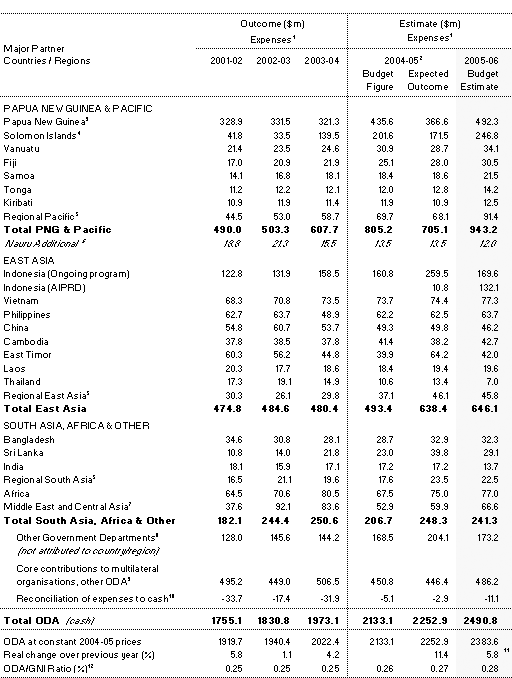
Notes to Table 1
- Shows total expenses, minus expenses to new multi-year liabilities (for example, the International Development Association (IDA) or the Heavily Indebted Poor Countries (HIPC) Initiative), plus cash payments for these multi-year liabilities. See Technical Notes for more detail.
- Estimated expenses for 2004–05 represent budget figures as at May 2004 and expected outcomes as estimated at May 2005.
- PNG estimated expenses in 2004–05 and 2005–06 include ODA-eligible expenditure by Other Government Departments (OGDs) related to the Enhanced Cooperation Program of $43.7 million and $168.9 million respectively.
- Solomon Islands estimated expenses in 2004–05 and 2005–06 include ODA-eligible expenditure by OGDs related to the Regional Assistance Mission to Solomon Islands of $72.2 million and $136.0 million respectively.
- Regional Pacific, Regional East Asia and Regional South Asia include multi-country and regional activities and small bilateral programs identified in Table 4.
- Nauru Additional represents additional funding appropriated to AusAID through new budget measures agreed by the government.
- Middle East and Central Asia includes Palestinian Territories, Afghanistan and Iraq.
- OGD not attributed to country/region includes ODA-eligible expenditure by OGDs/agencies that has not been allocated to a specific geographic area.
- Core contributions to multilateral organisations, other ODA expenditure includes expense payments that cannot be attributed to a particular country/region, such as payments to some UN and Commonwealth organisations, and departmental expenditure. The ODA-eligible components of cash payments to IDA, ADF, IFAD, GEF, HIPC and the MPMF are also included in this line item.
- See Technical Notes for an explanation of the relationship between expenses and cash.
- Real per cent change over 2004–05 expected outcome of $2,252.9 million. Budget-to-budget the real increase is 11.7 per cent.
- See Technical Notes for an explanation of the change in terminology from Gross National Product to GNI.
Table 2: Total Australian ODA by agency
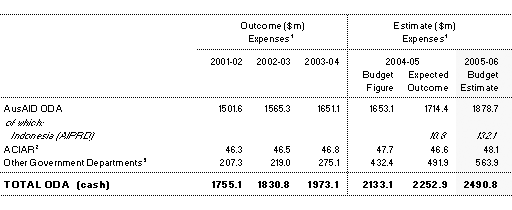
Notes to Table 2
- See Technical Notes for an explanation of the relationship between expenses and cash.
- ACIAR figures equal their total cash expenditure per year. ACIAR’s full financial statements are available in the Foreign Affairs and Trade Portfolio Budget Statement.
- Other Government Departments includes ODA-eligible activities by State governments and Commonwealth agencies other than AusAID and ACIAR.