



Chapter One: Focus of the Aid Program
Australia’s overseas aid program advances Australia’s national interest by assisting developing countries to reduce poverty and achieve sustainable development. In 2005–06, the aid program will continue to help build a stable, prosperous and democratic Asia–Pacific region. It will be flexible and responsive to urgent needs — as evidenced through the December 2004 Indian Ocean disaster — and help our neighbours address longer-term challenges such as poverty, economic growth, weak governance, instability and insecurity, and HIV/AIDS.
In recent years, development issues have become increasingly interlinked with broader Australian regional and international policy priorities, including regional security, trade, economic integration, and the transboundary threats posed by communicable diseases. The aid budget for 2005–06 reflects this changing agenda. Australian assistance to Indonesia will increase substantially, to take into account the $1 billion commitment to the Australia–Indonesia Partnership for Reconstruction and Development. Assistance to PNG and the Pacific will also increase, to reflect the Australian Government’s enhanced and long-term engagement in these countries. In East Asia, South Asia, and the rest of the world, Australia will focus its efforts increasingly at a regional level. The flexibility and responsiveness of the humanitarian program will be increased, so that Australia can continue to respond to crises and emergencies.
Diagram 1: Australian ODA in 2005–06
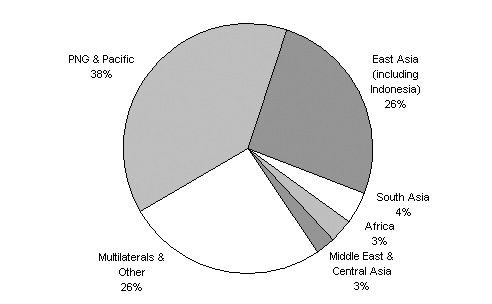
Note: ‘Multilaterals and Other’ includes expense payments that cannot be attributed to a particular country or region, for example payments to Multilateral Development Banks, some UN and Commonwealth organisations, and AusAID departmental expenditure.
In delivering the aid program, Australia will continue to develop the innovative approaches that have seen it emerge as a leader in the region. The Australian aid program will draw upon the skills and expertise of a wide range of Australian government agencies, and other stakeholders, to tackle issues in a direct, practical way. It will build long-term partnerships with other donors, regional and multilateral organisations, and most importantly with partner governments, to harmonise and align inputs and priorities.