



Ongoing program
The objectives of Australia’s ongoing program with Indonesia, as agreed between the two governments in 2003, are to:
- help strengthen economic and financial management;
- help build the institutions of democracy;
- promote stability and security; and
- improve the quality and accessibility of government service delivery, particularly in the poorer eastern provinces.
Strengthening economic and financial management
Australia will continue to help Indonesia strengthen its economic and financial institutions. The Technical Assistance Management Facility, a major five-year, $26 million program launched in 2004 to support key economic reforms, will work with central government agencies, including the Ministry of Finance, to assist in improving fiscal management, institutional reform, and strengthening the integrity of the financial system. Through the facility, Australia will also provide additional debt management assistance to follow on from the Debt Management Project which, by helping develop local debt management capacity, saved the Indonesian Government an estimated $12.5 million per annum. Australia has also committed $4 million to the Program for Eastern Indonesia Small to Medium Enterprise Assistance, to help develop a viable small and medium enterprise sector in Eastern Indonesia that will generate sustainable employment and economic growth.
Diagram 6: Estimated breakdown of ODA to Indonesia by sector 2005–06
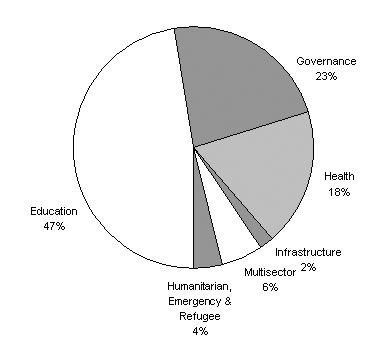
Note: Diagram 6 includes only the ongoing program to Indonesia ($169.6 million in 2005–06). It does not include the Australia–Indonesia Partnership for Reconstruction and Development.
Building the institutions of democracy
Assistance in the areas of legal reform, political governance, civil society development and anti-corruption will continue to be high priorities in 2005–06. Through the Legal Development Facility, a five-year, $22 million program which commenced in 2004, the aid program will work with Indonesian government institutions and civil society to assist with legal and institutional reform and development. Key partners include the Indonesian Supreme Court, the Human Rights Commission and the Directorate General for Human Rights.
In 2004, Australia provided assistance worth $15 million for Indonesia’s presidential and legislative elections. Beginning in 2005, Indonesia will hold direct popular elections for the provincial governor, district head and municipal mayor positions. Australia will provide assistance for this process of local-level democratisation through a coalition of Indonesian organisations known as the People’s Network for Voter Education. A new one-year program of cooperation with Indonesia’s newly formed Regional Representative Council (DPD) began in December 2004 and aims to support the DPD in conducting their constitutional functions relating to legislation, oversight, and regional representation.
Australia has helped the Government of Indonesia fight corruption by providing more than $6 million of assistance to a number of important institutions including the Ombudsman, Centre for Reporting and Analysis of Financial Transactions, the Supreme Audit Board, the State Banks Monitoring and Governance Unit, and the Anti–Corruption Commission. Australia will continue to respond quickly to new requests in this area.
Promoting stability and security
Counter-terrorism
The Australian and Indonesian governments continue to strongly condemn all forms of terrorism. The instability and uncertainty that occurs as a consequence of terrorist acts and organised criminal activity hinders Indonesia’s development aspirations.
Following the Prime Minister’s 2002 announcement of a $10 million commitment to assist Indonesia build its counter‑terrorism capacity, Australia has provided support in three broad areas: building the capacity of the Indonesian National Police to fight terrorism and transnational crime ($3.5 million), restricting the flow of financing to terrorists ($3.5 million), and enhancing travel security ($3 million).
On 7 December 2004, the Australian Government announced a doubling of this commitment over five years. The additional $10 million will support emerging counter-terrorism priorities, including removing anomalies from Indonesia’s counter-terrorism laws; strengthening the Indonesian bureaucracy’s counter-terrorism coordination efforts; further training for prosecutors and judges, particularly in the management of complex crimes of violence; and further assistance to fight money laundering.
Building partnerships with mainstream Islam
Islam is a major force for development in Indonesia. Mass-based Islamic organisations have networks throughout the country, giving them access and influence in the community unmatched by any other groups. These organisations provide basic services to communities in Indonesia and are committed to promoting pluralism and religious tolerance. The Australian aid program recognises the important role mainstream Islamic organisations play in the development of Indonesia and is continuing to develop partnerships with these organisations.
In 2004–05 Australia’s aid program has engaged with and supported moderate Islam in a range of ways:
- supported large-scale domestic election monitoring for the 5 July Presidential poll by a coalition of Indonesian organisations known as the People’s Network for Voter Education;
- provided funding to Aisyiyah, the women’s arm of the Islamic welfare organisation Muhammadiyah, to help individuals and families affected by the September 2004 Australian Embassy bombing;
- funded the regional Islamic Perspectives on Governance conference, bringing together Muslim leaders and academics from around South–East Asia;
- supported the International Dialogue on Interfaith Cooperation held in Indonesia in December 2004. A joint Australia–Indonesia initiative, the dialogue brought together faith leaders from around the region to discuss the potential role of religion to address issues relating to religiously diverse communities, including peace and conflict prevention; and
- continued to integrate partnerships with mainstream Islamic organisations into the ongoing aid program, particularly through the education and training program.
In 2005–06, the aid program will continue to develop community development and democratisation initiatives with mass‑based Islamic organisations. These organisations’ nationwide network and unparalleled access to communities make them invaluable partners in building democracy and civil society in Indonesia.
Australia will provide funding to the Peoples’ Network for Voter Education to undertake monitoring of Indonesia’s local elections which begin in June 2005. The elections will be the first ever popular elections for Indonesia’s provincial governors, district heads and municipal mayors. The aid program will also work with Islamic organisations through the Learning Assistance Program for Islamic Schools (LAPIS) and continue to explore ways of delivering small-scale assistance to moderate Islamic civil society organisations in democracy-building, through a partnership with the Asia Foundation.
Communicable diseases
The numbers infected by HIV/AIDS in Indonesia continue to grow alarmingly. Australia, working collaboratively with other key international development partners, is well-positioned to help Indonesia deal with the epidemic. The Australian aid program has played a major role in the HIV/AIDS response, drawing on Australia’s comparative advantage in injecting drug use harm reduction strategies, and understanding of the determinants of the epidemic in Eastern Indonesia. In 2005–06, in close partnership with other key donors, further assistance will be provided to national, and selected provincial, AIDS commissions to implement Indonesia’s National HIV/AIDS strategy. Australia will also support Indonesian community-based organisations who are working to deliver prevention and care services to high-risk groups.
Avian Influenza has affected a number of Asian countries, including Indonesia, since December 2003. Australia is actively supporting the Indonesian Government’s Avian Influenza Taskforce and, through participation in a multi-donor forum, is helping coordinate the international response.
Australia has initiated a new $3 million partnership with the World Health Organisation (WHO) to support emergency responses to zoonotic and communicable disease outbreaks in Indonesia. The program will strengthen monitoring and surveillance systems, and build the longer-term local capacity to prepare for and respond to future outbreaks. Through the partnership, Australia has already partly funded the WHO’s response to the Indian Ocean disaster and the latest Avian Influenza outbreaks. Australia has also assisted the WHO to develop a mass media campaign for the prevention of Avian Influenza, and to provide laboratory testing, anti-viral medicines and technical support to the Indonesian Ministries of Health and Agriculture.
Improving government service delivery, particularly in Eastern Indonesia
Education
Basic education institutions (primary and junior secondary) cater for approximately 45 million students across Indonesia. The Learning Assistance Program for Islamic Schools (LAPIS), which commenced in June 2004, will improve the quality of basic education in non-state Islamic schools. These schools play a critical role in educating poor children and girls, and enrol around 15 per cent of school-aged children. LAPIS has initially focused on building relationships and coordination with key stakeholders in the Islamic education sub-sector, including a detailed needs assessment in a number of locations throughout Indonesia. LAPIS is also responding to urgent needs, including the provision of $2 million in assistance to Aceh for Islamic junior secondary schools and the Banda Aceh State Institute of Islamic Studies (Institut Agama Islam Negeri). A number of other Australian programs are also working with schools, communities and local governments to improve the management and delivery of basic education services.
The Australian Development Scholarships program adopted a targeted approach for up to 33 per cent of its scholarships in 2004, in which awards are allocated to candidates from agencies involved with AusAID projects or AusAID-related activities. This will help ensure that human resource development is consistent with agreed development priorities. The scholarships program has also formed partnerships with two state Islamic universities, encouraging graduates of mainstream Islamic institutions to apply for further study in Australia.
The Indonesia–Australia Specialised Training Program will deliver over 325 short courses from 2004 to 2008, with a focus on capacity building for mid-career professionals in the fields of economic management, governance, and improving the delivery of basic services such as health and education.
In 2005–06, options for further assistance in vocational education and skills development will be explored, with a focus on policy-level support and skills development in Eastern Indonesia.
Maternal and child health
In Indonesia, and especially its eastern provinces, the health, nutrition and development status of women and children remains poor. For example, Indonesia’s maternal mortality ratio, variously estimated between 334 and 380 per 100,000 live births, is among the highest in ASEAN countries, and higher than many poorer countries worldwide. To assist in addressing maternal and child health issues in Indonesia, Australia will expand its support in selected provinces of Eastern Indonesia where the need is great, particularly Nusa Tenggara Timur, Papua, and Nusa Tenggara Barat. Australia will also strengthen its partnerships with other donors, particularly UNICEF and the United Kingdom’s Department for International Development. This will provide Australia with an excellent opportunity to take a lead role in assisting the Indonesian Government to harmonise policy and programming mechanisms.
Child protection
Child exploitation, trafficking and child sex tourism issues are becoming increasingly significant in Indonesia and South–East Asia. In Indonesia, Australia will deepen and broaden its engagement in child protection, and implement a flexible child protection pilot program, most likely in Bali and Lombok, with a view to developing a longer-term plan of engagement.
Australia – Nusa Tenggara Assistance for Regional Autonomy
In line with the development cooperation strategy agreed with Indonesia, Australia will establish a strategic, flexible approach to regional development in Nusa Tenggara Timur and Nusa Tenggara Barat, two of Indonesia’s poorest provinces. The $30 million, five-year, Australia – Nusa Tenggara Assistance for Regional Autonomy program will aim to reduce poverty through promoting sustainable and equitable social and economic development in Nusa Tenggara. Australia will focus on helping improve regional and provincial governance, increasing peri-urban and rural incomes, and improving the quality of and accessibility to basic services in a decentralised environment. Assistance will be provided through a strategic, flexible and program-based approach, facilitated by partnerships with a wide range of stakeholders within local governments, business communities and civil society organisations. Existing programs of Australian assistance in these areas will be brought together in a more coordinated way so as to reinforce impact.
In the longer term, a similar approach may be adopted in other selected eastern provinces of Indonesia. Opportunities for activity implementation are currently being explored.
Water supply and sanitation
In collaboration with the World Bank and other international organisations, Australia is helping Indonesia develop effective water and sanitation services for poor rural communities, promote hygiene awareness and hygienic behaviour, and develop policy frameworks for water supply and sanitation that encourage demand-driven and participatory initiatives for poor communities. Assistance is being provided through two projects, with a total value of $19.2 million and a focus on poorer eastern provinces.
Humanitarian relief
Indonesia remains vulnerable to natural disasters, terrorist attacks, and inter-communal conflict. Australia is helping Indonesia build national and local capacity to recognise and defuse triggers for conflict, and respond quickly and effectively to natural disasters and terrorist activities. Australia will continue to provide substantial support for national and international agencies mandated to prevent, mitigate, and/or respond to humanitarian crises, and increasingly enter into longer-term strategic partnerships with key humanitarian agencies. Australia has pre-positioned funds with the International Federation of Red Cross and Red Crescent Societies for rapid response to disasters, and provided support to the Indonesian Red Cross for disaster preparedness, prevention and mitigation.
In addition to its response to the Indian Ocean disaster, Australia will continue to respond quickly and generously to humanitarian crises in Indonesia. Following the 28 March 2005 earthquake off the Sumatra coast, Australia responded with a $1 million assistance package. In Bali, the 12 October Australia Memorial Centre burns unit is now officially open, and a new Australia–Bali Memorial Eye Centre is currently being constructed. Australia responded to the Australian Embassy Jakarta bombing with generous assistance for Indonesian victims of that tragedy. Humanitarian aid will continue to be provided for disaster and conflict-prone areas such as Muluku, West Timor, and Sulawesi.