



Chapter Three: Papua New Guinea
and the Pacific
Papua New Guinea
| Country program estimate Retirement benefits Estimated other ODA Estimated total ODA |
$300.0 million $13.6 million $178.6 million $492.3 million |
PNG development indicators

Source: GNI per capita: World Development Indicators, World Bank, 2003; other indicators: Human Development Report, UNDP, 2004.
The development of a stable and prosperous Papua New Guinea remains a high priority for the Australian Government. Official Development Assistance (ODA) to PNG is expected to total $492.3 million in 2005–06, an increase of $56.6 million.
PNG’s macroeconomic position improved markedly during 2004 through a combination of a favourable external environment, including buoyant commodity prices, and fiscal restraint. Increased foreign reserves and a strengthened kina helped inflation and interest rates remain low. With moderate GDP growth, rising tax receipts and reduced government borrowing costs, the PNG Government’s fiscal deficit is anticipated to remain small, coming off a modest surplus in 2004. However, with weak medium-term revenue prospects, PNG needs to consolidate and build on current economic and fiscal progress, and provide a level of basic services that will support broad-based growth. Improved accountability and governance mechanisms, including public expenditure management and public administration, are needed to facilitate and safeguard improved public sector performance.
It was agreed at the 16th Australia–PNG Ministerial Forum in December 2004 that a new medium-term country strategy for PNG would be developed during 2005. The new strategy will build on the findings of the August 2004 joint review of Australian development cooperation with PNG. It will incorporate a new approach which places substantially more emphasis on working through PNG’s own budgeting and planning mechanisms, both in terms of identifying priority inputs and in monitoring and reviewing performance.
Consistent with Australia’s approach to engaging with fragile states, the PNG country strategy is expected to include a focus on:
- fostering sustainable economic growth, particularly in rural areas;
- building stronger governance, including supporting state-building;
- developing institutional capacity at all levels of government; and
- addressing HIV/AIDS.
Diagram 7: Estimated breakdown of AusAID program in PNG by sector 2005–06
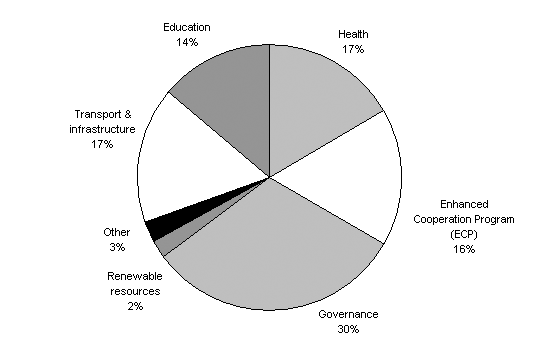
Note: Diagram 7 includes only AusAID country program expenditure to PNG.
Fostering sustainable economic growth
Transport infrastructure and renewable resources
Australia will assist PNG to promote growth in the agricultural economy by increasing opportunities for the rural poor to generate income. Initiatives will focus on the preconditions for agricultural growth such as sound infrastructure, law and order, the delivery of essential services to rural areas, and agricultural information.
Sound infrastructure improves access to essential services and markets, and is a major contributor to broad-based economic growth. Roads and airports in PNG play a significant role in promoting nation building, political stability and communication, particularly given PNG’s mountainous terrain and scattered population. In 2005–06, Australia will support the maintenance of the Highlands Highway and bridge restoration on major road networks. In the aviation sector, Australian support through the Enhanced Cooperation Program (ECP) will improve service delivery by the Civil Aviation Authority. Australia will continue to work with the Asian Development Bank (ADB) and World Bank to strengthen the Department of Transport and the Department of Works in establishing an affordable, prioritised national transport development plan.
Australia is designing a new program of assistance to agricultural research and development organisations in PNG, to encourage them to develop practical programs to transfer agricultural research information to village farmers. This program will build on previous work to strengthen the National Agricultural Research Institute and links between the research system and farmers.
Building stronger governance
Australia is working with PNG to strengthen civil society’s capacity to play an active role in the affairs of the state and deliver essential services. Over the past year the Community Development Scheme has developed strategic partnerships with local organisations and is supporting them to represent, and meet, the needs of society in a transparent and accountable way.
In 2005 the Electoral Support Program will expand to include capacity building for key government agencies as well as civil society reform activities. Planned outcomes include a peaceful and democratic first general election for the Autonomous Region of Bougainville in mid-2005, improvements to the PNG electoral legislative framework, and improvements in electoral planning and management in preparation for the 2007 PNG national elections.
The Media for Development Initiative will support the media sector, particularly rural radio, to improve access, content and voice. It will be delivered in partnership with the PNG Media Council and through a twinning relationship between the Australian Broadcasting Corporation and the PNG public broadcaster, the National Broadcasting Commission.
The Church Partnership Program aims to strengthen the capacity of the seven major churches in Papua New Guinea — Anglican, Catholic, United, Lutheran, Seventh Day Adventist, Baptist and Salvation Army — to contribute to development and stability. The program will operate for five years (2004 to 2009) with funding of up to $25 million. The PNG churches will receive targeted support from their sister churches in Australia to improve governance, expand essential health and education services, and strengthen organisational capacity.
Developing institutional capacity
Governance
Australia will continue to support PNG-led public expenditure management and administration reforms. In 2004–05, Australia helped implement important gains in procurement, debt management, civil service retrenchments, and expenditure control. In 2005–06, Australia will assist with central agency leadership of public sector wide improvements in budgeting, financial management, workforce development, and performance management.
Australia’s governance activities are provided in close coordination with other Australian government agencies under the ECP, and other development partners including the World Bank and the ADB. Australia will continue to engage with central agencies as they implement PNG’s Public Sector Reform Strategy 2003–07 and Public Expenditure Review and Rationalisation reform agenda, by providing advisory support, training and local contracting inputs, and facilitating capacity building programs that complement support provided under the ECP.
Health
In 2005–06, Australia will move away from conventional project-based assistance and, through a sector-wide approach, work to strengthen PNG’s own health system from within. While Australia’s recent project-based assistance has made significant contributions, sectoral approaches are more likely to yield long-term benefits. This evolution in approach is being undertaken in close harmony with other donors, and following analysis of the fundamental weaknesses within the PNG health sector.
Existing health projects will be completed during 2005–06, and new activities will be based around a health sector Capacity Building Service Centre. The centre will support PNG’s government and church-based health service delivery at national, provincial and district levels. Australia and other donors will also continue to contribute to basic services such as rural immunisation and outreach programs, and supervision and support to health centres and aid posts.
Education
Australian support for basic education has helped double, over the last 10 years, the number of children enrolled in PNG schools to approximately one million. In 2005–06, Australia will continue to support basic education through development and implementation of revised primary and lower secondary curricula, and by strengthening the capacity of provincial and local level organisations to plan and manage school infrastructure.
The Education Capacity Building Program, a flexible funding and technical assistance program, will work collaboratively within PNG government systems to strengthen planning and management, support improved coordination between government agencies, and strengthen monitoring, evaluation and reporting systems. A major objective of Australia’s education assistance is to support the PNG Government to refine and implement its National Education Plan for the period 2005 to 2014.
Law and justice
Law and justice assistance will support PNG-developed sector objectives (as opposed to individual agency priorities), recognising that improvements in law and justice depend on all parts of the sector working effectively; weakness in one part undermines the entire system. Assistance will be incentive-based, responsive to emerging priorities, and support agencies’ demonstrated commitment to improved operational and administrative performance.
The provision of broader Australian government assistance under the ECP has increased the scope for positive law and justice outcomes in PNG, particularly through increased AFP support to the Royal PNG Constabulary, and provision of legal specialists such as prosecutors, litigators, Solicitors-General and judges.
In 2005–06, improving the deterrence capacity of the system through increased effectiveness of agencies will be a priority. Other priorities include supporting the PNG Government’s National Coordinating Mechanism; supporting development of a sector strategic plan; strengthening planning, management and financial systems; and developing a sector performance monitoring system.
Addressing HIV/AIDS
PNG has the highest incidence of HIV/AIDS in the Pacific region. Since the 1990s, HIV prevalence amongst women has grown sharply. This is evident amongst women attending antenatal clinics, blood donors, and tuberculosis patients. Significant prevalence rates are found not only in large urban areas (for example Port Moresby), but also in rural pockets, particularly around primary industry sites.
Heterosexual transmission is the predominant means of infection. Approximately equal numbers of men and women are infected, except in the 15 to 29 year old age group where women outnumber men. The second most common means of infection is parent to child transmission.
An AusAID-commissioned report, Potential Economic Impacts of an HIV/AIDS Epidemic in Papua New Guinea, concluded that if not checked, the HIV epidemic in PNG will lead to major declines in economic and social indicators. The report concluded that PNG is facing a major HIV epidemic, with annual increases of 15 to 30 per cent in numbers infected; that HIV has the potential to exacerbate poverty in PNG, with measures of economic welfare falling between 12 and 48 per cent by the year 2020; that HIV could cut the labour force by 13 to 38 per cent by 2020; and that the budget deficit will increase by between 9 and 21 per cent by 2020.
The centrepiece of Australia’s response is the $60 million National HIV/AIDS Support Project (NHASP) which works with PNG’s National AIDS Council. The project commenced in October 2000 and operates in all provinces of PNG. With NHASP due to finish in late 2005, AusAID is currently working with the PNG Government and other development partners to design a new program of support that will build on international best practice and lessons learned from our experience to date.
Australia is also incorporating HIV prevention and education components into other PNG aid activities. For example, inmates and prison officers in PNG’s gaols are learning more about the transmission and prevention of HIV through a wider Correctional Services Development Project.
Delivering the PNG program
Since 2003 the Australian Government has worked with the PNG Government to develop new methods of delivering aid to PNG, to address better systemic governance issues and build more effective linkages between partners both within and between the Australian and PNG governments.
The Enhanced Cooperation Program, jointly agreed to by the governments of Australia and Papua New Guinea, is supporting PNG economic management and growth, aiming to improve the law and order situation, and supporting the integrity of national security systems. Through the integrated approach of the ECP, Australian police and officials are focused on improving the capacity of PNG institutions by creating durable institutional linkages between Australian and PNG government agencies.
Responsibility for the delivery of many key services in PNG rests with provincial and local administrators. However, public administration and basic service delivery at the sub-national level are failing due to a range of complex and interrelated problems such as mismanagement and lack of capacity. As a result service delivery, especially in rural areas, has been in decline with a detrimental impact on development in PNG.
The Sub-National Initiative will provide a means through which the aid program can more effectively help PNG address key constraints to effective service delivery. An initial trial will commence in three provinces during 2005 and involve the placement of AusAID officers within the Department of Provincial and Local Government Affairs and provincial administrations, to jointly manage the aid program with the PNG Government. The initiative will allow aid management to be better integrated within PNG systems. It will increase Australia’s understanding of these systems and enhance Australia’s ability to support key PNG policy and reform agendas.
The PNG Enhanced Cooperation Program
The Enhanced Cooperation Program has been designed to address weaknesses in PNG administrative capacity, re-establish investor confidence, and provide an enabling environment for broad-based development. It includes initiatives in policing (administered by the Australian Federal Police), law and justice, economic management, public sector management, and border and transport security. To date, 43 Australian public servants are working in a variety of non-policing positions in the PNG bureaucracy: 25 in economic and public sector administration agencies, 8 in law and justice agencies (non-policing), and 10 in the border and transport security agencies. The total cost of the non-policing program in 2005–06 is expected to be around $50 million. The ECP has built upon existing support to provide:
- improved planning and quality of the 2005 PNG Budget and other decision making processes related to economic management;
- assistance with public sector workforce management, including the removal of a number of non-operative staff from the payroll, and resolution of public sector pay claims; and
- assistance with operations at Port Moresby airport, including in areas of security and passenger processing.
In the future, the ECP will give priority attention to key challenges such as maintaining PNG commitment to sound economic and public sector management policies, tackling corruption, and coordinating efforts with other aid interventions to maximise impact.
To help officials improve their effectiveness, participating Australian agencies will engage in dialogue and provide guidance on issues such as:
- reporting, monitoring and evaluation;
- institutional strengthening; and
- workforce development.
The dialogue will include the officials’ PNG colleagues and will give emphasis to incorporating PNG systems and views into the processes for addressing these issues.
The Sub-National Initiative
In 1995, the PNG Government enacted the Organic Law on Provincial Governments and Local-Level Governments, which passed primary responsibility for service delivery to sub-national levels of government. However, the decentralised model for service delivery has faced many hurdles including insufficient funding and confusion over which level of government is responsible for service delivery. The PNG Government’s current Medium-Term Development Strategy (2005–2010) states that ‘the government will intensify its efforts to address the current problems of the decentralised system, and the impediments to service delivery in particular’.
The Sub-National Initiative (SNI) is Australia’s response to PNG’s decentralised system. It has three objectives: to improve the PNG National Government’s ability to support sub-national levels of government, to support sub-national governments to meet their service delivery mandates, and to improve the impact of the aid program by increasing consultation with both levels of government and by improving coordination between program sectors.
At the national level, the SNI will focus on building the capacity of the Department of Provincial and Local Government Affairs (DPLGA). With Australian support, the DPLGA has undertaken a comprehensive corporate planning process, remobilised PNG’s National Monitoring Authority, and developed a Provincial Performance Improvement Initiative (PPII) that will strengthen provincial public administration and the integrity of provincial planning and budgeting systems.
At the provincial level, the SNI will be tailored to suit the circumstances in each province, including their commitment to improve public administration and expenditure. To date, the SNI has focused on implementing the PPII in three provinces — Eastern Highlands, East New Britain and Central Province. Full-time budget advisors were mobilised in each of these provinces in October 2004. From 2005, the SNI will provide additional budgetary and technical support, with assistance directly linked to reviews of each province’s budget and improvement plan. This support will be jointly monitored by DPLGA, the Department of National Planning and Rural Development and AusAID on a quarterly basis.
The SNI supports and complements the ECP’s work with central agencies to help improve fiscal discipline and ensure appropriate expenditure in key sectors such as law and justice, infrastructure, health, and education. It is also consistent with PNG’s Public Expenditure Review and Rationalisation process.
Humanitarian relief
PNG is highly vulnerable to natural disasters. In recent years these have included drought, flood, a tsunami and volcanic eruptions. In 2004–05, Australia provided over $300,000 to assist the 10,000 people forced to flee the Manam Island volcano eruptions, supported the Rabaul Volcanological Observatory to provide early warnings of destructive volcanic events in PNG, and provided adviser assistance to the National Disaster Management Office to build PNG’s capacity to respond effectively to disasters. In 2005–06, Australia will continue to provide humanitarian assistance on an as needs basis.
Bougainville
Australian assistance has played a key role in bringing peace to Bougainville. Since 1997, over $200 million has been provided through the aid program to support the Bougainville peace process and the province’s post-conflict recovery.
Assistance to the law and justice sector in Bougainville remains a high priority for Australia, particularly during the transition period to autonomous government. Australia will also continue to support positive progress of the peace process and the conduct of the elections for the autonomous government planned for mid-2005.