



The Pacific
| Estimated total ODA to the Pacific in 2005–06 | $463.0 million |
Pacific regional development indicators
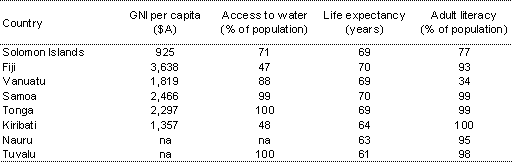
Source: GNI per capita: World Development Indicators, World Bank, 2003; life expectancy for Kiribati, Nauru and Tuvalu: World Health Organisation, 2002; other indicators: Human Development Report, UNDP, 2004.
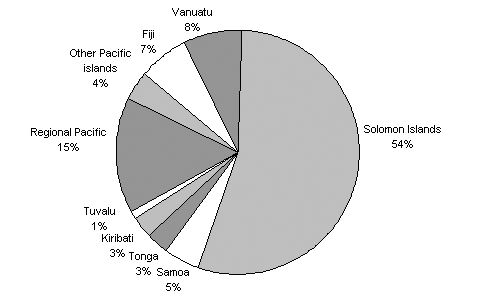
Diagram 8: Estimated Australian ODA to the Pacific by country 2005–06
Regional overview
The development prospects for the Pacific are mixed even though some achievements have been made, such as substantial improvements in life expectancy over the past 15 years. The fragile states of the Pacific are especially vulnerable to developmental decline due to their small size, lack of economic diversity, remoteness from major trade and commercial sectors, and weak governance frameworks. Economic gains have been weak, volatile, and unequally distributed. Weak public expenditure frameworks have affected the quality and distribution of key services and infrastructure. Social instability has hampered growth, particularly in Solomon Islands where civil unrest contributed to a decline of 25 per cent in GDP from 2000 to 2003. Growing populations pose future challenges for sustainable development.
Governance is the key development issue for the Pacific. Poverty is ultimately linked to poor governance, especially weak leadership and corruption. There is an urgent need to address key governance issues including the building of law and order, peace and stability; tackling corruption; and improving fiscal management. HIV/AIDS is a growing concern, especially given the high rate of STD transmission in Pacific countries. Pacific countries are particularly vulnerable to social and economic devastation were an HIV/AIDS epidemic to proceed unchecked.
A new Pacific Regional Aid Strategy 2004–09 provides the framework for Australia’s long-term development goals in the Pacific. The framework focuses on four themes: stronger broad-based growth; more effective, accountable and democratic government; improved law and justice and security; and enhanced service delivery, including effective fiscal management. Under the strategy, Australia will channel an increased proportion of assistance to Melanesia and focus more closely on capacity building and conflict prevention. The strategy will promote and be based on sound analytical analysis of the development situation in the Pacific.
Australia will apply a ‘hands-on’ approach to its aid program in the Pacific. Rather than stand back and let regional neighbours’ problems deteriorate, Australia will work actively to build the region’s capacity to pursue governance reform and work collectively to address shared problems. Links will be strengthened between core Australian agencies and their Pacific counterparts, including through placement of senior Australian government personnel in priority areas of Pacific Island governments.
In 2005–06, the aid program will implement a new Fragile States Initiative, which will bring together development, security, economic and political perspectives from across government into a single, dedicated unit. The initiative will boost Australia’s capacity to engage with fragile states at both strategic and operational levels. It will also provide Australia with an opportunity to play a leading role in shaping international thinking on approaches to fragile states: for example, our experience in Solomon Islands will be used as a pilot for the OECD’s Ten Principles of Good International Engagement in Fragile States. To complement the Fragile States Initiative, Australia will provide $10 million to the World Bank to support work on fragile states in the Pacific.
In line with the recommendations of the 2004 Pacific Islands Forum Review, Australia will place a greater emphasis on regional approaches in aid programming, and play a lead role in building cooperative frameworks with other donors and with regional organisations. Australia will also seek to harmonise its programs with other donors and align with Pacific countries’ own development plans.
A new ‘Pacific Plan’ will be developed by the Pacific Islands Forum during 2005. The plan will create stronger and deeper links between Pacific Island countries, and identify sectors where the region can gain most from sharing governance resources. Australia will work together with regional organisations through the Pacific Plan process to improve the effectiveness and impact of aid activities.
Pacific 2020
A new study, Pacific 2020, will focus on long-term growth options for the developing economies of the Pacific. The study will be a follow-up to the 1994 study of development prospects in the Pacific, Pacific 2010, and will be launched at a regional conference on growth prospects for the Pacific, PNG and East Timor to be held early in 2006.
Pacific 2020 will focus on the issues most critical to achieving sustainable growth and development in the region, and highlight the key actions needed in the short to medium term to give countries of the region the best chance of realising their potential by 2020. Issues will include:
- political governance;
- key productive sectors such as agriculture, fisheries and tourism;
- land property rights issues; and
- HIV/AIDS and demographic issues, including high population growth and the youth bulge.