



Appendix D: Description of the revenue heads
Income taxation
Individuals and other withholding taxation
These revenue heads broadly cover all personal income tax. A schedule of the personal income tax rates for the period covered in this budget is provided in Table D1.
Gross income tax withholding
The bulk of Gross income tax withholding (ITW) revenue arises from the Pay-As-You-Go (PAYG) withholding system, under which taxes are withheld from wage and salary income.
ITW also includes all other withholding taxes levied on natural resource payments, dividends, interest and royalties paid to non-residents, payments to Australian indigenous groups for the use of land for mineral exploration and mining, and amounts withheld because no Tax File Number or Australian Business Number was quoted — these taxes are often withheld from companies, rather than individuals. It also includes applicable Medicare levy revenue.
Gross other individuals
Gross revenue from other individuals consists of income tax paid by individuals other than that collected through the PAYG withholding system, and includes applicable Medicare levy revenue. It comprises:
- PAYG instalments paid directly by individuals — that is, not withheld by employers; and
- debit assessments on income tax returns.
Taxpayers in this category derive their income from many sources, including:
- profits from small unincorporated businesses, primary production and investment activities;
- wages and salaries (when PAYG withholding credits are insufficient to meet the tax liability on assessment); and
- capital gains.
Most revenue from other individuals is collected directly from the taxpayer through the PAYG instalment system. Individuals with annual tax liabilities of $8,000 or more and individuals who are registered for the GST will generally make quarterly payments. Individuals who have annual taxation liabilities of less than $8,000 and are not registered for the GST have the choice of making quarterly payments or an annual payment.
Revenue from other individuals is also collected from debit assessments on income tax returns. These arise when tax credits are insufficient to meet the final tax liability, requiring taxpayers to make an additional payment for the difference.
Income tax refunds for individuals
A final assessment of the income tax liabilities of individual taxpayers is normally made on the basis of returns lodged after the end of each financial year. Refunds from the ATO are made where tax credits to an individual exceed their final liability on assessment.
Medicare levy
The amount of Medicare levy paid is based on an individual's taxable income and is normally calculated at 1.5 per cent of taxable income, but this rate may vary depending on circumstances. An individual may be exempt from the levy or may pay a reduced levy if the taxpayer has a low income. Individuals and families on higher incomes who do not have an appropriate level of private hospital cover may also have to pay the Medicare levy surcharge, which is calculated at an additional 1 per cent of taxable income.
Low income tax offset (LITO)
The low income tax offset provides targeted tax relief to low income earners. The LITO is claimable on assessment and reduces a taxpayer's tax liability.
Table D1: Personal income tax rates(a)
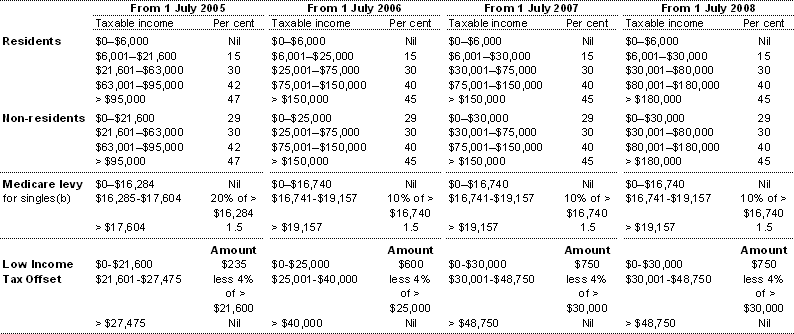
- These standard income tax rates can be offset by a range of concessional arrangements, including the senior Australians tax offset, the spouse tax offset, the low income tax offset and the mature age worker tax offset.
- These standard Medicare levy rates apply to singles. Different concessional and penalty rates apply in certain circumstances.
Fringe benefits tax
Fringe benefits tax is paid on non-salary benefits provided by employers to employees which are provided in place of, or in addition to, the salary and wages of employees.
The tax is payable by employers and is assessed on the value of the fringe benefits provided to employees or their associates. From 1 April 2006, fringe benefits tax has been levied at 46.5 per cent of the grossed-up taxable value of benefits, as calculated under the fringe benefits tax rules.
Following a reclassification in Government Finance Statistics reporting standards that was implemented at the 2006-07 Budget, fringe benefits tax includes revenue collected from employees of Australian Government agencies.
Taxation on superannuation funds
These taxes cover all income taxes generally paid by superannuation funds on behalf of their members on their contributions and earnings. A schedule of the superannuation funds tax rates for the period covered in this budget is provided in Table D2.
Table D2: Superannuation funds tax rates

Superannuation funds taxation
Superannuation funds are taxed generally at a concessional rate of 15 per cent in relation to taxable contributions received, realised capital gains and investment income. Only two-thirds of a capital gain is included in assessable income if the asset is held for at least 12 months.
From 1 July 2007, funds will be taxed at a rate of 46.5 per cent (involving an additional 31.5 per cent for complying funds) with respect to contributions where no tax file number has been quoted to the fund. Funds will be able to claim back the additional tax, as an income tax offset, where a valid tax file number is quoted to the fund within a four year period.
Life insurers and retirement savings account (RSA) providers also conduct superannuation business. Tax on superannuation contributions, realised capital gains and investment income in life insurers and RSA providers is levied at the same rates as applies to superannuation funds but is paid through the company income tax system.
Superannuation surcharge
The superannuation surcharge was abolished with effect from 1 July 2005 and does not apply after the 2004-05 financial year. However, assessments of surcharge and amended assessments continue to be issued in respect of the 2004-05 and earlier financial years. Interest will still accrue on any surcharge debt an individual has incurred.
Company and other related income taxation
These revenue heads broadly cover all income taxes paid by corporate type entities. A schedule of the company income tax rates for the period covered in this budget is provided in Table D3.
Table D3: Company and other related income tax rates

Company income taxation
Company income taxation includes all income taxes paid by companies, including incorporated and unincorporated associations, limited partnerships and some corporate unit trusts and public trading trusts.
Generally, every resident company that derives assessable income (including capital gains), whether sourced within or outside of Australia, and every non-resident company that derives assessable income from Australian sources is required to pay company tax.
Petroleum resource rent tax
Petroleum resource rent tax is levied at a rate of 40 per cent on taxable profit in respect of offshore petroleum projects other than some of the North-West Shelf production areas, which are subject to excise (included in excise on petroleum and other fuel products) and royalties. The amount paid is deductible from a company's taxable income when determining its company tax liability.
Indirect taxation
Excise and customs duty
Excise duty
The major categories of excisable products are petroleum and other fuel products, crude oil, oils and lubricants, tobacco and alcoholic beverages (other than wine). Equivalent duties on identical imported products are imposed through, and reported under, customs duty.
Petroleum and other fuel excise includes excise on petrol (gasoline), diesel, fuel ethanol, biodiesel, aviation gasoline, aviation kerosene, fuel oil, heating oil and kerosene. It is imposed at specific rates per litre of product.
- Petrol includes unleaded petrol and lead replacement petrol (which replaced leaded petrol but is taxed at the unleaded petrol rate).
- All revenue from excise duty on aviation gasoline and aviation kerosene contributes to the funding of aviation activities undertaken by the Civil Aviation Safety Authority. The rates of excise applying to aviation fuels are adjusted, as necessary, depending on the funding requirements of those activities.
Crude oil excise provides a return to the community for the exploitation of its natural resources. The crude oil excise regime applies to:
- production from offshore fields in the North-West Shelf production licence areas that are not subject to petroleum resource rent tax; and
- production from onshore fields and fields in coastal waters.
The rate of excise varies according to the quantity of crude oil sold, the sale price of the crude oil, and the dates of discovery and development of the oil field.
Other excise is derived from beer, spirits, other alcoholic beverages (other than wine) and tobacco products.
- For beer, spirits and other alcoholic beverages, excise is imposed on the alcohol content. The excise rate on beer in containers greater than 48 litres (draught beer) is lower than for other beer.
- Beer for personal consumption (non-commercial beer) brewed in commercial facilities attracts duty at a reduced rate, equivalent to 7 per cent of the applicable beer excise.
- Excise is imposed on a per stick basis for cigarettes that do not exceed 0.8 grams (actual tobacco content) and on a per kilogram basis for other tobacco products.
Wine is not subject to excise, but is subject to the wine equalisation tax.
Excise indexation
The excise rates for petroleum products and oils and lubricants are no longer indexed. Excise indexation for petroleum products was removed in March 2001.
The rates of duty for other excisable products are adjusted every August and February in line with half-yearly consumer price index (CPI) movements (Table D4). If the change in the CPI is negative, the excise rate is not reduced. Instead the decline is carried forward to be set off against the next positive CPI movement.
Table D4: Excise rates
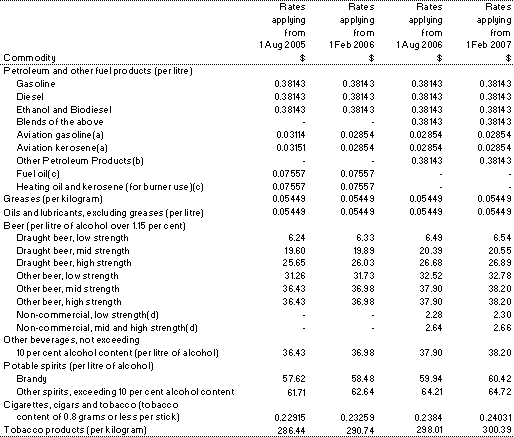
- Aviation fuel rates reduced to $0.02854 per litre with effect from 1 November 2005.
- Excise rates for these fuels increased to $0.38143 on 1 July 2006.
- Excise rates for these fuels increased to $0.38143 on 1 July 2006, and have been subsequently identified as components of other petroleum products.
- As of 1 July 2006, non-commercial beer was explicitly identified in the Excise Tariff Amendment (Fuel Tax Reform and Other Measures) Act 2006, with introductory rates of $2.22 per litre for low strength beer and $2.58 per litre for mid and high strength beer before the rate was indexed on 1 August 2006.
Customs duty
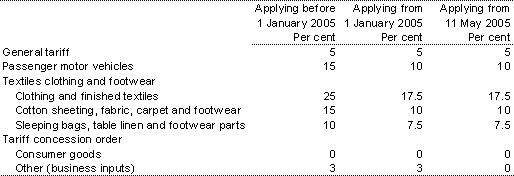
Customs duty is imposed as a percentage of the value of the imported good and/or on a volumetric basis (where duty is applied per unit of quantity) for excise equivalent products. In general, other dutiable goods attract a general tariff rate of 5 per cent.
Tariffs on passenger motor vehicles and textile, clothing and footwear account for around one-third of the total duty collected. Approximately 40 per cent of customs duty revenue is derived from duty imposed on imports of petroleum products, tobacco, beer and spirits, which is akin to excise duty on these items.
Table D5: Tariff rates
Other taxation
Wine equalisation tax
All wines, meads, perries, ciders and sakes are subject to a wine equalisation tax (WET) of 29 per cent on the wholesale value of the goods. The tax was introduced as part of The New Tax System to offset the removal of the previous wholesale sales tax on wine and the application of the goods and services tax. The WET was set at a rate to ensure that the price of cask wine need only increase by the estimated general price rise.
Unlike alcohol excises, the wine equalisation tax is an ad valorem tax. It is calculated at a rate of 29 per cent of the final wholesale price or, in certain other permitted circumstances, of a nominal wholesale value calculated as 50 per cent of the retail price, or alternatively at the average wholesale price for identical wine.
From 1 October 2004, a rebate has been payable on the first $290,000 in wine equalisation tax paid annually by any producer or producer group. This rebate increased to $500,000 from 1 July 2006.
Luxury car tax
The luxury car tax was introduced as part of The New Tax System to maintain a tax differentiation between luxury vehicles and other vehicles sold in Australia.
The luxury car tax applies at a rate of 25 per cent for every dollar over the luxury car threshold. The current luxury car threshold is $57,009. The threshold is indexed annually using the motor vehicle purchase component of the CPI, which is composed of observed price movements for new vehicles sold in Australia.
Agricultural levies
Agricultural levies and charges are used to fund industry activities, such as research and development, marketing and promotion, residue testing, and animal health programmes.
The need for a levy is usually identified by the industry itself and the levy is generally collected at the first point of sale of the primary produce or point of further processing.
All levies and charges are paid into the Consolidated Revenue Fund without deduction and then disbursed to fund the relevant programme.
Other taxes
The major contributors to this category are the passenger movement charge and import processing and depot charges administered by the Australian Customs Service.
Other contributors include broadcasting licence fees, which are payable by all commercial radio and television licensees and are calculated as a percentage of licensees' gross earning for the previous year. Other taxes also include the Superannuation Guarantee Charge and the Universal Service Obligation levy.
Non-taxation revenue
Sales of goods and services
This category consists of revenue from the direct provision of goods and services by the Australian Government general government sector, including reimbursement of GST administration costs received from the states.
Dividends
The main sources of dividends are the Australian Government's business enterprises, the Reserve Bank of Australia (RBA) and the Future Fund. Dividend payments from the RBA can be volatile, as they are sensitive to movements in interest rates and the exchange rate.
Interest
Interest from other governments
This category mainly consists of revenue from the States for interest on General Purpose and Specific Purpose borrowings.
The Australian Government receives interest payments from the States in respect of General Purpose borrowings made on behalf of the States under the State Governments' Loan Council Programme (and from the Northern Territory in respect of advances made under similar General Purpose capital assistance arrangements). Payments relating to these advances are made, in turn, by the Australian Government to bond holders.
Interest from the States on General Purpose borrowings is declining as a result of the June 1990 Loan Council decision that the States and Territories make additional payments to the Australian Government each year to facilitate the redemption of all maturing Australian Government securities issued on their behalf. The reduction in interest revenue from the States is matched by a reduction in public debt interest expenses.
The Australian Government also receives interest on Specific Purpose borrowings to the States, including on advances made under the Commonwealth-State Housing Agreements, States (Works and Housing) Assistance Acts, Northern Territory Housing Advances, and by the Australian Capital Territory on debts assumed upon self‑government.
Interest from other sources
This item includes interest income on Australian Government cash balances and on other financial assets including assets held by the Future Fund. It excludes swap transactions entered into as part of the Australian Government's debt management strategy, as they are reported separately in the Statement of Other Economic Flows under Government Finance Statistics standards. The Australian Office of Financial Management is responsible for the management and reporting of the Australian Government's net debt portfolio.
Other sources of non-taxation revenue
Other non-taxation revenue includes petroleum royalties paid by producers operating in the Timor Sea and the North-West Shelf oil and gas fields, Child Support Trust Revenue (collected by the Child Support Agency) and seigniorage from circulation coin production.