



Appendix E: Taxation revenue recognition
There are different methods of accounting for taxation revenue. Each method of revenue recognition results in estimates and outcomes that may be significantly different to those produced using other methods.
Accrual accounting was introduced by the Australian Government for the 1999-2000 Budget. Before then, all estimates and outcomes were reported only on a cash basis. Cash recognition still plays a role in budgeting and outcomes reporting, with both accrual and cash taxation revenue estimates and outcomes reported in the budget papers. Furthermore, there are also different methods for recognising accrual revenue.
This appendix provides an explanation of the different revenue recognition methods that apply to the various taxation revenue heads.
Revenue recognition methods
Cash recognition
Under cash recognition, which is also referred to as receipts recognition, taxation receipts are accounted for at the time a taxation payment is received by the relevant authority. The receipt may be a different amount than the taxation liability and result in a subsequent amended (refund or debit) assessment. The payment may also be received in a different period from which the taxation liability relates.
Cash recognition is an integral part of an accrual accounting framework because of its use in the cash flow statement and to provide additional information about the structure of taxation. Cash data are also available over a much longer period — accrual data are only available since 1999-2000 — and are therefore often used for time series analysis.
Accrual revenue recognition
The AAS and GFS standards for accrual accounting (refer to Appendix A in Statement 2 for an explanation of these reporting standards) require that taxation revenue be recognised in the reporting period in which the underlying economic transaction occurs, such as when the taxpayer earns the income that is subsequently subject to taxation. This is known as the Economic Transactions Method (ETM). However, the standards permit reporting using an alternative approach when there is an inability to reliably measure taxation revenues using the ETM approach.
Currently, ETM revenue has been determined not to be a reliable measure for several significant revenue heads — individuals and other withholding taxation, company income taxation and superannuation taxation. These revenue heads, which collectively account for the majority of total revenue, are recognised using the Taxation Liability Method (TLM) rather than ETM.
Under TLM, taxation revenue is accounted for at the time a taxpayer makes a payment or self assessment or when an assessment of a taxation liability is raised by the relevant authority. This method retains some elements of cash revenue recognition — for example, revenue is recognised when cash payment occurs prior to an assessment being raised.
The point of revenue recognition under ETM and TLM can sometimes be in different periods — for example, a taxation return lodged in October 2005 for the 2004-05 income year, and which results in a new taxation liability or a refund, would be recognised in the 2004-05 financial year under ETM and in the 2005-06 financial year for TLM. In this case, ETM requires that outcomes for 2004-05 include an estimation of liabilities or revenue relating to activities in 2004-05 that are likely to be identified in subsequent periods. TLM outcomes do not incorporate this estimation, as only currently identified taxation liabilities are reported. Consequently, aggregate TLM revenue outcomes are usually known with relative certainty, although there can be estimation issues involved in allocating aggregate amounts between different heads of revenue.
In addition, AAS and GFS treat prior period adjustments for revised estimates to ETM revenue outcomes differently. GFS requires that a time series of outcomes is maintained, such that prior year outcomes are continually adjusted as new information comes to light. This is consistent with the AAS treatment of changes in accounting policy or correction of errors which are recast in prior periods. In contrast, AAS requires that prior period adjustments as a result of revised estimates are not back-cast, and instead are reflected in the current period results. This difference in treatment reflects the different purpose in each of the standards:
- GFS ETM data may be more accurate over the long term, and may therefore be better for economic analysis, but have the disadvantage of constantly being revised; whereas
- AAS ETM outcomes are finalised at the end of each financial year (although, as noted above, changes in accounting policy and corrections of errors are recast in prior periods), and this greater level of certainty may be better for budgeting and reporting.
History of accrual revenue recognition
From 1999-2000 to 2005-06, all accrual taxation revenue has been recognised in the Budget on a TLM basis. From the 2006-07 Budget, ETM revenue recognition has been adopted for all revenue heads where the ETM revenue can be reliably estimated. This generally occurs where the economic activity, the identification of the liability and the receipt of the payment all occur with little or no lag — and consequently, the ETM and TLM (and cash) recognition methods produce relatively consistent results.
TLM revenue recognition continues to be used where ETM estimates are considered unreliable. At present, this is limited to individuals and other withholding taxation, company income taxation and superannuation taxation, but this will be reviewed periodically. ETM estimates and outcomes are inherently more volatile for these revenue heads, mainly because they incorporate the estimation of significant levels of liabilities likely to be identified in future periods. This additional level of estimation would increase the likelihood of differences between the revenue estimates and outcomes, with consequential impacts on the budget balances. This greater level of uncertainty would make the implementation of fiscal policy more problematic than if these revenue heads continue to be recognised using TLM.
Differences between the accrual and cash taxation revenue estimates
Table E1: Estimates of taxation revenue on an accrual and cash basis
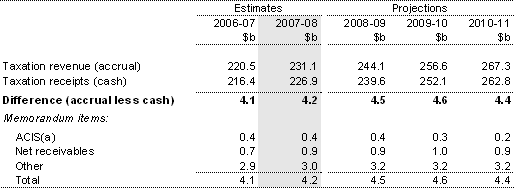
- Automotive Competitiveness and Investment Scheme.
Automotive Competitiveness and Investment Scheme
The Automotive Competitiveness and Investment Scheme (ACIS) operates by providing customs duty credits to exporters of Australian automotive products. The credits can be offset against future customs duty on specific imports.
Under accrual accounting, an expense is recognised when the ACIS credits are issued. Later, specified imports generate a customs duty liability and customs duty accrual revenue is recognised. However, no customs duty receipts are received as the redemption of the ACIS credits offsets the customs duty liability. Therefore, the redemption of the credits results in an increase in the difference between the accrual and cash estimates for customs duty. ACIS credits account for $400 million of the difference between the accrual and cash estimates in 2006-07.
Other
This category consists of other timing differences between the recognition of accrual revenue and cash receipts as well as instances where revenue has been recognised but payment is no longer expected to be received. For example:
- receivables arise where taxation liabilities are recognised in one period, but the taxpayer is not expected to pay the liability until a later period;
- remissions occur where taxation liabilities are recognised, but circumstances are taken into account and the Commissioner of Taxation reduces the amount of various penalties and interest required to be paid;
- a taxation liability may be written-off where the previously recognised revenue is no longer expected to be received;
- a credit amendment may be issued where a taxation assessment is amended (for example, where a court decision leads to a change in the interpretation of the taxation laws); and
- an economic transactions method adjustment for those revenue heads on an ETM basis, when the economic activity giving rise to a taxation liability takes place in one financial year and the payment is received in a subsequent financial year.