



Appendix F: Net tax thresholds
The impact of taxes on Australian households should be assessed alongside the level of assistance going to families from the government, either as offsets to tax or through direct payments.
Since 1996, the Government has substantially increased the level of Family Allowance and Family Tax Benefit provided to families (from around 1.3 per cent of GDP to 1.6 per cent of GDP in 2006-07). In particular, the Government has increased the real disposable income of families through the introduction of measures such as the Family Tax Benefit and the Baby Bonus.
One way of illustrating the combined effect of cash transfers and tax for families is by showing the change in the real net tax threshold. The net tax threshold is the point at which taxes paid begin to exceed cash transfers received. Table F1 shows that the net tax threshold will have increased by more than 39 per cent in real terms between 1996-97 and 2007-08 for a range of families.
Table F1: Increases in real net tax thresholds for families, (a) 1996-97 to 2007-08
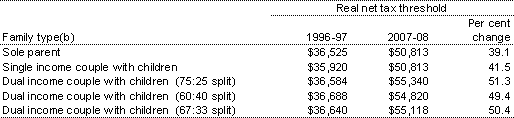
- The net tax threshold is the level of private income at which income tax paid first exceeds cash benefits received. Dollar amounts are calculated in 2007-08 prices.
- Families are assumed to have two children — one aged 3 years and the other aged 8 years. The numbers in brackets represent the share of wages of each working adult in couple families.