



Strengthening aid effectiveness
The increase in overseas aid to about $4 billion by 2010 is subject to the continued effective application of resources as well as improved governance and reduced corruption in partner countries. Increased aid effectiveness is being pursued through four interlinked strategies: combating corruption, strengthening the performance orientation of the aid program, enhancing Australian engagement with the region, and working with partners.
Combating corruption
Context
Corruption damages development prospects in many countries, undermining the efficient allocation of resources and impacting on economic growth, income equality and poverty reduction. Corruption also lowers private investment, can lead to unsustainable exploitation of natural resources, and undermines effective aid delivery. Research conducted by the World Bank Institute identified a '400 per cent governance dividend', concluding that countries that tackle corruption and improve the rule of law can increase their national incomes by as much as four times in the long term.
Response
Australia's goal to increase overseas aid is conditional on strengthened governance and reduced corruption in partner countries. Australia has consistently sought to help partner governments strengthen governance and reduce corruption, already providing substantial assistance to support improved governance.
A new policy Tackling corruption for growth and development2 was released in March 2007. The policy is the result of consultation and collaboration across the Australian Government. To implement more effective anti‑corruption activities, the policy brings together assistance programs of different departments and agencies under a single strategic framework for planning, implementing and reviewing Australian support.
The aid program will work more closely with partner countries to help them strengthen their own anti-corruption responses and to better monitor their performance. By continuing to place Australian government officials in public service positions and senior advisory roles, Australia will build capacity and develop long-term institutional partnerships with partner governments.
Anti-corruption will be a key consideration when developing new country strategies and designing and implementing aid activities. Country strategies will be updated to include country-specific anti-corruption plans, taking into account existing anti-corruption policies, donor and local initiatives already underway, and each country's overall needs and priorities. An Anti-Corruption for Development initiative outlined in Box 8 will support the expansion of Australian support for anti-corruption.
In Indonesia, new support in 2007-08 will focus on the procurement systems of counterpart agencies involved in roads improvement programs financed through the Australia-Indonesia Partnership for Reconstruction and Development. Assistance will also be expanded to Indonesia's parliamentary institutions. Audit activities in Papua New Guinea and the Philippines will work with partner government agencies to reduce opportunities for corruption. In Solomon Islands, assistance for corruption investigations will complement existing RAMSI law and justice activities. In East Timor, assistance will include strengthening audit and oversight institutions.
Global programs will include support for implementation of the Extractive Industries Transparency Initiative (EITI), implementation of the United Nations Convention Against Corruption (UNCAC), and further research and collaboration with international financial institution partners on corruption-related diagnostic and analytical work.
Strengthening the performance orientation of the aid program
The performance orientation of the aid program is being strengthened by improvements to program performance management led by the Office of Development Effectiveness (ODE) and AusAID's newly-created Operations Policy and Management Unit. Enhancements of business processes include integration of quality standards and reporting, updating country and regional strategies, and incorporating performance principles into the design and management of aid activities.
Performance assessment
The Australian Government established the Office of Development Effectiveness in March 2006 to monitor the quality and evaluate the impact of the Australian aid program. Its high-level staff include an expert on performance recruited from the UK National Audit Office, and an official on secondment from the Australian Federal Police. It is guided by a Development Effectiveness Steering Committee, chaired by AusAID's Director General and also comprising deputy secretaries from the departments of Prime Minister and Cabinet, Foreign Affairs and Trade, Treasury, and Finance and Administration.
A new performance assessment framework (PAF) will be operational from July 2007 centred on three questions:
- What results has the program achieved?
- How well is the program being managed and delivered?
- Is the program on track to meet White Paper priorities?
This new approach is providing more rigorous and comprehensive management information on the performance of the aid program. Augmenting the work of the PAF is a new quality reporting system that will provide consistent quality assurance and management reporting for aid activities. The new system includes new tools to monitor quality at entry, implementation and completion. Implementation of the quality reporting system is being led by the Operations Policy and Management Unit.
This quality and performance information is reported through Annual Program Performance Updates covering country and regional programs, and annual State of the Sector reports, summarising aid program performance in key sectoral areas such as health, education and economic governance.
This new approach to monitoring performance is designed not only to improve accountability but to strengthen management of the aid program. A key component of the new Annual Program Performance Updates will be an assessment of whether and how existing strategies and approaches need to change.
The ODE's work program also includes a series of thematic evaluations led by international experts, including in 2007-08 evaluations of HIV/AIDS support in PNG, and of assistance on anti-corruption.
The Annual Review of Development Effectiveness is the central element of the enhanced performance assessment approach. Information from the new performance framework and the evaluation program feed into the ARDE, the first of which is scheduled for completion by late 2007. This will ultimately cover the experiences of all Australian agencies delivering ODA. The ARDE will be integrated into the Government's budget cycle and will provide a practical link between aid allocations and aid effectiveness.
Revising country and regional strategies
AusAID has established a three-year program to revise all country and regional strategies. Country strategies provide the overall policy and implementation framework for Australia's aid program for each partner country. They translate the White Paper's overall guiding themes and strategies into programs tailored to individual country circumstances and priorities. Country strategies are developed and agreed jointly with partner governments. Revisions will ensure that strategies are consistent with the White Paper and encompass all relevant Australian Government aid effort in each country. Revised strategies will be required to have a rigorous performance framework that provides a better basis for assessing the impact of aid efforts. A new strategy for Australian aid to the Philippines is currently being developed and major strategies for Indonesia, East Timor and Papua New Guinea will follow during 2007-08. All major new country strategies will take account of the findings of ODE reviews of the past performance of Australian aid in the country in question.
Enhancing Australia's engagement with the Asia-Pacific region
Non-government organisation, volunteer and community programs
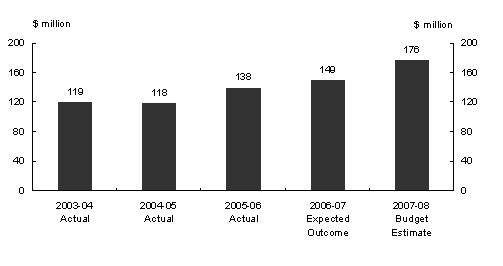
Non-government organisations (NGOs), volunteer and community programs are valuable components of Australian aid. NGOs provide specialist skills, respected networks and strong links to communities. The aid program will continue to support the work of the NGO community, supporting activities that are aligned with the focus and priorities of the White Paper and Australia's various country strategies. Overall aid program funding through NGOs and Volunteers is expected to rise by 15 per cent in real terms over the 2006-07 expected outcome to an estimated $176 million in 2007-08. The area of largest increase in funding is the AusAID-NGO Cooperation Program (ANCP), up from 0$27.4 million in 2006-07 to $37.5 million in 2007-08 (see Table 13 on page 58). Diagram 6 shows recent trends in total volunteer and NGO expenditure.
Diagram 6: Total volunteer and non-government organisation expenditure
Examples of cooperation with NGOs include the PNG Church Partnership Program and sector-specific cooperation agreements with NGOs in areas such HIV/AIDS. NGO engagement will continue to be subject to a rigorous accreditation process. In addition, six pre-qualified NGOs can access the Humanitarian Partnership Framework Agreements for emergency response activities.
People-to-people links are further supported through an expanded Australian Volunteer Program that is aligned with aid program priorities and linked with country programs. In 2007-08, the Australian Youth Ambassadors for Development program will continue to place young Australian volunteers aged 18-30 on short-term assignments in developing countries throughout Asia and the Pacific.
Business
The role of business in creating economic growth is clearly fundamental. However, business also has a role in addressing development challenges. An important example is the contribution that business can play in the fight against HIV/AIDS. The Australian Government has worked with the corporate sector to establish the Asia-Pacific Business Coalition on HIV/AIDS. Broadening the aid program's interaction with business to address development issues will be an important task in 2007-08.
Research
The Australian aid program is strengthening its analytical foundation by increasing and diversifying its investment in development research. In 2007, AusAID will finalise a new research strategy that will outline AusAID's research objectives and principles and a new performance framework for research.
AusAID's development research program will design a competitive program to provide support for priority and high quality proposals put forward by research institutions. A pilot grant funding round open to both domestic and international research organisations will be launched in mid-2007.
AusAID's research priority areas will reflect White Paper objectives. In 2007-08, research priorities will include new approaches to health and education; measuring the costs of transnational challenges such as HIV/AIDS; new ways of working with fragile states; increasing demand for better governance and promoting anti-corruption; understanding development dimensions of political stability and security; examining humanitarian and emergency responses; and promoting and sustaining economic growth in the Asia-Pacific region.
Working with partners
Australia will continue to strengthen its engagement with key partners over 2007-08. Partnerships are essential for an effective aid program. Partnering with a range of agencies enables increased access to expertise and financial resources, improving the efficiency and effectiveness of Australia's assistance.
Australia supports the principles of the 2005 Paris Declaration on Aid Effectiveness. These reaffirm partner country ownership over the development process and promote harmonisation and coherence among donors. Internationally and domestically, Australia is pursuing stronger partnerships with developing country governments, bilateral donors, and multilateral and international organisations.
A fundamental tenet of Australia's aid program is that assistance is jointly agreed and implemented with developing country partners. As highlighted on page 33, a number of country strategies will be revised over 2007‑08. These revisions will align Australian assistance with partner government priorities and be agreed jointly with partner governments.
Partnering with other bilateral donors supports the implementation of the Paris Declaration by reducing the burden of aid coordination for partner governments, as well as enabling effective and value for money assistance. For example, over the coming year Australia will strengthen existing partnerships with the United Kingdom's development cooperation agency (DFID), UNICEF and the German development agency (GTZ) in the field of maternal and child health in eastern Indonesia. In South Asia, Australian cooperation with DFID will continue and be expanded in 2007-08. DFID will be a key partner in delivering significantly expanded support through the Delivering Better Health and Delivering Better Education initiatives (Boxes 6 and 7). Cooperation with DFID will continue in Nepal on water and sanitation, and on promoting peace and electoral processes.
In 2007-08, Australia will continue to partner in the Pacific with New Zealand's development cooperation agency (NZAID). Support to Samoa will be provided in line with a joint strategy, focusing on improving opportunities for employment and investment as well as improving service delivery. A new harmonised program will commence in the Cook Islands in 2007-08, following a successful pilot phase of the arrangement.
Partnering with effective multilateral organisations is crucial to deliver on the priorities outlined in the White Paper. Effective partnerships with the multilateral development banks will enable Australia to leverage the banks' considerable technical and financial resources to focus on issues of core interest to Australia. Through partnerships with effective multilateral organisations, Australia is able to extend the reach of its aid program and participate in projects on a scale and scope beyond that achievable bilaterally.
Collaboration with the multilateral development banks will be important in implementing new budget initiatives for 2007-08, in particular the Infrastructure for Growth initiative. Australia is encouraging greater engagement from the multilateral development banks in the Pacific region, including through a Pacific Facility trust fund established with the World Bank. A joint cooperation agenda with the World Bank and Asian Development Bank will also be advanced in 2007-08 to promote further collaboration and harmonisation between the three agencies. The transport sector in Papua New Guinea is a particular example where senior managers, across the three agencies, are working together to improve collective efforts.
Negotiations regarding the next (15th) replenishment contributions to the International Development Association (IDA — the concessional lending arm of the World Bank Group) are expected to be finalised by December 2007. Australia is acting to ensure resources continue to be available for a strong concessional lending program through IDA. This Budget enables early discharge of Australia's remaining commitments to the 13th IDA replenishment of approximately $120 million, of which some $80 million will be brought forward from future year commitments.
Partnerships with multilateral and international organisations, including UN agencies, will also provide effective mechanisms for contributing to global humanitarian and development challenges while also advancing White Paper priorities. In particular, Australia's strategic engagement with the Global Fund to Fight Aids, Tuberculosis and Malaria is focused on maximising its impact in the Asia-Pacific region and will be strengthened by a further commitment of up to $45 million in 2007.
Overarching principles
Along with working in partnership with regional governments, the White Paper identified promoting gender equality and untying Australian aid as overarching principles that reinforce the strategic framework within which Australia's aid is delivered.
Promoting gender equality
Gender equality is integral to achieving growth, governance and stability. As well as integrating gender equality across the aid program, specific initiatives to promote equality and empower women will also be scaled up from 2007-08. A new gender policy, Gender equality in Australia's aid program — why and how3, launched in March 2007 outlines how Australia will support partner countries to achieve greater gender equality over the next 10 years, building on the White Paper's placement of gender equality front and centre in the effort to reduce poverty and increase the effectiveness of aid. Programs in 2007-08 will reflect the implementation of this policy. The key priority is to integrate gender equality into country and regional strategies.
Over the next five years, there will be concerted efforts to improve the economic status of women. This will include increasing women's access to and control of productive resources such as financial and business support services, training and technology.
Women remain under-represented in public office. In the Pacific in particular, women hold on average just 3 per cent of seats in national parliaments and an average of 19 per cent in East Asia. The Better Governance and Leadership initiative outlined at Box 4 on page 15 has a particular focus on the role of women in governance. Australia anticipates that implementing this initiative will, over time, lead to an increase in the number of women contesting parliamentary seats and an increase in the proportion of senior public service positions held by women. The Delivering Better Health initiative outlined at Box 6 on page 20 has a considerable focus on maternal and child health. Goals include helping partner countries to reduce the maternal mortality ratio by two thirds through improving access to basic health services and increasing the proportion of births attended by skilled personnel.
When it comes to educational opportunity, women in the developing world are particularly disadvantaged. They make up two-thirds of the 800 million people in the world who lack basic literacy skills. Through the new Delivering Better Education initiative outlined at Box 7 on page 25 and ongoing programs, Australia will continue in 2007-08 to assist education systems that reduce gender disparities in primary and secondary education, support programs promoting equal access to vocational and technical education, and provide scholarships so that women can increase their opportunities to work and earn an income.
Untying Australian aid
The Australian aid program was officially untied in April 2006 to coincide with the launch of the White Paper. Untying aid is the process of opening up bidding for implementation of development activities to firms from any country, beyond just Australia and New Zealand. The impact of untying continues to gather momentum with an increasing number of international firms competing for AusAID contracts either in their own right or in conjunction with Australian development contractors. Since the decision to untie, two major contracts have been awarded to European-based firms and a number of sub-contracts won by firms from developing countries, expanding the pool of expertise that Australia can access and enhancing value for money outcomes.
Agency reform
A program of corporate reform is being undertaken to deliver on the White Paper agenda. A blueprint, known as AusAID 2010, has been developed which outlines how AusAID plans to deliver a significantly increased aid program and implement the White Paper effectively. Increased departmental resources for AusAID through the 2007-08 Budget will assist this change process.
In line with the 2010 blueprint, AusAID is developing a larger, more comprehensive overseas presence. Overseas offices are taking on increasing responsibilities for program design, implementation and management, dialogue with partner governments and local communities, and the measurement of aid performance. New ways of delivering aid, including programs delivered directly by partner governments, require a greater level of engagement and high‑level dialogue in-country. To assist this work, AusAID is increasing the level and range of technical expertise it can draw on in Australia and overseas.
2 See www.ausaid.gov.au/publications/pdf/anticorruption.pdf
3 See www.ausaid.gov.au/publications/pdf/gender_policy.pdf