




Achieving better outcomes in infrastructure
The physical infrastructure of the economy is an important component of Australia's productive capacity. The above framework can be applied to infrastructure in a way that ensures infrastructure funding and provision respond appropriately to changes in demand, albeit with substantial challenges given the characteristics of infrastructure.
Trends and emerging challenges in infrastructure
While there is no definitive summary measure of infrastructure adequacy, a range of data, including historical trends, international comparisons, and survey based information, can be used as possible pointers to the adequacy of Australia's infrastructure stock and investment performance over time.
Total investment in economic infrastructure, comprising both public and private investment, has increased as a share of GDP over the past 20 years, from around 2.2 per cent of GDP in 1988 to around 3.2 per cent in 2007.6 It is important to recognise that this measure does not, in itself, directly measure costs and benefits or rates of return and therefore does not provide conclusive evidence about the adequacy of infrastructure. The contribution of private investment in economic infrastructure has increased strongly in recent decades to now account for around half of total infrastructure investment. This change in composition can, in part, be attributed to competition based reforms which have resulted in the privatisation of government owned businesses.
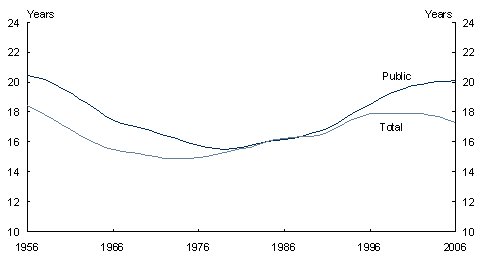
As physical infrastructure tends to have a long economic life, the flow of investment is unlikely to be a reliable indicator of infrastructure adequacy. The average age of Australia's public sector infrastructure has generally been rising since the 1970s (Chart 1), providing some support for the view that we are approaching, or past, the point where much of the large amount of public infrastructure put in place in the 1950s and 1960s will need to be renewed or replaced.7
Chart 1: Average age of infrastructure
Source: Coombs and Roberts (2007).
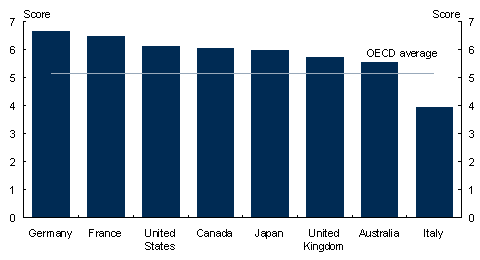
The different mix in public and private ownership of infrastructure between countries makes direct international comparisons difficult with respect to trends in infrastructure investment. However, a survey of a wide range of countries indicates that while Australia is slightly above the OECD average in terms of the perceived ability of infrastructure to support economic activity (Chart 2), it is below the average of leading advanced economies (World Economic Forum 2007).
Chart 2: Index of the ability of infrastructure to support
economic activity
Source: World Economic Forum (2007). Countries included comprise Australia and the G7.
Emerging challenges: Infrastructure bottlenecks and the terms of trade boom
The Australian economy has recently been operating closer to full capacity than it has been for many years. A number of studies have examined the question of whether constraints such as infrastructure bottlenecks and congestion are likely to impact on the productive capacity of the Australian economy as a whole and in particular industries and sectors.
The Business Council of Australia (BCA 2005, 2007), for example, highlighted concerns about infrastructure bottlenecks in a range of areas, including bulk and container ports, intermodal transport hubs, rail freight networks, urban roads, urban and agricultural water supply, and electricity networks. In 2005, the Export and Infrastructure Taskforce (the Fisher Taskforce), reported that there seemed to be export infrastructure constraints in some areas which had emerged in the context of the sharp increase in world demand for Australia's resource commodities. Although the Taskforce noted that these constraints were localised in nature, it also suggested that without policy action, significant additional bottlenecks in key areas could occur in the next 5 to 10 years (Fisher et al. 2005).8
These concerns reflect a view among commentators that the economy's physical infrastructure has not responded quickly enough to the shift in demand for our commodity exports reflected by the new highs in the terms of trade. Edwards (2007, p. 37), for example, noted that:
The lesson of the new decade is that failures of supply can be as damaging as failures of demand. … Policies that influence supply … include the removal of infrastructure bottlenecks, the provision of additional infrastructure to meet expected demand, programs in education, and training and retraining that increase the supply of skilled workers.
Concerns over Australia's infrastructure constraints and export performance in recent years were key factors in the Government's announcement in February 2008 of a review into Australia's export policies and programs, to be chaired by Mr David Mortimer AO. (Transport infrastructure bottlenecks are discussed in Box 1.)
Policies to improve the efficiency of infrastructure development and use
Effective policies to address identified capacity constraints or infrastructure bottlenecks should encompass both efficient investment by the private and public sectors and efficient utilisation of existing capacity. The long lead times and illiquid nature of much infrastructure investment highlight the importance of governments providing certainty around policy frameworks.
While Australia has made substantial progress in reforming its infrastructure markets, most notably through the adoption of National Competition Policy (NCP) in 1995, a range of impediments to the operation of efficient and competitive infrastructure markets remain (PC 2006). These impediments inhibit timely and efficient infrastructure development and use and highlight the need to adopt further measures that facilitate the efficient allocation of scarce resources and minimise waste. Such measures range from pricing and regulatory reforms that encourage private sector participation and promote efficient and competitive outcomes, through to the development of methodologies for improving the efficiency and transparency of individual investment decisions.
Price signals
Effective price signals in infrastructure provide investors and governments with an important guide as to where further investment is required. They are also an important mechanism for improving the efficiency of infrastructure use. The Australian Government is pursuing a range of policy initiatives in this area.
In transport, the Australian Government is working with its State and Territory counterparts through the Council of Australian Governments (COAG) to implement key pricing reforms in freight infrastructure, including the recent agreement amongst the nation's transport ministers to introduce a more efficient heavy vehicle pricing regime.
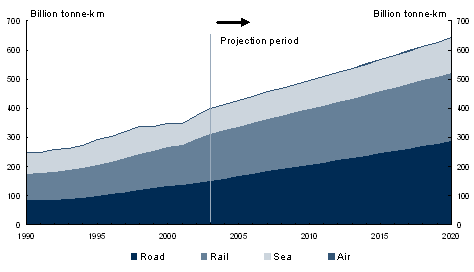
The new heavy vehicle pricing arrangements mark a first significant step in a program of road pricing reforms that seek to improve the efficiency and productivity of the transport sector. Under the regime, the cost of provision of the road network attributable to the heavy vehicle industry will be fully recovered to ensure all heavy vehicles pay their fair share of road infrastructure costs, including construction and maintenance. The new road pricing arrangements are being phased in over time to enable the trucking industry to make necessary adjustments and help mitigate any short‑term inflationary pressure associated with the reforms. The broader adoption of efficient pricing signals in the transport sector would be expected to significantly reduce urban congestion (see Box 1).
Reforms to the national electricity market have enabled the creation of a spot market with prices set every half hour according to supply and demand. These prices provide signals to the market regarding new investment in generation, whether through base‑load capacity for reliable and continuous supplies or peak capacity which can respond at short notice to high levels of demand. Further improvements could flow from improved market signals for transmission investment and from retail price signals that better reflect the costs of electricity generation at peak times.
There is also scope for pricing reform in water infrastructure. Australia is the world's driest inhabited continent and the recent drought has placed significant pressure on Australia's urban and rural water supplies due to nearly a decade of below average rainfall. Water restrictions have been introduced in most urban centres and water allocations to irrigators have been cut dramatically.
Water supply involves three basic phases; storage in dams and reservoirs, delivery via pipes and pumping stations and the removal of wastewater. Well functioning markets in water would fully account for both its scarcity value and the costs incurred in each phase, through price signals to guide investments in additional supply capacity and the use of existing capacity.
The National Water Initiative (NWI) includes a range of measures to promote well‑functioning water markets. To date there have been some gains in rural water reform under the NWI, but progress has been slow, and COAG has recently agreed to accelerate and broaden the water reform agenda.
Optimal government decision making
Where the social return from infrastructure investment is high but the direct financial return is insufficient to generate private‑sector involvement, and improving price signals is not possible or practical, there can be a role for government in infrastructure provision.9 This can be done through direct investment by government or in partnership with industry (for example, through public‑private partnerships). Where governments invest in infrastructure assets, it is essential that they seek to achieve maximum economic and social benefits, determined through rigorous cost‑benefit analysis including ex post evaluation and review.
The Government will establish three funds to invest in Australia's productive capacity — the Building Australia Fund (BAF), the Education Investment Fund (EIF) and the Health and Hospitals Fund (HHF). The Government will provide an initial allocation in the order of $40 billion, largely from the 2007‑08 and 2008‑09 surpluses, for future capital investment in transport and communications infrastructure, education and health. Both the capital and earnings of the funds may be drawn down over time after specific infrastructure projects have been identified. This arrangement ensures substantial funding is available for capital investment in infrastructure over the next few years. All spending from the funds will be subject to rigorous evaluation criteria. The Government will make further contributions from future surpluses as appropriate.
To improve processes around the assessment of infrastructure investment decisions, the Australian Government established Infrastructure Australia (IA) to advise governments on nationally significant infrastructure. IA's advice will be based on rigorous analysis of the costs and benefits of various infrastructure proposals. IA will identify strategic investment priorities and policy and regulatory reforms to facilitate timely and coordinated delivery of infrastructure investments of national importance between all levels of government and industry. IA's immediate priority is to complete a National Infrastructure Audit by the end of 2008, and develop an Infrastructure Priority List for COAG consideration in March 2009. It is also to develop best practice guidelines for Public Private Partnerships for COAG consideration by October 2008.
The Government is planning infrastructure feasibility studies with the States on high‑priority projects, at a cost of $75 million in 2007‑08. These feasibility studies will feed into the National Infrastructure Audit to be completed by IA.
Another key challenge is to ensure that infrastructure investment decision making takes into account the impact of the broader macroeconomic environment on infrastructure development. When the economy is at full capacity this would reduce expected social rates of return on investments, pointing to the need for rigorous prioritisation.
A range of measures introduced by Australian governments are supporting the coordinated development of infrastructure capacity and its efficient use.
In the area of transport, COAG has agreed that governments adopt national guidelines to support improved, and nationally consistent, approaches to strategic planning and appraisal of transport initiatives and, as part of a series of road and rail reforms, commit to examining alternative institutional arrangements for better linking road‑freight revenues to investment and enhancing decision‑making.
COAG has also agreed to a staged approach for the roll out of electricity smart meters. Smart meters will allow consumers to monitor their energy usage in real time. The roll out of smart meters is an important reform because it will help consumers to better manage their energy use and greenhouse gas emissions. Smart meters will also allow for possible future reforms such as the introduction of time of day pricing. Time of day pricing would improve the efficiency of energy usage and assist with reducing the volatility in demand for electricity.
Climate change and the responses to address climate change will have impacts across most areas of infrastructure. Actions being developed through COAG under the National Adaptation Framework will help policymakers factor climate change considerations into decisions regarding long‑lived investments such as infrastructure.
To address water shortages, governments have recently commenced significant new water infrastructure investment (particularly in urban areas), including desalination plants and piped irrigation channels. While responsibility for planning urban water investments rests with State and local governments, the Australian Government will help by providing $1 billion in tax credits and grants to eligible projects. Eligible desalination, water recycling and stormwater harvesting plants in urban areas will receive a tax credit or grant equivalent up to 10 per cent of their capital value to a maximum of $100 million per project.
Best practice regulation
A simple, timely and consistent national approach to the economic regulation of significant infrastructure is important to realising Australia's productive potential. This includes applying regulation only where it is necessary, setting out clear objectives that support commercially negotiated, economically efficient outcomes, and adopting approaches that are timely and consistent across jurisdictions. To achieve this, Australian governments, through COAG, have committed to a range of reforms to the regulation of key port infrastructure, nationally significant railways and other significant infrastructure.
COAG's energy market reforms have included the development of national regulations and governance for electricity and gas markets including the National Electricity Law and the National Gas Law. These reforms establish the Australian Energy Regulator as the national regulator and the Australian Energy Market Commission. Important ongoing work includes the development of a national framework for electricity retail policy.
The agreement reached on the operation of the Murray‑Darling Basin provides for more effective regulation of a nationally significant water resource across jurisdictional boundaries. The agreement includes the imposition of a sustainable cap on surface and groundwater extractions and will allow for uniform trading and market rules, overseen by an independent authority. COAG has also agreed to progress issues in relation to urban water reforms.
Broad principles for public infrastructure investment
In summary, efficient public infrastructure investment requires the development of coordinated, objective and transparent processes for decision‑making based on thorough and rigorous cost‑benefit analysis. Adoption of high level best practice principles to inform the development of these processes will help governments achieve this. These broad principles would overlay a range of desired best‑practice features as part of the investment process. Broad principles should include the following key elements.
- A nationally coordinated approach to the development of significant strategic infrastructure.
- The promotion of competitive markets.
- Decision making based on rigorous cost‑benefit analysis to ensure the highest economic and social benefits to the nation over the long term.
- A commitment to transparency at all stages of the decision making process.
- A public sector financial management regime with clear accountabilities and responsibilities.
6 Series based on Coombs and Roberts (2007) revised to include updated data (ABS cat. no. 8762.0) and includes: bridges; electricity generation, transmission and distribution; harbours; pipelines; railways; roads, highways and subdivisions; sewerage and drainage; and telecommunications.
7 This issue is discussed in more detail in Coombs and Roberts (2007).
8 The areas of principal concern identified in the study were port channels, road and rail access to major ports and rail track. The study also noted that new water supply infrastructure, electricity generation plants and gas pipelines would also be needed.
9 For example, ensuring the provision of public goods, and other cases where there are broader positive benefits and clearly established market failures that cannot be addressed effectively through other means such as improved regulatory frameworks.
If www.budget.gov.au responds slowly or you are having trouble downloading a document, try one of the Budget Website Mirrors
Note: Where possible, Budget documents are available in HTML and for downloading in Portable Document Format(PDF). If you require further information on any of the tables or charts on this website, please contact Treasury.