




Achieving better outcomes in education, training and skills
The skill base of the workforce is a critical component of Australia's productive capacity. A workforce with a level and allocation of skills in tune with those required in the labour market will make better use of available stocks of physical capital and be more productive.
Perspectives on skill shortages
Changes in the supply of and demand for occupational skills are normal features of market economies. In a competitive economy, with price and wage flexibility, these changes can be expected to be reflected in relative wage movements which then assist labour markets for particular skills or in particular regions to clear over time. To achieve this, it is important to have a labour market where wages are set with reference to productivity and where adjustment can occur as smoothly as possible.
However, even with a relatively flexible labour market, adjustment processes do not always happen quickly, which means that some employers can be left with a shortage of the skills they require in the short term. A range of factors can contribute to such inertia in labour markets. For example, it can take time for firms to respond to a shortage of available workers by offering higher wages. Similarly, workers take time to respond to the new wage rates. Delays in recognition of the changing demand patterns can also occur in education and training institutions. During the adjustment process, employers are likely to report shortages, skills gaps and recruitment difficulties (Shah and Burke 2003).
Employers, employees and policy analysts often have varying perspectives on what is meant by the term skill shortages. At one level it is important to differentiate between the concepts of scarcity and shortage. In the case of skills, scarcity could be thought of as a situation where the wage rate for a particular skill in a given region or occupation is relatively high, with demand for and supply of that skill matched at that high wage rate. A shortage, on the other hand, occurs where there is excess demand for skills at the prevailing wage rate.
Skills shortages of a more lasting duration can also occur due to institutional or other rigidities that impede price signals and adjustment mechanisms. In such instances, costs to productive capacity can be substantial and ongoing if not addressed and are therefore an important focus for policy.
Trends and emerging challenges in workforce skills
There has been increasing focus in recent years on the growth and composition of skills across the workforce (NCVER 2008; DEEWR 2008a; PC 2008).
One commonly used source of data to assess the skill requirements of the economy is the DEEWR annual list of skills shortages in professional and trade occupations. This list is based on a combination of employer surveys augmented by market information. It provides qualitative information on skills in demand in each State and Territory and helps inform business and policy makers. It is also used in the preparation of the biannual Migration Occupations in Demand List (MODL) which shows occupations in demand for migration purposes.
An examination of MODL data over the past five years indicates that two key areas of skills demand are highly represented (Table 1). These are trade‑related occupations — including carpenters, boilermakers, chefs, electricians, plumbers, mechanics, hairdressers; and health‑related occupations — including general and specialist practitioners, nurses, pharmacists, and a range of health professionals.
Sudden changes in demand for skills can necessitate large changes in wage rates to elicit the additional labour sought by the affected industries. An important recent example of has been the labour market responses to the terms of trade boom.
Table 1: Occupations listed in the Migration Occupations in Demand List in the five years to 2007
| Listed in all years | Listed in four of the past five years |
Listed in three of the past five years |
|---|---|---|
| Medical imaging professionals | Medical practitioner (includes GPs | Medical imaging professional |
| — Radiographer | and specialist practitioners) | — Radiation Therapist |
| — Sonographer | Sheetmetal Worker (First Class) | Dental practitioner |
| Nursing professionals | Automotive Electrician | — Dentist |
| — Nurse | Fitter | — Dental specialist |
| — Midwife | Furniture Upholsterer | Engineer |
| — Mental Health | Metal Fabricator (Boilermaker) | — Chemical |
| Occupational Therapist | Metal Machinist (First Class) | — Civil |
| Physiotherapist | Motor Mechanic | — Mining |
| Pharmacist | Welder (First Class) | — Petroleum |
| — Hospital | Panel Beater | Podiatrist |
| — Retail | Pastrycook | Speech Pathologist |
| Chef | Accountant | Bricklayer |
| Hairdresser | Toolmaker | Cabinetmaker |
| Refrigeration | Vehicle Painter | Carpenter and Joiner |
| — Airconditioning mechanic | Cook | |
| Electrical trade (Powerline) | ||
| Electrician | ||
| Electronic equipment trade | ||
| Fibrous and solid plasterers | ||
| Plumber |
Source: Commonwealth of Australia Gazette (various years).
As outlined in Statement 2, the terms of trade boom has resulted in increased demand for skills in affected industries. Occupations in demand include mechanical, electrical, project and geotechnical engineers, geologists, accountants, project managers, and surveyors. This increased demand has been reflected in above average increases in wages in the affected industries and states in recent years (Charts 3 and 4).
Chart 3: Wages growth |
Chart 4: Wages growth |
|
|
Source: ABS cat. no. 6345.0. |
Source: ABS cat. no. 6345.0. |
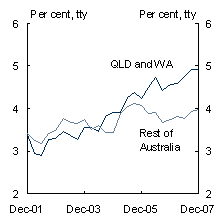
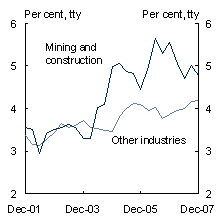
These higher wages have been associated with strong employment growth in the resource related sectors of mining and construction over much of the period, indicating that higher relative wages have helped to attract workers into these industries (Charts 5 and 6).
Chart 5: Employment growth |
Chart 6: Employment growth |
|
|
Source: ABS cat. no. 6202.0. |
Source: ABS cat. no. 6291.0. |
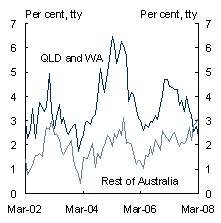
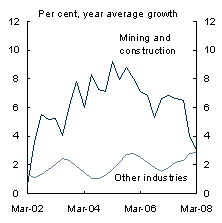
While skills shortages pose a range of challenges to business and may highlight areas in need of policy action, a tight labour market can mean lower adjustment costs for employees. There are a number of adjustment costs associated with a firm's closure to both individuals and the macroeconomy. For individuals, these adjustment costs are both financial (including lost wages, costs of job search and moving costs) and non‑financial (for example, the emotional costs associated with unemployment, change and dislocation). These costs tend to be lower and less enduring when labour markets are tight. In particular, workers with higher skills and experience are highly sought after in an economy with a tight labour market. The alternative, a surplus of skilled labour, has costs for the welfare of individuals and the overall economy.
The role of policy in response to skill shortages
In many cases skill shortages will resolve themselves over time through adjustments in relative wage levels and the subsequent responses of employers and employees. Nevertheless, an appropriate policy and institutional framework is important to facilitate this process.
Skilled migration
Immigration can be used as a policy instrument to alleviate specific skill shortages relatively quickly.
In recent decades skilled migrants have come to comprise an increasingly important component of total permanent migration, accounting for just under half of total gross migration in 2006‑07. These were mostly concentrated in professional occupations, tradespersons, managers and administrators, and associate professionals. In addition, the number of skilled migrants under the temporary business long‑stay visa has also been growing. Temporary migration of skilled workers complements the permanent migration program, in particular in assisting in responding to short term demands for skills in particular areas. In the medium to longer‑term, the level of net overseas migration plays an important role in maintaining sustainable economic growth. Migration can reduce the rate of population ageing because new migrants are younger on average than the resident population.
Immigration will continue to be an important contributor to labour supply, with skilled migration in particular helping to address Australia's skill needs in the short‑term while also delivering fiscal benefits. To this end, the Government will increase the skilled stream of the Migration Program by 31,000 places from 2008‑09 and is intending to improve the integrity and responsiveness of temporary business long‑stay visas.
The scope for better outcomes in education and training
The scope for achieving better outcomes in Australia's early childhood and school education, vocational and educational training (VET) and higher education sectors are examined below.
Early childhood and schools
The effectiveness of the early childhood and school education system is an important factor affecting overall skill levels of the Australian workforce. Basic literacy and numeracy provide the necessary foundation for developing higher‑order skills that contribute to a more productive workforce.
There is also evidence that early childhood education can play a role in improving long‑term developmental outcomes, particularly for children from disadvantaged backgrounds (Heckman and Masterov 2007). The Government will work with the States and Territories to ensure universal access to 15 hours per week of high quality early childhood education for four year olds by 2013. This and a number of other related initiatives outlined in Statement 1 are intended to play a role in improving children's educational outcomes later in life.
Australia's upper secondary attainment rates are lower than several other OECD countries. Following rapid increases through the 1980s and early 1990s, Year 12 retention rates in Australia have remained relatively constant at around 75 per cent over the past 15 years. Completing Year 12 is important not only as a pathway to further education, but because Australians who have not reached this level of attainment are significantly more likely to be unemployed than those who have (Kennedy 2007). Indeed, improving upper‑secondary education attainment was one of the five policy priorities the OECD identified for Australia in Going for Growth (OECD 2008).
Literacy and numeracy achievement is the most influential factor in Year 9 students staying on to complete Year 12 and the strongest predictor of tertiary entrance performance (McMillan and Marks 2003). Students with low levels of literacy and numeracy achievement are also more likely to leave school earlier. The teaching of literacy and numeracy in schools is therefore a critical element in improving participation and productivity to boost potential growth in the medium‑ and longer‑term.
While there is a range of research indicating that teacher quality is a critically important factor in improving educational outcomes,10 there is evidence that the literacy and numeracy achievement of teachers has been falling (Leigh and Ryan 2006). Given this, a key reform challenge is to improve the quality of teaching that takes place in the classroom. This means ensuring that well trained high quality people are both attracted to and retained in the teaching profession.
There is also scope to improve the quality of new teachers entering the profession. Ensuring that teacher training is evidence based and grounded in the practical skills required of teachers in the classroom is important. And reducing barriers to entry into teaching from highly skilled members of other professions could be expected to improve the overall quality of the field of candidates seeking to enter the teaching profession. The long and costly process required to obtain the necessary qualifications to teach, over and above existing academic qualifications, may discourage large numbers of potentially gifted teachers from entering the profession.
Finally, public reporting of student and school performance, along with greater school autonomy and demand side pressures from parents to enhance school performance is likely to have significant positive impacts on student performance (Hanushek and Wossmann 2007). OECD (2006) research finds that students in schools that publicly release their performance results performed substantially better than students in schools that did not, even after accounting for the demographic and socioeconomic background of students and schools. The study also found that students in educational systems that give more autonomy to schools to formulate the school budget and to decide on budget allocations within the school tend to perform better.
Vocational education and training
Within the VET sector there is evidence that the effectiveness of training is variable. Many of the trades with low completion rates are also occupations that regularly appear on the national skill shortages list discussed earlier in this statement (NCVER 2006).
While it is not possible with the available evidence to attribute low completion rates to the training or to broader workforce issues, it is clear that increasing the number of people participating in training alone is unlikely to be a cost‑efficient way of addressing reported skills shortages in these areas. Hence, the vocational training system requires reform to ensure that greater investment will deliver more responsive, higher quality training that will contribute to higher productivity growth.
To maximise the effectiveness of vocational education and training in Australia, a fundamental principle should be that those institutions that offer the highest quality and most relevant training to employers and industry should not be excluded from competing for government funding. More competition should be a goal in a more contestable training market.
Higher education
The Government recently announced a major review of Australia's higher education system, which will examine and report on the future direction of the higher education sector, its ability to meet the needs of the Australian community and economy and the options for ongoing reform. Two important challenges for future higher education policy relate to achieving optimal funding levels and funding mechanisms, and ensuring that institutions have sufficient autonomy and flexibility to deliver the best mix of high quality research and educational outcomes.
Private rates of return should play an appropriate role in guiding decisions taken by individuals as to whether to undertake higher education, and, if so, in which area. University graduates (especially in some occupations) earn substantially more on average over their lifetimes than non‑university graduates that form the majority of the taxpaying public. A related question is what the balance for university funding should be between taxpayers on the one hand and the students who will benefit from their education on the other. Another important principle in determining the appropriate funding balance is that equity remain a key feature of the system so as to not deter individuals from less privileged backgrounds from attending university. This is a particularly attractive aspect of the HECS‑HELP system in Australia, where students can elect for their fees to be payable on an income contingent basis.
It is important that universities have as much flexibility as possible to determine their own particular role to allow diversity and specialisation among institutions. Some universities could be better off specialising as research orientated institutions while others would have a more vocational focus and specialise in teaching. Other institutions might have a more regional specialisation and focus on serving their particular local community.
A policy framework for better outcomes in education and training
There are a number of policy challenges in ensuring Australia's education and training systems are effective and responsive in providing the skills development needed by individuals and firms. Improved regulatory and policy structures that allow the labour market to better match existing skilled labour to demand provide some safeguards against skill shortages arising and assist in ameliorating any that do arise.
Price signals
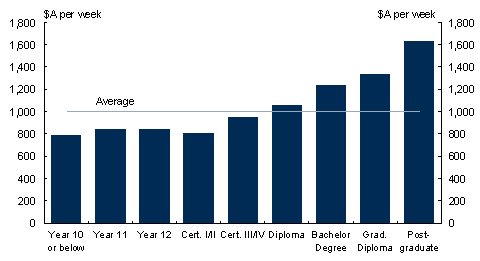
Studies for Australia and OECD countries generally indicate high positive private rates of return to education and training. For example, in Australia the latest available data indicate that average weekly full‑time earnings for people with Certificate III level qualifications and above are at least 10 per cent above, and up to double, those without these qualifications (Chart 7). Educational attainment is also strongly related to labour force participation and a lower probability of unemployment over an individual's lifetime (Kennedy 2007).
In view of this, the challenge for policy is to ensure that educational institutions deliver high quality education and training services and are responsive to changing student demands, which in turn, reflect students' response to shifts in relative wage signals in the market place. Achieving this goal does not necessarily involve simply increasing public expenditure. Evidence for Australia and other high income countries indicates that, while there is a minimum resource level required to ensure that students achieve at a basic level, the evidence is less clear as to whether additional public spending on education by itself will lift student achievement. 11
Chart 7: Average weekly full‑time earnings by level of qualification,
May 2005
Source: ABS cat. no. 6278.0.
Lack of appropriate price signals is likely to be one of the reasons for the consistent listing of health‑related occupations in the MODL. For some health related professions, wages and employment conditions appear to be flexible in response to skill shortages as is generally the case in many other labour markets. However, in many areas of notable skill shortage such as nurses, institutional and other factors limit the degree of labour market flexibility.12 Another group of public sector workers that would also fall into this category are teachers (Box 2).
Box 2: Skills shortages among teachers and nurses Reported skills shortages in some areas — for example, teachers and nurses — are not always a reflection of a lack of suitably qualified people. Australian Bureau of Statistics data indicate that there are around 450,000 people aged between 15 and 64 who are trained as teachers, with only around 280,000 working as teachers. In nursing the situation is similar, with around 200,000 people working as nurses from a pool of around 340,000 people of working age with nursing qualifications (ABS cat. no. 4221.0, 6227.0 and unpublished data). To the extent that there are reported shortages in these areas, this does not reflect an absolute shortfall in suitably qualified people, but rather, a choice by many of them not to work in these fields. Given the competing demands for labour, solving skills shortages within schools clearly involves more than simply boosting the number of people qualified as teachers. Population ageing is likely to see a dramatic increase in the demand for nurses due to changing burdens of disease, higher incomes and consequent expectations of the health system. However, many qualified nurses will be retiring just as the impact of ageing begins to place increased pressure on the health system. Currently, around 46 per cent of nurses are over 45 years of age. While demographic changes do not pose the same challenges on the demand for education services, the age profile within the teaching profession is even more pronounced than that of the nursing profession, with around 49 per cent of primary school teachers and 50 per cent of secondary school teachers over 45 years of age (DEEWR 2008b). |
The public sector is often more constrained than the private sector in its ability to respond to staff and skill shortages by paying higher wages. Even so, there is still scope to improve relative price signals in these occupations to make better use of public resources. Research on attitudes to teaching as a career indicates that current pay arrangements are a factor in deterring high‑quality graduates from entering teaching and deterring high‑quality teachers from staying in the profession.13 Leigh and Ryan (2006) find that pay dispersion in teaching has stayed the same, or declined, over the past thirty years, while wage dispersion has increased in many alternative occupations. The Productivity Commission (2007, p 252), notes that:
[P]rice signals have not been able to communicate the shortages in the teaching profession due to the inflexible nature of teachers' pay structures … providing greater flexibility in pay and reward structures would help to address the ongoing shortages.
The MODL lists also regularly include some other types of professionals, such as engineers and accountants, who are employed predominantly in the private sector, without the same restrictions on wages and employment conditions as is the case for nurses and teachers. Their inclusion in the MODL lists may broadly reflect the time it takes to train workers in these skills when demand for them increases sharply. To the extent that this is the case, there may only be limited scope for government intervention to address these shortages from domestic sources in the short term.
A key role for policy is to identify and reduce, as far as practicable, impediments to geographic mobility including regulatory barriers such as recognition of qualifications across States and Territories (Regulation Taskforce 2006). An example of this would be the introduction of a national registration and accreditation system for health professionals agreed to by COAG at its March 2008 meeting.
Optimal government decision making
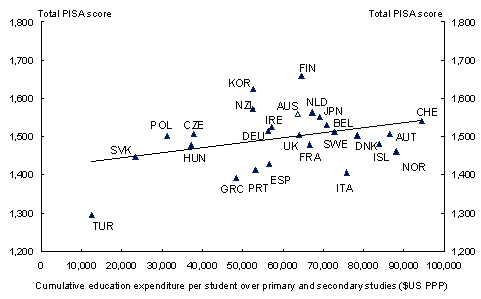
The OECD Programme for International Student Assessment (PISA) data indicate only a weak relationship between expenditure and educational outcomes across all OECD countries, and no relationship for high income countries (including Australia, Chart 8). McKinsey (2007) also highlights the weak relationship between expenditure and education outcomes among high income OECD countries. The OECD (2007, p 61), concludes that: 'While spending on educational institutions is a necessary prerequisite for the provision of high quality education, spending alone is not sufficient to achieve high level outcomes'.
Hence, in increasing expenditure on education it is critical to assess the likely effectiveness of such investment. For example, one common approach that governments have introduced to try to improve the quality of teaching in recent years has been to reduce class sizes, requiring substantial additional government expenditure. However, research indicates that reducing class sizes across the board generally has minimal impact on educational outcomes, apart from the very early years (Dee and Keys 2005, Krueger 1997).
Chart 8: PISA 2006 test scores and cumulative education expenditure
Source: OECD (2007).
The importance of a well functioning vocational and educational training (VET) sector is highlighted by the high representation of trade‑related occupations in skills in demand lists. This sector is characterised by a relatively low level of competitive pressures, with varying degrees of autonomy and incentives for publicly funded technical and further education institutes (TAFEs) to be flexible and responsive to the needs of students and industry. In addition, employers may not have the right incentives to provide training while employees (apprentices who receive a low wage in conjunction with a training commitment from the employer) would often have access to higher paying employment opportunities.
The Government's recently announced policy, Skilling Australia for the Future, adopts a demand driven approach to training delivery, in contrast to past supply driven approaches. As part of this policy, the Productivity Places Program will provide up to 630,000 new training places targeted at occupations facing skills shortages over the next five years. Up to 392,000 of these places will be for employers to train workers already in the workforce and up to 238,000 places will be targeted at job seekers.
A new body, Skills Australia, will provide the Australian Government with advice on the training needs of industry to help ensure that training is delivered in a way that responds to demand for skills. In particular, Skills Australia will undertake research and analysis on skills and workforce development needs; widely distribute this research and analysis to entrepreneurs, businesses and workers; advise the Government on current and future skills needs; and build relationships with State and Territory bodies associated with vocational education and training.
The Government will implement a reformed employment services system from 1 July 2009 with total funding of $3.7 billion over three years. The reformed system will better target assistance to the most disadvantaged job seekers, improve linkages with education and training, create greater flexibility for employment services providers to deliver assistance tailored to job seeker needs and encourage greater engagement with employers.
Under the reformed system, employment services providers will be encouraged to refer job seekers to education or training, including from the 238,000 additional training places (including apprenticeships) available for job seekers under the Government's Skilling Australia for the Future policy. Improving the skills of job seekers will boost their opportunity to gain sustainable employment.
10 See for example, Leigh (2007), Rivkin, Hanushek and Kain (2005) and Rowe (2003).
11 See for example, Hanushek and Wossmann (2007), McKinsey (2007) and Leigh and Ryan(2008).
12 For a discussion of the impacts of institutional factors and the role of professional associations on Australia's health workforce see PC (2005c).
13 DEST (2006), OECD (2005), Lewis and Butcher (2002).
If www.budget.gov.au responds slowly or you are having trouble downloading a document, try one of the Budget Website Mirrors
Note: Where possible, Budget documents are available in HTML and for downloading in Portable Document Format(PDF). If you require further information on any of the tables or charts on this website, please contact Treasury.