




Statement 4: Assessing the Sustainability
of the Budget
Stimulating aggregate demand
In an environment where a large global shock has pushed Australia into recession, it is necessary to stimulate aggregate demand in the short term. Discretionary fiscal stimulus is needed to provide additional support to that provided by the automatic stabilisers and monetary policy.
Automatic stabilisers are the components of tax and expenditure that automatically fluctuate in response to the economic cycle. The change in the budget balance due to these cyclical factors has been dominated by changes in tax revenues from parameter variations. These changes are estimated to have reduced the budget balance by around $49 billion in 2009‑10 and $55 billion in 2010‑11 (Table 1). These estimates do not include increases in payments such as unemployment benefits.
Table 1: The components of fiscal policy
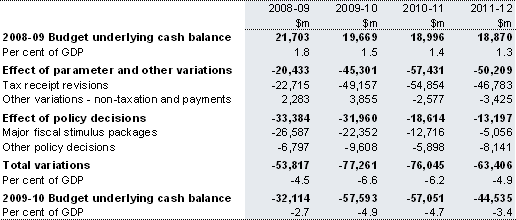
Note: Major fiscal stimulus packages are: Economic Security Strategy; November 2008 Council of Australian Governments reforms; December 2008 Nation Building Package; and Nation Building and Jobs Plan. Other policy decisions include the net effect of policy decisions in the 2009‑10 Budget.
Source: Treasury.
Discretionary fiscal measures are the outcome of explicit changes in the Government's tax and expenditure policy settings. These measures can meet specific policy objectives, and can be designed with the express purpose of affecting economic activity. The major fiscal stimulus packages announced since the 2008‑09 Budget have supported aggregate demand in the face of the global recession and have reduced the budget balance by $22.4 billion in 2009‑10 and $12.7 billion in 2010‑11 (Table 1).
Australia is one of many countries announcing discretionary fiscal stimulus measures in response to the global recession. Most countries, including China, Japan and the United States, have announced large discretionary fiscal stimulus packages to support aggregate demand.
These measures are consistent with the commitment by G‑20 countries to deliver the fiscal stimulus necessary to restore growth. The IMF (2009d) estimates that discretionary fiscal measures announced between late 2008 and mid‑April 2009 will provide a stimulus of 2 per cent of world GDP in 2009 and 1.5 per cent in 2010. Some countries have had limited scope to implement fiscal stimulus measures because they entered the crisis with less fiscal space.
The most effective fiscal stimulus measures are those that provide the largest boost to aggregate demand when it is most needed. Fiscal stimulus includes direct spending by government on goods and services and measures directed at households and businesses. Stimulus measures need to be timely, temporary and targeted.
Fiscal stimulus measures may result in a deterioration in the budget balance in the short term. However, the temporary nature of these measures ensures that the budget balance will improve over the medium term as the support to aggregate demand is withdrawn. Supporting aggregate demand in the short term is also likely to result in a budget deficit that is lower in the medium term than it would otherwise have been. This is because support to aggregate demand in the short term can improve economic growth prospects, and therefore the Government's fiscal position.
The impact of fiscal stimulus measures on aggregate demand depends on their overall size and delivery. Targeted measures ensure the largest possible boost to aggregate demand. For measures directed at households and businesses, the impact on aggregate demand depends on who receives the stimulus, how and when it is received, the amount spent and what it is spent on (Box 1).
Box 1: Discretionary fiscal policy measures
A variety of tax and expenditure measures can be used to provide fiscal stimulus. The fiscal multipliers for such measures — that is, the effects they have on economic output — depend on a number of factors.
The most effective measures for an immediate boost to aggregate demand are those that can be implemented quickly and targeted at those most likely to spend. This can include direct purchases of goods and services, transfers or temporary tax cuts and bonuses. Expenditure measures directed at credit‑constrained households may have quite high short‑term multipliers.
In the case of a prolonged downturn, discretionary fiscal policy can be more effective if it includes measures that add directly to demand and provide a boost to the economy over a longer period, such as infrastructure. Infrastructure investments may have a smaller impact in the short term as they take time to implement, but they provide a larger boost to output once implemented. Such measures also improve the productive capacity of the economy in the longer term.
Multipliers may also differ with economic circumstances. Where the economy is operating with a large amount of excess capacity, stimulus measures are expected to have a larger impact on activity. In contrast, where the economy is close to full employment, the multiplier would be close to zero as a result of exchange rate and price movements and the reaction of monetary policy.
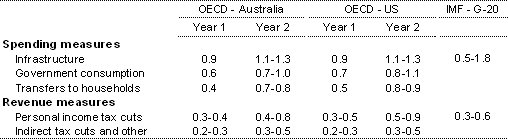
Numerous studies estimate a wide range of fiscal multipliers. The OECD (2009) estimates that the multipliers for direct spending and infrastructure range between 0.6 and 1.3 in Australia (Table A). Multipliers for transfer payments are estimated at between 0.4 and 0.8, while the multipliers for revenue measures are between 0.2 and 0.8. The IMF (2009a) estimates multipliers of between 0.5 and 1.8 for infrastructure measures across the G‑20 economies and between 0.3 and 0.6 for personal income tax cuts.
Table A: OECD and IMF estimates of fiscal multipliers
Source: OECD 2009 and IMF 2009a.
The Budget uses multipliers for the fiscal stimulus of between 0.5 and 1. These multipliers may prove to be conservative. In particular, the multiplier effects for infrastructure investment may be larger (Table A).
The OECD (2009) has found that Australia's fiscal stimulus measures are among the most effective in the OECD in terms of stimulating economic activity and supporting employment. The first phase of Australia's fiscal stimulus provided an immediate, significant and temporary boost to household incomes. Cash transfers to low‑income households are a quick and effective way to support aggregate demand, as these households are more likely to be credit constrained and affected by a recession.
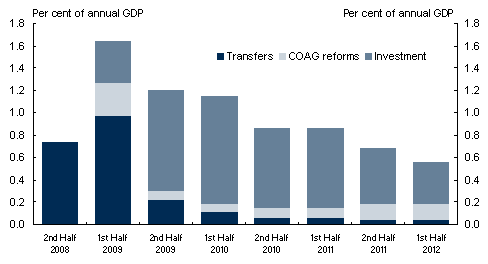
The second phase of fiscal stimulus focused on infrastructure investments that could be implemented within a relatively short timeframe, while the third phase, outlined in this Budget, moves to major economic infrastructure projects. While infrastructure investment can involve lengthy implementation lags, it provides longer term support to aggregate demand and employment and boosts the economy's productive capacity. These phases are reflected in the change in the composition of Australia's fiscal stimulus over time (Chart 1).
Chart 1: Composition of fiscal stimulus
Source: Treasury.
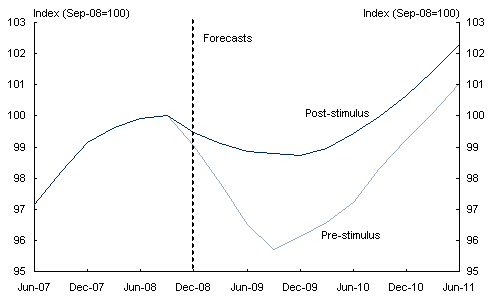
Australia's fiscal stimulus measures are expected to have a substantial impact on economic output and employment. As a result of the Government's fiscal stimulus measures, the level of real GDP is forecast to be higher than it would otherwise have been by 2¾ per cent in 2009‑10 and 1½ per cent in 2010‑11 (Chart 2). The stimulus measures are estimated to reduce the forecast peak in the unemployment rate by 1½ percentage points. Without the fiscal measures, the impact of the global recession on Australia's economy would be more severe. In the absence of policy action, the forecast unemployment rate would have reached 10 per cent.
Chart 2: Effect of fiscal stimulus on real GDP
Source: ABS cat. no. 5206.0 and Treasury.
If www.budget.gov.au responds slowly or you are having trouble downloading a document, try one of the Budget Website Mirrors
Note: Where possible, Budget documents are available in HTML and for downloading in Portable Document Format(PDF). If you require further information on any of the tables or charts on this website, please contact The Treasury.